Most smart glasses pitch convenience. Brilliant Labs’ Halo glasses are selling something more intimate: the idea that your daily experiences can be quietly captured, indexed, and recalled later, almost like an external layer of memory. At $299, Halo isn’t trying to outgun Apple, Meta, or Google on polish or performance; it’s aiming to make lifelogging and AI recall feel attainable, wearable, and just plausible enough to try.
The promise matters because this isn’t about notifications hovering in your vision or flashy AR overlays. Halo is built around passive observation, lightweight capture, and AI-assisted recall, with the glasses acting as a sensor hub for your life rather than a screen-first computing platform. If that sounds both compelling and slightly unsettling, that tension is exactly where Halo lives.
What follows is not hype, but a practical breakdown of what Halo actually is, how “remembering your life” works day to day, and why this price point forces a serious conversation about privacy, usefulness, and whether AI wearables are finally crossing from novelty into habit.
What the Halo glasses actually are
At a hardware level, Halo is a minimalist pair of smart glasses with a forward-facing camera, microphones, onboard sensors, and no full AR display competing for your attention. There’s no waveguide screen like Meta Ray-Ban Stories or Xreal glasses, and no attempt to replace your phone visually. Instead, Halo focuses on seeing and hearing what you do, then letting AI process that data later.
🏆 #1 Best Overall

- #1 SELLING AI GLASSES - Tap into iconic style for men and women, and advanced technology with the newest generation of Ray-Ban Meta glasses. Capture photos and videos, listen to music, make hands-free calls or ask Meta AI questions on-the-go.
- UP TO 8 HOURS OF BATTERY LIFE - On a full charge, these smart AI glasses can last 2x longer than previous generations, up to 8 hours with moderate use. Plus, each pair comes with a charging case that provides up to 48 hours of charging on-the-go.
- 3K ULTRA HD: RECORD SHARP VIDEOS WITH RICH DETAIL - Capture photos and videos hands-free with an ultra-wide 12 MP camera. With improved 3K ultra HD video resolution you can record sharp, vibrant memories while staying in the moment.
- LISTEN WITH OPEN-EAR AUDIO — Listen to music and more with discreet open-ear speakers that deliver rich, quality audio without blocking out conversations or the ambient noises around you.
- ASK YOUR GLASSES ANYTHING WITH META AI - Chat with Meta AI to get suggestions, answers and reminders straight from your smart AI glasses.
The frames are intentionally understated and lightweight, prioritizing all-day comfort over technical bravado. Materials and finishing are closer to budget-conscious eyewear than luxury optics, but that’s deliberate; Halo is designed to be worn often, not admired occasionally. Comfort, fit stability, and low-profile aesthetics matter more here than premium hinges or exotic frame materials.
Battery life is measured in hours, not days, and that’s one of Halo’s first reality checks. Continuous capture is power-hungry, so usage is episodic rather than constant, with users expected to turn recording on when context matters. This isn’t a 24/7 black box for your life, and Brilliant Labs is transparent about that limitation.
How “remembering your life” works in practice
The core idea behind Halo is contextual recall rather than raw video storage. The glasses capture short clips, audio, and environmental context, which are then analyzed by AI models to extract meaning rather than just footage. Instead of scrubbing through endless timelines, you ask questions like “What did the person I met yesterday say about the project deadline?” or “Where was that café with the blue chairs?”
Most of the intelligence happens after the fact, using cloud-based AI rather than heavy on-device processing. Halo is not continuously interpreting the world in real time; it’s building a searchable, semantic memory layer that you query later through a companion app or interface. That distinction matters, because it shapes both expectations and privacy trade-offs.
In practical use, this means Halo is best at augmenting memory for conversations, meetings, travel moments, and casual interactions, not capturing cinematic life footage. Think of it as an AI-enhanced notebook you wear on your face, not a replacement for human awareness or attention.
The AI ambition, and its current limits
Halo leans heavily on modern multimodal AI models that can understand speech, objects, and basic context across time. This allows for surprisingly human-style queries, where you don’t need to remember exact timestamps or keywords. The system is designed to bridge the gap between how humans remember and how computers traditionally store data.
That said, accuracy is not perfect, and Brilliant Labs does not pretend otherwise. Misinterpretations happen, names can be missed, and contextual nuance can be lost, especially in noisy or visually complex environments. Early adopters should expect moments of genuine magic mixed with moments where the AI simply guesses wrong.
Because much of the intelligence lives in the cloud, Halo’s usefulness depends on connectivity, server uptime, and the company’s long-term commitment to software updates. This is not a finished ecosystem; it’s an evolving experiment, and buyers are implicitly opting into that journey.
Why the $299 price point changes the conversation
At $299, Halo undercuts most serious smart glasses projects by a wide margin. That price makes experimentation feel acceptable, even if the device never becomes indispensable. It also reframes Halo less as a luxury gadget and more as an exploratory tool for understanding how AI memory might fit into everyday life.
The trade-off is refinement. You’re not getting premium optics, all-day battery life, or deep platform integrations with iOS or Android system features. What you are getting is early access to a concept that, until recently, lived mostly in research labs and sci-fi speculation.
For developers, researchers, and tech-forward users, that price makes Halo feel like a prototype you can actually live with. For mainstream consumers expecting seamlessness, it may feel unfinished.
Privacy, consent, and the social friction problem
Any device that remembers your life inevitably remembers pieces of other people’s lives too. Halo raises familiar but unresolved questions about consent, passive recording, and where personal memory ends and surveillance begins. Brilliant Labs emphasizes user control and transparency, but social norms around wearable cameras remain fragile.
There’s also the issue of data ownership and retention. If your memories are processed in the cloud, trust in the company’s policies becomes part of the product experience. Halo asks users to balance the value of recall against the discomfort of knowing that meaningful slices of their life exist as data.
This alone will disqualify Halo for some users, and that’s a rational response. Remembering your life is powerful, but it is not a neutral act.
Who Halo is really for, and who should skip it
Halo makes sense for early adopters who already experiment with smartwatches, fitness rings, and AI productivity tools, and who are comfortable trading polish for potential. It’s especially appealing to people who value conversations, learning, and contextual memory over visual AR experiences.
Those looking for hands-free navigation, notifications, or immersive displays should look elsewhere. Halo is not a phone replacement, not a fitness tracker, and not a fashion statement. It’s a memory experiment you wear, with all the quirks that implies.
As a first step toward everyday AI wearables, Halo feels less like a finished product and more like a line in the sand. It suggests that the future of smart glasses may not be about what you see, but about what you can remember, and whether that trade is worth making.
How Halo Actually ‘Remembers’: Cameras, Audio, Sensors, and the AI Memory Stack Explained
Understanding Halo’s promise requires stripping away the marketing language and looking closely at how memory is technically constructed. Halo does not store a continuous video of your life, nor does it function like a bodycam. Its “memory” is assembled from intermittent visual snapshots, ambient audio capture, sensor context, and a cloud-based AI layer that decides what matters.
This distinction is critical, because Halo’s usefulness and its limitations both stem from how selective and interpretive that stack really is.
The camera: low-resolution context, not cinematic capture
Halo’s outward-facing camera is designed for context recognition, not photography or video logging. Image capture is typically still-based or short bursts triggered by user input or AI prompts, rather than constant recording.
The resolution is intentionally modest, prioritizing power efficiency and privacy over visual fidelity. Faces, objects, whiteboards, screens, and environments are recognizable, but this is not footage you would archive or share.
In practice, the camera functions more like a visual indexer. It helps the AI anchor memories to places, objects, and moments, answering questions like “where was I?” or “what was I looking at?” rather than “what exactly happened frame by frame?”
Audio: conversations as the backbone of memory
If Halo has a primary sensor, it is audio. The built-in microphones are always ready, but not always recording in a traditional sense. Instead, Halo listens for conversational relevance, wake words, or contextual cues that suggest a moment may be worth remembering.
When activated, audio snippets are captured and transcribed, forming the backbone of Halo’s memory model. Names, decisions, explanations, and ideas spoken aloud are far more valuable to the system than visuals alone.
This makes Halo especially strong for meetings, informal discussions, lectures, and learning-heavy environments. It is far less useful in silent contexts, physical tasks, or situations where meaning is primarily visual.
Onboard sensors: time, motion, and situational awareness
Beyond camera and microphones, Halo relies on a small but important set of inertial and environmental sensors. Accelerometers and gyroscopes provide motion and posture context, helping distinguish between walking, sitting, or gesturing.
Time, location (coarse, not GPS-grade), and usage patterns also feed into the memory stack. These signals allow Halo to cluster moments into sessions, infer routines, and attach temporal meaning to events.
This is similar to how smartwatches contextualize workouts or sleep, but applied to cognition rather than physiology. Halo is less concerned with how your body moves and more interested in what your mind was engaged with.
The AI memory stack: from raw data to recallable insight
Captured data on its own is not memory. Halo’s defining feature is the AI layer that processes, summarizes, and indexes those inputs into something searchable and conversational.
Audio is transcribed, images are labeled, and context is inferred using large language and vision models running primarily in the cloud. Over time, Halo builds a semantic map of people, topics, places, and recurring themes in your life.
When you ask Halo a question, you are not retrieving a file. You are querying an interpretation. The system synthesizes past moments into an answer that feels like recollection rather than playback.
On-device versus cloud AI: why Halo can’t run locally
At $299, Halo does not have the silicon or battery capacity to run advanced AI models on-device. Most of the heavy lifting happens in the cloud, with the glasses acting as a sensor-rich terminal.
This allows Brilliant Labs to iterate quickly and improve memory quality over time, but it also introduces latency, connectivity dependence, and privacy trade-offs. If you are offline, Halo’s recall becomes far more limited.
It also means your memories are not just stored, but processed externally. Even with encryption and user controls, trust in the company’s infrastructure becomes inseparable from the product’s value.
Battery life and practical constraints
All of this sensing and intermittent recording has real power costs. Halo’s battery life is measured in hours, not days, and heavy use accelerates depletion quickly.
This forces intentionality. Halo is something you wear during meetings, learning sessions, or active work periods, not necessarily from morning to night like a smartwatch.
The glasses are lightweight and reasonably comfortable, but they are not invisible. Long sessions remind you that you are wearing a device with limitations, not an always-on cognitive prosthetic.
What Halo remembers well, and what it forgets
Halo excels at remembering conversations, explanations, names, and conceptual threads. It struggles with emotional nuance, silent moments, and anything that relies on high-resolution visual detail.
It also forgets by design. Not every moment is captured, and not every capture becomes meaningful memory. The AI filters aggressively, sometimes missing things you care about and sometimes surfacing details you forgot you mentioned.
This imperfection is not a bug so much as a philosophical choice. Halo is not trying to be a perfect record of your life. It is trying to be a useful one.
Why this approach matters at $299
At its price point, Halo is not competing with polished consumer electronics. It is competing with notebooks, voice memos, and your own fallible memory.
The technical stack reflects that ambition. By focusing on interpretation rather than recording, Halo attempts to deliver value without the hardware complexity of displays, optics, or full-time capture.
Whether that trade-off feels empowering or unsettling depends entirely on how much you trust an AI to decide what parts of your life are worth remembering.
On-Device vs Cloud AI: Where Your Memories Are Processed and Why It Matters
The philosophical trade-off behind Halo becomes clearest when you look at where its intelligence actually lives. These glasses feel intimate because they sit on your face and listen to your world, but most of the heavy thinking happens somewhere else.
That split between on-device processing and cloud-based AI shapes everything from latency and battery life to privacy and long-term trust.
What happens on the glasses themselves
On the hardware side, Halo is intentionally modest. The onboard silicon focuses on sensor management, audio capture, wake-word detection, and basic signal processing rather than full AI inference.
This keeps the glasses light, relatively cool, and affordable at $299. It also avoids the thermal and battery penalties that come with running large language models locally on a face-worn device.
In practical use, this means Halo can decide when to listen, record, or stop without constantly streaming raw data. That layer of local control is subtle, but it matters for responsiveness and baseline privacy.
Where the real “memory” is formed
Once audio is captured, the work that turns moments into memories happens in the cloud. Speech-to-text, semantic parsing, summarization, and long-term memory indexing rely on remote AI models.
This is where Halo gains its ability to answer questions like “What did I say about that client last week?” instead of just playing back audio. The glasses themselves never develop that understanding on their own.
The upside is capability. Cloud models are vastly more powerful and improve over time without new hardware. The downside is dependency, because Halo’s intelligence is only as strong as its connection to Brilliant Labs’ servers.
Rank #2
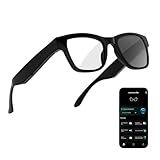
- 3-in-1 AI Glasses: Enjoy ① AI Voice Assistant (Powered by ChatGPT, Gemini & Deepseek), ② Stylish Photochromic Lenses Glasses, and ③ Bluetooth Open-Back Headphones, all in one.
- Free Talk Translation: Automatically detects and translates over 160 languages in real-time, allowing seamless work and translation without touching your phone or glasses.
- Voice, Video & Photo Translation: Supports over 98% of global languages, offering fast and accurate translations—ideal for international travel, business meetings, or cross-cultural communication.
- AI Meeting Assistant: Converts recordings from smart glasses into text and generates mind maps, making it easier to capture and organize meeting insights.
- Long Battery Life, Bluetooth 5.4 & Eye Protection: Up to 10 hours of music and 8 hours of talk time, with easy Type-C charging. Bluetooth 5.4 ensures stronger, stable connections, while photochromic lenses block UV rays and blue light, protecting your eyes in any environment.
Latency, reliability, and real-world friction
In ideal conditions, cloud processing feels nearly invisible. Responses arrive quickly enough to maintain the illusion of a continuous cognitive assistant.
But in poor connectivity environments, Halo’s limitations surface fast. Without reliable internet access, memory queries stall, summaries lag, or simply fail.
This is a reminder that Halo is not an offline memory prosthetic. It is a networked device, and its usefulness fluctuates with bandwidth in ways a notebook or voice recorder never does.
Privacy is not just about encryption
Brilliant Labs emphasizes encryption and user control, but the deeper question is architectural. Your memories are not just stored remotely; they are interpreted remotely.
That interpretation layer is where meaning is extracted, patterns are formed, and relevance is decided. Even if audio is deleted or anonymized, the semantic residue still reflects your life.
For some users, that trade-off is acceptable in exchange for powerful recall. For others, the idea that their personal history only becomes useful once processed externally will feel like a line crossed.
Why Halo can’t easily go fully on-device
Running advanced language models locally would require larger batteries, heavier frames, and far more aggressive heat management. At $299, those compromises would fundamentally change the product.
You would also lose the ability for Halo’s intelligence to evolve rapidly. Cloud AI lets Brilliant Labs update models weekly or monthly, effectively upgrading your memory assistant over time.
Halo chooses iteration speed and affordability over independence. That choice makes sense technically, but it locks the product into an ongoing relationship between user and company.
The long-term implications of cloud memory
Because Halo’s memories live in the cloud, longevity becomes a question. The value of the device depends on Brilliant Labs maintaining infrastructure, improving models, and honoring data stewardship commitments for years.
If the service changes, degrades, or disappears, the glasses become far less meaningful overnight. This is not a theoretical risk; it is the cost of cloud-first intelligence.
Halo asks you to trust not just a device, but a vision of how personal AI should exist. Whether that trust feels reasonable will largely determine if these glasses feel like the future, or an experiment you are not ready to participate in.
Hardware Reality Check: Design, Comfort, Cameras, Audio, and What’s Missing at $299
All of the philosophical questions around cloud memory and trust ultimately collide with something far more immediate: what it feels like to wear Halo every day. Brilliant Labs is asking users to accept deep architectural trade-offs, and those choices are visible the moment you put the glasses on.
This is not luxury hardware trying to disguise itself as fashion. Halo is deliberately minimal, almost utilitarian, because the budget and the mission both demand restraint.
Design language: intentionally plain, quietly technical
Halo looks closer to academic research eyewear than to Ray-Ban Metas or Snap Spectacles. The frames are lightweight plastic with a subdued, neutral aesthetic that avoids drawing attention in public.
There’s no overt branding, no metallic flourishes, and no attempt to pass as premium eyewear. That restraint helps Halo fade into daily life, but it also reinforces that this is a tool first, accessory second.
Frame thickness is modest but not invisible, especially around the temples where electronics are housed. From the front, Halo passes easily as standard glasses; from the side, the tech becomes more apparent.
Comfort and wearability: built for hours, not fashion statements
At this price, weight distribution matters more than materials, and Brilliant Labs largely gets that right. Halo is light enough to wear for extended periods without neck fatigue, even during long workdays.
The trade-off is rigidity. The frames lack the flex and refinement of higher-end eyewear, and users sensitive to pressure points may notice the temples after several hours.
Fit will also vary more than with premium frames. There’s no custom sizing, no interchangeable nose pads, and limited adjustability, which means comfort will depend heavily on face shape.
Cameras: memory capture, not content creation
Halo’s camera system is not designed for social media or cinematic POV footage. Resolution and sensor quality are tuned for contextual recall rather than visual fidelity.
This matters because it reframes expectations. The camera is there to help the AI understand where you were, who you were with, and what was happening, not to produce images you’ll want to share or archive manually.
Low-light performance is predictably limited, and fast motion can introduce blur. For memory prompts and semantic tagging, that’s usually sufficient, but it’s a clear reminder that Halo is not competing with action cameras or even modern smartphones.
Audio capture and playback: functional, not immersive
Microphones are arguably more important than cameras for Halo’s core mission, and this is where Brilliant Labs invests its limited hardware budget wisely. Audio capture is tuned for conversation, prioritizing voices over ambient noise.
In quieter environments, speech recognition performs reliably. In noisy public spaces, accuracy drops, which directly affects the quality of memories Halo can later surface.
Audio playback, meanwhile, is serviceable but basic. Speakers are designed for private prompts and short responses, not music or extended listening sessions. Think discreet assistant, not open-ear headphones.
Battery life: the silent constraint shaping everything else
Battery life is the least glamorous spec, but it’s the one that defines Halo’s daily usability. Expect a single day of mixed use, with active memory capture and AI interactions draining the battery faster than passive wear.
There is no miracle here. Continuous sensing, audio processing, and wireless connectivity are power-hungry, and $299 does not buy cutting-edge battery tech.
Charging becomes part of the routine, much like early smartwatches. Forget to charge overnight, and Halo becomes inert eyewear by mid-afternoon.
What’s missing at $299 is not accidental
There is no display in the traditional sense. No waveguides, no AR overlays, no floating notifications. Halo communicates through audio and, occasionally, subtle visual indicators.
There’s also no advanced sensor suite. No eye tracking, no depth sensors, no environmental mapping beyond what the camera can infer.
These omissions are not failures of imagination. They are the cost of hitting a $299 price point while keeping weight and heat manageable.
Durability and daily risk tolerance
Halo does not feel fragile, but it also doesn’t invite abuse. There’s no meaningful water resistance rating to inspire confidence in rain or workouts.
This positions Halo closer to a notebook or laptop than a sports watch. It’s something you consciously care for, not something you forget you’re wearing.
For users accustomed to rugged smartwatches or fitness trackers, this shift in mindset may be more jarring than any technical limitation.
Value perspective: hardware as a gateway, not the product
Judged purely as hardware, Halo is unremarkable for $299. The materials, sensors, and fit reflect careful cost control rather than indulgence.
But that’s the wrong lens if you’re evaluating it honestly. The hardware exists to enable a continuous relationship with cloud intelligence, not to impress on its own.
Halo’s physical reality makes one thing clear: you are not paying for what these glasses are today, but for what Brilliant Labs believes they can become over time.
Battery Life, Daily Wearability, and the Practical Limits of Always-On Memory Capture
Taken together, Halo’s hardware choices make a clear statement about priorities. This is a device optimized for presence and context, not endurance, and that reality shapes how “remembering your life” works in practice.
The promise of continuous memory capture sounds frictionless. The lived experience is far more conditional.
Battery life as the defining constraint
Halo’s battery life sits firmly in early-smartwatch territory. In real-world mixed use—periodic camera capture, ambient audio sensing, voice queries, and background syncing—you’re realistically looking at a single workday, not a full waking day.
Aggressive memory capture accelerates the drop-off. If you lean into the idea of documenting conversations, environments, and visual context, the glasses will need recharging well before evening.
This isn’t a software flaw so much as a physics problem. Tiny frames limit battery volume, and on-device processing competes directly with heat management and comfort.
Always-on memory isn’t actually always on
Despite the marketing language, Halo does not record everything continuously in a literal sense. Memory capture is episodic, triggered by user intent, contextual cues, or short recording windows rather than an unbroken stream.
This distinction matters. Continuous video and audio recording at meaningful resolution would overwhelm both battery and storage, not to mention raise severe privacy red flags.
What Halo is really doing is sampling your life. It collects moments, snippets, and contextual anchors that the AI can later stitch together into something that feels like recall.
The cognitive tradeoff of charging rituals
Daily charging changes behavior in subtle ways. You start to triage which moments are “worth” capture, just as early smartwatch users learned to ration GPS workouts or LTE usage.
Forget to charge overnight and the illusion collapses quickly. By mid-afternoon, Halo becomes conventional eyewear with inert electronics, severing the continuity that memory systems rely on.
This creates an odd paradox: the more you rely on Halo to remember things for you, the more disciplined you must become about maintaining it.
Comfort over long sessions
From a wearability standpoint, Halo benefits from its restraint. Without displays, waveguides, or heavy optics, weight distribution is reasonable, and heat buildup is minimal compared to AR-first designs.
That said, this is still electronics on your face. Extended use can produce subtle pressure fatigue at the temples, particularly for users sensitive to frame fit.
Rank #3

- 【AI Real-Time Translation & ChatGPT Assistant】AI glasses break language barriers instantly with AI real-time translation. The built-in ChatGPT voice assistant helps you communicate, learn, and handle travel or business conversations smoothly—ideal for conferences, overseas trips, and daily use.
- 【4K Video Recording & Photo Capture 】Smart glasses with camera let you capture your world from a first-person view with the built-in 4K camera. Take photos and record videos hands-free anytime—perfect for travel moments, vlogging, outdoor adventures, and work documentation.
- 【Bluetooth Music & Hands-Free Calls 】Camera glasses provide Bluetooth music and crystal-clear hands-free calls with an open-ear design. Stay aware of your surroundings while listening—comfortable for long wear and safer for commuting, cycling, and outdoor use.
- 【IP65 Waterproof & Long Battery Life】 Recording glasses are designed for daily wear with IP65 waterproof protection against sweat, rain, and dust. The built-in 290mAh battery provides reliable performance for workdays and travel—no anxiety when you’re on the go.
- 【Smart App Control & Object Recognition】Smart glasses connect to the companion app for easy setup, file management, and feature control. They support AI object recognition to help identify items and improve your daily efficiency—perfect for travel exploration and a smart lifestyle.
Unlike a smartwatch, you can’t simply forget Halo is there. Its presence is constant, and that matters when you’re wearing it eight to ten hours a day.
Audio-first interaction and its energy cost
Halo’s reliance on audio for feedback and interaction is a double-edged sword. It avoids the power draw of displays but shifts the burden to microphones, speakers, and wireless connectivity.
Voice queries, AI responses, and contextual prompts feel natural, but they also represent some of the most energy-intensive tasks the device performs.
In quieter environments this works well. In noisy settings, repeated interactions can become both less effective and more draining, pushing the battery toward empty faster than expected.
Heat, throttling, and invisible limits
Brilliant Labs has clearly tuned Halo to avoid discomfort. When internal temperatures rise, performance subtly scales back rather than pushing components to their limits.
Users won’t see warning messages or dramatic slowdowns. Instead, memory capture becomes less frequent, responses slightly delayed, and background tasks deprioritized.
This invisible throttling preserves comfort and safety, but it also reinforces that Halo’s intelligence is situational, not absolute.
Daily wearability versus social wearability
Battery life is only part of the equation. The social cost of wearing memory-capable glasses all day is harder to quantify but equally real.
Knowing the device could capture audio or images, even intermittently, changes how people around you behave. Some will be curious. Others will be uneasy.
This friction naturally limits how often Halo stays on your face, which in turn limits how complete its memory of your life can ever be.
The practical ceiling of lifelogging glasses
Halo exposes a fundamental truth about always-on AI wearables: the bottleneck isn’t intelligence, it’s tolerance. Battery tolerance, social tolerance, and personal comfort all cap what’s feasible.
At $299, Brilliant Labs has made the entry point low enough to experiment. But experimentation is exactly what this feels like—a glimpse of a future where memory assistance is ambient, not exhaustive.
For now, Halo doesn’t remember your life. It remembers fragments, intelligently chosen and imperfectly preserved, constrained by the realities of power, heat, and human behavior.
Privacy, Consent, and Social Acceptability: The Hard Questions Halo Forces You to Confront
All of the limits outlined above funnel into a more uncomfortable reality: even fragmentary memory capture carries social and ethical weight. Halo’s intelligence may be situational, but its presence is constant, and that alone changes the dynamics of everyday interaction.
This is where Brilliant Labs’ $299 experiment stops being about hardware constraints and starts forcing human ones into the open.
What does Halo actually record, and when?
Halo is not a continuous body cam. Its sensors and microphones are activated contextually, triggered by user prompts, environmental cues, and system-level thresholds designed to preserve battery life and manage heat.
That distinction matters, but it is largely invisible to the people around you. From the outside, glasses that can remember conversations and surroundings might as well be recording all the time, even if they technically aren’t.
This perception gap is one of Halo’s biggest challenges, and no amount of technical nuance fully resolves it.
On-device intelligence versus cloud memory
Brilliant Labs positions Halo as privacy-conscious, leaning on on-device processing where possible and limiting raw data uploads. Short-term analysis, wake-word detection, and some contextual inference happen locally, reducing the need to stream everything to the cloud.
But “remembering your life” still implies off-device storage at some point. Long-term recall, cross-day associations, and searchable memories require cloud infrastructure, even if the data is compressed, abstracted, or anonymized.
For users, the question becomes less about whether data leaves the glasses, and more about who ultimately controls it, how long it persists, and whether it can ever truly be erased.
Consent isn’t binary when glasses are involved
With a smartwatch, consent is implicit because the sensors are pointed inward. With Halo, microphones and cameras face outward, and consent becomes shared, negotiated, and often unspoken.
Friends may tolerate it. Colleagues may feel obligated to accept it. Strangers in public spaces never get a say at all.
Halo exposes a flaw in how we currently think about consent in wearables: it’s not something the wearer can grant on behalf of everyone else, yet the technology assumes exactly that.
Indicators, transparency, and social signaling
Visual indicators and audible cues help, but they don’t solve the problem. An LED that lights up during capture reassures some people, but others won’t notice it, won’t understand it, or won’t trust it.
Smart glasses demand a new kind of social signaling, where wearers actively explain what their device does and doesn’t do. That burden falls on the user, not the technology, and it grows heavier the more capable the glasses become.
For many owners, this means selectively wearing Halo only in environments where explanations feel acceptable, which again limits how complete its “memory” can be.
Workplaces, policies, and unspoken bans
Formal rules lag behind fast-moving hardware. Many offices already restrict cameras and recording devices, and Halo sits in a gray zone that invites scrutiny.
Even without explicit bans, social pressure often does the work. Wearing memory-capable glasses in meetings, interviews, or shared workspaces can signal surveillance, even when none is intended.
For professionals considering Halo as a productivity tool, this is not an edge case. It may be the primary reason the glasses stay in a bag during the workday.
The psychological weight of being remembered
There is also a quieter effect that doesn’t show up in spec sheets or privacy policies. Knowing that your words or actions could be recalled later, even imperfectly, changes how people behave.
Conversations become more guarded. Humor softens. Spontaneity erodes slightly at the edges.
Halo doesn’t create this tension on its own, but it amplifies it by making memory feel external, searchable, and persistent in a way human recall never is.
Why the $299 price makes this harder, not easier
At $299, Halo is accessible enough to spread beyond technologists and early adopters who already expect friction. That’s a double-edged sword.
Lower cost accelerates normalization, but it also pushes unresolved privacy norms into everyday life faster than society is ready to absorb them. When memory glasses are rare, they’re a curiosity. When they’re affordable, they become a social problem to solve.
Halo’s price is a statement that this future isn’t distant. It’s provisional, imperfect, and already testing how much surveillance-adjacent technology people are willing to tolerate from each other.
Social acceptability as the real performance ceiling
Just as battery life and heat impose invisible limits on Halo’s intelligence, social acceptability caps its usefulness in practice. The glasses can only remember what you’re comfortable capturing, and you’re only comfortable capturing what others will allow.
This makes Halo less of a personal archive and more of a negotiated one, shaped by context, trust, and restraint.
That negotiation is the hardest problem Brilliant Labs is asking users to participate in, and no firmware update can fully automate it.
The $299 Price Point in Context: Why Halo Is Cheap for AI Glasses—and What You Give Up
Seen against the social friction Halo introduces, the $299 price lands differently. It doesn’t just make the glasses easier to buy; it makes the entire idea of AI-assisted memory harder to ignore.
In the emerging category of AI glasses, $299 is not aggressive pricing. It’s disruptive pricing, and it explains nearly every design compromise Halo makes.
How $299 compares to the rest of the smart glasses market
Most camera-equipped or AI-enabled glasses sit far above Halo’s price. Meta Ray-Ban Stories launched at $299 but without persistent memory or on-device intelligence, and later generations crept higher as features expanded.
Higher-end experimental glasses from startups routinely land between $500 and $1,500, often before subscriptions. Devices that promise spatial awareness, computer vision, and real-time AI inference usually demand flagship smartphone money.
Halo undercuts that entire field by reframing expectations. It’s not trying to be immersive, expressive, or socially invisible. It’s trying to be minimal, always-available, and cheap enough to ship at scale.
Where the money goes, and where it doesn’t
At $299, Halo’s budget is clearly focused on sensors and basic compute rather than optics or materials. The frame construction is lightweight and functional, closer to consumer eyewear than luxury hardware.
There is no display, no waveguide, and no augmented reality layer. That omission alone saves enormous cost, but it also defines the experience: Halo listens and observes quietly, then surfaces information later through your phone.
You’re not paying for visual augmentation. You’re paying for capture, indexing, and recall.
Why Halo relies so heavily on the cloud
On-device AI is expensive in power, silicon, and thermal design. At this price, Halo can’t run large language models or advanced vision models locally for long without killing battery life or overheating.
Instead, Halo offloads intelligence to the cloud. Audio snippets, images, and contextual data are processed remotely, then returned as summaries or answers.
This architecture keeps the hardware cheap and light, but it introduces latency, dependency on connectivity, and unavoidable privacy tradeoffs. Halo remembers your life, but it doesn’t do so entirely on your terms.
Battery life as a hidden cost of affordability
Halo’s battery life reflects its price as much as its ambition. You’re not getting all-day continuous capture without careful management of recording modes and usage patterns.
Rank #4
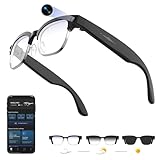
- 【8MPW Camera & 1080P Video and Audio】:These camera glasses feature an 800W camera that outputs sharp 20MP photos and smooth 1080P 30fps videos. Ultra-Clear Video + Powerful Anti-Shake tech+ Built-in dual microphones, you can capture crystal-clear video and audio together -sharply restoring details, perfect for vlogging, travel, and everyday moments
- 【Real-time AI translation Smart Glasses with Camera】:Instantly translate multiple major languages, breaking down language barriers in an instant—no phone required. Ideal for office settings, travel, academic exchanges, international conferences, watching foreign videos, and more
- 【Voice Assistant Recognition and Announcement】:Powered by industry-leading AI large models such as Doubao AI and OpenAI's GPT-4.0. AI voice wake-up lets you ask questions, recognize objects, and get answers on the go. Automatically recognizes objects, menus, landmarks, plants, and more, quickly analyzing the results and announcing them in real time. It instantly becomes your mobile encyclopedia on the go
- 【Bluetooth 5.3 Connection and Automatic Sync to Phone】:Equipped with a low-power BT5.3 chip and Wi-Fi dual transmission technology, offering ultra-low power and high-speed transmission. Captured images and videos are transferred to your phone in real time, eliminating manual export and eliminating storage worries
- 【290mAh Ultra-Long Battery Life】:Ultra-light at 42g, it's made of a durable, skin-friendly material, as light as a feather. Lenses are removable. Its simple, versatile design makes it a comfortable and comfortable wearer. 290mAh ultra-long battery life, 12 hours of music playback and 2 hours of photo or video recording, making it a perfect travel companion
In real-world use, Halo behaves more like a smartwatch than a camera. You activate it intentionally, let it listen for a stretch, then recharge.
That rhythm limits passive lifelogging. Memory becomes selective by necessity, not philosophy.
What you give up in comfort and durability
At $299, Halo prioritizes lightness over refinement. The frames are comfortable enough for short sessions but lack the balance and finishing of premium eyewear.
There’s no premium hinge engineering, no luxury acetate, no reassuring heft. Durability feels adequate, not reassuring, especially for something meant to be worn daily and carried everywhere.
This isn’t eyewear you forget you’re wearing. It’s a device you remain aware of.
No display means fewer social tells
Ironically, what Halo lacks may be what keeps it wearable at all. Without a visible display or obvious recording indicators, it doesn’t scream “smart glasses” from across the room.
That subtlety helps in casual settings, but it also creates ambiguity. People can’t easily tell when Halo is active, which feeds the social tension discussed earlier.
The lower price accelerates this ambiguity into more spaces, faster.
The absence of subscriptions, for now
One reason $299 feels attainable is the lack of a mandatory subscription at launch. That’s unusual in AI hardware, where ongoing model inference costs usually require recurring fees.
Whether this holds long-term remains unclear. Cloud processing isn’t free, and memory-heavy use cases are expensive to support.
Buyers should treat the current pricing as an early phase, not a permanent promise.
Who benefits most from the low price
Halo’s pricing favors experimentation. It invites developers, productivity hackers, and curious professionals to test AI memory without committing to a four-figure gamble.
It’s accessible enough to live in a bag, be used intermittently, and abandoned without guilt if social friction proves too high.
That flexibility is part of the product’s appeal, and part of its honesty.
Why cheap doesn’t mean disposable
Despite its compromises, Halo isn’t a toy. It’s a real attempt to compress sensors, cloud AI, and human memory into a wearable form factor that people might actually try.
The $299 price doesn’t trivialize the idea. It destabilizes it, pushing unresolved questions about privacy, consent, and cognitive outsourcing into everyday reach.
That tension is the real cost of Halo, and it’s one no amount of savings can fully offset.
Halo vs Meta Ray-Ban, Humane AI Pin, and Other AI Wearables: A Clear Positioning Breakdown
Once you place Halo next to its closest competitors, the compromises and intent become clearer. This isn’t a race to replace your phone, nor an attempt to build the most socially acceptable smart glasses on the market.
Halo sits in a narrow lane: passive, memory-first AI hardware that prioritizes capture over presentation. That positioning makes it easier to compare what it is not as much as what it is.
Halo vs Meta Ray-Ban: Memory device versus media glasses
Meta’s Ray-Ban smart glasses are best understood as audio-first social wearables with a camera attached. They excel at hands-free calls, music, quick photos, and short-form video capture, all anchored tightly to Meta’s ecosystem.
Halo flips that equation. There are no speakers, no music playback, no social sharing tools, and no emphasis on content creation.
Where Ray-Bans encourage intentional moments, Halo assumes most moments matter later. It listens continuously, captures context quietly, and relies on AI retrieval instead of user curation.
Physically, the Meta Ray-Bans are heavier but more polished. Materials, hinge strength, and long-term comfort feel closer to conventional eyewear, especially with proper lens fitting.
Halo feels more like a developer kit disguised as glasses. Lighter, simpler, and less refined, but also less performative.
Battery life reflects this philosophy. Ray-Bans are designed for short, active sessions with predictable drain, while Halo’s passive capture model creates anxiety around how much it’s actually recording versus how long it will last.
Privacy is where the trade-off sharpens. Ray-Bans make recording obvious, socially legible, and often intentional. Halo’s subtlety makes it easier to wear, but harder for bystanders to trust.
Halo vs Humane AI Pin: Glasses that listen versus a device that speaks
Humane’s AI Pin aimed to be a standalone computing paradigm. Voice-first interaction, cloud reliance, and an always-available assistant framed as a phone replacement.
Halo never pretends to replace anything. It assumes you already have a phone, a laptop, and a smartwatch, and quietly tries to sit behind them all.
The AI Pin’s biggest flaw was ambition without enough practical scaffolding. Battery life was limited, latency broke conversational flow, and the subscription requirement immediately raised the cost of failure.
Halo avoids that trap by lowering expectations. It doesn’t respond instantly, doesn’t project interfaces, and doesn’t demand constant engagement.
In daily use terms, the AI Pin wanted attention. Halo avoids it.
That difference matters. A device that speaks, interrupts, or replaces tasks invites scrutiny. A device that remembers quietly slips under the radar, for better and worse.
Where Humane overreached on interface innovation, Brilliant Labs underreaches intentionally. The trade-off is usefulness today versus promise tomorrow.
Halo vs smartphone-based AI memory apps
The most uncomfortable comparison for Halo isn’t another wearable. It’s your phone.
Smartphones already capture location, photos, messages, calendar context, and increasingly, ambient audio through apps. With the right permissions, many “AI memory” functions already exist without new hardware.
Halo’s counterargument is friction. Phones require intentional interaction, pulling them out, unlocking, aiming, or remembering to record.
Halo captures without ceremony. That changes what gets remembered, not just how it’s stored.
The risk is redundancy. If Halo’s retrieval isn’t dramatically better than phone-based alternatives, the glasses become an unnecessary layer.
This is where Brilliant Labs is betting on long-term model improvements rather than current feature parity.
Halo vs AR-first smart glasses
Compared to AR devices like Xreal or enterprise-focused headsets, Halo is almost anti-AR. There’s no visual layer, no spatial computing, no overlays competing for attention.
That absence is intentional. Visual AR still struggles with comfort, battery life, and social acceptance.
Halo sacrifices capability to gain endurance and subtlety. It assumes memory is more valuable than augmentation.
For users waiting for everyday AR, Halo will feel incomplete. For users overwhelmed by screens, it may feel refreshing.
Where Halo actually fits
Halo isn’t competing head-on with consumer smart glasses, assistant devices, or productivity wearables. It’s probing a different question: can AI memory exist without demanding behavior change?
Its closest peers are experimental. Lifelogging cameras, quantified-self devices, and academic prototypes, not polished consumer hits.
That makes the $299 price point make sense. It lowers the barrier to participation in an unresolved category.
Halo is not the best smart glasses product available. It may not even be the most useful today.
But it is one of the clearest expressions of where AI wearables might go once novelty fades and memory becomes the core feature people are willing to live with.
Who Halo Is Actually For—and Who Should Absolutely Avoid It
Once you accept Halo’s premise—that passive capture matters more than active interaction—the question stops being “Is this impressive?” and becomes “Do I actually want this kind of memory in my life?”
At $299, Brilliant Labs isn’t selling polish or certainty. It’s selling access to an idea that may reshape how personal data, recall, and context work—if you’re the right kind of user.
Ideal users: cognitively overloaded, context-driven professionals
Halo makes the most sense for people whose work lives are fragmented across conversations, locations, and unstructured moments. Consultants, researchers, founders, clinicians, journalists, and product managers often lose value not because information is unavailable, but because context slips away.
💰 Best Value

- #1 SELLING AI GLASSES - Move effortlessly through life with Ray-Ban Meta glasses. Capture photos and videos, listen to music, make hands-free calls or ask Meta AI* questions on-the-go. Ray-Ban Meta glasses deliver a slim, comfortable fit for both men and women.
- CAPTURE WHAT YOU SEE AND HEAR HANDS-FREE - Capture exactly what you see and hear with an ultra-wide 12 MP camera and a five-mic system. Livestream it on Facebook and Instagram.
- LISTEN WITH OPEN-EAR AUDIO — Listen to music and more with discreet open-ear speakers that deliver rich, quality audio without blocking conversations or the ambient noises around you.
- GET REAL-TIME ANSWERS FROM META AI — The Meta AI* built into Ray-Ban Meta’s wearable technology helps you flow through your day. When activated, it can analyze your surroundings and provide context-rich suggestions - all from your smart AI glasses.
- CALL AND MESSAGE HANDS-FREE — Take calls, text friends or join work meetings via bluetooth straight from your glasses.
For these users, Halo’s always-on capture can function like a background notebook. You’re not asking it to record meetings or take notes on command; you’re trusting it to preserve the connective tissue between moments so retrieval later feels natural.
This only works if you’re comfortable with delayed value. Halo rarely helps in the moment—it pays off days later, when you ask what was discussed, who said it, or where an idea surfaced.
Early adopters who understand unfinished software
Halo is not a mature assistant. Its AI recall depends heavily on model quality, indexing, and how well the system learns your personal patterns over time.
If you’ve lived through early smartwatch software, first-gen voice assistants, or beta AR platforms, the trade-offs will feel familiar. Features improve via updates, not hardware revisions, and some days retrieval will feel magical while others feel incomplete.
Users who expect deterministic, enterprise-grade reliability will be frustrated. Halo rewards curiosity, patience, and a tolerance for ambiguity.
People already comfortable with wearables—but tired of screens
Halo works best for users who already wear glasses or lightweight wearables daily and understand comfort as a first-order concern. The frames are intentionally minimal, closer to lightweight optical frames than tech hardware, and designed for long sessions rather than bursts of use.
There’s no display, no visual notifications, and no constant feedback loop. If your ideal wearable reduces interaction instead of increasing it, Halo aligns with that philosophy.
If you enjoy glancing at metrics, prompts, or visual cues, Halo will feel inert.
Privacy pragmatists, not absolutists
Halo is for people who think deeply about privacy—but don’t default to rejection. Audio capture, contextual memory, and cloud-based AI processing all introduce risk, even with on-device filtering and user controls.
If you already trust smartphones, cloud assistants, and location services under managed permissions, Halo is an extension of that relationship. If you believe any ambient capture is unacceptable, no technical safeguard will change that.
Social comfort also matters. Wearing a device that could be recording requires judgment, transparency, and restraint in shared spaces.
Who should absolutely avoid Halo: control-first users
If you need explicit start-and-stop recording, visual confirmation, or guaranteed data boundaries, Halo will feel unsettling. Its core value comes from removing friction, and that same removal can feel like loss of control.
This includes users in regulated environments, legal professionals with strict confidentiality requirements, or anyone whose work demands provable data governance.
Halo’s memory is probabilistic, not forensic.
People expecting AR, notifications, or assistant-style utility
If you’re shopping for smart glasses because you want turn-by-turn directions, live translations in your field of view, fitness metrics, or message previews, Halo is the wrong product.
It doesn’t compete with AR glasses, smartwatches, or earbuds on feature breadth. Its battery life, while optimized for capture, is not designed for constant interaction, and its usefulness depends on post-hoc querying rather than real-time guidance.
Treating Halo like a display-less smartwatch guarantees disappointment.
Anyone seeking immediate productivity gains
Halo does not optimize your day. It doesn’t schedule meetings, manage tasks, or proactively intervene when you’re distracted.
Its value compounds slowly, as the system accumulates enough personal context to surface meaningful recall. For users measuring ROI in hours or weeks rather than months, that ramp will feel unjustifiable.
This is not a productivity accelerator—it’s a memory hedge.
Why the $299 price matters for this decision
At $299, Halo is priced as an experiment you can live with, not a commitment you must justify daily. It’s closer to a mid-range smartwatch than to AR headsets or enterprise wearables, and that framing is intentional.
The cost lowers the psychological barrier to trying a new relationship with memory. But it also signals that you are buying into potential, not completeness.
For the right user, Halo becomes quietly indispensable. For everyone else, it will feel like a solution searching for a problem—and no amount of future AI updates will change that.
Is Halo a Glimpse of the Future or a Niche Experiment? What This Means for AI Wearables
Halo lands at an uncomfortable but revealing intersection: it works well enough to provoke serious questions, but not well enough to disappear into everyday life without friction.
That tension is precisely why it matters.
Halo reframes what “smart” wearables are supposed to do
Most wearables optimize for immediacy. Smartwatches surface notifications, earbuds respond to voice commands, and AR glasses promise contextual overlays in real time.
Halo rejects that model entirely. It doesn’t try to assist you in the moment; it tries to remember the moment for later.
That shift reframes AI wearables from tools of intervention to systems of accumulation. Instead of asking “How can this help me now?”, Halo asks “What will this know about me over time?”
“Remembering your life” works—but only in a specific, narrow way
In practical terms, Halo’s lifelogging is passive and probabilistic. It captures fragments of audio and images, compresses them into embeddings, and lets a language model reconstruct meaning when prompted.
You’re not replaying your day like a bodycam. You’re querying a fallible memory that feels closer to human recall than machine logging.
That distinction is crucial. When Halo gets it right, it feels magical. When it gets it wrong, it reminds you how fragile this entire category still is.
The hardware reality keeps the ambition in check
Physically, Halo looks like glasses because it needs to, not because it wants to replace eyewear. The materials are lightweight and unassuming, but the fit and comfort are only good enough for partial-day wear.
Battery life reinforces this limitation. Halo can’t be worn indefinitely without tradeoffs, and its capture-first design means you’re always balancing duration against fidelity.
This isn’t a device that disappears like a watch or ring. You remain aware you’re wearing it, and that awareness shapes behavior.
Privacy is the real gating factor, not technology
From a technical standpoint, Halo proves that on-device sensors paired with cloud-based AI can create usable personal memory systems today.
Social acceptance is another matter.
Even with user-controlled data, transparent policies, and no live streaming, the act of wearing always-on cameras and microphones creates friction with the world around you. Halo doesn’t solve that problem; it exposes it.
Until cultural norms shift, memory wearables will remain opt-in, context-sensitive, and quietly controversial.
Why the $299 experiment matters beyond Halo itself
The price is doing more than making Halo accessible. It’s testing demand elasticity for a new category.
At $299, users are willing to tolerate rough edges, incomplete software, and unclear long-term value. At $999, they wouldn’t be.
This pricing signals something important to the broader industry: AI wearables don’t need to be perfect to be compelling, but they must be affordable enough to justify curiosity.
What Halo signals to Apple, Meta, and everyone else
Halo won’t outsell smartwatches or replace earbuds. That was never the point.
What it demonstrates is that AI wearables don’t have to start with displays, notifications, or assistants. Memory, context, and recall may be the more durable foundation.
Expect larger players to study this closely, then reintroduce the concept with tighter hardware integration, clearer privacy boundaries, and deeper ecosystem lock-in.
So is Halo the future, or a footnote?
The honest answer is both.
Halo is unlikely to become a mass-market staple in its current form. Its limitations, social friction, and slow payoff ensure it remains a product for a very specific kind of user.
But as a proof of intent, it’s one of the clearest signals yet that AI wearables are moving beyond screens and commands toward something more intimate, and more unsettling.
Halo doesn’t tell you what to do. It remembers what you did.
Whether that becomes indispensable or intolerable will define the next decade of personal technology.