For more than a decade, AR glasses have promised to disappear into daily life, yet most have done the opposite. They have asked people to accept thicker frames, glowing optics, camera bulges, and unmistakable “tech face” energy in exchange for features that often felt half-baked or situational. The result is a category that technically exists, but socially never quite landed.
That tension between capability and normalcy is the single biggest reason AR glasses have struggled. Brilliant Labs’ Frame is interesting because it does not try to solve everything at once. Instead, it attacks the core problem that has quietly killed most attempts before they ever mattered: they don’t look or feel like something you’d willingly wear all day.
The physics problem no one escaped
At the heart of AR glasses is an unforgiving optical equation. Waveguides, micro-projectors, cameras, batteries, speakers, and processors all want physical space, and they all want to sit near your eyes. Traditional approaches either bulk up the temples to hide electronics or thicken the lenses to accommodate display optics, both of which immediately signal “this is not normal eyewear.”
Even relatively restrained products like Snap Spectacles or early Nreal designs still carried visible weight in the frame and a center-of-gravity problem that became obvious after an hour of wear. Comfort suffers quickly when glasses stop behaving like glasses. That alone has pushed AR devices out of everyday use and into novelty territory.
🏆 #1 Best Overall
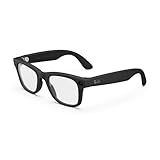
- #1 SELLING AI GLASSES - Tap into iconic style for men and women, and advanced technology with the newest generation of Ray-Ban Meta glasses. Capture photos and videos, listen to music, make hands-free calls or ask Meta AI questions on-the-go.
- UP TO 8 HOURS OF BATTERY LIFE - On a full charge, these smart AI glasses can last 2x longer than previous generations, up to 8 hours with moderate use. Plus, each pair comes with a charging case that provides up to 48 hours of charging on-the-go.
- 3K ULTRA HD: RECORD SHARP VIDEOS WITH RICH DETAIL - Capture photos and videos hands-free with an ultra-wide 12 MP camera. With improved 3K ultra HD video resolution you can record sharp, vibrant memories while staying in the moment.
- LISTEN WITH OPEN-EAR AUDIO — Listen to music and more with discreet open-ear speakers that deliver rich, quality audio without blocking out conversations or the ambient noises around you.
- ASK YOUR GLASSES ANYTHING WITH META AI - Chat with Meta AI to get suggestions, answers and reminders straight from your smart AI glasses.
Design decisions driven by demos, not daily wear
Another reason AR glasses look strange is that many were designed to impress in controlled demos. Wide fields of view, dual displays, hand tracking, spatial mapping, and always-on cameras look great on spec sheets and launch stages. They also force compromises that are immediately felt when you leave the demo room and step into real life.
Thicker frames interfere with peripheral vision, heavier fronts cause nose fatigue, and visible cameras make social interactions awkward. Even excellent software experiences struggle to overcome the feeling that you are wearing a prototype, not a personal object like a watch or pair of prescription frames.
Why “normal” matters more than features
Smartwatches succeeded not because they did everything phones could not, but because they fit seamlessly into an object people already accepted. AR glasses have largely skipped that lesson, trying to justify their existence through ambition rather than comfort, discretion, and familiarity.
Frame flips that priority. Instead of asking how much technology can be crammed into eyewear, it asks how little is needed to still be useful. That mindset immediately changes the industrial design, weight targets, and even the software philosophy behind the product.
Frame’s radical minimalism
Brilliant Labs’ Frame is striking precisely because it feels under-designed compared to its peers. The frames are thin, the lenses look like lenses rather than display panels, and there is no obvious external camera array advertising itself to the room. At a glance, it reads as slightly quirky eyewear, not a wearable computer.
This is where weight becomes the quiet headline feature. By aggressively limiting onboard hardware and leaning on a paired smartphone for heavy computation, Frame avoids the battery bulk and thermal constraints that usually bloat AR glasses. The result is a device that sits closer to the physical experience of standard acetate frames than anything traditionally labeled AR.
Accepting constraints instead of fighting them
Frame does not offer full-color spatial overlays, wide immersive visuals, or persistent world mapping. That is not a failure; it is a deliberate trade. The display approach is closer to glanceable, contextual information rather than cinematic AR, which allows the optics to remain subtle and the lenses visually clean.
This constraint-driven design also improves daily usability. Less heat, longer wearable sessions, and fewer social barriers matter more for something meant to live on your face for hours. In that sense, Frame behaves more like a watch than a headset, offering utility in short, frequent moments rather than demanding constant attention.
Why this approach may finally stick
What makes Frame different is not that it outperforms competitors on raw AR capability, but that it respects the reality of human behavior. People tolerate compromises on their wrists far more than on their faces, and even then only when comfort and aesthetics are right. Frame’s lightness, visual restraint, and software simplicity align with that reality in a way most AR glasses have ignored.
Whether this becomes a breakthrough or remains a niche experiment will depend on how useful users find its limited but focused features over time. What is clear already is that Frame reframes the conversation. Instead of asking when AR glasses will replace phones, it asks a more realistic question: what if they just felt normal first?
First Look at Brilliant Labs’ Frame: Design, Weight, and the Importance of Invisibility
Seen in person, Frame immediately reinforces the idea introduced earlier: this is eyewear first, computer second. There is no protruding visor, no mirrored lens treatment, and no obvious sensor cluster broadcasting intent. If you weren’t told these were smart glasses, you could easily assume they were slightly unconventional prescription frames.
That visual restraint is not accidental. Brilliant Labs is clearly betting that social acceptability is the real bottleneck for AR, not field of view or polygon count.
Design language that prioritizes normalcy
Frame’s silhouette sits closer to contemporary acetate glasses than to anything from the XR world. The front profile is slim, the lenses are visually clear, and the bridge does not bulge to accommodate optics. Even the temples avoid the chunky, battery-heavy look that has become synonymous with smart eyewear.
Up close, you can spot hints of technology, particularly in the right lens where the display lives and along the inner temple where components are discreetly housed. Crucially, none of this is visible at conversational distance, which is where most smart glasses fail their social test.
The material choices reinforce this restraint. The frames feel lightweight but not flimsy, closer to mid-range optical frames than plastic prototypes. Finishing is clean rather than luxurious, but it avoids the toy-like feel that can plague early wearable hardware.
Weight as a design constraint, not a spec flex
Brilliant Labs doesn’t shout about grams, but the experience makes the point for them. Frame weighs under 40 grams, putting it far closer to everyday glasses than to legacy AR devices that often double that figure. On the face, the difference is immediate and difficult to overstate.
That low mass changes how you wear them. There is less nose pressure, minimal ear fatigue, and no constant reminder that you are supporting a computer on your head. You stop adjusting them after a few minutes, which is one of the most telling indicators of good wearable design.
This is where the earlier trade-offs pay dividends. Offloading heavy computation to a paired smartphone allows the glasses themselves to remain cool and physically unobtrusive. The absence of heat buildup is especially noticeable during longer sessions, something even advanced AR headsets still struggle with.
Invisibility as the core feature
The most radical thing about Frame may be how little attention it draws. In public, they do not invite questions, stares, or discomfort from people around you. That “invisibility” is arguably more important than any single technical specification.
The display itself reinforces this philosophy. Rather than flooding your vision, information appears in a restrained, glanceable way, occupying a small portion of the visual field. It feels closer to checking the time on a watch than opening an app on a phone.
This matters because it aligns with how people actually behave. AR that demands sustained focus competes with reality, while AR that supports brief moments can coexist with it. Frame clearly targets the latter.
Comfort over hours, not minutes
Extended wear is where Frame separates itself from more ambitious AR attempts. Because the weight is low and evenly distributed, wearing them for hours feels plausible rather than aspirational. There is no creeping pressure point that forces you to take a break.
Fit will still depend on face shape and lens configuration, especially for prescription users, but the baseline ergonomics are solid. The temples flex just enough to feel secure without clamping, and the balance avoids the front-heavy sensation common in camera-equipped glasses.
This is where the watch analogy becomes useful again. Like a well-sized watch, Frame disappears when it fits correctly, only reminding you of its presence when it has something useful to offer.
What this means in the broader AR landscape
Compared to competitors chasing immersive overlays or always-on recording, Frame feels almost contrarian. It gives up visual spectacle in exchange for wearability, subtlety, and consistency. That will disappoint users expecting futuristic visuals, but it will appeal to those who value something they can actually live with.
In the current AR market, that positions Frame less as a rival to headsets and more as a parallel category. It sits alongside smartwatches rather than VR goggles, prioritizing daily integration over technical dominance.
Whether that makes Frame the most “normal” AR glasses yet depends on how you define success. If success means maximum capability, it falls short. If success means glasses you can forget you are wearing, Brilliant Labs may be closer than anyone else so far.
Display Philosophy: Micro-OLED, Monocular AR, and Why Less Can Be More
If comfort and social acceptability are the foundation of Frame, the display philosophy is the structural engineering that makes it possible. Brilliant Labs has made a series of deliberate, almost conservative choices around optics that run counter to the “more pixels, more immersion” race dominating AR marketing.
The result is a display system that feels intentionally limited, but also surprisingly coherent once you understand what Frame is trying to be.
Why Micro-OLED Fits Frame’s Goals
Frame uses a tiny micro-OLED display rather than a waveguide-based binocular system. That decision immediately constrains field of view and graphical ambition, but it unlocks meaningful advantages in size, weight, and power efficiency.
Micro-OLED panels excel at high contrast and deep blacks, which matters when your interface is floating over the real world rather than replacing it. Text and simple UI elements remain legible in varied lighting without needing aggressive brightness that would drain the battery or call attention to itself.
Just as importantly, the optical stack required for micro-OLED is far simpler than full waveguide systems. Fewer layers, fewer alignment challenges, and less bulk translate directly into glasses that look and feel closer to normal eyewear.
Monocular AR Is a Feature, Not a Compromise
Frame is a monocular system, meaning the display appears in only one eye. On paper, that sounds like a downgrade, but in practice it reinforces the watch-like behavior Frame encourages.
Because the information sits off to one side of your vision, it never attempts to dominate your perception. You glance, you read, and you look away. There is no pressure to merge two images into a single virtual world, and no fatigue from sustained stereoscopic focus.
This approach mirrors how people already interact with secondary information. Think of checking a smartwatch while walking, or glancing at a car’s heads-up display. The information is present when you need it, and invisible when you do not.
Field of View and the Discipline of Constraint
The limited field of view will be the most polarizing aspect of Frame’s display. It is not immersive, it does not fill your vision, and it will never deliver cinematic AR experiences.
But that limitation enforces discipline in software design. Interfaces must be concise, readable, and purposeful. Notifications feel more like whispers than interruptions, which aligns with Frame’s broader goal of coexistence rather than replacement.
In the context of daily wear, this restraint becomes an asset. A wider field of view might impress in a demo, but it also demands attention. Frame’s narrow window asks for moments instead of minutes.
Battery Life, Heat, and All-Day Practicality
Display choice is inseparable from battery life and thermal behavior, and this is where Frame’s philosophy pays off quietly. A single micro-OLED panel consumes far less power than dual displays pushing wide fields of view.
That efficiency helps keep the glasses cool, even during extended use, and supports a usage pattern measured in hours rather than sessions. No hot spots near the temples, no subtle warmth that reminds you electronics are strapped to your face.
This is similar to why low-power watch movements, whether quartz or efficient mechanical calibers, remain relevant despite more complex alternatives. Reliability and endurance often matter more than maximum capability.
Optical Clarity Versus Optical Ambition
Frame’s optics are optimized for clarity at a fixed focal distance, not for dynamic depth cues or spatial mapping theatrics. You are not meant to anchor objects to walls or reach out to grab holograms.
Rank #2
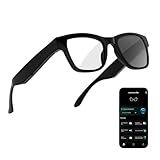
- 3-in-1 AI Glasses: Enjoy ① AI Voice Assistant (Powered by ChatGPT, Gemini & Deepseek), ② Stylish Photochromic Lenses Glasses, and ③ Bluetooth Open-Back Headphones, all in one.
- Free Talk Translation: Automatically detects and translates over 160 languages in real-time, allowing seamless work and translation without touching your phone or glasses.
- Voice, Video & Photo Translation: Supports over 98% of global languages, offering fast and accurate translations—ideal for international travel, business meetings, or cross-cultural communication.
- AI Meeting Assistant: Converts recordings from smart glasses into text and generates mind maps, making it easier to capture and organize meeting insights.
- Long Battery Life, Bluetooth 5.4 & Eye Protection: Up to 10 hours of music and 8 hours of talk time, with easy Type-C charging. Bluetooth 5.4 ensures stronger, stable connections, while photochromic lenses block UV rays and blue light, protecting your eyes in any environment.
Instead, the display behaves more like a floating reference layer. Text is crisp, icons are stable, and your eyes do not constantly refocus between virtual and real elements.
For professionals or frequent wearers, that matters more than novelty. Reduced eye strain and predictable behavior are the difference between something you try and something you adopt.
How This Compares to the Broader AR Market
Most modern AR glasses aim upward, chasing immersive use cases that justify their existence through spectacle. Frame aims inward, focusing on habits people already have and augmenting them gently.
Compared to waveguide-heavy designs from larger players, Frame sacrifices visual drama to gain approachability. It feels less like a prototype from the future and more like a product that fits into the present.
That trade-off will not satisfy everyone. But for users who have bounced off bulky headsets or socially awkward smart glasses before, Frame’s display philosophy may be exactly why it finally works.
Controls, AI, and Interaction: How You Actually Use Frame Day to Day
If Frame’s display philosophy is about restraint, its interaction model follows the same logic. Brilliant Labs has avoided the temptation to layer on novel input methods just because they are technically possible.
Instead, Frame is designed to disappear into your existing habits, much like a well-worn mechanical watch that delivers information at a glance without demanding attention. That design choice defines how you actually live with these glasses from morning to evening.
Minimal Physical Controls, on Purpose
Frame keeps hardware controls almost aggressively simple. There is no touchpad along the temple and no multi-button array to memorize, just a single physical input that handles wake, confirm, and basic navigation.
In practice, that means fewer accidental inputs and less fidgeting in public. You are not constantly brushing the frame and triggering unintended actions, which is a common failure point with touch-sensitive smart glasses.
This approach mirrors traditional watch ergonomics more than consumer electronics. One crown, one pusher, clear feedback, and nothing that competes with the act of wearing the object comfortably all day.
Voice First, but Not Voice Only
Most interactions with Frame begin with voice, but it is not locked into a voice-only worldview. Commands feel closer to issuing a short instruction than having a conversation, which reduces friction and social awkwardness.
You can ask for translations, summaries, reminders, or quick answers without launching into long prompts. The system responds quickly and, crucially, keeps output concise enough to remain readable in a single glance.
For quieter environments or moments when speaking out loud feels inappropriate, Frame supports simple non-voice interactions through its physical control. That flexibility makes it usable in meetings, public transit, and shared workspaces.
The Role of AI: Utility Over Personality
Brilliant Labs positions AI as an assistant layer rather than a character. There is no attempt to anthropomorphize the experience or keep you engaged through banter.
The AI’s strength lies in contextual awareness and brevity. It excels at lightweight cognitive offloading, such as recalling a name, summarizing a message, or extracting key points from longer text.
This is where Frame feels fundamentally different from phone-based assistants. Information appears in your line of sight, exactly when you need it, without pulling you into another app or screen-based distraction loop.
Notifications That Respect Your Attention
Frame handles notifications more like a high-end watch than a smartphone. Alerts are selective, subtle, and designed to be glanced at rather than interacted with extensively.
You can configure what comes through, and the system encourages restraint by design. The display is not optimized for endless scrolling, which naturally limits notification overload.
Over time, this creates a healthier relationship with alerts. You stay informed without feeling constantly interrupted, which is something even mature smartwatch platforms still struggle to balance.
Learning Curve and Daily Rhythm
Frame does not require a long onboarding period, but it does reward consistency. After a few days, interactions become instinctive, and you stop thinking about how to trigger functions.
The real shift happens when you stop reaching for your phone for small tasks. Checking a fact, translating a phrase, or confirming an appointment becomes a head movement and a glance instead of a full device interaction.
That rhythm is subtle but meaningful. It changes how often you break focus, which is one of the most underestimated benefits of head-worn displays done right.
Limitations You Will Notice Quickly
Frame’s interaction model also exposes its boundaries. This is not a device for long-form reading, deep multitasking, or complex workflows.
If you expect rich visual interfaces or spatial manipulation, you will feel constrained almost immediately. Frame is deliberately narrow in scope, and it does not pretend otherwise.
For some users, that will feel like a compromise. For others, it will feel like relief.
Why This Interaction Model Fits the Hardware
The controls and AI experience are tightly aligned with Frame’s lightweight construction and thermal discipline. There is no mismatch between ambition and ergonomics.
Because the glasses are comfortable and unobtrusive, interactions are short and purposeful. You use Frame in moments, not sessions, which preserves battery life and reduces fatigue.
This coherence is what makes Frame feel less like a tech demo and more like a finished object. Much like a thoughtfully sized watch case or a well-balanced bracelet, the best interaction design is the one that never calls attention to itself.
Battery Life, Processing, and the Reality of Ultra-Lightweight Hardware
That sense of coherence carries directly into how Frame handles power and performance. When glasses weigh this little and aim to look this normal, battery life and processing are no longer abstract specs but daily constraints that shape everything else.
Brilliant Labs has clearly accepted those constraints rather than trying to brute-force around them. The result is a system that behaves more like a finely tuned wearable than a miniature computer strapped to your face.
Battery Life Measured in Moments, Not Days
Frame’s battery life is best understood the same way you would evaluate a mechanical watch with a modest power reserve. It is not built for endurance marathons, but for reliable, predictable use within a defined rhythm.
In real-world use, Frame comfortably supports a full day of intermittent interactions: quick queries, translations, glanceable reminders, and short AI prompts. Continuous use or extended AI conversations will drain it faster, and there is no pretending otherwise.
This is the tradeoff of extreme lightness. There is simply no room in the temples for the kind of battery capacity seen in heavier AR headsets or even camera-first smart glasses like Ray-Ban Meta.
Charging Behavior and Daily Practicality
Charging is correspondingly frequent but uncomplicated. Frame is designed to top up quickly, encouraging short, habitual charging windows rather than overnight dependency.
Think of it more like charging true wireless earbuds than a smartwatch. You build the habit, and the friction disappears, provided you accept that this is not a device you leave untouched for days at a time.
For users already accustomed to charging rings, earbuds, and watches, Frame fits neatly into that ecosystem. For anyone expecting multi-day stamina, this will be an immediate reality check.
Processing Power: Just Enough, On Purpose
Frame’s on-device processing is intentionally modest. It handles sensor input, display output, and lightweight inference while offloading heavier AI tasks to a connected phone or the cloud.
This division is critical to keeping heat, weight, and power draw under control. There is no fan noise, no perceptible hotspot on the temples, and no creeping warmth during normal use.
The downside is that Frame is not a standalone computing platform. If your phone battery dies or connectivity drops, Frame’s capabilities narrow quickly, reinforcing its role as an extension rather than a replacement.
Thermals, Comfort, and Long-Term Wear
Thermal management is one of Frame’s quiet wins. Because the processor never pushes into sustained high-load territory, the glasses remain comfortable even after hours of wear.
This matters more than raw performance. Heat near the temples is one of the fastest ways to turn smart glasses from intriguing to intolerable, and Frame avoids that pitfall entirely.
The lightweight materials and minimal internal components also reduce pressure points. Like a well-proportioned watch case, the comfort comes from balance as much as from low mass.
Rank #3

- 【AI Real-Time Translation & ChatGPT Assistant】AI glasses break language barriers instantly with AI real-time translation. The built-in ChatGPT voice assistant helps you communicate, learn, and handle travel or business conversations smoothly—ideal for conferences, overseas trips, and daily use.
- 【4K Video Recording & Photo Capture 】Smart glasses with camera let you capture your world from a first-person view with the built-in 4K camera. Take photos and record videos hands-free anytime—perfect for travel moments, vlogging, outdoor adventures, and work documentation.
- 【Bluetooth Music & Hands-Free Calls 】Camera glasses provide Bluetooth music and crystal-clear hands-free calls with an open-ear design. Stay aware of your surroundings while listening—comfortable for long wear and safer for commuting, cycling, and outdoor use.
- 【IP65 Waterproof & Long Battery Life】 Recording glasses are designed for daily wear with IP65 waterproof protection against sweat, rain, and dust. The built-in 290mAh battery provides reliable performance for workdays and travel—no anxiety when you’re on the go.
- 【Smart App Control & Object Recognition】Smart glasses connect to the companion app for easy setup, file management, and feature control. They support AI object recognition to help identify items and improve your daily efficiency—perfect for travel exploration and a smart lifestyle.
Why Ultra-Lightweight Changes the Rules
Frame’s hardware philosophy forces a different definition of success. Instead of asking how much compute it can deliver, the more relevant question is how often you forget you are wearing it.
In that sense, the limited battery and processing power are not flaws but boundaries that protect the experience. They prevent feature creep, visual overload, and the kind of constant engagement that would make glasses socially awkward again.
This is where Frame separates itself from bulkier AR experiments. It is not trying to win spec comparisons; it is trying to disappear.
The Honest Tradeoff
None of this will satisfy power users who want persistent displays, rich graphics, or on-device AI independence. Frame will feel constrained, even fragile, compared to heavier, more ambitious platforms.
But for users who value comfort, discretion, and cognitive lightness, those constraints become the point. Frame behaves less like a gadget demanding attention and more like an ambient tool that shows up only when invited.
That balance is difficult to achieve, and it explains why so many smart glasses before it failed. Ultra-lightweight hardware does not forgive excess, but when disciplined correctly, it unlocks a kind of normalcy that AR has been chasing for years.
How Frame Compares to Meta Ray-Ban, Xreal, Vuzix, and Snap Spectacles
Once you accept Frame’s ultra-lightweight, intentionally constrained philosophy, the competitive picture sharpens quickly. Frame is not trying to beat other AR glasses at their own game; it is redefining which game is worth playing in the first place.
Instead of asking which product has the brightest display or most onboard compute, the better comparison is how each device fits into daily life without asking for behavioral compromises.
Frame vs Meta Ray-Ban: Presence Versus Perception
Meta Ray-Ban Stories succeed because they look normal and leverage Meta’s software ecosystem, but they are fundamentally camera-first glasses. Their value comes from capturing the world, not augmenting it in real time.
Frame flips that emphasis. There is no always-on camera feed or social recording bias; interaction is subtle, text-based, and largely private. Where Meta Ray-Ban feels like a social media peripheral, Frame feels more like an ambient interface layer.
Comfort also diverges over longer wear. Ray-Bans carry more weight in the temples due to cameras, speakers, and batteries, while Frame’s stripped-down internals make it easier to forget entirely. If Meta’s approach prioritizes sharing, Frame prioritizes thinking.
Frame vs Xreal: Wearable Glasses Versus Face-Mounted Displays
Xreal’s glasses are impressive technically, delivering large virtual displays that feel closer to portable monitors than eyewear. They shine when paired with phones, laptops, or game consoles, but they demand intention and setup.
Frame is the opposite. There is no cinematic screen, no spatial UI, and no expectation that you sit down to use it. Instead of pulling you into content, Frame quietly pushes small pieces of information into your peripheral awareness.
This makes Xreal far better for media consumption and productivity sessions, while Frame wins for mobility and social acceptability. One replaces a screen; the other dissolves into your routine.
Frame vs Vuzix: Enterprise DNA Versus Consumer Minimalism
Vuzix glasses are built with enterprise use cases in mind: logistics, remote assistance, industrial workflows. They prioritize durability, modularity, and functionality over aesthetics.
Frame has almost no overlap with that mission. It is not ruggedized, not display-heavy, and not optimized for task-specific overlays. Instead, it borrows from consumer design cues, favoring lightness and visual neutrality.
In watch terms, Vuzix feels like a professional tool watch built for harsh environments, while Frame is closer to a slim everyday piece that disappears under a cuff. Both are valid, but they serve fundamentally different users.
Frame vs Snap Spectacles: Experimentation Versus Intentional Restraint
Snap’s Spectacles have consistently pushed AR hardware forward, especially with spatial visuals and creative tools. They are ambitious, developer-focused, and unapologetically experimental.
That ambition comes at a cost. Spectacles remain bulky, short-lived on battery, and visually unmistakable, often signaling that the wearer is testing something rather than living with it.
Frame feels like a reaction to that exact tension. By refusing immersive visuals and heavy compute, it trades creative spectacle for longevity and comfort. Snap explores what AR could be; Frame asks what AR should actually do day to day.
Where Frame Actually Sits in the Market
Frame does not replace any of these products directly, and that is its quiet strength. It occupies a thin but meaningful slice of the market where normalcy, comfort, and cognitive restraint matter more than features.
For smartwatch owners who already live with subtle notifications and glanceable data, Frame feels philosophically aligned. It extends the wrist-based model to the face without demanding constant attention.
This positioning will limit its appeal, but it also protects it from direct competition. Frame is not chasing AR maximalism; it is carving out a space for glasses that behave like glasses first, technology second.
Real-World Use Cases: Where Frame Makes Sense (and Where It Doesn’t)
Seen through this lens, Frame’s real value only becomes clear when you stop expecting it to behave like a traditional AR headset. It is closer to a wearable interface layer than a visual computing platform, and that distinction shapes exactly where it works well.
Glanceable Information Without Social Friction
Frame makes the most sense in situations where you would normally check a smartwatch or pull out a phone, but want that information to stay closer to eye level. Calendar reminders, short notifications, navigation cues, and lightweight AI prompts all fit naturally into its display philosophy.
Because the optics are minimal and the frames look ordinary, these interactions feel socially acceptable in a way that bulky smart glasses never quite manage. You are not “using AR” in public; you are simply wearing glasses that happen to be helpful.
For smartwatch owners, this feels familiar. Just as a slim mechanical watch or low-profile fitness tracker fades into the background until needed, Frame delivers information without demanding attention or altering behavior.
Quiet Productivity and Cognitive Offloading
Frame is well-suited to individual, low-interruption workflows. Think writers, developers, researchers, or students who want subtle prompts, quick definitions, or reminders without breaking focus by switching devices.
The absence of a rich visual interface becomes a strength here. There is no temptation to browse, scroll, or visually explore. Frame acts more like an external memory aid than a screen, nudging information into your awareness and then getting out of the way.
In watch terms, this is the difference between a chronograph packed with complications and a clean time-only dial. Frame favors legibility and restraint over capability.
Everyday Wear for Long Sessions
Comfort is one of Frame’s most compelling advantages in real-world use. Its light weight and conventional balance make it viable for all-day wear in a way most smart glasses simply are not.
This matters more than spec sheets suggest. A device that can be worn continuously becomes part of your routine, while a heavier or more conspicuous headset ends up reserved for specific sessions.
Frame’s materials and proportions feel closer to standard acetate or lightweight metal eyewear than consumer electronics. For users already accustomed to wearing prescription glasses, the transition is almost frictionless.
AI Companion, Not Visual Overlay Engine
Frame works best when treated as an always-available AI interface rather than an AR display. Voice queries, contextual suggestions, and passive listening align with its hardware constraints.
It excels at answering questions, summarizing information, or providing real-time context without visual clutter. That makes it useful during walks, commutes, or conversations where pulling out a phone would feel disruptive.
This also clarifies who Frame is for. It is not for users chasing spatial anchors, persistent overlays, or immersive data visualization.
Where Frame Falls Short: Visual and Task-Heavy AR
If your mental model of AR involves floating windows, rich graphics, or multi-step visual workflows, Frame will disappoint. Its display is intentionally limited, and that caps its usefulness for anything requiring sustained visual engagement.
Navigation-heavy applications, design work, field service tasks, or gaming are simply outside its comfort zone. The hardware is not built to replace a phone, tablet, or dedicated AR headset.
This limitation is not a flaw so much as a boundary. Frame draws a clear line around what it refuses to do, and that line excludes many of the most common AR demos.
Not a Fitness, Health, or Sensor Platform
Unlike many wearables, Frame does not attempt to monitor your body. There is no heart rate tracking, motion analysis, or wellness data collection built into the experience.
For users accustomed to smartwatches handling health metrics, this may feel incomplete. For others, it is a welcome narrowing of scope that keeps the device focused and battery-friendly.
Frame assumes your wrist, ring, or phone already handles biometrics. It exists purely at the interface level, not the sensing layer.
Rank #4
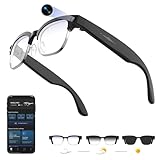
- 【8MPW Camera & 1080P Video and Audio】:These camera glasses feature an 800W camera that outputs sharp 20MP photos and smooth 1080P 30fps videos. Ultra-Clear Video + Powerful Anti-Shake tech+ Built-in dual microphones, you can capture crystal-clear video and audio together -sharply restoring details, perfect for vlogging, travel, and everyday moments
- 【Real-time AI translation Smart Glasses with Camera】:Instantly translate multiple major languages, breaking down language barriers in an instant—no phone required. Ideal for office settings, travel, academic exchanges, international conferences, watching foreign videos, and more
- 【Voice Assistant Recognition and Announcement】:Powered by industry-leading AI large models such as Doubao AI and OpenAI's GPT-4.0. AI voice wake-up lets you ask questions, recognize objects, and get answers on the go. Automatically recognizes objects, menus, landmarks, plants, and more, quickly analyzing the results and announcing them in real time. It instantly becomes your mobile encyclopedia on the go
- 【Bluetooth 5.3 Connection and Automatic Sync to Phone】:Equipped with a low-power BT5.3 chip and Wi-Fi dual transmission technology, offering ultra-low power and high-speed transmission. Captured images and videos are transferred to your phone in real time, eliminating manual export and eliminating storage worries
- 【290mAh Ultra-Long Battery Life】:Ultra-light at 42g, it's made of a durable, skin-friendly material, as light as a feather. Lenses are removable. Its simple, versatile design makes it a comfortable and comfortable wearer. 290mAh ultra-long battery life, 12 hours of music playback and 2 hours of photo or video recording, making it a perfect travel companion
A Niche That Only Works If You Accept the Tradeoffs
Frame makes sense for people who value discretion, comfort, and mental bandwidth over features. It is for users who already understand that the best wearable technology often does less, not more.
It does not make sense for buyers seeking spectacle, immersive visuals, or a clear replacement for existing devices. Frame adds a new layer rather than consolidating hardware.
That tension is exactly why Frame will feel transformative to some and irrelevant to others. It is not trying to win the AR market; it is trying to quietly exist alongside the wearables you already trust.
The Developer Angle: Open Source DNA and Why That Matters Long Term
That tightly drawn boundary around what Frame does and does not attempt is also what makes its developer story unusually coherent. Brilliant Labs is not chasing a closed, mass-market app ecosystem; it is building a small, legible platform and then stepping out of the way.
This matters because, at Frame’s scale and ambition, software flexibility is not a nice-to-have. It is the difference between a curiosity that fades after the first week and a tool that quietly evolves alongside its most dedicated users.
Open Source as a Strategic Choice, Not a Marketing Bullet
Frame’s firmware, tooling, and core software stack lean heavily toward open source, and that decision feels deliberate rather than ideological. The company is effectively acknowledging that it cannot predict the most compelling use cases for such a minimal AR interface.
Instead of locking developers into a polished but rigid SDK, Brilliant Labs exposes the guts of the system. Developers can see how text is rendered, how inputs are handled, and how power constraints shape every design choice.
For a device with limited display real estate and modest on-device compute, this transparency is crucial. It invites experimentation that works with the hardware’s constraints rather than fighting them.
Why Minimal Hardware Needs Maximum Software Freedom
Frame’s lightweight design and all-day comfort come at the cost of raw capability. Battery life, thermal headroom, and processing power are all tightly managed, and that leaves little margin for bloated software abstractions.
Open access allows developers to optimize ruthlessly. You can build glanceable utilities, notification filters, or context-aware prompts that sip power instead of draining it, which is the only way Frame remains wearable for more than a few hours.
This is a sharp contrast to heavier AR glasses that rely on brute-force hardware to mask inefficient software. Frame cannot afford that luxury, and its developer model reflects that reality.
A Different Kind of App Ecosystem
Do not expect a glossy app store filled with spatial experiences or brand-name integrations. Frame’s ecosystem is more likely to resemble early smartwatch hacking communities than modern mobile platforms.
Think command-line-adjacent tools, productivity experiments, language prompts, memory aids, or discreet AI-driven assistants that surface exactly one line of text when needed. These are not apps you demo; they are utilities you live with.
For developers, this lowers the psychological barrier to building. You are not competing for attention in a crowded marketplace; you are solving a specific problem for yourself and a small group of like-minded users.
Longevity Through Modifiability
Open source also changes the risk profile of buying into such a niche product. Even if Brilliant Labs were to pivot, slow down, or disappear, Frame would not instantly become a paperweight.
The community can maintain firmware, extend compatibility with future phones, and adapt the software layer as operating systems evolve. That is not theoretical; it is how many beloved niche devices have survived long past their commercial peak.
For early adopters wary of yet another abandoned wearable platform, this matters more than polished launch apps or roadmap promises.
How This Compares to Closed AR Platforms
Most AR glasses today treat developers as guests in a carefully controlled house. You get access to APIs, but the architecture, update cadence, and long-term direction remain firmly in the company’s hands.
Frame flips that relationship. Brilliant Labs provides the hardware and a starting point, then implicitly trusts developers to push it in directions the company itself may never pursue.
This is riskier, messier, and far less scalable. It is also how genuinely new interaction paradigms tend to emerge, especially when the hardware itself is intentionally understated.
The Catch: This Is Not for Everyone
Open source does not magically make Frame more capable out of the box. If you want polished experiences, seamless onboarding, and guaranteed long-term support, a closed ecosystem may still serve you better.
Frame’s developer-first approach assumes curiosity and tolerance for rough edges. It rewards users who are willing to tinker, configure, and occasionally troubleshoot in exchange for control.
That tradeoff mirrors the hardware philosophy perfectly. Frame is not trying to be the future of AR for everyone; it is trying to be the most adaptable version of its very specific idea of what AR should be.
Social Acceptability and Wearability: Can You Forget You’re Wearing AR?
That developer-first, deliberately modest philosophy carries straight into how Frame feels on your face. Brilliant Labs is clearly betting that if AR is ever going to escape early-adopter circles, it has to stop announcing itself the moment you walk into a room.
Weight, Balance, and the Disappearing Hardware Problem
Frame’s most quietly radical achievement is how little of it you actually notice. At roughly 40 grams, it sits closer to a pair of lightweight acetate eyeglasses than any AR product most people have tried, and the weight distribution is unusually even across the bridge and temples.
There is no front-heavy drag, no subtle downward creep that forces constant micro-adjustments. After a few minutes, the hardware recedes in the same way a well-sized mechanical watch does once it settles on your wrist.
That matters more than spec sheets suggest. Many AR glasses fail not because of display quality or battery life, but because your body never stops reminding you that something unnatural is attached to your head.
Design Language: Normal Glasses First, Computer Second
Visually, Frame does not try to look futuristic, and that restraint is intentional. The silhouette reads as contemporary eyewear, not a tech demo, with thin rims, understated proportions, and none of the camera-bulge theatrics that still plague much of the category.
From conversational distance, most people will register them as “interesting glasses,” not “recording device” or “surveillance tech.” That distinction is critical for social acceptability in public spaces, offices, cafés, and transit.
This is the same shift smartwatches went through when they stopped looking like shrunken phones strapped to wrists and started borrowing cues from traditional watch design. Normalcy is not boring; it is liberating.
Living With Them All Day
Comfort over long sessions is where Frame separates itself from heavier, more capable competitors. The temples are thin but not sharp, the nose contact points are forgiving, and heat buildup is minimal even after extended use.
You do feel the battery limits before you feel physical fatigue. Realistically, you are working within a few hours of intermittent use rather than an all-day, always-on experience, but that constraint aligns with how socially acceptable AR actually functions today.
Frame works best when it appears, helps, and disappears again. It is not designed to dominate your field of view or demand continuous attention, which paradoxically makes it easier to keep wearing.
Social Friction, or the Lack of It
The absence of obvious outward-facing cameras significantly lowers the social temperature. People are less guarded, conversations feel normal, and you do not sense the unspoken question of whether they are being recorded.
This is a subtle but profound difference compared to more visibly instrumented smart glasses. The technology stays private, which encourages trust in shared spaces.
In practice, that means you are more likely to actually use Frame in the environments where lightweight AR could be useful, rather than reserving it for solitary or explicitly technical settings.
Comparison to Bulkier AR and XR Alternatives
Compared to devices like Meta’s Ray-Ban collaboration or larger waveguide-based AR glasses, Frame sacrifices spectacle for wearability. There is no immersive overlay, no cinematic display, and no illusion of full spatial computing.
What you gain instead is plausibility. Frame feels like something you could wear on a commute, during meetings, or while walking through a city without self-consciousness.
In the broader AR landscape, that may prove more disruptive than higher-resolution optics. The hardest problem AR faces is not visual fidelity; it is convincing people that wearing computers on their faces is socially acceptable.
The Psychological Threshold Frame Lowers
Perhaps the most telling test is whether you forget you are wearing them at all. Frame passes that test more often than expected, especially once the novelty fades.
When AR stops feeling like an event and starts feeling like an accessory, usage patterns change. You reach for it not because it is impressive, but because it is there and not in the way.
That quiet shift may be Frame’s most important contribution. Even if it remains a niche product, it demonstrates that AR does not have to look strange or feel burdensome to exist in the real world.
💰 Best Value

- #1 SELLING AI GLASSES - Move effortlessly through life with Ray-Ban Meta glasses. Capture photos and videos, listen to music, make hands-free calls or ask Meta AI* questions on-the-go. Ray-Ban Meta glasses deliver a slim, comfortable fit for both men and women.
- CAPTURE WHAT YOU SEE AND HEAR HANDS-FREE - Capture exactly what you see and hear with an ultra-wide 12 MP camera and a five-mic system. Livestream it on Facebook and Instagram.
- LISTEN WITH OPEN-EAR AUDIO — Listen to music and more with discreet open-ear speakers that deliver rich, quality audio without blocking conversations or the ambient noises around you.
- GET REAL-TIME ANSWERS FROM META AI — The Meta AI* built into Ray-Ban Meta’s wearable technology helps you flow through your day. When activated, it can analyze your surroundings and provide context-rich suggestions - all from your smart AI glasses.
- CALL AND MESSAGE HANDS-FREE — Take calls, text friends or join work meetings via bluetooth straight from your glasses.
Market Context: Is Frame a Breakthrough Product or a Smart Niche Bet?
Frame lands at an awkward but potentially opportune moment for AR glasses. The industry has spent the last decade oscillating between overpromising futuristic visions and retreating into cautious, incremental hardware that few people actually want to wear.
Against that backdrop, Frame feels less like a moonshot and more like a course correction. Instead of trying to replace your phone, monitor, or reality itself, it focuses on removing friction until face-worn computing stops feeling like a statement.
The AR Glasses Market Is Stuck Between Two Extremes
On one end, you have full XR headsets and spatial computers that are technically impressive but physically and socially heavy. They demand intention, isolation, and often a dedicated use case that justifies the bulk.
On the other end sit camera-first smart glasses, which look normal enough but struggle to answer why they exist beyond passive capture or notifications. They feel closer to accessories than tools, which limits how essential they become over time.
Frame deliberately avoids both extremes. It neither chases immersion nor reduces itself to a glorified Bluetooth peripheral, and that positioning is rare in the current market.
A Smartwatch-Like Strategy, Not a Smartphone Replacement
The closest historical parallel is not smartphones, but early smartwatches. The first successful models did not try to replace phones; they offloaded small, contextually useful tasks that benefited from being always present.
Frame applies that same philosophy to AR. Quick prompts, discreet AI interactions, and glanceable information are its core strengths, not rich visuals or spatial mapping.
That framing matters because it sets expectations correctly. If you judge Frame as a miniature Vision Pro, it fails immediately, but if you judge it as a face-worn companion to your existing devices, it makes far more sense.
Where Frame Clearly Breaks from Competitors
Most lightweight smart glasses still betray themselves through thickness, visible sensors, or awkward proportions. Even well-designed frames often feel like prototypes masquerading as eyewear.
Frame’s biggest competitive advantage is that it prioritizes optical normalcy over technical bravado. Materials, weight distribution, and minimal hardware exposure all contribute to something that behaves like glasses first and technology second.
That choice limits capabilities, but it dramatically increases wear time. In wearables, minutes worn per day often matter more than peak specifications.
The Trade-Offs That Keep It from Being Mass Market—For Now
Frame’s restraint is also its limitation. Battery life, processing headroom, and display ambition are constrained by its commitment to thinness and comfort.
This is not a device for developers building spatial apps or power users expecting constant visual feedback. The software experience lives or dies by how well AI features integrate into daily routines, and that remains an evolving story.
As with early smartwatches, usefulness compounds slowly. The risk is not that Frame is bad, but that it is ahead of a software ecosystem that has not fully caught up to its form factor.
A Niche Bet That Could Quietly Redefine the Category
Calling Frame a breakthrough depends on how you define progress. It does not move AR forward in terms of optics, immersion, or computational power.
What it does challenge is the assumption that progress must look futuristic. By making AR glasses that do not announce themselves, Frame questions whether the industry has been solving the wrong problem all along.
Even if sales remain modest, the design philosophy is likely to echo outward. Competitors chasing everyday wearability rather than spectacle may owe more to Frame than to any headline-grabbing headset.
Who Should Actually Buy Brilliant Labs’ Frame — and Who Should Wait
Seen in context, Frame’s appeal is not about replacing anything you already own. It is about adding a layer of awareness and utility that disappears when you do not need it, which sharply narrows the audience it truly makes sense for today.
Understanding whether Frame fits your life depends less on how excited you are about AR, and more on how you already use wearables day to day.
Buy Frame If You Value Wearability Over Features
Frame is best suited to people who have bounced off smart glasses before because they felt heavy, awkward, or socially intrusive. If you already wear prescription or non-prescription glasses daily, Frame’s lightweight build, balanced temples, and restrained design immediately work in its favor.
The experience feels closer to wearing a well-fitted acetate or lightweight metal frame than a gadget. There is no constant pressure point, no front-heavy sag, and no visual reminder that you are testing early hardware every time you catch your reflection.
If your definition of success is something you can leave on for hours without thinking about it, Frame delivers where many technically superior devices fail.
Buy Frame If You Want Subtle, Assistive AI—Not Visual Overload
Frame makes the most sense for users who want occasional, glanceable intelligence rather than persistent displays. Notifications, contextual prompts, or AI-driven assistance feel more like a quiet tap on the shoulder than a stream of information fighting for your attention.
This pairs well with professionals who already rely on a smartwatch or phone for heavy interaction. Frame does not compete with those devices; it complements them by reducing how often you need to pull them out.
If you see value in lightweight translation, memory cues, or ambient assistance—and are comfortable with those features evolving over time—Frame aligns with that mindset.
Buy Frame If You Are Comfortable Living on the Software Curve
Like early smartwatches or first-generation fitness trackers, Frame rewards patience. Features will improve through updates, and the real value may emerge months after purchase rather than on day one.
This is a good fit for early adopters who enjoy watching platforms mature and do not expect every use case to be solved immediately. Frame feels intentionally open-ended, which can be exciting if you enjoy experimentation.
If you want a finished, locked-in experience with predictable workflows, Frame may feel undercooked today.
Wait If You Expect Full AR or Visual Immersion
Frame is not a display-first AR product. There is no rich spatial UI, no wide field of view, and no attempt to anchor digital objects convincingly in the world around you.
If your interest in smart glasses is driven by navigation overlays, immersive workspaces, or hands-free content consumption, this is the wrong category entirely. Devices like this prioritize restraint, not spectacle.
Waiting makes sense if your expectations are shaped by headsets or demo-driven AR experiences rather than everyday eyewear.
Wait If Battery Life Anxiety Already Defines Your Wearables
Frame’s commitment to thinness naturally caps battery capacity. While it is designed for intermittent use rather than constant engagement, it still demands mindful charging habits.
If you already find smartwatch charging annoying or forgetful, adding another device to your daily rotation may feel like friction rather than freedom. Frame works best when it is worn deliberately, not assumed to be always-on.
Future revisions will almost certainly improve efficiency, but this generation requires realistic expectations.
Wait If You Want One Device to Do Everything
Frame is intentionally narrow in scope. It does not track workouts, replace earbuds, or act as a standalone computing platform.
Users looking for consolidation—one wearable to rule notifications, health metrics, navigation, and media—will find Frame lacking. It thrives as a supporting character, not the protagonist of your tech stack.
If you value maximal functionality per dollar, waiting or looking elsewhere is the rational choice.
The Bottom Line: A Smart Purchase for the Right Kind of User
Brilliant Labs’ Frame is not trying to win the spec sheet war, and it is not pretending to be the future of AR in a cinematic sense. Its ambition is quieter: to make smart glasses that people actually keep on their face.
For users who prioritize comfort, social acceptability, and subtle utility, Frame may be the most believable everyday smart glasses yet. For everyone else, especially those chasing immersion or immediacy, it is wiser to watch this category mature.
Frame matters because it reframes the question. Instead of asking how powerful smart glasses can become, it asks how little they need to be before they finally make sense.