Even Realities isn’t trying to wow you with sci‑fi visuals or full-blown mixed reality. What it’s launching with G2 is a deliberately constrained, everyday-first smart glasses system that treats information as something that should sit quietly at the edge of your vision, not dominate it. The headline isn’t just the glasses themselves, but the decision to make a smart ring the primary way you interact with them.
That framing matters because smart glasses have repeatedly failed not on display tech, but on control. Touch pads on temples, awkward voice commands, and phone-first interactions all break the illusion of “effortless” wear. Even Realities is betting that offloading control to a ring solves more problems than it creates, and that the G2 should be judged as a system, not a standalone gadget.
What follows is a clear breakdown of what the G2 actually is, how the ring-first control model works in real use, and why this approach positions Even Realities differently from camera-led glasses like Ray-Ban Meta or display-centric players like Xreal.
The G2 smart glasses: restrained hardware by design
At a hardware level, the G2 smart glasses are intentionally conservative. They resemble lightweight, minimalist optical frames rather than overt tech wearables, prioritizing long-term comfort and social acceptability over visual spectacle. This is not a headset you “put on,” but something Even Realities expects you to wear for hours, indoors and out.
🏆 #1 Best Overall

- #1 SELLING AI GLASSES - Tap into iconic style for men and women, and advanced technology with the newest generation of Ray-Ban Meta glasses. Capture photos and videos, listen to music, make hands-free calls or ask Meta AI questions on-the-go.
- UP TO 8 HOURS OF BATTERY LIFE - On a full charge, these smart AI glasses can last 2x longer than previous generations, up to 8 hours with moderate use. Plus, each pair comes with a charging case that provides up to 48 hours of charging on-the-go.
- 3K ULTRA HD: RECORD SHARP VIDEOS WITH RICH DETAIL - Capture photos and videos hands-free with an ultra-wide 12 MP camera. With improved 3K ultra HD video resolution you can record sharp, vibrant memories while staying in the moment.
- LISTEN WITH OPEN-EAR AUDIO — Listen to music and more with discreet open-ear speakers that deliver rich, quality audio without blocking out conversations or the ambient noises around you.
- ASK YOUR GLASSES ANYTHING WITH META AI - Chat with Meta AI to get suggestions, answers and reminders straight from your smart AI glasses.
The display philosophy follows the same restraint. Instead of immersive overlays or virtual screens, the G2 uses a monocular-style micro-display designed for glanceable information such as navigation cues, short text prompts, translations, and notifications. The goal is legibility without tunnel vision, keeping the real world dominant at all times.
Materials and weight are tuned for daily wear rather than durability extremes. These are lifestyle glasses first, with the expectation that users will still rely on a smartphone for heavy interaction and media consumption. Battery life reflects that role as well, focusing on all-day standby with periodic interactions rather than continuous display use.
Why Even Realities is making the ring the hero
The most radical part of the launch is the control model. Instead of treating the ring as an optional accessory, Even Realities positions it as the primary input device for the G2. The glasses can function without it, but the experience is clearly designed around ring-based interaction.
The ring acts as a subtle, tactile controller worn on the finger, using gestures, taps, and small rotational movements to navigate menus, confirm actions, and scroll through information. Because your hand naturally rests at your side or on a surface, these gestures can be performed discreetly, without drawing attention or forcing exaggerated movements near your face.
This solves a long-standing usability issue with smart glasses: precision. Temple touchpads are limited by surface area and accidental input, while voice control is situational and socially awkward. A ring gives Even Realities a dedicated, always-available control surface that doesn’t compromise the glasses’ clean design.
How the G2 system works in everyday use
In practical terms, the G2 system is built around quick interactions rather than sessions. You glance at the display, make a small gesture on the ring, and move on. Notifications can be dismissed without reaching for a phone, directions can be checked mid-walk, and short responses can be triggered without breaking stride.
The glasses remain lightweight and passive most of the time, while the ring handles intentional input. This separation reduces cognitive load, because the glasses are never asking for attention unless you actively engage. It also helps with battery management, since the display doesn’t need to remain active waiting for touch input.
Software-wise, the experience is tightly coupled with a companion smartphone app, which handles setup, app management, and deeper configuration. The G2 doesn’t try to replace your phone or smartwatch, but instead sits alongside them as a fast-access layer for information you’d otherwise pull from your pocket.
Where this sits in the current smart glasses landscape
Compared to Ray-Ban Meta, the G2 is almost the philosophical opposite. Meta’s glasses center on cameras, audio, and AI-driven capture, with interaction largely happening through voice and physical buttons. Even Realities strips cameras out of the equation and focuses purely on private, visual information delivery.
Against display-focused options like Xreal or Rokid, the G2 is far less immersive but significantly more wearable. Those products shine when seated, watching content, or working at a virtual desk, but struggle as all-day companions. Even Realities is targeting the moments between those use cases, when pulling out a phone feels like friction.
The ring-first control concept is what ultimately differentiates the G2. If it works reliably and comfortably over time, it could represent a meaningful step toward smart glasses that fade into daily life rather than demand accommodation. If it doesn’t, the system risks feeling fragmented. Either way, Even Realities is making a clear statement about what it thinks practical AR should look like right now.
From G1 to G2: What’s New, What’s Fixed, and Why This Second Generation Matters
The G2 doesn’t reinvent Even Realities’ core idea so much as it stress-tests it under real-world conditions. Where the first-generation G1 proved that discreet, display-only smart glasses could work in principle, the G2 is about making that concept livable day after day. The changes aren’t flashy on a spec sheet, but they directly address the friction points that limited how often people actually wore the G1.
A more mature hardware foundation
Physically, the G2 refines the G1’s lightweight frame rather than chasing radical redesign. Materials and weight distribution have been subtly adjusted to improve long-term comfort, especially around the nose bridge and temples, where pressure hotspots tended to appear during extended wear on the G1. The result is less awareness of the glasses on your face, which matters more for something designed to be worn passively most of the time.
The micro-display system has also been tuned rather than replaced. Brightness consistency, edge clarity, and alignment feel more predictable across different face shapes, reducing the need for constant micro-adjustments. That makes quick glances more reliable, which is essential when the entire value proposition hinges on momentary interactions rather than prolonged viewing.
The smart ring goes from optional to essential
The biggest conceptual shift from G1 to G2 is the elevation of the smart ring from a clever accessory to a core part of the system. Early G1 users could rely more heavily on head gestures or limited touch controls, but those methods often felt imprecise or socially awkward. With G2, the ring is clearly positioned as the primary input device, and the rest of the interaction model is built around it.
In everyday use, this matters because intentional input becomes deliberate and private. Small finger movements replace exaggerated head tilts, and commands can be issued with your hands down by your side or resting on a table. That change alone reduces fatigue and makes interactions feel less like a performance and more like a habit.
Fixing friction in daily usability
Battery behavior is one of the quieter but more important improvements. The G1 could make you hyper-aware of power management, particularly if you interacted frequently throughout the day. G2’s tighter coordination between the glasses and ring means the display wakes only when genuinely needed, extending usable time without forcing users into constant battery anxiety.
Connectivity stability has also been addressed. Dropouts between glasses, ring, and phone were a known pain point for early adopters, especially when switching environments or pulling the phone in and out of sleep. G2 feels more resilient in those transitions, which is critical for a device meant to disappear into the background.
Software that better understands restraint
On the software side, the G2 refines what information deserves to be surfaced at eye level. Notifications are more selectively filtered, and glanceable data feels better prioritized, reducing the temptation to overload the display. This aligns with Even Realities’ philosophy that smart glasses should reduce phone dependency, not recreate it inches from your eyes.
The companion app has matured alongside the hardware. Setup is smoother, customization is clearer, and the relationship between what lives on the phone versus what appears in the glasses is more thoughtfully defined. That clarity makes the system easier to recommend to users who already juggle a smartwatch, earbuds, and a phone.
Why G2 matters beyond Even Realities
Zooming out, the G2 is significant because it shows iteration rather than experimentation. Many smart glasses launches stall after a first generation that proves a concept but fails to refine it. By directly addressing comfort, interaction fatigue, and reliability, Even Realities is signaling that it sees smart glasses as a long-term category, not a novelty.
This second generation doesn’t suddenly make AR mainstream, but it narrows the gap between interesting idea and practical tool. If the G1 asked whether minimal, private smart glasses were viable, the G2 asks a more important question: can they become something you actually choose to wear every day without thinking about it?
Hardware Breakdown: Displays, Optics, Audio, Cameras (or Lack Thereof), and Industrial Design
If the G2’s software philosophy is about restraint, the hardware is where that mindset becomes tangible. Even Realities hasn’t chased spec-sheet bravado here; instead, it has focused on making each physical component disappear as much as possible in daily use, while still delivering enough capability to justify wearing glasses that do more than correct vision.
Micro-displays and what you actually see
The G2 continues to use a binocular micro-display setup rather than a single monocular panel, which immediately places it closer to true heads-up computing than notification-only smart eyewear. Each lens projects a compact, centrally anchored image that sits just below the natural line of sight, designed to be glanceable without forcing eye strain or exaggerated head movement.
Resolution and brightness are tuned for indoor and mixed lighting rather than direct sunlight dominance. This is not a display meant to compete with waveguide-heavy AR glasses like Xreal in terms of cinematic immersion; instead, it prioritizes crisp text, clear icons, and stable contrast for navigation cues, message previews, and lightweight contextual data. In practice, this makes the G2 more usable for quick checks and longer wearing sessions, even if it won’t wow you with visual spectacle.
Optics: clarity over spectacle
Even Realities’ optical approach favors minimal distortion and visual comfort over field-of-view expansion. The optical engine is compact, keeping lens thickness and edge artifacts under control, which matters when the goal is all-day wear rather than short demo sessions.
The trade-off is a narrower effective display area than full AR glasses, but that limitation feels intentional. By constraining the visual footprint, Even Realities reduces cognitive load and avoids the visual clutter that can make early AR systems feel fatiguing. For users already accustomed to smartwatch glances, the G2’s optics feel like a natural extension rather than a new visual language to learn.
Audio without the ear fatigue
Audio is handled through discreet open-ear speakers embedded into the frame arms, delivering directional sound without sealing off the ear canal. This design keeps the G2 socially acceptable and situationally aware, allowing you to hear notifications, navigation prompts, or assistant responses while remaining connected to your surroundings.
Sound quality is serviceable rather than audiophile-grade, with clarity favored over bass presence. That’s the right compromise for glasses that may be worn for hours at a time. Calls are intelligible, spoken prompts are easy to parse, and the absence of in-ear pressure reinforces the G2’s positioning as a background device rather than an attention-demanding one.
No camera, and why that’s deliberate
Perhaps the most conspicuous hardware omission is the lack of an onboard camera. In a market where Ray-Ban Meta leans heavily on first-person capture and social sharing, Even Realities has taken the opposite stance.
The absence of a camera dramatically improves privacy optics, reduces weight, and simplifies thermal and battery management. It also avoids the social friction that camera-equipped glasses still carry in public spaces. This decision narrows the G2’s use cases, ruling out visual search and content capture, but it strengthens its claim as a discreet, everyday wearable rather than a surveillance-adjacent gadget.
Industrial design: closer to eyewear than tech
Physically, the G2 looks and feels more like a thoughtfully designed pair of glasses than a tech prototype. The frame balances weight evenly across the bridge and arms, reducing pressure points during extended wear. Materials lean toward lightweight composites with a finish that resists fingerprints and minor scuffs, reinforcing the sense that these are meant to be worn daily, not babied.
From a wearability perspective, this matters as much as any internal component. The G2 integrates prescription lens support without turning the frame into a bulky compromise, and its proportions remain closer to conventional eyewear than many AR-first designs. That makes it easier to imagine pairing it with a watch, a ring, and earbuds without feeling overloaded by devices.
Rank #2
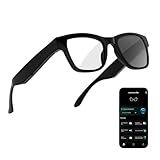
- 3-in-1 AI Glasses: Enjoy ① AI Voice Assistant (Powered by ChatGPT, Gemini & Deepseek), ② Stylish Photochromic Lenses Glasses, and ③ Bluetooth Open-Back Headphones, all in one.
- Free Talk Translation: Automatically detects and translates over 160 languages in real-time, allowing seamless work and translation without touching your phone or glasses.
- Voice, Video & Photo Translation: Supports over 98% of global languages, offering fast and accurate translations—ideal for international travel, business meetings, or cross-cultural communication.
- AI Meeting Assistant: Converts recordings from smart glasses into text and generates mind maps, making it easier to capture and organize meeting insights.
- Long Battery Life, Bluetooth 5.4 & Eye Protection: Up to 10 hours of music and 8 hours of talk time, with easy Type-C charging. Bluetooth 5.4 ensures stronger, stable connections, while photochromic lenses block UV rays and blue light, protecting your eyes in any environment.
In the broader smart glasses landscape, this hardware profile places the G2 in a distinct lane. It lacks the visual ambition of display-heavy AR glasses and the content-first appeal of camera-driven wearables, but it compensates with comfort, discretion, and coherence. As a piece of industrial design, it feels less like a statement and more like an object you’d forget you’re wearing, which may be the most important spec of all for smart glasses trying to earn a place in everyday life.
The Smart Ring Controller Explained: How It Works, Why It Exists, and How It Changes Daily Use
If the G2’s glasses are designed to disappear on your face, the smart ring exists so your hands never have to reach for the frame. Even Realities’ decision to pair smart glasses with a dedicated finger-worn controller is not a gimmick; it’s a deliberate attempt to solve one of the hardest problems in wearable AR: input that feels natural in public.
Rather than relying on voice-first interaction or awkward temple taps, the G2 shifts most control to the hand, where micro-gestures can be executed discreetly and consistently. This choice reshapes how the glasses are used throughout the day, from quick glances to extended sessions.
What the ring actually is, physically and technically
The smart ring is a lightweight, low-profile wearable designed to be worn on the index or middle finger, with a form factor closer to an Oura Ring than a chunky gesture controller. Materials appear focused on durability and skin comfort, with a smooth interior surface and a matte exterior finish that avoids drawing attention.
Internally, the ring integrates motion sensors and capacitive or pressure-based input surfaces that detect subtle finger movements and taps. It connects wirelessly to the G2 glasses with low-latency communication, prioritizing responsiveness over raw data throughput to keep interactions feeling immediate.
Battery life is tuned for daily wear rather than marathon sessions, with Even Realities positioning it as a device you charge alongside a smartwatch or earbuds. That framing matters, because it signals the ring is meant to live in an ecosystem, not operate as a standalone novelty.
How input works: gestures over spectacle-touching
In practice, the ring replaces the need to touch the glasses themselves. Simple gestures like swiping a finger, tapping, or holding a press allow users to scroll information, dismiss notifications, or cycle through views without lifting a hand to their face.
This approach solves several ergonomic and social issues at once. Touching eyewear repeatedly can feel awkward, disrupt fit, and attract attention, while mid-air gestures quickly become fatiguing and conspicuous in public.
By keeping movements small and hand-level, the G2 system encourages interactions that look like fidgeting rather than tech use. That subtlety aligns perfectly with the G2’s camera-free, low-profile philosophy and reinforces its positioning as an everyday wearable rather than a performative one.
Why a ring exists instead of relying on voice
Voice control remains an important part of the G2 experience, but Even Realities clearly does not see it as sufficient on its own. Voice input breaks down in noisy environments, feels intrusive in quiet spaces, and raises privacy concerns when used frequently in public.
The ring provides a silent, always-available fallback that works on a train, in an office, or during a meeting without broadcasting intent. It also allows faster, more precise control for tasks like navigating text, adjusting display elements, or confirming actions where voice would feel slow or clumsy.
This dual-input strategy mirrors how smartwatches evolved beyond voice-only assistants by adding crowns, bezels, and buttons. It acknowledges that no single input method works everywhere, especially on a device meant to be worn all day.
How the ring changes real-world daily use
In day-to-day wear, the ring enables quick, glanceable interactions that don’t interrupt your flow. Checking a navigation prompt, skimming a translation, or dismissing a notification becomes a one-finger action rather than a full interaction ritual.
This matters because smart glasses fail when they demand too much attention. The ring helps keep interactions brief, controlled, and intentional, reinforcing the idea that the display should surface information and then get out of the way.
It also reduces dependency on a phone as an intermediary. While the G2 still relies on a connected smartphone for data and processing, the ring makes it less necessary to pull that phone out repeatedly, which is a meaningful quality-of-life improvement rather than a headline feature.
Comfort, wearability, and long-term friction
Rings are inherently more intrusive than watches for some users, especially during typing or manual tasks. Even Realities mitigates this by keeping the ring slim and lightweight, but it will still be a personal comfort call, much like watch size or strap material.
For users already accustomed to wearing multiple wearables, such as a watch and earbuds, the ring feels like a natural extension rather than an overload. For others, it may become the deciding factor in whether the G2 fits their lifestyle.
Crucially, the ring is optional in spirit if not in design philosophy. The glasses remain usable via voice and limited on-frame controls, but the full experience clearly assumes ring adoption, which is both its strength and its risk.
How this compares to rivals like Ray-Ban Meta and Xreal
Ray-Ban Meta glasses prioritize voice and physical frame controls, leaning heavily on camera-driven use cases like capture and streaming. That makes sense for social content but results in more overt interactions and less subtle control.
Xreal and other display-focused AR glasses typically rely on handheld controllers, phones, or touchpads, which work well for seated or immersive use but feel out of place for constant, mobile wear. The smart ring splits the difference by offering dedicated input without requiring something to be held.
In that context, Even Realities’ ring is less about novelty and more about intent. It signals a belief that smart glasses will only become truly wearable when interaction is as discreet and habitual as checking the time on a watch, and the ring is the quiet enabler of that vision.
User Interface and Interaction Model: Glanceable AR, Gesture Control, and Cognitive Load
What the ring ultimately enables is a very specific interface philosophy: information should appear only when it is explicitly summoned, remain readable in a fraction of a second, and disappear just as quickly. The G2 is not trying to turn your field of view into a dashboard, and that restraint is central to how its UI feels in daily use.
Rather than persistent overlays, the glasses operate in short interaction bursts. You glance, act, and return to the real world, which is a markedly different rhythm from both phone-based AR experiments and camera-first smart glasses.
Glanceable AR instead of persistent overlays
The G2’s display model prioritizes micro-interactions over continuous augmentation. Notifications, navigation cues, translations, or contextual prompts appear briefly, typically anchored just outside the central line of sight, and are designed to be legible without demanding visual focus.
This approach mirrors how people already interact with watches: a quick check for time or information, not prolonged engagement. By borrowing that mental model, Even Realities lowers the learning curve and reduces the sense of visual intrusion that has plagued earlier smart glasses.
Just as importantly, the UI avoids visual clutter. There are no layered panels or floating app grids competing for attention, which helps keep the glasses usable while walking, commuting, or conversing.
Ring-driven gesture control as primary input
The smart ring is the backbone of this interaction model. Subtle finger movements handle scrolling, selection, dismissal, and context switching, all without reaching for the frame or speaking commands aloud.
Because the gestures are performed below the line of sight, they feel more like muscle memory than conscious action over time. This is closer to the tactile certainty of a rotating watch bezel or crown than to mid-air hand gestures, which often feel performative and imprecise.
Crucially, the ring allows for eyes-forward control. You are not breaking posture, shifting attention to a phone, or telegraphing interaction to people around you, which reinforces the G2’s emphasis on discreet, socially acceptable use.
Voice as a secondary, not dominant, interface
Voice input remains available, but it is clearly positioned as a fallback rather than the default. This is a notable departure from Ray-Ban Meta’s voice-centric design, which works well for capture but can feel awkward or noisy in public settings.
On the G2, voice is best suited for longer queries, dictation, or hands-busy scenarios. For quick interactions, the ring is faster, quieter, and more predictable, especially in environments where voice recognition struggles.
This hierarchy of inputs matters because it keeps cognitive friction low. Users are not forced to decide how to interact each time; the system nudges them toward the most efficient method for the task at hand.
Managing cognitive load in everyday use
The most understated achievement of the G2’s interface is how deliberately it manages cognitive load. By limiting the duration, density, and frequency of on-screen elements, the glasses avoid the mental fatigue associated with constant digital presence.
Rank #3

- 【AI Real-Time Translation & ChatGPT Assistant】AI glasses break language barriers instantly with AI real-time translation. The built-in ChatGPT voice assistant helps you communicate, learn, and handle travel or business conversations smoothly—ideal for conferences, overseas trips, and daily use.
- 【4K Video Recording & Photo Capture 】Smart glasses with camera let you capture your world from a first-person view with the built-in 4K camera. Take photos and record videos hands-free anytime—perfect for travel moments, vlogging, outdoor adventures, and work documentation.
- 【Bluetooth Music & Hands-Free Calls 】Camera glasses provide Bluetooth music and crystal-clear hands-free calls with an open-ear design. Stay aware of your surroundings while listening—comfortable for long wear and safer for commuting, cycling, and outdoor use.
- 【IP65 Waterproof & Long Battery Life】 Recording glasses are designed for daily wear with IP65 waterproof protection against sweat, rain, and dust. The built-in 290mAh battery provides reliable performance for workdays and travel—no anxiety when you’re on the go.
- 【Smart App Control & Object Recognition】Smart glasses connect to the companion app for easy setup, file management, and feature control. They support AI object recognition to help identify items and improve your daily efficiency—perfect for travel exploration and a smart lifestyle.
There is a clear sense that the system was designed around interruption control rather than maximum information throughput. Notifications are filtered and summarized, not mirrored wholesale from the phone, which prevents the glasses from becoming a second, more intrusive screen.
Over long periods of wear, this restraint becomes the difference between a device that feels assistive and one that feels exhausting. It is a design choice that prioritizes longevity of use over short-term wow factor.
Learning curve and habit formation
For new users, the ring-plus-glasses combo requires an adjustment period. Gestures must be learned, and the idea of controlling visual output without looking directly at a device is unfamiliar at first.
However, once those gestures become habitual, interaction speed improves dramatically. Much like mastering a watch clasp or a rotating bezel, the payoff comes with repetition, not instant gratification.
This makes the G2 better suited to users willing to invest time in forming new habits. Casual or sporadic users may never fully unlock its advantages, which reinforces its positioning as a tool for daily wear rather than occasional novelty.
Positioning against rivals in interface philosophy
Compared to Ray-Ban Meta, the G2 feels quieter and more inward-facing. Where Meta emphasizes outward capture and sharing, Even Realities focuses on personal information flow and subtle augmentation.
Against display-focused players like Xreal, the difference is even starker. Xreal’s interfaces assume seated use and longer sessions, often tethered to external controllers or phones, while the G2 assumes movement, interruption, and constant context switching.
In that sense, the G2’s UI is less about showing what AR can do and more about proving how little it needs to do to be useful. The ring is not just an input device; it is the mechanism that keeps the entire system lightweight, intentional, and mentally sustainable.
Battery Life, Charging, and Wearability Trade-Offs: Glasses vs Ring vs Phone
All of the G2’s interface restraint ultimately funnels into a more practical question: where does the power go, and how often do you have to think about charging? Even Realities’ decision to split interaction across glasses, ring, and phone isn’t just about ergonomics or UI philosophy; it is a deliberate battery strategy.
Instead of asking one device to do everything, the system spreads energy demands across three smaller batteries, each optimized for a specific role. The result is not headline-grabbing endurance on paper, but a setup that better matches how the glasses are actually used throughout the day.
Glasses battery: designed for endurance, not spectacle
The G2 glasses themselves carry the heaviest technical load: micro-displays, sensors, wireless connectivity, and constant context awareness. Even so, their projected real-world battery life aligns more with a full working day of intermittent use than with continuous AR sessions.
That distinction matters. Unlike display-heavy competitors that assume seated, tethered use, the G2 is built around short glances, filtered notifications, and brief information checks, which dramatically lowers average power draw.
In practical terms, this means the glasses are less about “hours of screen-on time” and more about surviving a long day of wear without forcing the user to ration interactions. It’s a familiar trade-off to smartwatch users, where battery longevity is shaped as much by usage style as by raw capacity.
The smart ring as a battery pressure valve
Offloading input to the smart ring does more than improve interaction subtlety; it meaningfully reduces how often the glasses need to wake displays or process gestures. The ring’s battery requirements are modest by comparison, supporting days rather than hours of use depending on interaction frequency.
Because the ring handles gesture detection locally, the glasses can remain in a lower-power standby state until input is intentional. This separation mirrors the logic behind mechanical watch complications: distribute function across components so no single system is overburdened.
The downside, of course, is another device to charge. But the upside is that the ring’s charging cadence is slow enough that it fades into the background, much like topping up a fitness tracker rather than a phone.
Charging routines and real-world friction
Charging friction is where multi-device ecosystems often stumble, and the G2 is no exception. Glasses, ring, and phone each have their own charging needs, and there is no escaping the cognitive load of managing three batteries instead of one.
However, the system avoids worst-case scenarios. The glasses are not rendered useless if the ring runs flat, and the ring does not become dead weight if the glasses are charging. Each component degrades gracefully, preserving core functionality rather than collapsing entirely.
For users already accustomed to juggling a smartwatch, wireless earbuds, and a phone, this will feel familiar rather than alarming. For minimalists, it may be the most compelling argument against daily wear.
Weight, balance, and long-term comfort
Battery placement directly affects wearability, and here the G2 shows a clear understanding of eyewear ergonomics. By keeping battery mass distributed along the arms rather than concentrated at the front, the glasses avoid the nose-heavy fatigue that plagues many early smart glasses.
The result is closer to wearing a well-balanced pair of acetate or lightweight metal frames than a gadget strapped to the face. Over hours, this matters more than shaving a few grams off the total weight.
The ring, meanwhile, is small enough to disappear during use, but substantial enough to avoid feeling disposable. Like a well-sized watch case, it signals permanence rather than novelty.
Phone dependency and the invisible battery anchor
The phone remains the system’s silent partner, handling heavy computation, connectivity, and data synchronization. This shifts the largest battery burden to a device users already charge daily, reducing the need for oversized batteries in the glasses themselves.
There is a philosophical trade-off here. The G2 is not an independent computer in the way some AR purists might want, but it is also not pretending to be something it isn’t.
In exchange, Even Realities achieves a balance where glasses stay light, ring interactions stay efficient, and the phone absorbs the energy cost that would otherwise compromise comfort. It’s less futuristic in isolation, but far more livable as a system.
Software, Apps, and Ecosystem: Phone Dependency, OS Approach, and Third-Party Potential
If the hardware strategy is about distributing weight and batteries sensibly, the software strategy is about distributing intelligence. Even Realities’ G2 does not try to replace the smartphone; it deliberately leans on it, shaping the entire software experience around a companion-first model rather than an on-device OS arms race.
A phone-first architecture, by design
At the core of the G2 experience is a companion app that functions as both control center and computational hub. Core tasks like connectivity, data processing, cloud sync, and AI-assisted features are handled on the phone, with the glasses acting as a low-latency display layer and the ring as an input surface.
In daily use, this feels closer to how smartwatches originally positioned themselves than to standalone AR headsets. Notifications, navigation prompts, translations, reminders, and glanceable widgets are pushed from the phone to the glasses rather than generated locally.
The upside is predictability. Performance is tied to the phone you already trust, battery life is easier to manage, and updates can roll out without touching firmware as often. The downside is obvious too: without a phone nearby, the G2’s intelligence contracts significantly, leaving it more like an advanced HUD than a computing platform.
A lightweight OS approach, not a wearable Android clone
Even Realities has avoided the temptation to build a full wearable operating system in the image of Android XR or visionOS. Instead, the G2 runs a tightly scoped system focused on rendering information efficiently, managing inputs from the ring, and maintaining stable connections with the phone.
This means no traditional app launcher floating in your field of view and no attempt to recreate phone paradigms in mid-air. Interactions are contextual, surfaced when relevant, and dismissed just as quickly, which suits glasses better than persistent UI layers.
Compared to Ray-Ban Meta, which emphasizes voice-first interaction and background AI capture, the G2’s software feels more intentional and controllable. Compared to Xreal, which leans into virtual screens and spatial computing, Even Realities is clearly targeting everyday augmentation rather than immersive workspaces.
Ring-driven interaction as a software philosophy
The smart ring is not just a hardware accessory; it shapes how the software behaves. Scrolling, selection, confirmation, and dismissal are all designed around subtle finger movements rather than head gestures or constant voice commands.
Rank #4

- 【8MPW Camera & 1080P Video and Audio】:These camera glasses feature an 800W camera that outputs sharp 20MP photos and smooth 1080P 30fps videos. Ultra-Clear Video + Powerful Anti-Shake tech+ Built-in dual microphones, you can capture crystal-clear video and audio together -sharply restoring details, perfect for vlogging, travel, and everyday moments
- 【Real-time AI translation Smart Glasses with Camera】:Instantly translate multiple major languages, breaking down language barriers in an instant—no phone required. Ideal for office settings, travel, academic exchanges, international conferences, watching foreign videos, and more
- 【Voice Assistant Recognition and Announcement】:Powered by industry-leading AI large models such as Doubao AI and OpenAI's GPT-4.0. AI voice wake-up lets you ask questions, recognize objects, and get answers on the go. Automatically recognizes objects, menus, landmarks, plants, and more, quickly analyzing the results and announcing them in real time. It instantly becomes your mobile encyclopedia on the go
- 【Bluetooth 5.3 Connection and Automatic Sync to Phone】:Equipped with a low-power BT5.3 chip and Wi-Fi dual transmission technology, offering ultra-low power and high-speed transmission. Captured images and videos are transferred to your phone in real time, eliminating manual export and eliminating storage worries
- 【290mAh Ultra-Long Battery Life】:Ultra-light at 42g, it's made of a durable, skin-friendly material, as light as a feather. Lenses are removable. Its simple, versatile design makes it a comfortable and comfortable wearer. 290mAh ultra-long battery life, 12 hours of music playback and 2 hours of photo or video recording, making it a perfect travel companion
This has implications for app design. Interfaces must be linear, glanceable, and tolerant of minimal input, closer to a watch complication than a phone app. In practice, this makes the system quieter and more socially acceptable, particularly in public settings where voice input feels intrusive.
It also reduces cognitive load. Instead of learning gesture vocabularies or navigating layered menus, users interact with information streams that respond predictably to a small set of inputs, which aligns well with the glasses’ all-day wear ambitions.
Current app scope: practical, not playful
At launch, the G2’s software ecosystem is intentionally narrow. Core functions center on notifications, navigation cues, translations, basic productivity tools, and contextual information overlays tied to phone apps.
There is little emphasis on entertainment or novelty experiences, which differentiates it sharply from earlier smart glasses experiments that chased demos over durability. The focus is on features that earn their place in daily routines, even if that means fewer headline-grabbing use cases.
For smartwatch users, this will feel familiar. The G2 behaves less like a new device category and more like an extension of existing workflows, prioritizing usefulness over spectacle.
Third-party potential and the open question
Where the G2 becomes more speculative is third-party development. Even Realities has signaled interest in opening APIs for notifications, contextual data, and ring-based input, but this is not yet a mature developer ecosystem.
If handled well, this could be where the platform differentiates itself. Lightweight, glance-based extensions of existing apps—messaging, fitness cues, travel alerts, enterprise workflows—fit the hardware’s strengths far better than fully custom AR experiences.
If handled poorly, the system risks stagnation, locked into a small set of first-party features while competitors with deeper software benches iterate faster. For now, the G2 sits in a middle ground: promising in structure, unproven in scale.
Positioning within the wider smart glasses landscape
Taken as a whole, the software strategy reinforces Even Realities’ broader thesis. This is not an attempt to win the platform war outright, but to build a livable, wearable system that respects the constraints of faces, fingers, and daily habits.
Against Ray-Ban Meta, the G2 trades AI spectacle and social capture for precision and control. Against Xreal, it sacrifices immersive visuals for comfort and permanence. Whether that trade-off resonates will depend less on specs and more on how seamlessly the software fades into daily life.
The G2’s ecosystem is still young, but its restraint feels intentional rather than underdeveloped. In a category that has often failed by trying to do too much too soon, that may be its most quietly radical choice.
Real-World Use Cases: Navigation, Notifications, Translation, and Subtle Everyday AR
The G2’s restraint starts to make sense once you imagine wearing it outside a demo environment. Rather than asking users to change behavior, the system is designed to sit quietly alongside routines that already exist, surfacing information only when it is genuinely useful and disappearing just as quickly.
This is where the pairing of glasses and smart ring matters most. The glasses handle output, while the ring becomes the primary way of interacting without raising a hand to your face or pulling out a phone.
Navigation that stays out of your way
Navigation is one of the most immediately practical uses for the G2, and also one of the easiest to get wrong in smart glasses. Even Realities avoids full map overlays or persistent turn-by-turn visuals, opting instead for directional cues, distance indicators, and brief prompts that appear only when needed.
In practice, this feels closer to a smartwatch haptic tap than a heads-up display demanding attention. A subtle arrow or street name appears near the edge of your vision, then fades, letting you keep your eyes on the environment rather than the interface.
The ring controller plays a quiet but important role here. A small rotation or tap can confirm a route, cycle between upcoming turns, or dismiss guidance entirely, all without breaking stride or looking conspicuous in public.
Notifications as glances, not interruptions
Notifications on the G2 are clearly modeled after the best smartwatch conventions. Messages, calendar alerts, and call notifications arrive as brief text snippets, positioned to be readable at a glance but not persistent enough to dominate your field of view.
Unlike voice-driven systems, the G2 does not force verbal interaction in public. You can scroll or dismiss notifications using the ring, allowing for one-handed, pocket-level control that feels more socially acceptable than mid-air gestures.
For smartwatch users, this will feel immediately familiar, with one key difference. The information sits closer to natural eye movement, reducing the constant wrist-raising that defines smartwatch checking, particularly while walking or carrying something.
Translation that prioritizes speed over spectacle
Real-time translation is another area where Even Realities favors utility over visual flair. Instead of full captions floating across your view, the G2 presents short translated phrases or keywords, enough to understand intent without overwhelming the display.
This approach works best for travel scenarios like ordering food, reading signs, or catching key points in conversation. It is not designed to replace fluent understanding, but to bridge gaps quickly and quietly.
The ring again proves useful here, letting you trigger translation mode, switch languages, or pause output without fumbling through menus. That tactile control matters when context changes quickly and attention is already split.
Subtle everyday AR rather than persistent overlays
Beyond headline features, the G2’s most interesting use cases live in small, repeatable moments. Timers, reminders, fitness cues, or contextual prompts can appear briefly, then vanish, reinforcing behavior without creating dependency.
This is where the system’s limited field of view becomes an advantage rather than a constraint. By keeping AR elements minimal and peripheral, the glasses avoid the fatigue and cognitive load that have plagued earlier smart glasses attempts.
The experience feels closer to ambient computing than augmented reality in the traditional sense. Information is present when useful, absent when not, and rarely asks the user to engage for more than a second or two.
The smart ring as the missing interaction layer
The smart ring is not just an accessory; it is foundational to how these use cases work in real life. Its low-profile form factor allows for constant wear without the bulk or visual statement of a smartwatch, and its tactile inputs are easier to execute reliably than touch-sensitive frames.
From a comfort and wearability standpoint, this division of labor makes sense. The glasses remain lightweight and balanced, while the ring absorbs most interaction demands, reducing smudges, accidental inputs, and social awkwardness.
This separation also hints at scalability. As software evolves, new functions can be layered onto the ring’s inputs without redesigning the glasses themselves, giving Even Realities room to iterate without compromising the core wear experience.
Competitive Positioning: Even G2 vs Ray-Ban Meta, Xreal, and the Broader Smart Glasses Field
Viewed through the lens of interaction design, the G2’s ring-first control model immediately sets it apart. Where many smart glasses still lean on voice, touch-sensitive temples, or phone dependency, Even Realities is betting that offloading interaction to a separate, tactile wearable produces a calmer and more reliable daily experience.
That choice reshapes how the G2 should be compared to its peers. It is not trying to be a camera-first social device or a portable cinema, but a low-friction information layer that quietly augments everyday routines.
Even G2 vs Ray-Ban Meta: ambient utility versus social capture
Ray-Ban Meta smart glasses are optimized around cameras, microphones, and cloud AI. Their strength is hands-free photo and video capture, voice-driven queries, and passive listening, with the glasses acting as a visible extension of Meta’s ecosystem.
The Even G2 moves in the opposite direction. There is no emphasis on outward-facing cameras or social sharing, and the display is inward, private, and ephemeral, designed for the wearer rather than the audience around them.
In real-world use, this changes the social contract. Ray-Ban Meta glasses invite questions about recording and privacy, while the G2’s minimal optics and lack of obvious capture hardware make it easier to wear continuously without drawing attention.
💰 Best Value

- #1 SELLING AI GLASSES - Move effortlessly through life with Ray-Ban Meta glasses. Capture photos and videos, listen to music, make hands-free calls or ask Meta AI* questions on-the-go. Ray-Ban Meta glasses deliver a slim, comfortable fit for both men and women.
- CAPTURE WHAT YOU SEE AND HEAR HANDS-FREE - Capture exactly what you see and hear with an ultra-wide 12 MP camera and a five-mic system. Livestream it on Facebook and Instagram.
- LISTEN WITH OPEN-EAR AUDIO — Listen to music and more with discreet open-ear speakers that deliver rich, quality audio without blocking conversations or the ambient noises around you.
- GET REAL-TIME ANSWERS FROM META AI — The Meta AI* built into Ray-Ban Meta’s wearable technology helps you flow through your day. When activated, it can analyze your surroundings and provide context-rich suggestions - all from your smart AI glasses.
- CALL AND MESSAGE HANDS-FREE — Take calls, text friends or join work meetings via bluetooth straight from your glasses.
Interaction is another dividing line. Meta’s glasses depend heavily on voice commands and touch gestures along the frame, both of which can feel unreliable in noisy environments or awkward in public. The G2’s ring allows silent, one-handed control without lifting a finger to your face, which better suits quick translations, subtle prompts, or discreet notifications.
Battery priorities follow those philosophies. Ray-Ban Meta allocates power toward cameras, audio, and always-on connectivity, while the G2’s display-first approach, paired with the ring handling input, is optimized for brief, low-energy visual bursts rather than constant engagement.
Even G2 vs Xreal: lightweight AR assistance versus immersive display hardware
Xreal’s glasses, like the Air series, are fundamentally display devices. They function as wearable external monitors for phones, handheld consoles, or laptops, delivering large virtual screens with high refresh rates and immersive visuals.
The G2 is not competing in that space at all. Its field of view is intentionally narrow, its resolution is tuned for legibility rather than immersion, and its content appears briefly before disappearing.
This makes the Xreal experience closer to a head-mounted display, something you put on with intent to watch, play, or work. The G2, by contrast, is meant to be worn passively throughout the day, surfacing information only when needed.
Control systems reinforce this split. Xreal relies on external devices and head tracking for navigation, which works well for media consumption but ties usage to specific contexts. The G2’s ring enables glanceable interactions while walking, commuting, or mid-conversation, where pulling out a phone or focusing on a large virtual screen would break flow.
Comfort and ergonomics also diverge. Xreal glasses prioritize optics and display size, often at the cost of all-day wearability. The G2’s lighter build and division of labor with the ring reduce face pressure and interaction fatigue, aligning with its ambient computing goal.
Positioning within the broader smart glasses landscape
Across the wider market, most smart glasses fall into one of three categories: camera-first lifestyle wearables, immersive display viewers, or experimental developer platforms. The G2 sits uncomfortably in none of these, which is both its risk and its defining strength.
Its closest conceptual peers are earlier notification-driven glasses that promised subtle AR but struggled with clumsy controls, limited battery life, or intrusive designs. By pairing the glasses with a dedicated ring, Even Realities addresses one of the most persistent usability failures in this category: how to interact without breaking social norms.
The modularity of the system also matters strategically. Decoupling interaction from the glasses themselves allows future iterations to evolve software, gestures, or even input hardware without redesigning the optical core. That is a more scalable approach than cramming microphones, touch panels, and sensors into increasingly crowded frames.
Compatibility plays a role here as well. The G2’s reliance on a companion phone and ring positions it as an ecosystem product rather than a standalone computer, which lowers hardware ambition but increases reliability and battery predictability in daily use.
Who the G2 is actually for
In competitive terms, the G2 is not aimed at content creators, AR gamers, or users looking for a replacement screen. It targets people already comfortable with wearables who want faster access to information without escalating screen time.
Smartwatch users are a particularly relevant audience. Many of the G2’s functions mirror smartwatch notifications, timers, or navigation cues, but move them into the user’s line of sight while freeing the wrist and phone from constant checking.
The ring becomes the differentiator here. It offers the immediacy of a physical button with the discretion of a hidden interface, something neither Ray-Ban Meta nor Xreal meaningfully address.
In that sense, the G2 occupies a narrow but coherent niche. It treats smart glasses not as a spectacle or a display upgrade, but as a quiet extension of existing wearable habits, designed to fit into daily life rather than redefine it.
Early Verdict: Is the G2 and Ring Combo a Meaningful Step Toward Practical AR or Still a Niche Play?
Viewed in context, the G2 feels less like a moonshot and more like a careful correction. Even Realities is not trying to wow with holograms or spatial computing theatrics, but to solve the mundane friction points that have quietly killed many smart glasses before it.
That restraint shapes the early verdict. The G2 and ring combo does not redefine AR, but it does make a credible case for why lightweight, notification-first glasses might finally earn a place alongside smartwatches rather than compete with them.
Why the ring changes the equation
The ring is not a gimmick add-on; it is the product’s most consequential design decision. By offloading interaction to a tactile, always-available controller, Even Realities sidesteps the awkwardness of frame tapping, voice commands in public, or mid-air gestures that never quite feel natural.
In daily use terms, this matters more than display resolution or field of view. A subtle thumb movement on a ring is faster, more private, and more reliable than most alternatives, especially when the goal is glancing at directions, triaging notifications, or controlling simple UI elements without drawing attention.
It also mirrors the success pattern of other wearables. Just as physical crowns and buttons remain essential on smartwatches despite touchscreens, the ring acknowledges that frictionless input still benefits from something you can feel.
Practical AR, narrowly defined
If your definition of AR involves immersive overlays or spatial anchoring, the G2 will feel underwhelming. Its display use is intentionally constrained, prioritizing legibility, comfort, and battery life over visual ambition.
But within its chosen lane, the experience is coherent. Navigation cues in your line of sight, short-form notifications, timers, and prompts work precisely because they do not ask the user to linger or engage deeply.
That makes the G2 closer in spirit to an always-on HUD than a wearable screen. It is information as punctuation, not as content, which aligns well with real-world usage patterns rather than demo-stage fantasies.
How it stacks up against Ray-Ban Meta and Xreal
Compared to Ray-Ban Meta, the G2 trades camera-first functionality and social sharing for personal utility. There is no aspiration to capture life moments; the emphasis is on consuming information discreetly, with fewer privacy and social friction concerns.
Against Xreal-style display glasses, the contrast is even sharper. Xreal aims to extend your phone or laptop into a floating screen, often at the cost of portability and setup complexity, while the G2 deliberately avoids becoming a screen replacement at all.
In that sense, Even Realities is not chasing the same buyers. It is targeting users who already understand the limits of current AR hardware and are willing to accept less spectacle in exchange for something they might actually wear every day.
Still niche, but for the right reasons
The G2 is undeniably niche, but it is a focused niche rather than an accidental one. You have to be comfortable wearing glasses, willing to adopt a ring, and content with a supporting role rather than a standalone device.
Yet that narrowness is also its strength. By designing around realistic expectations, Even Realities avoids the overpromising that has plagued smart glasses for a decade.
The system will not convert skeptics overnight, but it does offer a compelling upgrade path for smartwatch users who want faster, more glanceable access to information without adding another screen to check.
The early takeaway
As an early statement, the G2 and ring combo feels like a meaningful step toward practical AR, provided we accept that “practical” means modest, complementary, and socially aware. It advances the category not through breakthrough optics, but through better interaction design and ecosystem thinking.
For now, it remains a product for enthusiasts who value subtlety over spectacle. But if smart glasses are ever going to break out of novelty status, they will likely look a lot more like this than the sci-fi visions that came before it.