James Park and Eric Friedman are no strangers to building technology that quietly reshapes daily life. At Fitbit, they helped normalize the idea that passive, always-on sensors could translate human behavior into actionable health insight, starting with steps and sleep and eventually expanding into heart rate, recovery, and long-term wellness trends. With Luffu, they are turning that same systems-level thinking toward a far more emotionally complex and underserved problem: the invisible load carried by family caregivers.
Caregiving today sits at an uncomfortable intersection of modern life. Families are living longer, chronic conditions are more common, and care responsibilities are increasingly managed by adult children balancing jobs, distance, and burnout rather than by centralized healthcare systems. Park and Friedman are stepping into this gap at a moment when consumer health technology has matured enough to move beyond self-optimization and toward shared care, coordination, and emotional support.
A personal problem hiding in plain sight
Unlike the early days of Fitbit, where the challenge was motivating individuals to move more, caregiving is defined by fragmentation and isolation. Information is scattered across calendars, text threads, medical portals, and sticky notes, while the emotional weight often goes unacknowledged by technology altogether. Luffu’s origin reflects a recognition that caregiving is not a niche use case but a near-universal life phase that most digital health platforms have treated as secondary or invisible.
For Park and Friedman, this represents both a personal and structural inflection point. As founders who spent over a decade translating raw sensor data into meaningful narratives about health, they now appear focused on translating human coordination, empathy, and responsibility into software that reduces friction rather than adds another dashboard to manage. The move signals an understanding that the next frontier of digital health is not more data, but better support around life transitions.
🏆 #1 Best Overall
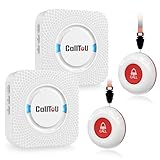
- [ Wireless Guard ] 2 Receiver 2 Call Button. Allow caregivers and residents to be free while ensuring that help is still available at the touch of a button, ideal for elderly, seniors, patients, disabled
- [ Easy to Carry ] The receiver can be moved with the caregiver and the open area working range is 500+ ft, you can take it to the bedroom, kitchen or living area(receiver requires plugging into an outlet). The call button can also be hung around the neck of the person with a neck strap who needs help like a pendant or secured with a bracket or double sticker
- [ Smart Ringtones ] The receiver of caregiver pager has 55 ringing tones to choose from and 5 level adjustable volume from 0db to 110db. Easy use by plug the receiver into an electrical outlet
- [ High Quality ] Both call button and receiver are waterproof and dustproof. Whether you install it in the washroom or take it outside on a rainy day, you don't have to worry about this caregiver pager getting wet
- [ Dont Hesite to Order ] The sophisticated packaging helps you keep the pager secure without worrying about losing it. If you have any questions, you can check the included user manual, and 24 hours customer services and professional technology team are standing by
Why caregiving fits the post-Fitbit thesis
Fitbit’s long arc, especially leading up to its acquisition and integration into Google’s health ecosystem, exposed both the power and limits of wearables. Devices became excellent at measuring the individual body, yet far less capable of supporting shared decision-making or collective care. Luffu’s direction suggests Park and Friedman are deliberately stepping away from sensor-first thinking toward relationship-first design, where the unit of value is the family or care circle, not the individual user.
This is a notable philosophical shift. Rather than asking what can be tracked, Luffu starts by asking what caregivers actually struggle with day to day: remembering tasks, coordinating responsibilities, communicating changes, and feeling seen. It positions itself less like a wearable companion and more like a connective tissue layer that sits above devices, services, and people, integrating into daily life without demanding constant attention.
Timing the shift from fitness to care infrastructure
The launch of Luffu also reflects broader market timing. Consumer health technology is facing saturation in fitness and recovery metrics, while caregivers represent a massive, underserved population with high willingness to engage if tools genuinely reduce stress. Advances in cloud platforms, mobile UX, and interoperability now make it feasible to build caregiving software that feels lightweight rather than clinical.
For industry watchers, this move underscores a larger signal: the center of gravity in digital health is shifting from performance optimization to life support systems. Park and Friedman’s credibility gives Luffu immediate weight, but the real significance lies in what it represents for the category. If caregiving becomes a core design pillar for future health platforms, it could redefine what “consumer health tech” means in a world aging faster than its systems are prepared for.
What Is Luffu? Core Mission, Philosophy, and the Caregiving Problem It Aims to Solve
Seen in the context of that broader shift from performance metrics to life infrastructure, Luffu is best understood not as a gadget or a single-purpose app, but as an attempt to reframe caregiving as a shared system that deserves modern product thinking. Park and Friedman are applying lessons learned from building one of the world’s most widely adopted health platforms to a problem that is emotionally heavy, operationally complex, and largely invisible in consumer tech.
At its core, Luffu is designed to reduce the cognitive and emotional load placed on family caregivers by making care coordination simpler, clearer, and more humane. Instead of optimizing the body, it aims to support the people surrounding the body.
A relationship-first definition of caregiving
Luffu starts from a different premise than most digital health tools. Rather than treating caregiving as a set of medical tasks or compliance checkpoints, it frames care as an ongoing relationship between parents, children, partners, siblings, and friends.
This perspective matters because most family caregiving happens outside formal healthcare settings. It lives in calendars, text threads, mental notes, and quiet anxiety about what might be forgotten. Luffu’s mission is to surface that invisible work and give it structure without stripping away its humanity.
The problem: fragmented care, invisible labor, constant mental load
Family caregivers are often juggling medication schedules, appointments, daily check-ins, changing needs, and coordination across multiple people. Existing tools tend to address only slices of this reality, such as medical portals, reminder apps, or disease-specific platforms, leaving caregivers to stitch everything together themselves.
The result is fragmentation. Information lives in too many places, responsibility is unclear, and the emotional burden falls disproportionately on one person, usually without recognition. Luffu is targeting this gap by focusing on shared awareness and shared responsibility, not just task completion.
How Luffu differs from wearables and traditional health apps
Unlike fitness trackers or health monitoring devices, Luffu does not appear to be sensor-led. There is no emphasis on heart rate, steps, or sleep scores as the primary value proposition. Instead, the platform is positioned as a connective layer that can sit above devices, services, and people.
This is a notable departure from the Fitbit playbook. Where wearables quantify the individual, Luffu is built around coordination, communication, and context. Its success depends less on hardware accuracy or battery life and more on whether it fits naturally into daily routines without demanding constant interaction.
Designing for daily usability, not clinical intensity
Early signals around Luffu suggest a deliberate effort to avoid the clinical feel that often alienates families from health tools. The philosophy emphasizes lightweight interaction, clarity, and emotional sensitivity rather than dashboards overloaded with data.
This aligns with what Park and Friedman learned scaling Fitbit globally: products only change behavior if they are comfortable to live with. In caregiving, comfort is not about wrist ergonomics or materials, but about emotional friction, trust, and whether a tool makes life feel simpler instead of heavier.
A platform mindset rooted in Fitbit’s legacy
While Luffu is not a wearable, it carries clear DNA from Fitbit’s platform evolution. Fitbit succeeded not just because of hardware, but because it built habits, social reinforcement, and long-term engagement around health behaviors.
Luffu appears to be applying that same systems thinking to caregiving. The goal is not to replace doctors, home care services, or devices, but to act as a unifying layer that helps families stay aligned as needs evolve over months or years.
Why this mission resonates now
Demographic pressure is making family caregiving unavoidable for a growing portion of the population. People are living longer, often with chronic conditions, while families are more geographically dispersed and time-constrained than ever.
Luffu’s mission speaks directly to this reality. By treating caregiving as a first-class use case for consumer health technology, it signals a future where digital health is measured not only by how well it tracks bodies, but by how well it supports the relationships that keep those bodies safe, dignified, and cared for.
How Luffu Works: Platform Design, Key Features, and Real-World Caregiving Use Cases
Seen through the lens of Fitbit’s platform-era thinking, Luffu functions as a coordination layer rather than a destination app. It is designed to sit quietly alongside daily life, surfacing just enough structure and context to keep caregivers aligned without demanding constant attention.
The emphasis is not on tracking more data, but on reducing ambiguity. In caregiving, uncertainty is often the biggest source of stress, and Luffu’s design aims to replace that uncertainty with shared awareness.
A shared caregiving space built around people, not metrics
At the core of Luffu is a shared care circle that brings family members, trusted friends, and other helpers into a single, permissioned space. Each participant has a clear view of who is involved, what roles they play, and how responsibilities are distributed.
This mirrors the social scaffolding that made Fitbit’s early community features effective. Instead of leaderboards or step counts, the shared object here is care itself, framed in human terms rather than numerical ones.
Task coordination without the project-management feel
Luffu’s task system is intentionally lightweight, avoiding the rigidity of traditional to-do or caregiving management tools. Tasks can represent everything from medication pickups to check-in calls or transportation to appointments.
What matters is not just that tasks exist, but that their status is visible to everyone who needs to know. That visibility reduces duplication, prevents missed handoffs, and removes the awkwardness of asking whether something has already been handled.
Contextual updates that replace constant messaging
Rather than pushing caregivers into endless group chats, Luffu centers updates around context. Notes, status changes, and observations are tied to the care recipient and their day-to-day needs, not buried in message threads.
This creates a passive awareness loop. Caregivers can check in when they have time, see what has changed, and understand the situation without starting from zero each time.
Designed for asynchronous caregiving across distances
Luffu appears especially well suited for families spread across cities or time zones. The platform assumes that not everyone is available at the same time, and that caregiving often happens in short windows between work, parenting, and other obligations.
By making care information persistent and structured, Luffu reduces the need for real-time coordination. That design choice reflects a deep understanding of modern family dynamics rather than idealized, always-available support networks.
Emotional sensitivity as a product feature
One of the more subtle aspects of Luffu’s design is its emotional tone. Language, prompts, and interactions are framed to support caregivers rather than judge them, avoiding the guilt-inducing patterns common in productivity or health apps.
This is where Luffu most clearly diverges from traditional digital health tools. Success is not defined by compliance or completion rates, but by whether caregivers feel more supported and less alone.
Privacy and trust as foundational infrastructure
Caregiving involves deeply personal information, and Luffu treats access control as a core feature rather than an afterthought. Different caregivers can have different levels of visibility, ensuring sensitive details are shared only with those who need them.
This trust-centric model echoes lessons learned from managing health data at scale. Adoption depends not just on functionality, but on confidence that the platform respects boundaries and family dynamics.
Rank #2

- [ Wireless Guard ] 3 Receiver 2 Call Button. Allow caregivers and residents to be free while ensuring that help is still available at the touch of a button, ideal for elderly, seniors, patients, disabled
- [ Easy to Carry ] The receiver can be moved with the caregiver and the open area working range is 500+ ft, you can take it to the bedroom, kitchen or living area(receiver requires plugging into an outlet). The call button can also be hung around the neck of the person with a neck strap who needs help like a pendant or secured with a bracket or double sticker
- [ Smart Ringtones ] The receiver of caregiver pager has 55 ringing tones to choose from and 5 level adjustable volume from 0db to 110db. Easy use by plug the receiver into an electrical outlet
- [ High Quality ] Both call button and receiver are waterproof and dustproof. Whether you install it in the washroom or take it outside on a rainy day, you don't have to worry about this caregiver pager getting wet
- [ Dont Hesite to Order ] The sophisticated packaging helps you keep the pager secure without worrying about losing it. If you have any questions, you can check the included user manual, and 24 hours customer services and professional technology team are standing by
Compatibility with the broader health ecosystem
While Luffu is not a wearable or medical device, it is designed to coexist with them. The platform’s value increases when it complements existing tools like calendars, reminders, or health services rather than trying to replace them.
This positions Luffu as connective tissue in the caregiving ecosystem. It translates fragmented inputs into shared understanding, which is often more valuable than additional data streams.
Real-world use case: coordinating care for an aging parent
In a typical scenario, siblings living in different cities use Luffu to coordinate care for an aging parent. One handles appointments, another manages finances, while a third focuses on regular check-ins and emotional support.
Luffu provides a single place where these roles are visible and evolving needs are documented. The result is fewer misunderstandings and less emotional labor spent on alignment.
Real-world use case: supporting recovery after illness or surgery
During short-term recovery periods, caregiving intensity spikes and coordination becomes critical. Luffu can act as a temporary command center, tracking who is helping on which days and what support is still needed.
Once recovery stabilizes, the platform does not force continued high engagement. It naturally recedes into the background, aligning with Luffu’s philosophy of low-friction, situational use.
Real-world use case: long-term chronic condition management
For families supporting someone with a chronic condition, Luffu supports continuity over months or years. Observations, routines, and preferences accumulate into shared knowledge that does not disappear when one caregiver steps back.
This long-view approach reflects Fitbit’s legacy of sustained engagement. The platform is designed not for bursts of attention, but for the slow, uneven rhythms of real caregiving life.
Beyond Wearables: How Luffu Differs from Fitbit, Health Trackers, and Traditional Care Apps
Seen in the context of the real-world scenarios above, Luffu’s most defining trait is what it deliberately does not try to be. It is neither a sensor-driven health tracker nor a clinical care platform, and that distinction is central to understanding why its launch matters.
Where Fitbit and its peers optimized for individual behavior change through data, Luffu is built around shared responsibility, emotional context, and coordination across people.
From quantified self to shared context
Wearables like Fitbit, Apple Watch, and Garmin excel at capturing continuous streams of physiological and activity data. Heart rate, sleep stages, step counts, and trends over time are their native language, optimized for dashboards, goals, and personal insight.
Luffu operates almost entirely upstream of that data. Instead of asking “what does the body say today,” it asks “what does this person need, and who is supporting them right now.”
This shift reflects a core insight from caregiving: numbers rarely resolve uncertainty between family members. Context, expectations, and clarity of roles do.
No hardware dependency, by design
Unlike Fitbit, Luffu does not require a device on someone’s wrist, a battery to charge, or sensors to trust. That makes it accessible to care recipients who may resist wearables due to comfort, cognitive load, or stigma.
This hardware-free approach also sidesteps common friction points in older populations, including skin sensitivity, limited dexterity, or inconsistent charging habits. In practice, that can determine whether a tool is actually used.
For caregivers, it means Luffu fits into daily life without adding another thing to manage.
Complementing health data rather than competing with it
Traditional health trackers focus on collecting more data and surfacing insights from it. Caregiving platforms, by contrast, often try to centralize medical records, medications, and provider communication.
Luffu occupies a different layer. It can coexist with Fitbit data, electronic health records, and calendar-based reminders, without attempting to ingest or interpret them directly.
This allows Luffu to remain lightweight while still benefiting from the broader health ecosystem. The value comes from alignment, not aggregation.
Designed for family dynamics, not compliance
Many traditional care apps are built with clinical workflows in mind. They emphasize task completion, adherence, and documentation, often mirroring professional care environments.
Luffu is tuned for family systems, where emotional labor, uneven availability, and unspoken expectations are the real sources of strain. Its structure prioritizes visibility over enforcement.
By making contributions and needs explicit without framing them as obligations, the platform reduces guilt-driven engagement, a common reason caregiving tools are abandoned.
Situational engagement instead of constant monitoring
Wearables thrive on daily use and continuous tracking. Miss a few days, and the data narrative breaks.
Luffu is comfortable with uneven rhythms. During a health crisis or recovery period, engagement may be high; during stability, it may drop to occasional check-ins.
This elasticity reflects lived caregiving patterns and avoids the burnout that comes from tools demanding constant attention even when nothing is wrong.
Product philosophy shaped by Fitbit’s evolution
Fitbit’s later years revealed both the power and the limits of data-driven wellness. Long-term users benefited most when insights translated into behavior and support, not just charts.
Luffu appears to internalize that lesson. Instead of chasing more metrics, it focuses on reducing friction between people, where many health outcomes are quietly decided.
In that sense, Luffu feels less like a departure from Fitbit’s legacy and more like its next logical chapter, moving from optimizing individual health signals to supporting the social infrastructure around care.
The Caregiver Burden Crisis: Market Context, Demographics, and Why This Moment Matters
Luffu’s product philosophy only fully makes sense when placed against the scale and urgency of today’s caregiving crisis. What it addresses is not a niche use case, but a structural shift in how care is delivered, coordinated, and emotionally absorbed within families.
An aging population colliding with longer, more complex care needs
Across the U.S. and other developed markets, populations are aging faster than care infrastructure is evolving. Adults are living longer with chronic conditions that require years of intermittent, non-clinical support rather than short, acute interventions.
This has quietly moved the center of care from hospitals into homes. Family members now manage medication schedules, appointments, transportation, and emotional reassurance, often without training or formal tools.
Unlike prior generations, today’s caregivers are also balancing careers, parenting, and geographic dispersion. Care is rarely centralized in a single person, which makes coordination—not effort—the primary point of failure.
Rank #3

- Wi-Fi Smart & Flexible 2+1 Design: The receiver connects to home Wi-Fi (2.4G only) for smart global access. Includes 2 call buttons + 1 wearable Wristband panic button (on-the-go). 230ft range through walls. Ideal for homes, hospitals, and nursing facilities
- Smart App Control: Custom Tones, Volume & Real-Time Monitoring. Assign 18 ringtones, adjust 4 volume levels & track battery/signal status in-app. Name devices (e.g., "Bedroom Button") for faster response. No monthly fees—lifetime free updates
- Multi-Channel Instant Alerts: Press any panic button to trigger a loud alarm with flashing lights and instantly receive an app notification on your phone. Share notifications with family via the app; Note: SMS, phone, email require subscription
- An Essential Component of Any Elderly Assistance Products and Gifts for Elderly Men / Women: This elderly monitoring system is a cost-effective way to ensure seniors' safety and well-being. It is also one of the best gifts for elderly women and men
- Pre-paired and Versatile: The medical alert systems for seniors come ready to use. Adjustable, hypoallergenic wristband for all-day wear. Buttons mount on walls/tables. Perfect for bedroom, clinics & dementia care
The invisible workforce propping up modern healthcare
Family caregivers represent one of the largest unpaid labor forces in healthcare. In the U.S. alone, tens of millions of adults provide regular care to a parent, partner, or relative, with economic value measured in the hundreds of billions annually.
Yet most of this work is undocumented and unsupported by mainstream health technology. Clinical systems capture diagnoses and outcomes, while consumer health apps focus on individual optimization.
What falls through the gap is the relational work: who is checking in, who is overwhelmed, and where small lapses quietly accumulate into burnout or missed care.
Caregiving is a mental load problem before it is a medical one
The hardest part of caregiving is rarely the task itself. It is the constant background processing—remembering what needs attention, negotiating who will handle it, and worrying about what has been forgotten.
Traditional care apps often assume a single accountable user and clear authority. Family care rarely works that way, and tools that enforce compliance tend to increase friction rather than reduce it.
Luffu’s emphasis on visibility, shared context, and emotional signaling directly targets this mental load, which is why its lightweight approach resonates in a space crowded with heavier solutions.
Why wearables alone cannot solve caregiving strain
Wearables have become excellent at capturing physiological signals: heart rate trends, sleep quality, activity levels, and recovery. Fitbit helped normalize this data as part of everyday life.
But caregiving stress is not primarily a biometric problem. It shows up as decision fatigue, fractured communication, and uneven participation—none of which are meaningfully addressed by step counts or readiness scores.
Luffu complements the wearable layer by operating where sensors cannot: between people. It translates awareness into coordination, rather than attempting to quantify care itself.
The economic and emotional cost of caregiver burnout
Burnout among family caregivers has downstream effects that ripple through healthcare systems. Stressed caregivers are more likely to experience depression, sleep disruption, and chronic illness themselves.
When caregivers fail, care defaults back to emergency services or institutional settings, driving up costs and reducing quality of life for everyone involved. This makes caregiver support not just humane, but economically rational.
Despite this, most innovation funding has flowed toward patient-facing diagnostics or clinical efficiency tools. Platforms designed explicitly for caregivers have been comparatively underbuilt.
Why this launch timing is not accidental
The post-pandemic period reshaped expectations around remote care, asynchronous coordination, and digital-first health support. Families are now more willing to rely on software for sensitive, non-clinical roles.
At the same time, trust in big, data-hungry platforms has softened. Tools that promise restraint, clarity, and purpose-built scope feel safer than those that attempt to own the entire health picture.
Luffu arrives at a moment when families are actively searching for something that fits between group chats, calendars, and medical portals without trying to replace them.
A signal of where consumer health technology is heading
Fitbit’s co-founders launching a caregiving platform is itself a market signal. It suggests that the next frontier of consumer health is not better sensors, but better social infrastructure.
Health outcomes are increasingly shaped by coordination, empathy, and shared responsibility rather than individual discipline. Technology that acknowledges this shift stands to play a foundational role.
Luffu’s emergence underscores a broader transition: from optimizing bodies to supporting relationships, and from tracking health to sustaining the people who make care possible in the first place.
Leveraging the Fitbit Playbook: Data, Behavioral Design, and Trust in Consumer Health Tech
If Luffu feels deliberately restrained compared to modern health platforms, that is not an accident. Its design philosophy reflects lessons learned from building one of the most influential consumer health companies of the last decade, where scale was achieved not through clinical complexity, but through behavioral clarity and earned trust.
Fitbit succeeded by meeting people where they were, then gradually expanding what data could mean in everyday life. Luffu applies that same consumer-first lens to caregiving, a domain where emotional load, not physiological metrics, is the primary constraint.
From raw metrics to meaningful signals
Fitbit’s early advantage was never just step counts or heart rate sensors, but its ability to translate continuous data into signals that felt understandable and actionable. Daily goals, streaks, and trends abstracted complexity without hiding it, creating confidence rather than anxiety.
Luffu borrows that principle, but shifts the unit of measurement from the body to the care network. Instead of biometrics, the platform organizes tasks, responsibilities, and check-ins into a shared system that reduces ambiguity about who is doing what, and when.
This approach recognizes that in caregiving, the most dangerous gaps are not clinical blind spots, but coordination failures. By surfacing shared context rather than overwhelming families with information, Luffu positions data as a stabilizing force rather than another source of stress.
Behavioral design that respects cognitive load
Fitbit’s product teams became experts in behavioral economics long before the term was fashionable in consumer tech. Subtle nudges, gentle reminders, and positive reinforcement were used to build habits without relying on guilt or pressure.
That sensibility is evident in Luffu’s interaction model. The platform emphasizes small, achievable actions and shared accountability, avoiding the trap of turning caregiving into a performance dashboard where missed tasks feel like failures.
Crucially, Luffu appears designed for moments of fatigue, not optimization. Interfaces, notifications, and workflows are structured to be usable when caregivers are tired, distracted, or emotionally overwhelmed, a standard most productivity and health apps quietly fail to meet.
Trust as a product feature, not a marketing claim
Fitbit’s long relationship with consumers was built on a fragile but durable trust compact. Users were willing to share intimate health data because the value exchange was clear and the data felt purpose-bound, not opportunistic.
Luffu enters a trust-sensitive category where privacy concerns are amplified by family dynamics, aging parents, and vulnerable dependents. Here, restraint matters as much as capability.
Rather than positioning itself as an all-seeing health hub, Luffu’s scope appears intentionally narrow. By focusing on coordination and communication rather than medical data ingestion, it reduces the risk of overreach and aligns with growing consumer skepticism toward platforms that attempt to own the entire health narrative.
Decoupling caregiving from surveillance culture
One of the quiet tensions in modern health tech is the slide from support into surveillance. Wearables can blur the line between empowerment and monitoring, especially when data is shared across family members.
Luffu’s heritage suggests an awareness of that boundary. The platform is not about tracking a loved one’s body or behavior, but about supporting the people responsible for care decisions.
This distinction matters. Caregiving relationships depend on dignity and consent, and tools that prioritize coordination over observation are more likely to be adopted long-term without eroding trust within families.
Rank #4

- [ Wireless Guard ] 1 Receiver 1 Call Button. Allow caregivers and residents to be free while ensuring that help is still available at the touch of a button, ideal for elderly, seniors, patients, disabled
- [ Easy to Carry ] The receiver can be moved with the caregiver and the open area working range is 500+ ft, you can take it to the bedroom, kitchen or living area(receiver requires plugging into an outlet). The call button can also be hung around the neck of the person with a neck strap who needs help like a pendant or secured with a bracket or double sticker
- [ Smart Ringtones ] The receiver of caregiver pager has 55 ringing tones to choose from and 5 level adjustable volume from 0db to 110db. Easy use by plug the receiver into an electrical outlet
- [ High Quality ] Both call button and receiver are waterproof and dustproof. Whether you install it in the washroom or take it outside on a rainy day, you don't have to worry about this caregiver pager getting wet
- [ Dont Hesite to Order ] The sophisticated packaging helps you keep the pager secure without worrying about losing it. If you have any questions, you can check the included user manual, and 24 hours customer services and professional technology team are standing by
Applying platform thinking without platform excess
Fitbit eventually evolved from a device company into a software platform, integrating mobile apps, cloud analytics, and partner ecosystems. That experience is visible in Luffu’s architecture, which appears designed to sit alongside existing tools rather than replace them.
Calendars, messaging apps, and healthcare portals already exist in caregivers’ lives. Luffu’s value lies in acting as connective tissue, not a monolithic system demanding total migration.
This is a notably mature posture for a new consumer health product. It reflects an understanding that in emotionally complex domains, interoperability and humility often outperform feature breadth.
What this signals for the next phase of consumer health tech
Fitbit’s co-founders moving into caregiving suggests a broader recalibration underway in the industry. As sensor accuracy and battery life plateau, differentiation is shifting toward how technology supports human systems rather than individual performance.
Luffu represents a bet that the next generation of health impact will come from reducing friction between people, not adding more data points to dashboards. It reframes consumer health technology as social infrastructure, optimized for trust, clarity, and sustained use under real-world strain.
In that sense, Luffu is less a departure from the Fitbit legacy than a continuation of it, applying the same playbook to a problem where the stakes are higher, the users more vulnerable, and the definition of success far more human.
Where Wearables and Caregiving May Converge Next: Integrations, Sensors, and Passive Health Signals
If Luffu’s current strength is coordination without surveillance, the next question is how far that philosophy can stretch as wearables and ambient sensors become harder to ignore. The caregiving burden the platform targets is increasingly shaped by data streams that already exist on wrists, phones, and in homes.
The opportunity ahead is not to turn Luffu into a health-tracking app, but to selectively interpret signals that can ease decision-making for caregivers without crossing into constant monitoring. That tension sits squarely at the intersection of Fitbit’s legacy and the ethical constraints Luffu appears intent on respecting.
From raw metrics to caregiving-relevant signals
Traditional wearables excel at collecting physiological data like heart rate, sleep stages, activity levels, and, more recently, trends in skin temperature or oxygen saturation. For caregiving, the raw numbers matter far less than deviations that indicate when something may require attention.
A subtle change in sleep consistency over several nights, for example, can be more actionable for a family caregiver than a daily sleep score. In this context, wearables function best as early-warning systems rather than diagnostic tools.
Fitbit’s history is instructive here. Its most successful features over time were not the charts themselves, but the way they translated continuous sensing into simple narratives that users could understand and act on without clinical training.
Passive sensing without constant intrusion
One of the most promising areas for caregiving-focused technology is passive health signaling, where the user does not need to actively log symptoms or remember to interact with an app. Wearables already do this well, running for days on a charge, collecting data quietly in the background, and fading into daily life.
For caregivers, passive signals reduce the emotional labor of checking in, asking repetitive questions, or wondering whether something has been missed. A system that flags changes rather than broadcasting everything preserves autonomy while still offering reassurance.
This is also where hardware design matters. Devices that are lightweight, comfortable during sleep, durable enough for daily wear, and capable of five to seven days of battery life are far more realistic for older adults or those managing chronic stress.
Integration as a filter, not a firehose
Any future convergence between Luffu and wearables will depend less on sensor sophistication and more on integration discipline. Caregivers already face notification overload from calendars, pharmacies, insurance portals, and messaging threads.
The value lies in filtering, not aggregating. A well-integrated system might pull a single insight from a wearable platform and contextualize it alongside caregiving tasks, upcoming appointments, or medication schedules.
This mirrors the evolution Fitbit underwent as it matured. Its platform became more valuable when it connected to broader health ecosystems, rather than insisting users live entirely within its app.
Consent-driven data sharing as a core design constraint
Caregiving differs fundamentally from fitness tracking because the subject and the decision-maker are often not the same person. Any integration with wearables must be grounded in explicit, revocable consent and clarity about what is shared and why.
Granular permissions matter here. A loved one may be comfortable sharing sleep disruption trends but not location data or moment-to-moment activity logs.
Designing for this level of nuance is complex, but it aligns with the trust-first posture Luffu has taken so far. It also reflects lessons learned from earlier consumer health platforms that underestimated how quickly trust erodes when data flows feel opaque.
Beyond the wrist: ambient and contextual signals
While wrist-worn devices dominate the conversation, caregiving-relevant signals increasingly come from beyond wearables. Smartphones, smart speakers, and even home sensors can provide contextual cues about routine disruption or environmental stressors.
Patterns like missed calendar interactions, unusual phone inactivity, or changes in daily movement within the home can sometimes signal challenges before they escalate. When handled responsibly, these signals can complement wearable data rather than replace it.
The challenge is restraint. Not every signal needs to be surfaced, and not every deviation requires intervention. Effective caregiving technology must understand when silence is the correct response.
What Google Health and platform ecosystems may enable
Given Fitbit’s integration into Google’s broader health ambitions, the long-term platform implications are hard to ignore. APIs that allow controlled access to health trends, combined with cloud-based analytics, could enable tools like Luffu to remain lightweight while still benefiting from sophisticated sensing elsewhere.
This separation of concerns is critical. Luffu does not need to become a hardware company to benefit from advances in sensors, nor should it compete with established wearable platforms on accuracy or validation.
Instead, its role could be interpretive, translating health-adjacent signals into caregiving context, where timing, tone, and relevance matter more than precision.
A shift from personal optimization to shared resilience
The deeper convergence between wearables and caregiving signals a broader transition in consumer health technology. The focus is moving away from optimizing individual performance toward supporting shared resilience within families.
Fitbit helped normalize the idea that everyday data could improve health outcomes at scale. Luffu extends that idea into a domain where the outcome is not a better VO2 max or step streak, but fewer crises, clearer communication, and reduced emotional burnout.
In that sense, wearables become less about self-quantification and more about quiet scaffolding, present when needed, invisible when not, and always subordinate to human judgment.
Privacy, Emotional Health, and Human-Centered Design in Family Care Platforms
As caregiving platforms move closer to the rhythms of daily family life, the design bar shifts from technical competence to emotional intelligence. The same restraint discussed earlier applies even more forcefully here, because caregiving data is not abstract; it is relational, contextual, and often emotionally charged.
Luffu’s early positioning suggests an understanding that trust is not earned through features alone, but through the careful limits placed around them. In family care, what a system chooses not to collect, not to infer, and not to notify can matter as much as what it does.
Privacy as a relationship, not a checkbox
Traditional health apps tend to frame privacy as a compliance exercise, centered on permissions, encryption, and regulatory language. In caregiving, privacy becomes interpersonal, involving power dynamics between parents and adult children, siblings, or spouses with uneven responsibilities.
💰 Best Value

- Get help with one click:just one press Caregiver pager, help is on the way. Caregivers are alerted instantly, and family mobile phones can also be notified at any time.(Only Supports 2.4GHz Wi-Fi)
- Life Alert Multi-Channel Instant Alerts: Press the medical alert panic button to trigger a flashing and loud alarm, while an app notification is instantly sent to your phone. Notifications can also be shared with family members anywhere in the world, and life alert systems for seniors no monthly fee. Note: SMS and phone call alerts require a subscription.
- The signal penetrates corners easily:fall alert devices for elderly has a control range of up to 656 feet (200 meters) and can easily penetrate walls and doors, making it suitable fall detection for seniors at homes, hospitals, and care facilities.
- Multiple security guarantees:Designed alert button for seniors at home, the life alert necklace offers customizable ringtones, four volume levels, waterproof protection, and convenient slots for bathroom, bedside, or temporary use.
- Wide range of uses:call button for elderly at home is ideal for use in homes, hospitals, and nursing facilities. Seniors can easily call for help from the bedroom, bathroom, or living room, while caregivers and family members receive instant notifications—ensuring timely assistance and peace of mind.
A platform like Luffu sits in the middle of these relationships, which makes consent an ongoing process rather than a one-time opt-in. Who can see which signals, how those signals are summarized, and when they surface must be adjustable as family roles evolve over time.
This is where the Fitbit founders’ experience is particularly relevant. Fitbit spent years learning that users want insights without feeling surveilled, and that trust erodes quickly when data use feels opaque. Applying that lesson to family care means designing defaults that err toward minimalism and reversible sharing.
Designing for emotional safety, not just task completion
Caregiving tools often fail by over-optimizing for logistics. Medication reminders, schedules, and checklists are useful, but they can also amplify guilt, anxiety, and the feeling of always being behind.
Luffu’s emphasis appears to be on emotional load as much as operational efficiency. By focusing on patterns and gentle signals rather than constant alerts, the platform can help caregivers feel supported rather than judged by their own tools.
This aligns with a broader shift in digital health toward emotional safety. Just as modern wearables now frame recovery and readiness alongside performance, caregiving platforms must acknowledge that burnout, uncertainty, and emotional fatigue are part of the problem they are trying to solve.
Human-centered design in multi-generational households
Family care platforms must work across a wide range of comfort levels with technology. Unlike fitness wearables, which are typically worn by a motivated individual, caregiving tools often involve older adults who may never actively engage with the app at all.
Human-centered design in this context means minimizing required behavior changes. Passive signals, ambient awareness, and unobtrusive integration with existing devices are more realistic than expecting daily check-ins or manual data entry.
The founders’ background in consumer hardware and software ecosystems shows up here. Fitbit succeeded not because users loved dashboards, but because the devices faded into the background of daily life. Luffu appears to be aiming for a similar invisibility, where the system supports care without becoming another obligation.
Boundaries between insight and intrusion
One of the hardest problems in caregiving technology is deciding when insight becomes intrusion. A missed routine might be meaningful, or it might simply be a choice, and software is notoriously bad at understanding intent without context.
Luffu’s approach seems to favor pattern-level awareness over moment-to-moment monitoring. This reduces the risk of false alarms and avoids turning family members into amateur diagnosticians reacting to every deviation.
This philosophy echoes best practices emerging in advanced wearable platforms, where long-term trends are prioritized over single data points. In caregiving, that restraint is not just a technical choice, but an ethical one.
Why this matters beyond Luffu
The launch of Luffu signals a maturation moment for consumer health technology. After a decade of measuring bodies, the next challenge is supporting relationships, responsibilities, and emotional wellbeing without overreaching.
If successful, this class of platform could redefine what “health tech” means for families. Instead of dashboards and scores, the value becomes clarity, reduced stress, and better timing of human intervention.
For Fitbit’s co-founders, this represents a logical extension of their legacy. The tools may no longer live on the wrist, but the core insight remains the same: technology is most powerful when it respects human limits and quietly helps people take better care of each other.
What Luffu Signals for the Future of Consumer Health Technology Beyond Fitness Tracking
Taken together, Luffu’s design philosophy points to a broader shift already underway in consumer health technology. The industry is moving past individual optimization and toward systems that support shared responsibility, long-term care, and real-world constraints that don’t fit neatly into activity rings or recovery scores.
This is not a rejection of wearables, but an evolution of what their data is ultimately for. Luffu treats health signals as context for human decisions, not as instructions that demand constant attention.
From quantified self to supported relationships
The first decade of mainstream wearables was defined by the quantified self. Steps, sleep stages, heart rate variability, and readiness scores all assumed a motivated individual acting on their own data.
Caregiving breaks that model. Decisions are distributed across family members, and the goal is often stability rather than improvement. Luffu’s focus on routines, deviations, and gentle alerts reflects a future where health technology is designed around relationships instead of self-tracking performance.
This is a critical reframing. In caregiving scenarios, success is measured by reduced anxiety, fewer surprises, and better coordination, not by hitting daily targets.
Software-first health platforms that are device-agnostic
Another signal embedded in Luffu is the decoupling of health platforms from proprietary hardware. Fitbit’s early success came from tight integration between device, app, and cloud, but the market has since fragmented across Apple Watch, Pixel Watch, Samsung, Oura, Garmin, and ambient sensors in the home.
Luffu appears built to sit above that layer, pulling meaning from whatever devices are already present rather than asking families to standardize on new hardware. That flexibility is essential in caregiving, where comfort, battery life, form factor, and durability vary widely by age and health status.
In practice, this suggests the next generation of consumer health platforms will compete less on sensors and more on interpretation, trust, and interoperability.
Health insights designed for low-engagement realities
One of the most under-discussed truths in digital health is that sustained engagement is rare. Even well-designed apps see drop-off once novelty fades, especially among older adults or people dealing with chronic stress.
Luffu’s emphasis on passive signals and background awareness aligns with how people actually use technology over months and years. This mirrors lessons learned from wearables with long battery life, minimal user interaction, and comfortable, forgettable designs that succeed precisely because they don’t demand attention.
For caregivers juggling work, family, and emotional labor, low-engagement design is not a nice-to-have. It is a prerequisite for adoption.
The emergence of emotional infrastructure as health tech
Perhaps the most important signal Luffu sends is that emotional load is finally being treated as a legitimate health technology problem. Caregiving stress contributes directly to burnout, missed work, and declining physical and mental health, yet most platforms still frame health as purely physiological.
By focusing on reassurance, timing, and shared awareness, Luffu positions itself as emotional infrastructure. It does not replace human care, but it reduces uncertainty and the constant background worry that defines many caregiving experiences.
This expands the definition of consumer health technology. The value is not just better data, but better peace of mind.
What this means for the next wave of health platforms
Luffu suggests a future where consumer health tools are evaluated less on feature checklists and more on how well they integrate into real lives. Compatibility, subtlety, ethical restraint, and respect for autonomy will matter as much as accuracy or sensor sophistication.
For industry watchers, this also hints at where innovation dollars may flow next. Platforms that can responsibly translate health data into shared understanding, without overwhelming users or crossing privacy boundaries, are likely to define the next chapter beyond fitness tracking.
As this section of the market matures, Luffu stands as an early example of how lessons from wearables can be applied to one of the hardest problems in health technology. Supporting people not just as users, but as family members trying to care for each other, may ultimately prove to be the most meaningful evolution of all.