If you’ve landed here, chances are the Garmin lineup has started to blur together. Fenix, Epix, Pro, Sapphire, AMOLED versus MIP—it’s no longer obvious where one watch ends and another begins, especially if you’re cross-shopping against an Apple Watch Ultra or Galaxy Watch.
The Fenix E exists precisely because of that confusion. It’s not a clean-sheet product and it’s not a technological leap; it’s a strategic reshuffle that tells you a lot about where Garmin sees pressure in the premium smartwatch market and how it intends to respond.
What follows is a clear-eyed breakdown of what the Fenix E actually is, how it relates to the Epix you may already know, and why Garmin decided the Fenix name suddenly mattered more than the Epix one.
A Fenix in name, an Epix in reality
At a hardware level, the Fenix E is effectively a rebadged Epix-class watch. You’re getting an AMOLED display instead of the traditional memory-in-pixel panel that defined the Fenix line for years, paired with Garmin’s top-tier multisport internals.
🏆 #1 Best Overall

- Stylish Design, Vibrant Display: The lightweight aluminum build blends effortless style with workout durability, while the vivid 1.97" AMOLED display keeps your data easy to read, even under bright sunlight.
- All-in-One Activity Tracking: The Amazfit Bip 6 fitness tracker watch offers 140+ workout modes including HYROX Race and Strength Training, plus personalized AI coaching and 50m water resistance.
- Up to 14 Days Battery Life: The Amazfit Bip 6 smart watch powers through your training and recovery for up to two weeks at a time - no nightly charging needed.
- Accurate GPS Tracking & Navigation: Stay on course with free downloadable maps and turn-by-turn directions. Support from 5 satellite systems ensures precise tracking of every move and fast GPS connection.
- 24/7 Health Monitoring: The Amazfit Bip 6 smartwatch provides precise, real-time monitoring of heart rate, sleep, blood-oxygen and stress, empowering you with actionable insights to optimize your health and fitness.
That means the same high-resolution touchscreen, comparable case dimensions, similar weight, and identical durability credentials, including a metal bezel, reinforced case construction, and water resistance suited to open-water swimming and harsh outdoor use. On the wrist, it wears like an Epix, not like a legacy Fenix.
This is the core truth Garmin doesn’t spell out loudly: the Fenix E is not a new Fenix generation, but a repositioned Epix presented under a more recognizable flagship name.
Shared sensors, shared software, no hidden upgrades
From a feature standpoint, there is no meaningful separation between the Fenix E and the Epix models it mirrors. You’re looking at the same optical heart rate sensor generation, the same multi-band GNSS support, identical training metrics, offline maps, breadcrumb navigation, and full access to Garmin’s endurance-focused software stack.
Battery life follows the AMOLED reality rather than the old Fenix mythos. Expect strong multi-day endurance by smartwatch standards, but nowhere near the weeks-long longevity of MIP-based Fenix models, especially if you use always-on display modes or frequent GPS tracking.
There’s no exclusive health metric, no new sport mode, and no software experience unique to the Fenix E. If you’ve used an Epix recently, you already know exactly how this watch behaves day to day.
Why Garmin moved it under the Fenix name
The decision to rebrand an Epix-style watch as a Fenix is less about engineering and more about market psychology. Outside Garmin’s enthusiast bubble, the Fenix name carries far more weight than Epix, especially among buyers comparing spec sheets against Apple and Samsung in retail settings.
Apple Watch Ultra and Galaxy Watch models have trained consumers to expect bright, high-contrast OLED displays at premium prices. By placing an AMOLED watch directly into the Fenix family, Garmin simplifies the story: this is our top outdoor watch, and yes, it has a modern screen too.
In short, the Fenix E is Garmin removing friction from the buying decision. Instead of asking shoppers to choose between “the Fenix with better battery” or “the Epix with the nicer display,” Garmin is collapsing those distinctions under its most powerful brand.
Who the Fenix E is actually for
The Fenix E is aimed squarely at buyers who want Garmin’s training depth and rugged credibility but are also tempted by the visual polish and everyday usability of mainstream smartwatches. It’s the watch for someone who wants maps, training load, and long GPS sessions, but also expects their screen to pop indoors and at night.
For existing Garmin users, the value question is unavoidable. If you already own an Epix or a recent Fenix Pro, the Fenix E doesn’t meaningfully move the needle. For new buyers entering the ecosystem, however, it simplifies the choice and makes Garmin’s premium offering easier to understand in a market dominated by Apple and Samsung.
From Epix to Fenix E: The Rebrand Explained and What Actually Changed
If the Fenix E feels instantly familiar, that’s because it is. At its core, this watch is not a clean-sheet Fenix redesign but a strategic repositioning of what the Epix already was, reframed to better fit how premium smartwatch buyers shop in 2025.
Garmin hasn’t quietly swapped internals or overhauled the experience. Instead, it has changed the label, the lineup logic, and the way the product is explained at the shelf, while leaving the underlying watch almost entirely intact.
The Epix DNA, unchanged in daily use
From a hardware perspective, the Fenix E is functionally the same watch as the Epix it replaces. You get the same AMOLED display with identical resolution and brightness characteristics, the same case dimensions, and the same button layout and touchscreen behavior.
Materials and finishing are unchanged as well. The Fenix E uses the familiar fiber-reinforced polymer case with metal bezel options, sapphire glass variants, and standard Garmin quick-release straps, resulting in the same wrist presence and comfort Epix owners already know.
In real-world wear, nothing feels different. The weight distribution, thickness, and balance during long runs, hikes, or sleep tracking are identical, and so is the way the watch disappears under a jacket cuff or clashes slightly with tighter dress sleeves.
Software, features, and metrics: a mirror image
On the software side, the Fenix E runs the same Garmin OS experience as the Epix, with no exclusive features or UI layers. Training Readiness, Training Load, Body Battery, HRV Status, maps, navigation, and sport profiles behave exactly as before.
There are no new sensors, no additional health metrics, and no new sport modes introduced specifically for this model. GPS accuracy, multi-band performance, and battery drain under identical settings line up almost perfectly with the outgoing Epix.
Even small details like watch face options, widget flow, and menu depth remain unchanged. If you’ve spent time customizing an Epix, you could pick up a Fenix E and never notice you were using a different product name.
Battery life: still the same trade-off
Battery performance is another area where expectations need to be managed. The Fenix E delivers strong endurance by AMOLED smartwatch standards, easily outlasting Apple Watch Ultra and Galaxy Watch models in multi-day use.
However, it does not suddenly inherit the legendary weeks-long battery life of MIP-based Fenix models. Always-on display modes and frequent GPS tracking still define the same limits Epix users have already learned to work around.
Garmin hasn’t attempted to blur that line technically. The distinction between AMOLED Fenix E and MIP Fenix models remains very real in how often you charge and how aggressively you manage settings.
What actually changed: naming, positioning, and shelf logic
The meaningful change with the Fenix E is not what it does, but where it sits. By moving the AMOLED model under the Fenix umbrella, Garmin simplifies its flagship story at a time when competitors are winning on clarity.
Apple sells one premium watch. Samsung sells one premium watch. Garmin, until now, asked buyers to understand the difference between Fenix and Epix before they even got to price or features.
With the Fenix E, Garmin collapses that cognitive load. The message becomes simpler: Fenix is the top-tier Garmin watch, and you choose your display preference rather than a different product family.
A strategic response to Apple and Samsung, not a technical leap
This repositioning makes far more sense when viewed through the lens of mainstream competition. Apple Watch Ultra and Galaxy Watch models have normalized bright OLED displays as a default expectation at the high end.
By branding an AMOLED watch as a Fenix, Garmin signals that it can meet that expectation without asking buyers to step outside its most recognizable name. It’s a defensive move against showroom comparisons, not an attempt to leapfrog its own technology.
The Fenix E exists to keep Garmin relevant in conversations where visual impact, indoor legibility, and perceived modernity matter just as much as GPS accuracy and training depth.
Is there real value here, or just a relabel?
For existing Epix owners, the answer is straightforward. There is no functional reason to upgrade, sidegrade, or reconsider your purchase based on the Fenix E name alone.
For new buyers, the value lies in clarity rather than innovation. The Fenix E makes it easier to justify choosing Garmin over Apple or Samsung without feeling like you’re settling for an outdated display or a niche product line.
Ultimately, the Fenix E is honest about what it is: a premium Garmin multisport watch with an AMOLED screen, now carrying the brand name that most buyers already trust. The innovation happened years ago with Epix; the change now is how Garmin chooses to tell that story.
Hardware Deep Dive: Case, Display, Build Quality, and Wearability
Once you strip away the naming strategy, the Fenix E reveals its true nature almost immediately on the wrist. This is not a redesigned Fenix, nor a hybrid experiment, but a familiar Epix-class hardware platform now wearing Garmin’s most recognizable badge. That context matters, because it frames every physical decision Garmin has made here.
Case architecture and dimensions: Pure Epix DNA
The Fenix E uses the same case architecture that defined the Epix Gen 2, with no meaningful deviations in geometry or ergonomics. You’re looking at a substantial, tool-oriented watch designed for durability first, with a diameter that lands firmly in “serious sports watch” territory rather than lifestyle accessory.
In practical terms, that means a large footprint, pronounced lugs, and enough thickness to house a big battery and full sensor stack. It wears closer to a Fenix 7 than an Apple Watch Ultra in shape, even if the screen tech now invites that comparison.
Weight distribution is one of the quiet strengths here. Despite its size, the mass is spread evenly across the case and strap interface, which helps it feel more stable during long runs, hikes, or sleep tracking than its dimensions suggest.
Materials and finishing: Garmin’s familiar rugged premium
Garmin sticks to its established material hierarchy with the Fenix E. Depending on configuration, you get a fiber-reinforced polymer case with a metal rear cover, paired with either a stainless steel or titanium bezel.
The finishing is utilitarian rather than decorative. Bezel edges are functional, text is etched rather than polished, and everything is designed to survive repeated impacts, abrasion, and sweat exposure rather than look pristine under boutique lighting.
Compared to Apple and Samsung, the Fenix E feels less like consumer electronics and more like expedition equipment. That distinction won’t appeal to everyone, but it reinforces Garmin’s positioning as the brand for users who value resilience over refinement.
AMOLED display: The real reason the Fenix E exists
The display is the defining hardware feature, and the reason this watch now lives under the Fenix name. Garmin’s AMOLED panel is bright, high-contrast, and sharply legible indoors, in gyms, and during early morning or evening workouts.
Colors are vibrant without being cartoonish, and the higher pixel density makes maps, data fields, and training charts feel more modern than Garmin’s traditional memory-in-pixel displays. In side-by-side retail comparisons, this is the feature that allows the Fenix E to stand confidently next to Apple Watch Ultra and Galaxy Watch models.
There is, however, an inherent trade-off. AMOLED demands more power, and while Garmin has done excellent work optimizing brightness and always-on modes, battery life will never match its solar-assisted MIP siblings. Garmin clearly accepts that compromise here, because visual impact is non-negotiable in today’s premium smartwatch market.
Rank #2

- Stylish Design, Bright Display: The sleek stainless steel build blends classic style with workout durability, while the bright 1.32" AMOLED display keeps your data easy to read, even under bright sunlight.
- Precise Heart Rate and Sleep Tracking: Amazfit's BioTracker technology tracks your heart rate and sleep data with accuracy that previous sensors just can't match.
- Up to 10 Days of Battery Life: With long battery life that lasts up to 10 days with typical use, nightly recharges are a thing of the past.
- Free Maps with Turn Directions: Stay on-track with free downloadable maps, and get turn-by-turn guidance on-screen or via your Bluetooth headphones. Enjoy ski maps for global resorts, including guidance for cable cars, slopes, and more.
- Faster and More Accurate GPS Tracking: 5 satellite positioning systems ensure fast GPS connection and accurate positioning whenever you're out running, walking, cycling or hiking.
Buttons, touchscreen, and real-world control
The Fenix E retains Garmin’s five-button layout alongside a responsive touchscreen. This dual-input system remains one of Garmin’s biggest advantages over Apple and Samsung for outdoor and endurance use.
Buttons are tactile, glove-friendly, and reliable in wet or cold conditions. The touchscreen adds convenience for maps, widgets, and daily navigation, but it never becomes a single point of failure during workouts.
This hybrid control scheme reinforces what the Fenix E is actually built for. It may look more mainstream thanks to the AMOLED display, but its interaction model is still unapologetically performance-first.
Durability, water resistance, and environmental confidence
The Fenix E is rated to 10 ATM water resistance, aligning with serious swimming, open-water use, and exposure to harsh weather. Combined with sapphire glass options and reinforced construction, it’s designed to handle environments that would make mainstream smartwatches feel delicate.
Thermal tolerance, vibration resistance, and impact survivability are all part of Garmin’s design language here, even if they aren’t headline specs. This is hardware built for years of abuse, not annual upgrade cycles.
That philosophy contrasts sharply with Apple and Samsung, which prioritize sleekness and sensor-forward designs. The Fenix E unapologetically prioritizes survivability.
Strap system and long-term comfort
Garmin’s QuickFit strap system returns unchanged, and that’s a good thing. Swapping between silicone, nylon, or leather straps takes seconds, and third-party support is excellent.
On the wrist, comfort is highly dependent on strap choice and wrist size. For smaller wrists, the Fenix E can feel imposing, especially during sleep tracking, while larger wrists benefit from the watch’s wide contact area and stability.
Over long sessions, the case curvature and strap integration do their job. This is a watch you can wear for ultra-distance events or multi-day trips without constant adjustment, even if it never disappears on the wrist the way slimmer smartwatches do.
How it compares physically to Apple Watch Ultra and Galaxy Watch
Physically, the Fenix E sits apart from its mainstream rivals in both feel and intent. Apple Watch Ultra is flatter, denser, and more sculpted, while Samsung’s premium watches lean lighter and more lifestyle-oriented.
The Fenix E feels bulkier, but also more purpose-built. Its buttons, bezel, and overall form factor signal function before fashion, even as the AMOLED display closes the visual gap.
This is where Garmin’s repositioning becomes tangible. The Fenix E now looks modern enough to compete in a retail display, while still feeling unmistakably like a Garmin once it’s on your wrist.
Performance Core: Sensors, GPS Accuracy, and Multisport Credentials
Once the physical intent is clear, the real identity of the Fenix E reveals itself through its performance stack. This is where the “rebadged Epix” argument carries the most weight, because at a hardware and firmware level, the Fenix E is fundamentally an Epix-class multisport engine wearing a different nameplate.
Garmin didn’t dilute the internals to hit a price tier or broaden appeal. Instead, it repositioned a proven performance platform under the Fenix banner to directly counter premium mainstream smartwatches on capability rather than app ecosystems.
Sensor suite: familiar, mature, and purpose-driven
The Fenix E uses Garmin’s latest-generation Elevate optical heart rate sensor, the same core module found in the Epix Pro and higher-end Fenix models. In day-to-day training, heart rate tracking is stable during steady-state efforts and significantly improved during intervals compared to older Garmin generations, though it still benefits from a chest strap for high-intensity or strength-focused sessions.
Pulse Ox, respiration rate, body battery, stress tracking, sleep staging, and skin temperature trend tracking are all present and fully integrated into Garmin’s Firstbeat-derived metrics. These aren’t standalone data points; they feed into training readiness, recovery time, acclimation status, and long-term load analysis in a way Apple and Samsung still struggle to contextualize beyond surface-level wellness summaries.
ECG support, where regionally enabled, is handled conservatively. Garmin positions it as a spot-check health tool rather than a headline feature, reflecting its focus on performance reliability over medical-adjacent marketing.
GPS accuracy: where Garmin still sets the standard
Multi-band GNSS with SatIQ is the backbone of the Fenix E’s outdoor credibility. In real-world use, this translates to consistently clean tracks in dense forests, urban corridors, and mountainous terrain without forcing the user to manually choose power-hungry modes.
Compared to Apple Watch Ultra, GPS accuracy is effectively on par in open environments, but Garmin retains an edge in battery-aware positioning over long durations. Against Samsung’s Galaxy Watch models, the difference is more pronounced, particularly in challenging signal conditions where track smoothing and elevation data remain more reliable on the Fenix E.
Elevation is handled via a barometric altimeter rather than GPS-derived estimates, which matters for trail runners, climbers, and ski tourers who rely on ascent and descent totals. Combined with temperature and compass sensors, the Fenix E behaves like a wrist-mounted navigation instrument rather than a fitness accessory.
Multisport depth: Epix DNA, Fenix expectations
This is where the rebranding becomes clearest. The Fenix E inherits the Epix’s full multisport profile library, including advanced running dynamics, cycling power support, swimming metrics, and discipline-specific profiles for activities like trail running, gravel riding, ski touring, paddling, and indoor training.
Structured workouts, race widgets, pace pro strategies, stamina tracking, and climb-focused analytics are all present. These features are not trimmed-down or simplified for mass appeal, which reinforces that Garmin sees the Fenix E as a serious training watch first, and a smartwatch second.
Multisport mode handling remains class-leading. Triathletes can transition seamlessly between disciplines with reliable lap detection and sensor continuity, something Apple has improved but still frames primarily around fitness rather than competitive training workflows.
Software experience: familiar Garmin logic, not mainstream polish
The user interface mirrors the Epix almost exactly, including widget glances, activity profiles, and training dashboards. If you’ve used a modern Fenix or Epix, there’s no learning curve; if you’re coming from Apple or Samsung, the experience feels more utilitarian and data-dense.
Touchscreen interaction is present and useful for maps and navigation, but the five-button layout remains the primary control method during activities. This matters in rain, gloves, or cold conditions, reinforcing why Garmin resists going fully touch-first despite mainstream trends.
Garmin Connect remains the central hub, offering deep historical analysis rather than motivational nudges. It rewards consistency and curiosity, but it does demand more engagement from the user than the passive insights favored by Apple Health or Samsung Health.
Battery behavior under performance load
Battery life under GPS-heavy use is where the Fenix E justifies its existence against smartwatch rivals. Multi-band GNSS with the AMOLED display active still delivers endurance measured in days, not hours, and extended expedition modes push that even further without turning the watch into a featureless tracker.
This is not simply about raw longevity. It’s about predictable battery behavior during ultra-distance events, multi-day hikes, or back-to-back training sessions where charging access is limited. Apple Watch Ultra narrows the gap, but Garmin still leads in efficiency when accuracy, mapping, and sensors are all active simultaneously.
What this performance core says about Garmin’s strategy
By placing Epix-level performance inside a Fenix-branded product, Garmin is signaling that the Fenix name now represents capability rather than display technology or rugged aesthetics alone. The Fenix E doesn’t introduce new performance features, but it consolidates Garmin’s best into a single, more competitive narrative aimed squarely at Apple and Samsung shoppers.
For buyers, this means the Fenix E isn’t about innovation for existing Garmin users. It’s about clarity. You’re getting a mature, proven multisport engine with few compromises, positioned to look modern enough for daily wear while retaining the depth that defines Garmin’s ecosystem.
Whether that feels like value or redundancy depends on how much you care about AMOLED visuals versus product naming. From a performance standpoint, there’s no ambiguity: this is an Epix at heart, and that’s exactly the point.
Battery Life Reality Check: AMOLED vs Apple and Samsung Endurance
With the Fenix E, Garmin is deliberately stepping into a space it once avoided: an AMOLED-first Fenix that must be judged against Apple Watch Ultra and Samsung’s Galaxy Watch flagships on everyday battery behavior, not just expedition scenarios. This is where the rebadged Epix DNA matters, because it sets expectations very differently from legacy Fenix models with memory-in-pixel displays.
The question is no longer whether Garmin wins on battery in absolute terms. It’s how much it wins by, and whether that margin still matters to buyers considering a mainstream smartwatch with outdoor ambitions.
What AMOLED really costs Garmin, and what it doesn’t
AMOLED changes the visual experience dramatically, but it doesn’t suddenly turn the Fenix E into a daily charger. In real-world mixed use with notifications, health tracking, and several GPS workouts per week, the Fenix E still operates on a multi-day cadence that Apple and Samsung simply do not match.
Expect roughly a week or more of smartwatch use with the display set to gesture wake, and several days even with always-on enabled. That’s shorter than a solar-assisted Fenix with a transflective display, but it’s still a fundamentally different ownership rhythm from charging every night or every other night.
The key detail is that Garmin’s AMOLED implementation is tightly controlled. Brightness scaling, aggressive idle behavior, and Garmin’s conservative background app model keep energy draw predictable rather than dynamic and spiky.
GPS endurance: where the gap still becomes obvious
Once you move into sustained GPS use, the Fenix E’s Epix lineage shows its advantage clearly. Multi-band GNSS with full mapping and an active AMOLED display still delivers endurance measured in tens of hours, not single digits.
For long trail runs, ultra events, or back-to-back outdoor days, that difference compounds quickly. Apple Watch Ultra has improved dramatically here, especially with low power GPS modes, but those modes reduce sampling rates and screen behavior in ways Garmin users typically avoid.
Samsung’s Galaxy Watch lineup remains the least competitive in this category. Its endurance under continuous GPS load is acceptable for casual sessions, but it is not designed for multi-day outdoor tracking without aggressive compromises.
Apple Watch Ultra: strong daily battery, fragile margins
Apple Watch Ultra performs well within Apple’s ecosystem assumptions. One to two days of use is realistic, and extended GPS workouts no longer feel risky for marathon-length activities.
Rank #3
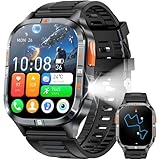
- BUILT-IN GPS & COMPASS– This military smartwatch features high-precision GPS to pinpoint your location while hiking, cycling, or traveling, keeping you safely on track without extra gear. Tap the compass icon and it locks your bearing within three seconds—engineered for pro-level outdoor adventures like camping, climbing, and trekking.
- BLUETOOTH CALLING & MESSAGES – Powered by the latest Bluetooth tech, the men’s smartwatch lets you answer or make calls right from your wrist—no need to pull out your phone. Get real-time alerts for incoming texts and app notifications so you never miss an invite. (Replying to SMS is not supported.)
- BIG SCREEN & DIY VIDEO WATCH FACE – The 2.01" military-spec display is dust-proof, scratch-resistant, and forged from high-strength glass with an aluminum alloy bezel, passing rigorous dust and abrasion tests so the screen stays crystal-clear. Upload a short family video to create a dynamic, one-of-a-kind watch face that keeps your memories alive.
- 24/7 HEALTH MONITORING – Equipped with a high-performance optical sensor, this Android smartwatch tracks heart rate and blood-oxygen levels around the clock. It also auto-detects sleep stages (deep, light, awake) for a complete picture of your health, ensuring you always know how your body is doing.
- MULTI SPORT MODES & FITNESS TRACK – Choose from running, cycling, hiking, basketball, and more to log every workout. Set goals, monitor progress, and sync data to the companion app. Bonus tools include photo gallery, weather, alarm, stopwatch, flashlight, hydration reminder, music/camera remote, find-my-phone, mini-games, and other everyday essentials.
Where it struggles is margin. A long day of workouts, cellular use, and navigation can push it uncomfortably close to empty, especially if you forget to manage display or background settings.
By contrast, the Fenix E encourages a different mental model. You plan activities knowing the watch will outlast the schedule, not the other way around.
Samsung Galaxy Watch Ultra: endurance through restriction
Samsung advertises impressive headline numbers, but much of that endurance depends on power-saving profiles that limit sensor access, screen behavior, or smart features. In full-featured mode with GPS and AMOLED active, battery life drops quickly.
This makes the Galaxy Watch Ultra feel more like a conventional smartwatch with outdoor styling than a true endurance tool. It’s fine for structured workouts and daily wear, but it lacks the confidence-inspiring overhead that Garmin builds into the Fenix E.
For buyers comparing spec sheets, this distinction is easy to miss. In practice, it’s immediately obvious after a few long weekends outdoors.
Charging habits and long-term ownership reality
Battery life isn’t just about numbers; it’s about friction. The Fenix E charges quickly enough that top-ups are practical, but infrequent enough that charging never becomes part of a daily routine.
That matters over months and years of ownership. Less frequent charging cycles reduce wear, simplify travel, and make the watch feel like equipment rather than a dependent device.
This is where Garmin’s value proposition quietly asserts itself. Even with AMOLED now in the mix, the Fenix E still behaves like a performance instrument first, and a smartwatch second.
Software, Training Tools, and the Garmin Ecosystem Advantage
Battery confidence sets the tone, but software is where the Fenix E fully separates itself from mainstream smartwatches. Garmin’s approach assumes the watch is a training partner and navigation instrument first, with “smart” features layered on top rather than driving the experience.
This is also where the rebadging from Epix to Fenix matters most. The Fenix E doesn’t introduce a new software direction; it deliberately inherits the most mature, feature-complete version of Garmin’s performance platform and positions it against Apple and Samsung’s app-centric ecosystems.
Garmin OS: functional depth over visual polish
Garmin’s operating system looks conservative next to watchOS or Wear OS, especially on an AMOLED display. Animations are restrained, menus are dense, and the learning curve is real for new users.
That density is intentional. Every screen is optimized for quick access to data fields, sensor control, and activity customization, which matters when you’re adjusting settings mid-ride, mid-climb, or with cold hands in the backcountry.
On the Fenix E, the AMOLED panel finally gives this utilitarian interface the contrast and clarity it deserves. It looks closer to an Epix than a traditional Fenix, but it behaves like every other serious Garmin tool: predictable, consistent, and optimized for muscle memory rather than visual flair.
Training metrics that go beyond workout tracking
Where Apple and Samsung focus on recording activities, Garmin focuses on interpreting them. The Fenix E includes the full stack of Firstbeat-derived metrics: Training Readiness, Acute Load, Chronic Load, Training Status, HRV Status, Recovery Time, and Body Battery.
These aren’t isolated numbers. They are interlinked, updated continuously, and designed to influence decision-making before you start a workout, not just summarize it afterward.
In real-world use, this changes behavior. Instead of asking “Did I close my rings?” you’re asking whether today’s readiness supports intensity or whether a long aerobic session makes more sense. That mental shift is exactly what Garmin wants, and it’s something neither Apple nor Samsung currently replicates in a unified way.
Structured training, not just encouragement
The Fenix E supports adaptive training plans for running, cycling, and triathlon that adjust daily based on sleep, HRV, and recent workload. Suggested workouts are context-aware, factoring in upcoming races, recovery needs, and historical performance.
This isn’t coaching theater. The suggestions often conflict with ego, telling you to slow down or rest when other platforms would nudge you to “stay active.”
For athletes who already follow external coaching plans, the Fenix E integrates cleanly with platforms like TrainingPeaks and Final Surge. Workouts sync reliably, execute precisely on the watch, and feed performance data back into the broader ecosystem without friction.
Multisport depth and outdoor specialization
The Fenix E retains the Fenix family’s defining advantage: absurdly deep activity profiles. Beyond running and cycling, you get trail-specific metrics, ski touring, climbing, surfing, rowing, tactical modes, and customizable multisport transitions.
Navigation is equally uncompromising. Full-color offline maps, turn-by-turn routing, ClimbPro, Up Ahead, and course-based pacing tools like PacePro are built into the core experience, not offered as optional apps.
This is where the rebadged Epix identity becomes clear. Hardware-wise, the Fenix E may feel familiar, but software-wise it is still a Fenix: a watch designed to replace dedicated bike computers, handheld GPS units, and basic expedition tools for many users.
Health tracking as context, not obsession
Garmin’s health features are comprehensive but deliberately understated. Sleep tracking, SpO2, respiration, stress, and HRV run quietly in the background, feeding into training and recovery models rather than demanding constant attention.
The Fenix E does not chase medical-grade claims or lifestyle gamification. There are no flashy mindfulness streaks or aggressive nudges to stand every hour.
For endurance athletes, this restraint is a feature. Health data exists to support performance and long-term consistency, not to compete for attention throughout the day.
Garmin Connect: data-first, cloud-agnostic
Garmin Connect remains one of the most polarizing platforms in wearables. It is information-dense, occasionally inelegant, and unapologetically complex.
But it is also powerful. Historical trends, training load charts, segment analysis, heat acclimation, and gear tracking are all accessible without subscriptions or hidden paywalls.
Unlike Apple Health or Samsung Health, Garmin Connect does not assume your phone is the center of the universe. The Fenix E functions independently, syncing when convenient rather than constantly, which aligns with its role as equipment rather than accessory.
Smartwatch features: present, but clearly secondary
The Fenix E supports notifications, music storage, Garmin Pay, safety tracking, and basic third-party apps through Connect IQ. These features work reliably, but they are not the reason to buy the watch.
There is no LTE option, voice assistant, or deep app ecosystem. Garmin has made a conscious decision not to chase smartwatch parity at the expense of endurance or stability.
In the context of Apple and Samsung, this is a strategic tradeoff. The Fenix E isn’t trying to replace your phone; it’s trying to make sure your watch never limits what you can do when the phone stops being practical.
Why the Fenix E name matters here
Rebranding the Epix hardware under the Fenix name is less about hardware differentiation and more about signaling software intent. The Fenix label tells buyers this is Garmin’s most complete performance platform, not a lifestyle-oriented AMOLED experiment.
By folding the Epix experience into the Fenix identity, Garmin simplifies its lineup and sharpens its message to Apple and Samsung. This is not a smartwatch competing on apps or aesthetics; it is a performance system that happens to have a beautiful screen.
For buyers deciding between ecosystems, the question becomes less about which watch looks better on the wrist and more about which software philosophy aligns with how they train, explore, and live with a device over years, not upgrade cycles.
Smartwatch Smarts: How Fenix E Compares to Apple Watch Ultra and Galaxy Watch
Seen through a smartwatch-first lens, the Fenix E immediately feels different from Apple and Samsung’s flagships. That difference is not accidental or the result of missing features, but the outcome of a design philosophy that prioritizes autonomy, endurance, and predictability over convenience-driven intelligence.
Apple Watch Ultra and Galaxy Watch aim to be extensions of your phone. The Fenix E is designed to remain useful when the phone is absent, offline, or irrelevant.
Notifications, apps, and daily intelligence
All three platforms handle notifications well, but only Apple and Samsung treat them as a core interaction model. On Apple Watch Ultra and Galaxy Watch, notifications are actionable, deeply integrated with third-party apps, and often encourage short, frequent interactions throughout the day.
The Fenix E takes a more restrained approach. Notifications are readable, reliable, and easy to triage, but rarely interactive beyond basic dismissals or canned responses on Android.
This makes the Fenix E less mentally demanding over long days. For users who view their watch as equipment rather than a constant prompt generator, this restraint is a feature rather than a limitation.
App ecosystems and platform lock-in
Apple Watch Ultra remains unmatched in app breadth, polish, and developer attention. If you want native apps for productivity tools, smart home control, airline boarding passes, or messaging platforms, Apple’s ecosystem is decisively ahead.
Rank #4

- 【Built-in GPS & Multi-System Positioning】Stay on track with the Tiwain smartwatch’s built-in GPS. Featuring military-grade single-frequency and six-satellite support (GPS, GLONASS, Beidou, Galileo, NAVIC, QZSS), this watch offers fast and accurate location tracking wherever you go. It also includes a compass, altimeter, and barometer, giving you real-time data on your altitude, air pressure, and position.
- 【Military-Grade Durability】Engineered to withstand the toughest conditions, the Tiwain smartwatch meets military standards for extreme temperatures, low pressure, and dust resistance. Crafted from tough zinc alloy with a vacuum-plated finish, this watch is also waterproof and built to resist wear and tear. The 1.43-inch AMOLED HD touchscreen offers clear visibility in all environments, and the watch supports multiple languages for global users.
- 【170+ Sport Modes & Fitness Tracking】Track your fitness journey with 170+ sport modes, including walking, running, cycling, hiking, basketball, and more. Set exercise goals, monitor progress, and sync your data to the companion app. The smartwatch also offers smart features like music control, camera remote, weather updates, long-sitting reminders, and more.
- 【LED Flashlight for Outdoor Adventures】The Tiwain smartwatch comes equipped with a built-in LED flashlight that can illuminate up to 20 meters. Activate it with the side button for added convenience during nighttime activities or outdoor adventures.
- 【Comprehensive Health Monitoring】Monitor your health with real-time heart rate, sleep, blood pressure, and blood oxygen level tracking. The smartwatch will vibrate to alert you of any abnormal readings. You can also make and receive calls directly from the watch, and stay connected with message and app notifications (receive only, no sending capability) – perfect for when you’re driving or exercising.
Samsung’s Galaxy Watch ecosystem sits between Apple and Garmin. It offers solid Google integration, voice assistants, and Wear OS apps, but battery life constraints and inconsistent performance still limit how far users push it beyond convenience use.
Garmin Connect IQ is narrower by design. Most apps focus on data fields, sport extensions, navigation tools, or minor quality-of-life utilities rather than replacing phone apps.
This reflects Garmin’s belief that watches should specialize. The Fenix E does fewer things, but those things are stable, offline-capable, and designed to function the same way five years from now as they do today.
Voice assistants, LTE, and independence
Apple Watch Ultra and LTE-equipped Galaxy Watch models can operate independently for short periods. Calls, messages, music streaming, and emergency services are all accessible without a phone nearby.
The Fenix E deliberately opts out of this model. There is no LTE, no microphone-driven assistant, and no always-connected dependency.
In exchange, Garmin delivers weeks of battery life, predictable behavior in remote environments, and zero reliance on carrier plans or background connectivity. For expedition use, multi-day events, or travel where charging and signal are unreliable, this tradeoff heavily favors the Fenix E.
Battery life as a defining differentiator
Battery life is where the comparison becomes less subtle. Apple Watch Ultra typically requires daily or near-daily charging with active use, while Galaxy Watch models often last one to two days depending on settings.
The Fenix E, drawing directly from its Epix hardware roots, stretches into double-digit days even with an always-on AMOLED display, GPS usage, and continuous health tracking. In expedition modes, that runtime expands dramatically.
This fundamentally changes how the watch fits into daily life. Charging becomes a planned activity rather than a constant concern, reinforcing the Fenix E’s identity as a tool you live with rather than manage.
Health tracking depth versus interpretation style
All three platforms track heart rate, sleep, activity, and blood oxygen, but they interpret that data very differently. Apple and Samsung emphasize clarity, trend summaries, and broad wellness framing aimed at the general user.
Garmin’s health metrics are more granular and often more demanding to interpret. Body Battery, HRV status, training readiness, and recovery time assume the user wants context, not simplification.
The Fenix E does not soften this experience. It inherits the Epix’s full physiological model and presents it without filtering, reinforcing that this is a performance platform first, even when worn as an everyday smartwatch.
Materials, comfort, and real-world wearability
Physically, the Fenix E aligns more closely with the Apple Watch Ultra than the standard Galaxy Watch. Titanium construction, sapphire glass, and a thicker case profile communicate durability rather than elegance.
Despite its size, the Fenix E wears more comfortably over long periods than its dimensions suggest. The case curvature, button placement, and silicone or nylon strap options are clearly optimized for extended wear during training and sleep.
Apple’s flat display and digital crown feel more refined for casual interaction, while Samsung’s rotating bezel variants excel in one-handed navigation. Garmin’s five-button layout remains unmatched for gloves, wet conditions, and muscle-memory operation during sport.
Payments, music, and everyday conveniences
Garmin Pay works reliably but with more limited bank support than Apple Pay or Samsung Pay. Music storage and offline playback are solid, though syncing remains slower and less intuitive than Apple’s tightly integrated system.
Apple Watch Ultra excels here, especially for users already invested in Apple Music, AirPods, and iPhone automation. Samsung offers similar strengths within the Android ecosystem, particularly with Google services.
The Fenix E covers the essentials without trying to be delightful. It prioritizes consistency over charm, which mirrors Garmin’s broader approach to smartwatch features as secondary utilities.
Value positioning against Apple and Samsung
Price-for-price, the Fenix E sits closer to Apple Watch Ultra than to most Galaxy Watch models. On paper, that makes it a difficult sell if judged purely as a smartwatch.
Viewed as a performance watch with smartwatch capabilities, the equation shifts. The Fenix E includes advanced mapping, training analytics, and long-term software support without subscriptions, areas where Apple and Samsung increasingly rely on services and ecosystem gravity.
For buyers deciding between platforms, the real question is not which watch is smarter. It is whether you want a watch that adapts to your phone-centered life, or one that remains competent when the phone fades into the background.
Positioning and Pricing: Where the Fenix E Sits in Garmin’s Crowded Lineup
Garmin’s challenge in 2026 is no longer technology, but clarity. With Fenix, Epix, Enduro, Forerunner, Venu, and now the Fenix E all overlapping in price and capability, buyers are often left decoding subtle differences rather than obvious tiers.
The Fenix E exists as an attempt to simplify that confusion, even if the execution introduces a new kind of overlap. It is best understood not as a new platform, but as a strategic reframe of an existing one.
A Fenix in name, an Epix in hardware
At a hardware level, the Fenix E is effectively a rebadged Epix. It uses the same AMOLED display technology, similar case construction, identical sensor suite, and runs the same core Garmin OS with full mapping, training readiness, and multisport depth.
The differences are not about performance or capability, but about narrative. Where Epix previously stood as the AMOLED alternative to the MIP-based Fenix, the Fenix E brings that AMOLED experience under the Fenix banner, which carries stronger recognition among outdoor and tactical users.
This is less about innovation and more about consolidation. Garmin is betting that the Fenix name has more gravitational pull than Epix ever achieved, especially when competing against the Apple Watch Ultra and Galaxy Watch Pro at the same visual and price tier.
Why Garmin moved the Epix concept under the Fenix umbrella
The decision to reposition the Epix as Fenix E is largely a response to market pressure rather than user demand. Apple and Samsung sell a single flagship smartwatch narrative, while Garmin has historically segmented by use case and display technology.
In practice, consumers increasingly compare watches by screen quality first, then battery life, then features. AMOLED has become the expected standard in the premium smartwatch category, and the Fenix E allows Garmin to offer that without fragmenting its top-tier branding.
This also future-proofs the Fenix line. By normalizing AMOLED within Fenix rather than treating it as a parallel product, Garmin gains flexibility to phase out legacy distinctions without admitting that the lineup had become too complex.
Pricing relative to Fenix, Epix, and Enduro models
Pricing is where the Fenix E becomes most contentious. It typically launches at or near the historical Epix price point, placing it just below sapphire-equipped Fenix flagships and above most Forerunner and Venu models.
That positions it directly against the Apple Watch Ultra and well above Samsung’s Galaxy Watch range. From a pure smartwatch perspective, that feels aggressive, especially given Garmin’s weaker app ecosystem and limited smart features.
Within Garmin’s own catalog, however, the Fenix E is meant to be the accessible premium option. You get the full training engine, premium materials, AMOLED clarity, and long battery life without paying the absolute top-tier Fenix tax for solar charging or titanium exclusivity.
Who the Fenix E is actually for
The Fenix E makes sense for buyers who want one watch to do everything, but who prioritize training depth and autonomy over lifestyle polish. It is aimed at athletes who previously looked at Epix but hesitated, and at Apple Watch Ultra shoppers who want weeks of battery life and button-first control.
It is less compelling for existing Fenix owners unless AMOLED is a must-have upgrade. For Epix owners, it offers no functional advantage beyond naming continuity and potential long-term positioning within Garmin’s software roadmap.
For new buyers entering Garmin’s ecosystem at the high end, the Fenix E arguably becomes the default recommendation. It avoids the decision paralysis of MIP versus AMOLED while delivering the full Garmin experience without compromise.
Value versus innovation: rebrand or rationalization?
The Fenix E does not introduce new sensors, new training metrics, or a new software paradigm. Its value lies in packaging and positioning rather than advancement.
That does not make it cynical. In a market dominated by Apple and Samsung’s clean, singular product stories, Garmin needed a clearer flagship narrative that could stand shoulder to shoulder in retail comparisons.
The Fenix E is Garmin’s answer to that reality. It is not a leap forward, but it is a strategic acknowledgment that how a product is framed now matters almost as much as what it can do.
Who the Fenix E Is Really For (and Who Should Buy Something Else)
Seen in context, the Fenix E exists to simplify a decision that had become overly technical. Garmin is no longer asking buyers to choose between Epix versus Fenix on display technology alone, but between philosophies of use.
This makes the question less about specs and more about how you actually live with a watch day to day.
💰 Best Value

- Smart Watch with GPS and Offline Map: This smart watch connects to multiple satellite systems for accurate real-time positioning, and includes a professional-grade compass, altimeter, and barometer for precise data, ensuring you maintain your sense of direction in any outdoor environment. The map version supports downloading offline maps; select a route or destination to view the route even without a signal, eliminating the risk of getting lost.
- Bluetooth Call & Message Functionality: This smart watches for men allows you to make and receive calls; receive text and social media notifications (Facebook, WhatsApp, Instagram, Twitter, etc.); and reply to text messages with voice-to-text or set up quick replies (text reply functionality is available for Android phones).
- Sports & Health Monitoring: This 5ATM waterproof fitness watch supports over 100 sports modes and tracks daily activity data, calories, distance, steps, and heart rate. You can use it to monitor your health metrics (blood oxygen, heart rate, stress, and sleep), monitor your fatigue and mood, and perform PAI analysis. You can also use this smartwatch to set water intake and sedentary reminders. Stay active and healthy with this fitness tracker watch.
- Customizable Watch Faces & AI Functionality: This smart watch features a 1.46-inch HD touchscreen and over 100 downloadable and customizable watch faces. You can even use your favorite photos as your watch face. Equipped with AI technology, it supports voice descriptions in multiple languages to generate personalized AI watch faces. The watch's AI Q&A and AI translation features provide instant answers to questions and break down language barriers, making it an ideal companion for everyday life and travel.
- Large Battery & High Compatibility & More Features: This smart watch for android phones and ios phone features a large 550ml battery for extended battery life. It's compatible with iOS 9.0 and above and Android 5.0 and above. It offers a wealth of features, including an AI voice assistant, weather display, music control, camera control, calculator, phone finder, alarm, timer, stopwatch, and more. (Package Includes: Smartwatch (with leather strap), spare silicone strap, charging cable, and user manual)
The ideal Fenix E buyer
The Fenix E is best suited to athletes who train frequently across multiple disciplines and want a single device that can handle structured workouts, navigation, recovery metrics, and long stretches away from a charger. If your weeks include runs, rides, gym sessions, and occasional outdoor adventures, the Fenix E aligns naturally with that rhythm.
Button-first control is a key part of the appeal. For users who train in rain, cold, gloves, or high-sweat conditions, the five-button layout remains more reliable than touch-centric interfaces on Apple and Samsung watches.
Comfort also plays a role here. Despite its substantial case size, the Fenix E wears flatter than the Apple Watch Ultra on most wrists, and the polymer back helps manage weight during long sessions. With Garmin’s silicone or nylon straps, it disappears more than its rugged styling suggests.
Apple Watch Ultra cross-shoppers who value autonomy
This is the clearest group Garmin is targeting. If you are drawn to the Apple Watch Ultra’s size and durability but frustrated by daily charging and a phone-dependent experience, the Fenix E offers a fundamentally different trade-off.
You give up LTE, deep app integrations, and Apple’s notification handling. In return, you gain multi-week battery life, offline mapping, and a watch that remains fully functional without a smartphone nearby.
For users who train seriously and treat smartwatch features as secondary, that exchange often feels rational rather than limiting.
Garmin newcomers buying at the high end
For first-time Garmin buyers with the budget for a premium watch, the Fenix E has effectively become the cleanest entry point. It delivers the full training engine, advanced health metrics, and AMOLED clarity without forcing decisions about solar charging or titanium finishes.
Software-wise, nothing meaningful is held back. Training Readiness, HRV status, advanced sleep tracking, and full navigation tools are all present, making it representative of Garmin’s ecosystem as a whole.
This is where the rebranding works. The Fenix name carries weight, and the Fenix E now communicates “this is the safe flagship choice” in a way Epix never quite did outside enthusiast circles.
Who should stick with Epix or existing Fenix models
If you already own an Epix Gen 2, the Fenix E offers no functional upgrade. The hardware, sensors, display, and software experience are effectively the same, and the name change alone is not a reason to switch.
Likewise, recent Fenix 7 owners who prefer the always-on MIP display and solar-assisted battery life gain little by moving to the Fenix E. This remains a lateral move unless AMOLED readability is a personal priority.
In both cases, Garmin’s value proposition favors keeping what you have rather than chasing the new label.
Who should consider a Forerunner instead
Runners and triathletes focused on performance rather than durability may find the Fenix E excessive. The Forerunner 965 delivers nearly identical training metrics, the same AMOLED display, and a lighter, more comfortable chassis at a lower price.
If you rarely use maps, do not need expedition-level durability, and prefer a slimmer watch under daily clothing, the Forerunner line remains the more efficient choice.
The Fenix E earns its place when ruggedness and versatility matter as much as pace charts and race predictions.
Who should buy an Apple or Samsung smartwatch instead
If smart features are the primary reason you wear a watch, the Fenix E is not the right tool. Notification handling is functional but basic, voice assistants are absent, and third-party apps remain limited compared to WatchOS and Wear OS.
Users who rely on LTE connectivity, mobile payments as a core habit, rich messaging, or smartwatch apps for work and social life will feel constrained. Apple and Samsung still dominate this space, and Garmin has made no attempt to compete feature-for-feature here.
The Fenix E assumes your phone is secondary during training, not central to your wrist experience.
Wrist size, style, and daily wear considerations
At over 47mm, the Fenix E is not discreet. Smaller wrists may find the case visually dominant, and the rugged aesthetic does not blend seamlessly into formal or office-heavy wardrobes.
Materials and finishing are solid rather than luxurious. Stainless steel and reinforced polymer emphasize durability over jewelry-like refinement, which may matter for buyers comparing it to premium lifestyle watches.
This is a tool-first watch that happens to be wearable every day, not a lifestyle smartwatch that dabbles in sport.
The value question in plain terms
The Fenix E makes sense when training depth, battery life, and reliability matter more than ecosystem lock-in or smartwatch polish. It is less about innovation and more about alignment between product identity and buyer expectations.
For the right user, that clarity is valuable in itself.
Final Verdict: Strategic Masterstroke or Redundant Rebadge?
The Fenix E only feels redundant if you look at Garmin’s lineup in isolation. Viewed against the broader smartwatch market, it becomes clear that this is less about internal cannibalization and more about external positioning.
Garmin did not create the Fenix E to surprise existing Epix owners. It created it to simplify its message at the top end and to give mainstream buyers a familiar flagship name that stands toe-to-toe with Apple and Samsung on perceived prestige.
What the Fenix E actually is, stripped of marketing
At a hardware level, the Fenix E is functionally an Epix Gen 2 with a new badge and a Fenix-aligned identity. The AMOLED display, GNSS performance, training algorithms, sensor stack, and software experience are effectively the same in day-to-day use.
You are getting the same HR accuracy, the same Training Readiness and HRV Status metrics, the same full-color maps, and the same multi-band GPS reliability that made the Epix such a strong performer.
Nothing about the Fenix E reinvents Garmin’s tech platform. That is not the point of its existence.
Why Garmin moved it under the Fenix name
Outside of enthusiast circles, the Epix name never carried the same weight as Fenix. The Fenix line is Garmin’s halo product, shorthand for “the best watch we make,” in the same way Ultra and Pro have become for Apple and Samsung.
By folding an AMOLED-based watch into the Fenix family, Garmin removes buyer confusion and strengthens its competitive stance in retail environments where specs are skimmed and brand recognition drives decisions.
This is a strategic branding correction, not a technological leap.
How it competes with Apple Watch Ultra and Galaxy Watch
Against Apple and Samsung, the Fenix E wins on endurance, training depth, and autonomy. Multi-day battery life with always-on display, full offline mapping, and a training platform that assumes serious intent still set Garmin apart.
Where it concedes ground is obvious and intentional. There is no LTE, no voice assistant, no rich app ecosystem, and no ambition to replace your phone.
The Fenix E does not chase smartwatch convenience. It doubles down on being a wrist-based instrument that keeps working when your phone becomes irrelevant.
Is there genuine value for buyers?
For new buyers entering the premium multisport category, the answer is yes. The Fenix E delivers Garmin’s most complete AMOLED experience under a name that signals durability, longevity, and outdoor credibility.
For existing Epix owners, the value is far less compelling. There is no functional reason to switch, and Garmin is clearly not asking you to.
The watch makes the most sense for buyers cross-shopping Apple Watch Ultra, Galaxy Watch, and high-end Garmins who want clarity rather than choice overload.
Strategic masterstroke or redundant rebadge?
As a product, the Fenix E is conservative. As a strategy, it is quietly effective.
Garmin has acknowledged that naming, perception, and shelf presence matter just as much as sensor accuracy and battery graphs. The Fenix E simplifies the story: if you want Garmin’s best all-rounder with a modern display, this is it.
For enthusiasts who already understand the lineup, it may feel unnecessary. For everyone else, it makes Garmin’s flagship easier to find, easier to understand, and easier to choose.
That does not make it exciting, but it does make it smart.