Offshore communication has always been a patchwork of overlapping tools, each reliable only within a narrow slice of conditions. Sailors learn quickly that what works perfectly inshore can fail silently once the coastline drops below the horizon. That gap between “connected” and “completely alone” is exactly where satellite messaging on a wrist starts to matter.
For years, the safety stack at sea has been a compromise between immediacy, range, and consequence. VHF is instant but local, cellular is familiar but fragile, and EPIRBs are life-saving but final. The Garmin Quatix 8 Pro’s satellite messaging sits deliberately between those extremes, offering a way to communicate beyond line-of-sight without escalating straight to a mayday.
The hard limits of VHF once you leave the harbor
VHF marine radio remains the backbone of short-range safety, but it is fundamentally constrained by line-of-sight. Even with a masthead antenna, effective range is often 20 to 30 nautical miles, less on smaller vessels or in heavy seas. Beyond that, a handheld VHF on deck is little more than a comfort blanket.
VHF also assumes someone is listening on the same channel at the right moment. In lightly trafficked offshore areas, or at night, that assumption becomes increasingly risky. A smartwatch with satellite messaging does not replace VHF, but it removes dependence on proximity and chance.
🏆 #1 Best Overall
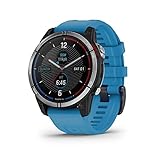
- Rugged, sophisticated design features an always-on 1.3” display, stainless steel bezel, buttons, rear case and QuickFit band system
- Traditional button controls that work in any environment are matched with a highly responsive touchscreen interface for quick, convenient access to selections
- Provides comprehensive connectivity with compatible Garmin chartplotters and remote control of key MFD features, including chart zoom, layout shortcut, Fusion stereo, autopilot and other compatible marine devices
- Access to key information such as tide data on watch face and new alarms to notify you of anchor drag or imminent tide changes on compatible marine devices
- Support for optional BlueChart g3 coastal charts and LakeVü g3 inland maps
Why cellular coverage fails earlier than most expect
Cellular connectivity drops off far closer to shore than many sailors realize, often within 5 to 10 nautical miles depending on tower height and terrain. Even before total loss of signal, data becomes unreliable, messages stall, and weather apps quietly stop updating. Relying on LTE or 5G offshore is fine for coastal hops, but it is not a safety strategy.
Quatix 8 Pro’s satellite messaging bypasses terrestrial infrastructure entirely. When paired with Garmin’s satellite network and an active subscription, it allows text-based messages and SOS functionality anywhere with a clear view of the sky. That distinction becomes critical the moment cellular bars disappear.
EPIRBs and PLBs: powerful, but all-or-nothing
An EPIRB or PLB is designed for one scenario: grave and imminent danger. Once activated, it triggers a rescue response that cannot be scaled back, clarified, or casually tested. Most experienced skippers are reluctant to deploy one unless the situation is truly catastrophic.
Satellite messaging fills the psychological and practical gap before that threshold. With the Quatix 8 Pro, you can inform a shore contact of a mechanical issue, delayed arrival, or worsening conditions without initiating a full search-and-rescue response. That ability to communicate context is often the difference between a manageable problem and a cascading emergency.
What satellite messaging actually enables at sea
In practical terms, satellite messaging on the Quatix 8 Pro allows two-way text communication, location sharing, and SOS activation directly from the watch interface. Messages are short and deliberate, optimized for reliability rather than speed. Battery consumption is higher than normal smartwatch use, but vastly lower than running a full satellite communicator continuously.
This is not real-time voice communication, and it is not intended to replace onboard satcom systems on bluewater yachts. It is a personal safety layer, always on your wrist, functional even if you are separated from the vessel or electronics fail. Compared to previous Quatix models, this represents a meaningful shift from vessel-centric safety to crew-centric safety.
Subscriptions, limitations, and realistic expectations
Satellite messaging requires an active Garmin subscription, with tiered plans depending on message volume and tracking features. Without a subscription, the hardware capability is effectively dormant. It also requires a clear view of the sky, meaning performance can degrade under heavy canopy, below decks, or in extreme latitudes.
Most importantly, satellite messaging is not a replacement for proper marine safety equipment. It is best understood as an escalation step between inconvenience and emergency, adding flexibility rather than redundancy. For offshore sailors and anglers, that middle ground is precisely where most real-world problems actually live.
What Garmin Means by Satellite Messaging on the Quatix 8 Pro (and What It Is Not)
Coming out of the practical middle ground between inconvenience and emergency, it is important to be precise about what Garmin is actually delivering here. “Satellite messaging” on the Quatix 8 Pro is not marketing shorthand for generic GPS, nor is it a stripped-down EPIRB bolted onto a smartwatch. It is a narrowly defined communication capability designed to function when every terrestrial option has already failed.
At sea, that distinction matters. Offshore users tend to assume anything labeled “satellite” implies unlimited reach and near-magic reliability, and that assumption can lead to dangerous expectations if left uncorrected.
What the Quatix 8 Pro can actually do over satellite
In real-world use, satellite messaging on the Quatix 8 Pro enables short, two-way text communication and SOS alerting when you are outside cellular coverage. Messages are sent and received directly from the watch, using Garmin’s satellite infrastructure and backend coordination rather than a paired phone or chartplotter.
This allows you to send status updates like a delayed arrival, gear failure, or weather-related diversion to a predefined contact on shore. Crucially, it also allows incoming replies, so you are not just shouting into the void and hoping someone heard you.
The SOS function is integrated into the same system, escalating to emergency coordination if needed. Unlike a PLB or EPIRB, the SOS workflow supports ongoing text communication with responders, which can materially change outcomes when the situation is serious but still evolving.
How this differs from older Quatix models
Previous Quatix watches relied entirely on paired devices for long-range communication. If your phone drowned, the MFD lost power, or you were separated from the boat, the watch reverted to being a very good instrument display and fitness tracker with no outbound reach.
The Quatix 8 Pro breaks that dependency. The satellite radio is self-contained, meaning the watch remains capable of messaging even when it is the only functioning electronics you have left.
That shift from vessel-dependent safety to personal, wrist-based safety is the real upgrade. It aligns the Quatix line more closely with how accidents actually unfold offshore, where people and boats are often separated before help is needed.
What it is not: no voice, no live chat, no constant tracking
Satellite messaging on the Quatix 8 Pro is deliberately limited. There is no voice calling, no live conversation, and no expectation of instant delivery. Messages are queued, transmitted when satellite geometry allows, and delivered in bursts rather than streams.
It is also not designed for continuous breadcrumb tracking in the background the way dedicated satellite trackers can be. Tracking intervals, if enabled, are conservative to preserve battery life and thermal stability in a watch-sized device.
If you expect the experience of a satphone or a permanently mounted satcom terminal, this will feel slow and constrained. That is by design, not a shortcoming.
Subscription requirements and practical costs
Satellite messaging on the Quatix 8 Pro requires an active Garmin subscription. Without it, the satellite hardware is present but functionally inactive, including SOS.
Plans are tiered based on message volume and optional tracking features, and they are billed separately from Garmin Connect or any charting subscriptions you may already carry. For seasonal sailors, the ability to pause or downgrade plans becomes an important consideration rather than a footnote.
From a value perspective, the ongoing cost is best justified as insurance rather than convenience. If you already carry an EPIRB or PLB, this does not replace that obligation, but it does add a communication layer those devices cannot provide.
Environmental limits you need to respect
Satellite messaging still obeys physics. A clear view of the sky is required, and performance degrades below decks, inside metal enclosures, or under heavy canopy.
High latitudes, steep terrain, and severe weather can increase message latency. The system is resilient, but it is not immune to the realities of satellite geometry and atmospheric interference.
Battery life is another constraint. Satellite transmissions draw significantly more power than normal smartwatch functions, and extended messaging sessions will shorten operational runtime. The Quatix 8 Pro manages this intelligently, but it rewards deliberate use rather than casual chatter.
How this compares to other marine wearables
Most marine-focused smartwatches still treat safety as an extension of navigation rather than a standalone function. They excel at instrument mirroring, route guidance, and performance metrics, but they remain silent once cellular coverage disappears.
By adding independent satellite messaging, Garmin is positioning the Quatix 8 Pro closer to expedition-grade wearables while retaining its marine-first interface and ecosystem integration. That combination is still rare, especially in a watch designed to live comfortably on the wrist for weeks rather than be donned only for emergencies.
For skippers, anglers, and offshore crew who already understand that problems rarely start as emergencies, this feature is not just an SOS button. It is a controlled way to keep small problems from becoming large ones, without prematurely pulling the emergency cord.
Inside the Technology: Iridium Network Coverage, Message Types, and Real-World Latency at Sea
What makes satellite messaging on the Quatix 8 Pro genuinely different from earlier Quatix generations is not just that it exists, but how it is implemented. Garmin has borrowed heavily from its inReach lineage, adapting proven offshore communication hardware and software into a wrist-worn form factor that is realistic for daily use on deck.
To understand where this system excels, and where expectations need to be calibrated, it helps to break the technology into three parts: the satellite network itself, the types of messages the watch can send and receive, and what actually happens when you try to communicate hundreds of miles offshore.
Why Garmin chose the Iridium network
The Quatix 8 Pro uses the Iridium satellite constellation, a network of 66 active low Earth orbit satellites arranged to provide true global coverage, including polar regions and the open ocean. Unlike geostationary systems that rely on a fixed satellite high above the equator, Iridium satellites constantly move across the sky, handing off signals as they pass overhead.
For maritime use, this matters more than most sailors realize. On a rolling deck with limited antenna size and orientation, having satellites regularly passing overhead dramatically improves the odds of establishing and maintaining a connection, even when sea state or rigging interferes with line of sight.
This is also why Iridium remains the gold standard for offshore safety devices like EPIRBs, PLBs, and dedicated satellite communicators. Garmin’s decision to anchor Quatix 8 Pro messaging to this network signals that this feature is intended for real offshore use, not coastal novelty.
What kinds of messages the Quatix 8 Pro can actually send
Satellite messaging on the Quatix 8 Pro is not a single-purpose SOS button. It supports three distinct communication layers, each with different expectations and use cases.
First is SOS emergency messaging, which routes distress alerts through Garmin’s International Emergency Response Coordination Center. This functions similarly to inReach devices, transmitting your GPS position, vessel context, and ongoing updates until the incident is resolved or assistance arrives.
Second is two-way custom text messaging. These are short, structured messages sent to predefined contacts or ad hoc recipients via phone number or email, allowing genuine back-and-forth communication rather than a one-way distress signal.
Rank #2

- This nautical smartwatch features a 1.4” stunning AMOLED display with a titanium bezel and built-in LED flashlight
- Keep your focus on the water, and control your compatible chartplotter via BLUETOOTH connectivity with voice commands
- Enjoy comprehensive connectivity and remote control capabilities with select compatible Garmin chartplotters, autopilots, Force trolling motors, Fusion stereos and more
- Onboard system connectivity with boat data streaming shows your heading, speed, water depth and more when paired with your compatible Garmin chartplotter or instrument
- Boating and sailing apps provide the data you need to track your time on the water; stay aware and get alarms for imminent tide changes or anchor drag
Third is preset messaging, which allows the watch to send canned status updates like “Delayed but OK” or “Arrived safely” without consuming message credits on most plans. For offshore crew rotations or long passages, these presets often become the most-used feature.
Crucially, all of this operates independently of your phone once configured. The watch does not need a paired smartphone or cellular coverage to function, which is the point at which it separates itself from standard LTE-enabled smartwatches.
Latency at sea: what to expect in real conditions
Satellite messaging does not behave like instant messaging, and Garmin does not pretend that it does. In real-world offshore conditions, message delivery typically ranges from 20 seconds to several minutes, depending on satellite visibility, sky obstruction, and atmospheric conditions.
On open water with a clear horizon, outgoing messages often transmit faster than many expect, especially when the watch is held stationary with a clear view of the sky. Incoming replies can take longer, as they depend on the next satellite pass aligned with both sender and recipient.
During heavy weather, high latitudes, or when operating near tall rigging and radar arches, latency increases. This does not usually mean messages fail, but patience becomes part of the workflow. The Quatix 8 Pro provides clear transmission status indicators so you are not left guessing whether a message is still pending or has been sent.
This is an important mindset shift for anyone new to satellite communication. The system rewards deliberate, well-timed use rather than rapid-fire conversation.
How this differs from previous Quatix models
Earlier Quatix watches were deeply integrated with Garmin chartplotters, wind instruments, and autopilot systems, but they were communication-dependent on the boat’s existing infrastructure. Once the vessel lost cellular connectivity, the watch became informational rather than communicative.
The Quatix 8 Pro breaks that dependency. It can now act as a standalone safety endpoint, capable of initiating communication even if the boat’s power systems, antennas, or primary electronics are compromised.
This distinction matters in real emergencies, but it also matters in quieter scenarios, such as a delayed landfall, a mechanical issue, or an unexpected weather diversion. These are the moments where communication prevents escalation, and where previous Quatix models had no voice.
Subscription mechanics and operational transparency
Satellite messaging on the Quatix 8 Pro requires an active Garmin satellite subscription, shared with other inReach-compatible devices on the same account. Plans scale by message volume and can be paused or adjusted seasonally, which aligns well with how most sailors actually operate.
The watch itself is transparent about message usage, signal acquisition, and battery impact. There is no hidden background transmission or surprise data consumption, which reinforces the idea that this is a safety tool first, not a passive always-on feature.
From a system design standpoint, Garmin has done something subtle but important here: it has made satellite messaging accessible without trivializing it. The Quatix 8 Pro encourages informed use, clear expectations, and realistic trust in the technology rather than blind reliance.
Emergency vs Routine Use Cases: Man Overboard, Breakdown, Solo Sailing, and Offshore Angling Scenarios
With the mechanics and limitations of satellite messaging understood, the practical question becomes when and how it should actually be used at sea. The Quatix 8 Pro draws a clear line between true emergencies and routine but safety-critical communication, and that distinction matters for both outcomes and expectations.
Man overboard and life-threatening emergencies
In a man overboard scenario, satellite messaging on the Quatix 8 Pro is not a replacement for PLBs, AIS-MOB devices, or vessel-based alarms, but it adds a new personal safety layer. If the wearer is separated from the vessel but conscious, the watch can initiate an SOS or send a predefined distress message with live position updates via Garmin’s satellite network.
This matters most on short-handed boats, night passages, or offshore racing where recovery may be delayed or impossible without external assistance. The watch’s always-on wrist placement, physical button access, and water-resistant construction mean it remains usable when phones are lost, soaked, or unreachable.
It is important to be realistic about limitations. Satellite messaging requires line-of-sight to the sky, cannot transmit voice, and does not replace the immediacy of AIS alerts to the vessel itself, but it dramatically improves survivability once separation has already occurred.
Mechanical breakdowns and delayed arrivals
Not every offshore problem is dramatic, and many safety situations begin quietly with a failed alternator, fouled prop, or steering issue. In these cases, routine satellite messaging is often more valuable than an SOS because it allows controlled communication before the situation escalates.
The Quatix 8 Pro allows short, deliberate updates to shore contacts or support services explaining the issue, current position, and intended plan. This reduces unnecessary rescue activations while still creating an external safety net if conditions deteriorate.
Compared to earlier Quatix models, which became silent once cellular range was lost, this is a meaningful upgrade in risk management. It shifts the watch from a passive instrument display into an active part of the vessel’s contingency planning.
Solo sailing and watchkeeping realities
For solo sailors, satellite messaging changes the psychological and operational dynamic offshore. The ability to send a position update or check in without leaving the cockpit or powering up additional electronics improves both safety and fatigue management.
The Quatix 8 Pro’s form factor matters here. Its balanced case size, curved lugs, and flexible strap options make it comfortable enough to wear continuously, including during sleep, without the wrist fatigue that heavier expedition watches can cause.
Battery life is the practical constraint. While the watch can last days in smartwatch mode, frequent satellite use will shorten endurance, reinforcing the idea that this is a periodic safety tool rather than an open communication channel.
Offshore angling and small-crew operations
Offshore anglers often operate far from cellular coverage with minimal crew and aggressive schedules dictated by weather windows. In this context, satellite messaging becomes less about emergencies and more about accountability and coordination.
The Quatix 8 Pro can be used to confirm return times, report mechanical issues, or update marina staff and family without diverting attention from boat handling. Its compatibility with Garmin marine electronics also means the watch fits naturally into existing helm workflows rather than becoming another isolated gadget.
For small center consoles and trailer boats without redundant communication systems, this capability meaningfully improves safety margins. It does not replace a fixed VHF or EPIRB, but it fills a critical gap between normal operations and full distress.
Understanding when not to use it
Just as important as knowing when to use satellite messaging is knowing when not to rely on it. Message delivery is not instantaneous, conversations are slow, and battery impact is real, especially in cold or wet conditions.
The Quatix 8 Pro encourages disciplined use by design, with clear transmission status indicators and deliberate message composition. That design philosophy aligns well with maritime safety principles, where clarity, restraint, and redundancy matter more than constant connectivity.
In practice, satellite messaging on the Quatix 8 Pro is neither a novelty nor a panic button. It is a controlled communication bridge that fills the space between routine check-ins and full-scale rescue, and that space is where many real-world incidents are either resolved calmly or allowed to spiral.
Subscriptions, Costs, and Activation: What Owners Actually Have to Pay and Manage
The disciplined, situational way satellite messaging fits into maritime safety carries over directly into how Garmin prices and manages it. This is not a hidden-cost feature, but it is also not “included” in the way GPS or onboard sensors are, and understanding the financial and administrative side is essential before relying on it offshore.
Garmin’s approach mirrors how most professional safety tools are handled at sea: low barrier to entry, optional commitment, and predictable costs that scale with actual use rather than hype-driven expectations.
The inReach subscription requirement
Satellite messaging on the Quatix 8 Pro is powered by Garmin’s inReach system, which uses the Iridium satellite network for global coverage. That capability requires an active inReach subscription; without one, the hardware remains dormant, even though the watch itself functions normally as a marine and multisport smartwatch.
Garmin offers several tiered inReach plans, typically ranging from a basic safety-focused option with a small number of preset and custom messages per month to higher tiers designed for frequent communicators. For most boaters, especially those using satellite messaging as an occasional safety and coordination tool, the lower-tier plans are sufficient and keep monthly costs modest.
Unlike cellular smartwatch plans, inReach subscriptions are billed directly through Garmin and are not tied to a carrier. This keeps the system globally portable, whether you are coastal cruising, crossing international boundaries, or fishing remote offshore grounds.
Flex plans versus annual commitments
One of the more pragmatic aspects of Garmin’s pricing is the availability of flexible “Freedom” plans alongside traditional annual contracts. Freedom plans allow users to activate satellite messaging only during months when it is needed, paying a slightly higher monthly rate but avoiding a year-long commitment.
For seasonal sailors, offshore anglers, or delivery skippers who only venture beyond cell range part of the year, this flexibility is critical. It allows the Quatix 8 Pro to remain a dormant safety asset during the off-season without ongoing subscription drain.
Annual plans reduce the per-month cost and make sense for professionals, liveaboards, or expedition users who expect consistent offshore use. In either case, suspension and reactivation are handled through Garmin’s account portal and do not require contacting support or re-pairing the watch.
Rank #3

- This nautical smartwatch features a 1.4” stunning AMOLED display with a titanium bezel and built-in LED flashlight
- Keep your focus on the water, and control your compatible chartplotter via BLUETOOTH connectivity with voice commands
- Enjoy comprehensive connectivity and remote control capabilities with select compatible Garmin chartplotters, autopilots, Force trolling motors, Fusion stereos and more
- Onboard system connectivity with boat data streaming shows your heading, speed, water depth and more when paired with your compatible Garmin chartplotter or instrument
- Boating and sailing apps provide the data you need to track your time on the water; stay aware and get alarms for imminent tide changes or anchor drag
Message limits, overages, and real-world usage costs
Each inReach plan includes a defined number of custom text messages per month, with preset messages typically not counting against that limit. Presets are particularly relevant in a marine context, allowing routine check-ins like “All OK, returning as planned” without consuming message credits.
Once the monthly allotment is exceeded, additional messages are billed per message. While overage fees are not excessive, they are high enough to discourage casual back-and-forth conversations, reinforcing the system’s intended role as a safety and coordination channel rather than a chat platform.
From real-world use, most responsible operators rarely exceed basic plan limits. The deliberate pace of satellite communication, combined with the watch’s interface, naturally keeps usage focused and efficient.
Activation, setup, and pairing with the Garmin ecosystem
Activating satellite messaging on the Quatix 8 Pro is done through a Garmin account, either via the Garmin Explore web portal or companion app. The process includes selecting a plan, entering emergency contact details, and defining preset messages before the feature is enabled on the watch.
Once activated, the watch integrates seamlessly with Garmin’s broader ecosystem. Contacts, message history, and SOS configuration sync across compatible Garmin devices, which is particularly useful for users who already carry a handheld inReach or use Garmin chartplotters and mobile apps onboard.
Importantly, activation does not change the watch’s daily usability. When satellite messaging is not in use, there is no background drain, no forced prompts, and no interference with navigation, health tracking, or marine data screens.
SOS services and emergency response coverage
An active inReach subscription also includes access to Garmin’s 24/7 emergency response coordination service. Triggering an SOS from the Quatix 8 Pro connects the user to a staffed monitoring center that communicates with local rescue authorities while maintaining two-way messaging with the vessel.
This service is included in the subscription cost and does not carry additional per-incident fees. From a safety planning perspective, that predictability matters, especially when compared to ad-hoc emergency solutions that may involve uncertain costs or limited follow-up communication.
It is still critical to understand that SOS coordination supplements, rather than replaces, traditional maritime distress systems. VHF DSC, EPIRBs, and PLBs remain primary tools, with the watch serving as a highly accessible, personal-layer backup.
Total cost of ownership in context
When viewed holistically, the cost of satellite messaging on the Quatix 8 Pro is best understood as an operational expense rather than a feature surcharge. The watch itself commands a premium price due to its materials, display, battery capacity, and marine-specific software, and the subscription simply unlocks a separate safety function layered on top.
For users already invested in the Garmin marine ecosystem, the value proposition is strong. There is no need to carry a separate communicator, manage additional batteries, or learn another interface, and the subscription cost often undercuts the combined expense of standalone devices.
For occasional offshore users, the ability to activate service only when needed keeps ownership rational and controlled. The Quatix 8 Pro does not force continuous payment for peace of mind, but it does require intentional planning, which aligns well with the realities of responsible boating and offshore risk management.
How Quatix 8 Pro Compares to Previous Quatix Models and Garmin inReach Devices
Seen in context, the Quatix 8 Pro’s satellite messaging capability represents a structural shift for Garmin’s marine watch line rather than a simple feature addition. Previous Quatix models were already deeply capable at the helm, but they assumed the presence of other safety systems when cellular coverage disappeared. This new generation closes that gap at the wrist.
Against earlier Quatix generations
Earlier Quatix watches, including the Quatix 6 and Quatix 7 families, focused on marine data control, navigation mirroring, and fitness tracking, not independent offshore communication. They could relay smart notifications and log tracks flawlessly, but once the phone signal dropped, their connectivity story ended.
The Quatix 8 Pro changes that dynamic by adding direct satellite messaging hardware rather than relying on phone pairing or external relays. That distinction matters offshore, where losing your phone, draining its battery, or simply leaving it below deck can instantly sever communications.
From a wearability standpoint, the Quatix 8 Pro still follows Garmin’s established design language. It retains a large, glove-friendly case, sapphire-protected display, reinforced lugs, and a silicone or nylon strap suited for saltwater use, but the added satellite hardware slightly increases internal complexity rather than dramatically altering wrist feel.
Battery management is also different in practice. Earlier Quatix models were optimized for multi-day sailing with GPS and display efficiency, while the 8 Pro introduces a new power hierarchy that prioritizes emergency availability. Satellite functions are clearly sandboxed so they do not compromise navigation, health tracking, or helm control during normal use.
What satellite messaging adds that older Quatix watches could not do
The key difference is independence. Previous Quatix watches were situationally smart but operationally dependent, requiring either a connected phone or a separate communicator to reach beyond VHF range.
With the Quatix 8 Pro, two-way satellite messaging, check-ins, and SOS can be initiated directly from the watch. That transforms it from a marine accessory into a personal safety endpoint, especially valuable for single-handed sailors, anglers working away from the cockpit, or crew moving between vessels.
Importantly, this does not replace marine radios or distress beacons. Instead, it fills the gap between “everything is fine” and “full-scale emergency,” allowing early communication when situations are developing rather than already critical.
Comparison with standalone Garmin inReach devices
Garmin’s inReach handhelds and mini communicators remain the gold standard for dedicated satellite messaging. They offer larger antennas, longer satellite-active endurance, physical buttons, and proven reliability for expeditions measured in weeks rather than days.
The Quatix 8 Pro does not attempt to replace those devices outright. Its strength lies in immediacy and accessibility rather than maximum endurance. A watch is always on the user, visible, and operable one-handed, even if you are clipped in, wet, or separated from your gear.
In real-world marine use, that distinction is critical. Many incidents escalate because the communicator is stowed, forgotten, or unreachable at the moment it is needed. The Quatix 8 Pro reduces that friction dramatically, even if it cannot match an inReach Mini’s battery life when used as a full-time messenger.
Messaging experience and software continuity
Where the comparison tilts strongly in the Quatix 8 Pro’s favor is interface familiarity. Garmin’s marine users already understand its menu logic, message presets, and safety prompts, and the watch integrates satellite messaging without forcing a new mental model.
Preset messages, manual text entry, and SOS workflows mirror the inReach ecosystem, minimizing training time. For users already subscribed to inReach services, the experience feels like an extension of what they know rather than a parallel system.
This continuity reduces error under stress. When something goes wrong offshore, the last thing you want is to navigate an unfamiliar device hierarchy or wonder which button does what.
Use-case clarity: watch versus communicator
The practical takeaway is not that the Quatix 8 Pro replaces inReach hardware, but that it reshapes decision-making. For coastal sailors, offshore anglers, and delivery crews operating within defined passages, the watch may be sufficient as a personal safety layer.
For bluewater crossings, polar routes, or expeditions where days of continuous messaging may be required, a dedicated inReach device still makes sense. Many professionals will ultimately carry both, using the watch for immediacy and the handheld for endurance and redundancy.
What matters is that previous Quatix users now have a meaningful safety upgrade path without changing ecosystems. Satellite messaging is no longer something you add around the watch; it is something the watch itself can handle when it matters most.
Satellite Messaging vs Rival Marine Wearables and Smartwatches: Who Else Even Comes Close?
Once you accept the Quatix 8 Pro as a watch-first safety device rather than a miniature handheld communicator, the natural next question is whether any other marine wearable actually competes on the same ground. The short answer is that very few do, and none match the same blend of offshore readiness, ecosystem depth, and wrist-based execution.
This is not about which watch looks best dockside or tracks the most workouts. It is about which devices can still help you communicate when you are beyond cellular range, wet, fatigued, and potentially alone.
Apple Watch Ultra and Ultra 2: impressive tech, limited maritime depth
Apple’s satellite Emergency SOS, introduced with the Ultra and refined in the Ultra 2, is the most commonly cited alternative. It uses Globalstar satellites and works reliably for distress alerts, but it is strictly an emergency-only system with no routine two-way messaging.
There are no check-in messages, no casual “delayed but safe” texts, and no integration with marine navigation workflows. You cannot message your shore contact to adjust a pickup window or confirm a weather delay unless it rises to SOS-level urgency.
Battery life is also a practical constraint offshore. Even with Apple’s low-power modes, multi-day passages without charging are unrealistic, and saltwater exposure still requires more care than with a purpose-built marine watch.
For coastal sailors who never leave busy waters and want an all-around lifestyle smartwatch, the Ultra has appeal. As a safety communicator for offshore use, it is an emergency flare, not a conversation tool.
Garmin Fenix and Epix with satellite messaging: close cousins, not marine specialists
Within Garmin’s own lineup, Fenix and Epix models equipped with satellite messaging are the closest functional peers. They share the same Iridium network, subscription structure, and core messaging logic as the Quatix 8 Pro.
Rank #4

- Solar powered smartwatch with scratch-resistant Power Sapphire lens and always-on 1.4” display, diamond-like carbon coating, buttons, rear case and QuickFit band system
- Traditional button controls that work in any environment are matched with a highly responsive touchscreen interface for quick, convenient access to selections
- Provides comprehensive connectivity with compatible Garmin chartplotters and other devices and remote control of key MFD features, including chart zoom, layout shortcut, Fusion stereo, autopilot and other compatible marine devices
- Access to key information such as tide data on watch face and new alarms to notify you of anchor drag or imminent tide changes on compatible marine devices
- Support for optional BlueChart g3 coastal charts and LakeVü g3 inland maps
Where they differ is in marine prioritization. Quatix adds helm-specific shortcuts, sailing and powerboat profiles, autopilot control, Fusion audio integration, and tighter chartplotter awareness, all optimized for use on deck rather than on a trail.
From a wearability standpoint, the cases, displays, and materials are similar, with comparable durability and comfort over long days. The difference is contextual intelligence, not raw hardware.
If you split your time evenly between mountains and the sea, a Fenix with satellite messaging may be the better generalist. If boating is your primary environment, Quatix remains the more coherent tool.
Suunto Vertical and Race: endurance without communication
Suunto’s recent watches excel at battery life and GNSS accuracy, and their build quality is excellent for harsh environments. What they lack entirely is any form of satellite messaging or off-grid communication.
In a marine safety context, that absence matters. A watch can log your route beautifully and last for weeks, but it cannot tell anyone you need help or even that you are delayed.
Suunto’s ecosystem is strong for adventure sports, but offshore sailors must still rely on separate PLBs or messengers. That separation reintroduces the accessibility problem the Quatix 8 Pro is explicitly trying to solve.
Coros Vertix and Apex: rugged, affordable, and silent offshore
Coros watches are popular with endurance athletes for their long battery life and straightforward software. They are tough, light on the wrist, and good value for money.
Like Suunto, they offer no satellite communication of any kind. From a safety standpoint at sea, they are inert unless paired with another device.
For budget-conscious users who already carry an inReach or EPIRB religiously, Coros can work as a performance watch. It cannot function as a personal safety layer on its own.
Dedicated PLBs and AIS-MOB devices: critical, but fundamentally different
Personal locator beacons and AIS-MOB devices remain essential safety tools, and nothing in the smartwatch world replaces them outright. Their signal strength, regulatory backing, and reliability in worst-case scenarios are unmatched.
However, they are binary devices. They activate when everything has already gone wrong, and they offer no nuance, no updates, and no reassurance short of full-scale rescue activation.
The Quatix 8 Pro occupies a different tier. It allows early communication, status updates, and coordination before a situation escalates, while still offering SOS as a last resort.
Why the Quatix 8 Pro stands largely alone
What sets the Quatix 8 Pro apart is not that it is the first watch with satellite SOS, but that it enables ongoing, two-way messaging from the wrist in a marine-optimized form. That combination remains extremely rare.
The watch’s size, water resistance, button-first control scheme, and legibility under spray all support real-world use. The satellite feature does not feel bolted on; it feels like part of the operating logic.
There are limits, of course. Message throughput is slow compared to cellular, battery drain increases when used heavily, and a subscription is mandatory. This is not continuous chat, and it is not free.
But within those constraints, no other marine-focused smartwatch currently delivers the same balance of immediacy, familiarity, and offshore relevance. For users already invested in Garmin marine electronics, the Quatix 8 Pro does not just come close to rivals. It quietly moves the goalposts for what a safety-capable watch at sea can be.
Battery Life, Antenna Performance, and Wearability Impacts of Always-Available Satellite Safety
Adding two-way satellite messaging to a wrist-worn marine watch fundamentally changes how power, radio design, and physical comfort must be balanced. The Quatix 8 Pro does not escape those trade-offs, but Garmin’s implementation shows clear intent to keep satellite safety usable without turning the watch into a fragile or short-lived gadget offshore.
Battery life realities with satellite messaging enabled
In normal smartwatch and marine activity use, the Quatix 8 Pro behaves much like previous Quatix and Fenix-class models. Expect multiple days of runtime with typical helm use, sensor tracking, and intermittent GPS, aligning with Garmin’s established power management profile for AMOLED or MIP variants depending on configuration.
Satellite messaging changes the equation only when actively used. Sending or receiving messages triggers a high-power radio burst and keeps the antenna active until confirmation is received, which can noticeably dent battery life if messaging becomes frequent rather than occasional.
In real-world offshore terms, this is the correct trade-off. The system is designed for periodic check-ins, coordination, and escalation management, not continuous conversation, and battery drain reflects that safety-first priority.
Standby impact versus active transmission
One of the most important distinctions is that satellite capability does not mean the radio is constantly transmitting. In standby, the Quatix 8 Pro maintains readiness with minimal impact, similar to how inReach handhelds behave when not actively messaging.
This matters for passagemaking and multi-day trips where power budgeting is critical. You are not paying a continuous battery penalty simply for having the safety layer available on your wrist.
Once a message is initiated, transmission time depends on sky visibility, satellite pass timing, and antenna orientation. Open decks, cockpits, and flybridges deliver far better efficiency than enclosed cabins, which directly affects both success rate and power consumption.
Antenna design and satellite reliability at sea
Fitting an Iridium-compatible antenna into a watch-sized chassis is non-trivial, especially when saltwater exposure, shock resistance, and water ingress protection are non-negotiable. Garmin leverages its experience from inReach and aviation wearables, using a carefully tuned internal antenna rather than an external protrusion.
In practice, this means performance is highly sensitive to how the watch is worn and where the user is positioned. A wrist held above deck level with a clear horizon dramatically improves message success compared to a watch buried under foul-weather gear below decks.
This is not a flaw unique to the Quatix 8 Pro. It is a physical reality of low-earth-orbit satellite communication, and Garmin’s documentation is refreshingly honest about optimal usage conditions.
Water resistance, materials, and RF compromise
Marine watches face a constant tension between shielding electronics and allowing radio signals to pass. The Quatix 8 Pro maintains its robust water resistance rating and metal-reinforced case construction without resorting to fragile antenna windows or external elements.
That choice preserves durability under spray, immersion, and deck impacts. It also means users must be more deliberate about exposure during transmission, rather than assuming the watch can communicate equally well from any position.
From a safety standpoint, this is a sensible compromise. The watch remains a true marine instrument first, with satellite messaging as an added layer rather than a design liability.
Wearability during long passages and active use
The physical size and mass of the Quatix 8 Pro inevitably increase slightly compared to non-satellite models, driven by battery capacity and antenna requirements. On paper, this places it firmly in the large-watch category, but on the wrist it remains well-balanced.
Garmin’s strap options and lug geometry distribute weight evenly, which matters during multi-day wear when chafe and pressure points become real concerns. The watch sits securely under foul-weather cuffs without digging into the wrist during winching or wheel time.
For sailors and anglers who already tolerate robust dive watches or prior Quatix models, the transition is easy. For smaller wrists or casual users, it is a deliberate choice rather than a fashion-neutral one.
Thermal and comfort considerations during transmission
High-power radio transmission generates heat, even in compact electronics. During active satellite messaging, the Quatix 8 Pro can feel slightly warmer against the skin, particularly in calm conditions without airflow.
This is brief and controlled, and Garmin’s thermal management prevents uncomfortable hotspots. In practice, it is comparable to the warmth felt during long GPS tracking sessions rather than anything alarming.
From a usability perspective, it reinforces that satellite messaging is an intentional action, not something happening invisibly in the background.
What this means for real-world offshore safety use
The combined impact of battery draw, antenna orientation, and wearability shapes how the feature is actually used at sea. The Quatix 8 Pro works best as an early-stage communication and coordination tool, activated when you still have the time, visibility, and dexterity to use it properly.
💰 Best Value

- High-performance marinized smartwatch features a 1.3” always-on, stunning AMOLED display with a titanium bezel
- Battery life: up to 16 days in smartwatch mode; up to 30 hours in GPS mode
- Built-in LED flashlight with variable intensities and strobe modes provides convenient illumination when you need it; red light mode preserves night vision after the sun sets
- Enjoy comprehensive connectivity and remote control capabilities with select compatible Garmin chartplotters, autopilots, Force trolling motors, Fusion audio speakers and more
- Updated marine apps — such as the sail expedition activity — provide the data you need to track your time on the water; stay aware on the water, and get alarms for imminent tide changes or anchor drag
It does not encourage reckless reliance or passive safety assumptions. Instead, it rewards good seamanship: stepping into the open, managing power intelligently, and using messaging before a situation becomes critical.
As a result, the watch integrates into offshore routines without demanding constant attention, while still being ready when the margin for error starts to shrink.
Limitations and Failure Modes: When Satellite Messaging Won’t Save You
Satellite messaging changes the safety equation offshore, but it does not eliminate risk. Understanding where the Quatix 8 Pro’s capabilities end is just as important as knowing when to use them, especially when conditions deteriorate faster than technology can compensate.
Sky visibility is non‑negotiable
Satellite messaging only works when the watch has a clear view of the sky, and that requirement becomes more restrictive at sea than many users expect. A dodger, hardtop, sprayhood, or even standing too close to a mast or radar arch can block transmission attempts.
Below deck, in a cabin, or inside a life raft with reflective insulation, the system may fail entirely. This is why Garmin’s interface pushes you to move into the open and orient your wrist deliberately, but it also means there are realistic scenarios where messaging simply cannot get out.
Antenna orientation and body shielding matter
Unlike a dedicated satellite communicator with a fixed external antenna, the Quatix 8 Pro relies on a compact, wrist-mounted antenna constrained by size and ergonomics. Your body can block signal paths, especially when bracing, crouching, or working in confined cockpit spaces.
In heavy weather, holding your arm still and correctly oriented for long enough to complete a send cycle can be difficult. This is not a flaw unique to Garmin, but it reinforces that successful messaging requires time, mobility, and some physical control.
Battery depletion under stress conditions
Satellite messaging is one of the most power-intensive functions the watch performs. Cold temperatures, long GPS tracking sessions, or days without charging can leave you with insufficient battery margin precisely when you need it most.
If the battery is critically low, the watch may prioritize core functions or fail to initiate a satellite session altogether. This is why Garmin positions the feature as part of a broader power management strategy, not a substitute for charging discipline or redundant safety gear.
Water exposure during active transmission
While the Quatix 8 Pro is built for marine use and handles immersion without issue, satellite messaging assumes the antenna is above water and relatively stable. A person in the water, particularly in swell or breaking seas, may struggle to maintain the conditions required for a successful send.
Spray, rain, and wave action do not damage the watch, but they can interrupt transmission cycles. In a man-overboard scenario, this limitation becomes critical and underscores why satellite messaging is not equivalent to an EPIRB or PLB.
Latency and message certainty are not immediate
Satellite messaging is not real-time communication. Messages can take several minutes to send, receive, or be acknowledged, depending on satellite availability and sky geometry at that moment.
In fast-moving emergencies, this delay can create false confidence if users assume help has been notified when a message is still pending. The interface makes status clear, but in stressful situations, patience and confirmation are essential.
Subscription, coverage, and regulatory constraints
The feature requires an active satellite subscription, and coverage is not truly global. Certain high-latitude regions, restricted jurisdictions, or geopolitical constraints may limit functionality or prevent service activation altogether.
This is a practical failure mode that often gets overlooked until it matters. A watch without an active plan, or operating outside supported regions, reverts instantly to being just a watch, regardless of its hardware capability.
Human factors under injury or exhaustion
Satellite messaging assumes the user can interact with the device. Severe injury, hypothermia, fatigue, or panic can make even simple on-screen steps difficult or impossible.
Gloved hands, reduced dexterity, or impaired cognition are common offshore realities. In those moments, automatic distress systems or single-purpose emergency devices have an advantage over any smartwatch interface, no matter how refined.
Software dependency and edge-case failures
The Quatix 8 Pro relies on firmware, satellite network integration, and backend services working in harmony. While Garmin’s track record is strong, no connected system is immune to bugs, stalled sessions, or rare software faults.
These are low-probability events, but offshore safety planning is built around low-probability, high-consequence scenarios. Relying on any single digital system, watch or otherwise, introduces a point of failure that seamanship traditionally avoids.
Not a replacement for certified distress beacons
Perhaps the most important limitation is conceptual. Satellite messaging on the Quatix 8 Pro is not a certified distress system, and it does not replace an EPIRB, PLB, or DSC-equipped VHF radio.
Search and rescue authorities prioritize standardized distress signals with known protocols and reliability guarantees. The watch adds a valuable layer of early communication and coordination, but it does not carry the same legal, operational, or rescue-weight certainty as dedicated maritime safety equipment.
Who Should Upgrade (and Who Shouldn’t): Is Satellite Messaging a Game-Changer or an Emergency Backup?
Taken together, the limitations above frame the Quatix 8 Pro’s satellite messaging exactly where it belongs: not as a silver bullet, but as a capability that shifts risk margins in specific, meaningful use cases. Whether that shift is worth the upgrade depends heavily on how, where, and why you go offshore.
Upgrade if you regularly operate beyond cellular range but short of full expedition isolation
For coastal-to-offshore sailors, offshore anglers, and delivery skippers who routinely lose cell coverage but remain within commonly trafficked waters, satellite messaging is genuinely useful. It enables low-bandwidth communication when nothing else personal does, without reaching for a dedicated device.
Being able to send a brief status update, coordinate a delayed return, or request non-emergency assistance can prevent small problems from escalating. In these scenarios, the Quatix 8 Pro’s messaging acts as a pressure-release valve rather than a last-resort panic button.
Upgrade if you already live deep inside the Garmin marine ecosystem
For users running Garmin chartplotters, radar, autopilot, and sensors onboard, the Quatix 8 Pro consolidates situational awareness and personal safety into a single wearable. Satellite messaging becomes another data layer, not a standalone feature you must remember to manage separately.
This matters in real-world use. Fewer devices means fewer batteries to monitor, fewer interfaces to learn, and fewer items to fumble for in bad conditions. As a wrist-worn extension of an existing Garmin helm, the added messaging capability fits naturally rather than feeling bolted on.
Upgrade if you value redundancy at the personal level
Even on well-equipped vessels, the watch fills a unique gap. If you are separated from the boat, knocked overboard during a maneuver, or operating solo on deck, satellite messaging provides a personal line of communication independent of the vessel’s systems.
This does not replace AIS-MOB, PLBs, or onboard distress systems. It complements them by giving the individual sailor or angler a way to communicate context, intent, and updates if time and condition allow.
Think twice if your safety planning relies on certified distress hardware
If your offshore safety strategy centers on EPIRBs, PLBs, DSC radios, and AIS transponders, the Quatix 8 Pro does not change that calculus. Satellite messaging does not trigger standardized rescue workflows or guarantee priority handling by search and rescue authorities.
For bluewater passagemakers, high-latitude expeditions, or commercial operators bound by regulation, the watch remains a secondary tool. In those environments, its messaging is best viewed as informational rather than mission-critical.
Skip the upgrade if your voyages rarely exceed cellular coverage
For day sailors, inshore anglers, and coastal cruisers who stay within reliable LTE range, satellite messaging will see limited real-world use. You may pay for a subscription that sits idle most of the season.
In these cases, previous Quatix models or other high-end Garmin watches already deliver the navigation, health tracking, durability, and battery life that matter day to day. The Pro’s satellite capability becomes an expensive insurance policy rather than a functional upgrade.
Not ideal for those who want a set-and-forget emergency solution
Satellite messaging still requires interaction, situational awareness, and an active subscription. It assumes you remember how to use it under stress and that the software behaves as expected.
If your priority is a single-purpose device that works with one action and no decision-making, a PLB or EPIRB remains the correct tool. The Quatix 8 Pro is for users willing to manage complexity in exchange for flexibility.
So is it a game-changer or just a backup?
In practical maritime terms, it is both, depending on context. It is a game-changer for personal communication in the gray zone between inconvenience and emergency, where early contact can prevent escalation.
At the same time, it is firmly an emergency backup when viewed against certified distress systems. It adds resilience and options, not absolution from established safety practices.
For the right user, the Quatix 8 Pro’s satellite messaging meaningfully improves safety at sea by expanding when and how you can communicate. For everyone else, it remains a capable watch with a powerful feature you hope you never truly need, and that distinction is exactly what makes it worth evaluating honestly.