The Tactix line has never tried to hide its origin story. From the first model, it has been a Fenix at heart, sharing the same chassis dimensions, the same underlying software platform, and the same reputation for being overbuilt to the point of absurdity for most civilians. What Garmin did differently was decide that “overbuilt” wasn’t enough, and that a subset of users wanted something that felt less like an adventure watch and more like issued equipment.
If you already know the Fenix ecosystem, the Tactix doesn’t ask you to relearn Garmin’s language. It asks a harder question instead: do you want your watch to disappear into the background of civilian life, or do you want it to announce—quietly but unmistakably—that it was designed with night operations, restricted environments, and controlled observability in mind? This section is about how the Tactix line evolved from a feature-skinned Fenix into a deliberate tactical statement, and why the Tactix 8 pushes that identity further than ever before.
Born from the Fenix, Not Separate from It
Every Tactix to date has been structurally inseparable from its contemporary Fenix. Same case architecture, same MIL-STD 810 compliance, same water resistance, same multi-band GNSS performance, and the same core training and navigation engine. Garmin has never pretended otherwise, and that transparency matters when you’re deciding whether the price delta is justified.
Where the divergence begins is not hardware capability, but intent. The Fenix is built to be visible, readable, and socially acceptable whether you’re trail running, flying commercially, or wearing it with a softshell at the office. The Tactix starts with the assumption that visibility can be a liability, and everything flows downstream from that premise.
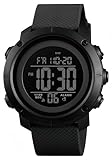
🏆 #1 Best Overall

- 10-Year Battery Life: Powered by a reliable CR2032 battery, this watch is designed to provide a decade of uninterrupted performance, perfect for everyday use and adventure.
- 100-Meter Water Resistance: Built to handle swimming, snorkeling, and other water activities with ease, ensuring durability in all conditions.
- Versatile Timekeeping Functions: Includes dual time, a 1/100-second stopwatch, and a 24-hour countdown timer with auto-repeat, ideal for managing your schedule and activities.
- Bright LED Backlight with Afterglow: The amber LED backlight ensures clear visibility in low-light environments, making it easy to read the time anytime, anywhere.
- Organized with 5 Multi-Function Alarms: Stay on track with five independent alarms, including a snooze function, and an hourly time signal for additional convenience.
The Tactical Feature Set Was Never About Gimmicks
Night vision goggle compatibility, stealth mode, kill switch functionality, and aviation-derived navigation tools weren’t added to the Tactix line to pad spec sheets. They were responses to real operational constraints, particularly for military personnel and contractors who were already using Fenix watches unofficially and needed tighter control over emissions, logging, and display behavior.
Stealth mode doesn’t just pause GPS; it halts wireless communications and data recording in a way that aligns with operational security protocols. The kill switch isn’t a party trick; it’s a fast, deliberate wipe that assumes the worst-case scenario. These features have always been niche, but they are coherent, which is more than can be said for most “tactical” branding in consumer wearables.
Materials and Finish as Signaling, Not Luxury
The Tactix line has consistently leaned into non-reflective finishes, DLC-coated titanium, and subdued colorways that trade visual flair for light discipline. This isn’t about luxury finishing in the Hodinkee sense; it’s about reducing glare, scuffs that catch light, and visual noise under harsh conditions. Even the sapphire crystal choices have historically prioritized durability and clarity under NVG use over indoor readability.
Strap options follow the same philosophy. Nylon and silicone dominate, favoring secure fit, quick drying, and comfort over extended wear rather than desk-friendly aesthetics. The watch is designed to be worn continuously, including sleep and multi-day operations, not swapped out to match an outfit.
From “Tactical Fenix” to Identity Product
Earlier Tactix models could reasonably be dismissed as a Fenix with a different skin and a few buried menu options. That criticism held water when the functional overlap was nearly total and the tactical tools felt bolted on rather than foundational. Over time, however, Garmin began using the Tactix line to explore how far the Fenix platform could be pushed when civilian compromise was no longer the priority.
The Tactix 8 represents the most confident version of that philosophy. It doesn’t try to win over casual outdoor users, and it doesn’t apologize for being excessive. Instead, it doubles down on the idea that some users want maximum control, maximum durability, and minimum broadcast of their presence—even if that means accepting extra bulk, cost, and a learning curve that feels unapologetically professional.
Tactix 8 at a Glance: Specs, Case, Display Options, and Why It Exists at All
Seen in context, the Tactix 8 isn’t trying to replace the Fenix line so much as strip it of compromise. Where the Fenix has to satisfy ultrarunners, climbers, triathletes, and weekend hikers all at once, the Tactix 8 assumes a narrower audience and pushes the same platform harder in one direction. Think of it as a Fenix taken out of the showroom and dropped straight into an operational environment.
This is why the spec sheet reads familiar at first glance, then increasingly unhinged as you dig deeper. Garmin isn’t reinventing its hardware stack here; it’s selectively reinforcing it.
Core Hardware: Familiar Bones, Less Apology
At its heart, the Tactix 8 rides on the same multi-band GNSS, sensor array, and software foundation as the latest Fenix generation. You get the full Garmin ecosystem: advanced training metrics, mapping with multi-continent coverage, SatIQ-style GNSS optimization, and compatibility with Garmin’s wider sensor and accessory lineup. If you already live inside Garmin Connect, nothing about the core experience will surprise you.
What does change is how aggressively the hardware is specified. Case sizes skew large-only, with no attempt to court smaller wrists, and the materials package defaults to DLC-coated titanium and sapphire rather than offering them as upgrades. This isn’t about choice; it’s about setting a baseline that assumes abuse.
Case Design: Size as a Feature, Not a Drawback
The Tactix 8 case is unapologetically big, thick, and heavy by consumer smartwatch standards. That mass buys rigidity, thermal stability, and impact resistance rather than wrist comfort for all-day office wear. On-wrist, it feels closer to a military instrument than a lifestyle wearable, and that’s entirely the point.
Button guards are more pronounced, lugs are squared-off, and edges are deliberately softened to avoid snagging on gear. The finish stays matte and light-absorbing, prioritizing non-reflectivity over visual drama. This is a watch designed to disappear visually, even if it never disappears physically.
Display Options: AMOLED or MIP, Both Taken to Extremes
Garmin continues to split the Tactix 8 into two philosophical camps: high-contrast AMOLED or transflective memory-in-pixel with solar assist. The AMOLED variant delivers exceptional resolution, deep blacks, and superior map readability indoors or at night, especially when paired with night-vision-compatible modes. It’s the most visually impressive Tactix to date, but it pays for that clarity in battery life if you lean on always-on settings.
The MIP solar version, by contrast, exists for users who value endurance over visual punch. In bright conditions, it remains effortlessly readable, and its power efficiency enables multi-week runtimes that still embarrass most competitors. Solar input doesn’t make it infinite, but it meaningfully stretches operational margins when charging access is limited.
Battery Life: Endurance as a Design Constraint
Battery performance is one of the clearest signals of who this watch is for. Depending on configuration and usage, the Tactix 8 operates in ranges that cover days of intensive GPS tracking or weeks of mixed use without ceremony. Power management tools are granular, allowing users to deliberately trade sensor frequency, display behavior, and connectivity for runtime.
This isn’t battery life optimized for convenience; it’s battery life optimized for planning. The expectation is that you will think about power as part of your mission or expedition profile, not hope the watch makes it through a long weekend.
Software and Compatibility: Garmin, Unfiltered
On the software side, the Tactix 8 runs Garmin’s full-fat OS with minimal hand-holding. Menus are deep, customization is extensive, and the learning curve is real if you’ve never lived inside a Fenix-class device. Health tracking, sleep analysis, and daily activity features are all present, but they feel secondary to navigation, mapping, and tactical tooling.
Smartwatch features like notifications, music control, and payments exist largely because removing them would be inconvenient, not because they define the product. This is still a Garmin watch first, not a smartwatch trying to act rugged.
Why the Tactix 8 Exists at All
The simplest explanation is that the Fenix became too successful. As Garmin refined it into a do-everything outdoor watch, it also accumulated compromises aimed at mass appeal. The Tactix 8 exists to carve out a space where those compromises are reversed, even if that means shrinking the audience.
For most users, a standard Fenix or Epix will deliver 90 percent of the experience at a lower cost and with better day-to-day comfort. The Tactix 8 justifies itself only when that remaining 10 percent matters more than price, bulk, or simplicity. That’s a narrow use case, but it’s one Garmin has chosen to serve without dilution.
Fenix DNA Turned Up to 11: What’s Actually Different Under the Hood
If the previous section explained why the Tactix 8 exists, this is where Garmin shows its work. Underneath the familiar silhouette and interface, the Tactix 8 is not a clean-sheet design, but it is far from a cosmetic reskin of the Fenix. The differences are deliberate, layered, and aimed squarely at users who treat their watch as equipment rather than lifestyle tech.
Tactical Hardware Choices, Not Just Tactical Marketing
The Tactix 8 shares core internals with the latest Fenix generation, including multi-band GNSS, an updated sensor suite, and the same mapping engine. Where it diverges is in how those components are deployed and protected, starting with materials and finish.
The bezel and case construction skew more aggressively toward abrasion resistance and glare reduction, with a matte, non-reflective treatment that feels purpose-built rather than decorative. This is a watch designed to avoid catching light, not attract it, which is a subtle but telling departure from the increasingly polished look of mainstream Fenix and Epix models.
Display Philosophy: Legibility Over Visual Flair
Depending on configuration, the Tactix 8 continues Garmin’s preference for memory-in-pixel displays rather than leaning fully into AMOLED like the Epix line. The advantage is not beauty but consistency, especially in harsh light and low-power states.
Night vision goggle compatibility is the obvious headline feature here, but the real benefit is predictable visibility across lighting conditions without relying on aggressive brightness curves. Compared to an Epix, the Tactix 8 looks utilitarian to the point of austerity, but that restraint is intentional.
Positioning, Navigation, and Sensor Bias
On paper, the positioning hardware mirrors the Fenix: multi-band GPS, SatIQ, barometric altimeter, compass, and gyroscope. In practice, the Tactix 8 prioritizes stability and redundancy over speed or user-friendly abstraction.
Features like applied ballistics support, waypoint projection, dual-grid coordinate formats, and kill switch functionality push the navigation stack beyond recreational use. This is not about recording a cleaner GPX file; it’s about controlling how location data is generated, displayed, and, when necessary, erased.
Software Layers the Fenix Never Needed
The underlying OS is unmistakably Garmin, but the Tactix 8 carries additional software layers that most Fenix users will never touch. Stealth mode, night mode, aviation-specific tools, and mission-oriented profiles sit alongside standard activity tracking without trying to integrate themselves into daily wellness workflows.
This separation matters. The Tactix 8 doesn’t pretend that tactical features are just another sport mode; they live in their own conceptual space, accessed intentionally rather than accidentally during a morning run.
Buttons, Controls, and the Absence of Convenience
The physical interface mirrors the five-button Garmin layout, but the tuning is different. Button travel feels firmer, presses more deliberate, and accidental inputs less likely when gloved or under stress.
There’s a noticeable lack of effort to streamline or simplify interactions for casual use. Compared to a Fenix that increasingly tries to accommodate touchscreen-first habits, the Tactix 8 remains stubbornly committed to mechanical control.
Size, Weight, and the Cost of Capability
Dimensionally, the Tactix 8 sits at the upper end of what most wrists will tolerate daily. Thickness, mass, and lug-to-lug presence are closer to a tool watch than a fitness wearable, and that has consequences for comfort during sleep tracking or extended desk work.
Garmin clearly accepted this trade-off. The Tactix 8 wears like equipment you put on for a purpose, not jewelry you forget you’re wearing, and that alone will disqualify it for a large segment of Fenix fans.
Shared Core, Different Intent
At its heart, the Tactix 8 runs on the same technological spine as the Fenix, but the intent behind every design decision diverges. Where the Fenix optimizes for versatility and approachability, the Tactix optimizes for control, durability, and operational clarity.
The result is not a better Fenix, but a stricter one. If you don’t immediately understand why those differences matter, you’re probably better served by Garmin’s more mainstream flagships.
Tactical-Only Features Explained: Ballistics, Night Vision, Kill Switches, and Stealth Reality
Once you move past the shared Fenix DNA, the Tactix 8 justifies its existence through features that are not lifestyle-adjacent or aspirational. These tools are narrow, deliberate, and in many cases useless unless you already know exactly why you’d need them.
Rank #2

- ⌚ MENS WATCHES ANALOG: Mens military watches made with shock-resistant stainless steel case and anti-scratch mineral window, exquisitely crafted and durable. Men's watch strap width: 22mm / 0.86 inches, stainless steel case: 42mm / 1.65 inches.
- ⌚ MILITARY WATCHES FOR MEN: This mens field watch is very suitable for active lifestyles, with a comfortable double nylon strap, will suitable for personal use and good for anniversary, graduation, business, birthday , the father's day , Christmas .
- ⌚3 ATM WATERPROOF MILITARY WATCHES: 30M waterproof, sweat-proof, rain-proof and hand-washing for daily life, no problem. But NOT suitable for swimming, bathing, diving or touch hot water. Perfect for most of indoor / outdoor sports.
- ⌚ EASY TO READ TIME: 12 / 24 hrs military time and luminous dial. The mens watches equipped with date calendar can tell you the time quickly and accurately. Come with luminous function, easy to read the time even in the dark.
- ⌚ PURCHASE WITHOUT WORRY: Japan imported quartz analog movement and battery, long-term operation. for 1 years,24-hour customer service is at your service.
This is where the watch stops pretending to be a generalist. The tactical stack is less about expanding what you can do on a Saturday hike and more about removing ambiguity when the environment, the mission, or the rules of engagement change.
Applied Ballistics: Precision, Not Convenience
The headline tactical feature remains Applied Ballistics integration, and it’s not a gimmick layered on for marketing. When paired with the appropriate AB license tier, the Tactix 8 functions as a wrist-mounted ballistic solver that accounts for elevation, inclination, wind, temperature, humidity, and Coriolis effects.
In practice, this is not something you casually “try out.” Data input is slow by consumer smartwatch standards, calculations are dense, and the interface assumes the user already understands external ballistics rather than teaching it.
Compared to pulling a phone from a pocket or referencing a dedicated Kestrel, the advantage is discretion and consolidation. The trade-off is that the watch becomes part of a larger system, not a standalone solution, and its value depends entirely on the operator’s discipline and training.
Night Vision Compatibility and Display Behavior
Night Vision Goggle compatibility is one of those features that sounds dramatic until you understand how narrowly it’s implemented. The Tactix 8 doesn’t magically glow in infrared; instead, it reduces visible light output and alters display behavior to minimize bloom and signature when viewed through NVGs.
The backlight becomes heavily restricted, color usage is suppressed, and contrast shifts toward legibility under amplification rather than daytime clarity. This makes the screen objectively worse for normal viewing, which is exactly the point.
For civilian users, this mode will feel like a curiosity. For anyone operating in low-light environments where light discipline matters, it’s a rare example of Garmin prioritizing operational requirements over user comfort.
Stealth Mode: What It Actually Does, and What It Doesn’t
Stealth Mode is often misunderstood, and Garmin doesn’t do much to clarify it. When enabled, the Tactix 8 disables wireless communications, halts GPS recording, and stops storing location-based data, effectively turning the watch into an offline timepiece with sensors running locally.
What it does not do is make you invisible. Heart rate, barometric data, and other onboard metrics can still be collected temporarily, and the watch itself remains an electronic device that can be physically detected under the right conditions.
The real value here is intent. Stealth Mode ensures that nothing leaves the device and nothing is logged unintentionally, which is a meaningful safeguard in environments where digital exhaust matters more than fitness records.
Kill Switches and Data Denial
The kill switch is the most extreme expression of the Tactix philosophy. With a predefined input sequence, the watch can instantly wipe user data, location history, and stored credentials, rendering it functionally inert from an intelligence perspective.
This is not a factory reset hidden behind menus. It’s designed to be executed under stress, without confirmation prompts, and without visual theatrics.
For everyday users, this borders on absurd overkill. For military or government operators, it’s a simple acknowledgment that wearable devices are potential liabilities as much as they are tools.
Dual-Format GPS, Mission Profiles, and Aviation Crossover
Beyond the headline features, the Tactix 8 adds quieter refinements that reinforce its mission-first identity. Dual-position coordinate formats, jumpmaster modes, waypoint projection, and aviation tools like direct-to navigation and barometric trend tracking are deeply integrated, not bolted on.
These modes do not attempt to simplify themselves for broader appeal. Menus are dense, terminology is unapologetically technical, and the watch assumes familiarity rather than curiosity.
It’s here that the Tactix 8 feels less like a smartwatch and more like a digital instrument cluster strapped to the wrist, borrowing its usability cues from avionics and field computers rather than consumer electronics.
Stealth Reality Check: Who This Is Actually For
Taken together, these features draw a hard line between capability and necessity. The Tactix 8 doesn’t make you more tactical by wearing it, and it doesn’t meaningfully enhance outdoor recreation in ways a Fenix already can.
What it does offer is confidence through constraint. By limiting convenience, visibility, and automation, Garmin has built a watch that prioritizes control and predictability over polish.
If those priorities resonate immediately, the Tactix 8 makes sense in a way few consumer wearables ever will. If they don’t, no amount of tactical branding will turn these features into something you’ll genuinely use.
Build, Wearability, and Ergonomics: Living With a 51mm Military Sledgehammer
All of that mission-first software logic would collapse instantly if the hardware didn’t match the intent. This is where the Tactix 8 stops pretending to be a variant of the Fenix and instead plants its flag as a physical object with very clear priorities. It is big, unapologetically so, and it wants you to feel that every time you strap it on.
Dimensions and Materials: When 51mm Is the Point
At 51mm, the Tactix 8 doesn’t just sit on the wrist, it occupies it. Thickness hovers in the mid-teens depending on configuration, and the footprint is closer to a dive computer than a smartwatch, even by Garmin standards.
The titanium case is bead-blasted into a non-reflective matte that looks intentionally dull, absorbing light rather than playing with it. This isn’t luxury finishing in the watch-nerd sense; it’s functional abrasion resistance designed to look the same after a year of knocks, scrapes, and door frames.
Up top, sapphire glass is standard, and Garmin opts for a flat profile rather than domed flair. It minimizes glare, protects the edges, and reinforces the tool-watch ethos, even if it lacks the visual warmth that mechanical watch collectors obsess over.
Weight Distribution and Wrist Presence
On paper, the Tactix 8 isn’t dramatically heavier than a 51mm Fenix with sapphire and titanium, but on wrist it feels more purposeful. That comes down to balance rather than mass.
The caseback sits flat and wide, spreading pressure evenly across the wrist instead of creating hot spots. During ruck marches, long hikes, and extended wear under load-bearing gear, it’s surprisingly stable for something this large.
That said, there’s no escaping physics. Smaller wrists will feel overwhelmed, and this is not a watch you forget you’re wearing while typing at a desk or sleeping in a tight bivy.
Buttons, Bezel, and Glove-First Interaction
The five-button layout is classic Garmin, but the execution here is more deliberate. Buttons are larger, more spaced out, and require a firmer press than on consumer-oriented models.
That resistance matters with gloves, wet hands, or adrenaline in the mix. Accidental inputs are rare, and each press feels mechanically defined rather than soft or mushy.
The bezel itself is tall and squared-off, protecting the crystal but also increasing the overall slab-like profile. It will catch on cuffs, jacket sleeves, and plate carriers, but that’s a known trade-off Garmin clearly accepted.
Strap System and Long-Term Comfort
Garmin’s QuickFit system remains one of the quiet ergonomic wins here. Swapping between the stock nylon tactical strap, silicone, or a third-party band takes seconds and doesn’t feel like an afterthought.
The included nylon strap deserves credit. It’s breathable, dries quickly, and distributes weight better than silicone during long wear, especially in hot environments.
However, the watch’s mass means strap choice is not optional if you care about comfort. Run it on silicone for multi-day use and you’ll feel pressure fatigue far sooner than on a smaller Fenix or Epix.
Daily Wear Reality: Tactical Tool, Not a Lifestyle Watch
This is where the Tactix 8 draws another hard line. It does not pretend to be versatile in social or professional settings.
Under a jacket, it bulges. On a shirt cuff, it fights back. At a desk, the case height constantly reminds you it’s there.
For users who genuinely live outdoors, in uniform, or in operational roles, this is acceptable friction. For anyone else, it becomes a constant negotiation between capability and inconvenience.
Durability as Design Philosophy
Everything about the Tactix 8 feels designed to survive boredom and abuse in equal measure. It’s rated for extreme temperatures, water resistance suitable for serious submersion, and impact scenarios that would destroy most consumer wearables.
Rank #3
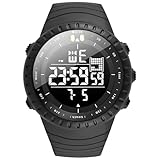
- FUNCTIONS: Countdown,Snooze,Hourly time,Date/Week,EL night-light,Stopwatch(1/100 seconds),Alarm,12/24 hour formart
- 164FT/50M WATERPROOF:Can't wear swimming and taking a hot bath. Because the general watch uses a sealing method to prevent the intrusion of sweat and harmful gases, it is not absolutely not water.only wash hands, shower, Satisfy daily use.NOTE: *Please don't press any buttons under water*
- HIGH QUALITY:Made with quality materials which enable the watch to be tough and durable.COMFORTABLE :Silicone watch band,Suitable for your wrist, Light weight and comfortable to wear.
- BACKLIGHT UPGRADE:Easy-to-read numbers can be clearly seen during the day and night.
- GIFT : It is a great gift for family and friends, especially suitable for you. WARRANTY:We provide a 12-month Movement warranty and 30-day money back guarantee. If you have any questions, please feel free to contact us.
But durability here isn’t just about surviving accidents. It’s about maintaining consistency. Buttons feel the same after months. The bezel doesn’t polish itself shiny. The case doesn’t develop character, it resists it.
That philosophy will thrill some and leave others cold. If you value patina and emotional wear, this watch gives you none. If you value predictability, it gives you exactly that.
Ergonomics in Context: Compared to the Fenix and Epix
Compared to a Fenix 7 or 7X, the Tactix 8 feels less accommodating and more demanding. The Fenix tries to balance ruggedness with everyday usability; the Tactix unapologetically tips the scale toward the former.
Against the Epix, the contrast is even sharper. Where the Epix leans into visual clarity and lifestyle adaptability, the Tactix prioritizes tactile certainty and visual restraint.
If you already find a Fenix X-size borderline excessive, the Tactix 8 will push past that line. If you’ve always wished Garmin would stop softening the edges, this is the answer.
Battery Life, Solar Performance, and Mission-Length Endurance
If the Tactix 8 feels physically demanding on the wrist, its battery philosophy mirrors that same mindset. This is not a watch designed around nightly charging habits or gentle power optimization. It is engineered to stay alive long after you stop thinking about it.
Baseline Battery Life: Built for Neglect
In standard smartwatch mode, the Tactix 8 delivers battery life that immediately outpaces lifestyle-focused Garmins and even stretches beyond most Fenix configurations. Realistically, you are looking at multiple weeks on the wrist with notifications active, wrist-based heart rate running continuously, and no obsessive micromanagement of settings.
The key difference is how consistent that performance feels over time. The battery curve drops slowly and predictably, without the sudden cliff that OLED-based models like the Epix can hit once you cross into low-charge territory.
This predictability matters more than raw numbers. When you’re running multi-day operations, long expeditions, or extended field training, knowing roughly where you’ll be tomorrow matters more than squeezing out one flashy spec-sheet maximum.
Solar Charging: Supplemental, Not Miraculous
Garmin’s solar implementation on the Tactix 8 remains true to its philosophy: it is an extender, not a savior. Under sustained outdoor exposure, especially in high-angle sunlight, solar meaningfully slows battery drain during GPS activity and daylight wear.
It does not, however, turn the watch into a perpetually powered device. You still need to start with a full charge, and you still need to manage expectations if you’re in dense forest, urban environments, or winter conditions.
Where solar earns its keep is during long GPS sessions. Activities that would normally chew through battery at an alarming rate instead feel manageable, stretching from “barely enough” into “comfortably survivable” territory.
GPS Modes and Power Profiles: Choosing Your Trade-Off
The Tactix 8 inherits Garmin’s full suite of multi-band GNSS and power management profiles, and this is where endurance becomes a tool rather than a fixed limit. Full multi-band GPS with high-frequency tracking is brutally accurate but predictably hungry.
Drop into Expedition mode or one of the custom low-power profiles, and the watch transforms. Position tracking slows, sensors scale back, and suddenly you’re talking about endurance measured in weeks rather than days.
The important point is flexibility. The Tactix 8 does not force a single definition of endurance; it lets the mission define it. That flexibility is something lifestyle users rarely exploit, but professionals absolutely will.
Night Vision, Backlight Discipline, and Power Reality
Night vision compatibility and the subdued backlight design play a subtle but real role in power efficiency. The display is legible without excessive brightness, and the watch resists the temptation to blast light at every wrist movement.
Used properly, especially in low-light or covert scenarios, this keeps battery drain under control during overnight operations. It also reinforces the watch’s character: this is a device that assumes you are paying attention to how you use it.
If you’re the kind of user who constantly wakes the screen, scrolls widgets, and treats the watch like a tiny phone, you’ll drain it faster than Garmin’s marketing suggests. The Tactix 8 rewards restraint.
Charging in the Field: Practical, Not Elegant
Despite all the endurance talk, the reality remains that you will eventually need to charge it. Garmin’s proprietary charging cable is durable but not particularly elegant, and field charging still means carrying a power bank or vehicle-based solution.
The upside is how infrequently you need to do it. Charging becomes a planned logistical event rather than a daily annoyance, which is exactly how a watch like this should behave.
For military users, first responders, or expedition leaders, that shift in charging psychology is significant. The watch fades into the background, which is the highest compliment you can give a tool designed for long-haul use.
Compared to Fenix and Epix: Endurance Over Experience
Against a Fenix, the Tactix 8 feels more single-minded. Battery life is comparable on paper in some configurations, but the Tactix encourages conservative use and rewards it more reliably.
Compared to the Epix, the difference is stark. The Epix offers a more engaging visual experience but demands far more frequent charging, especially under heavy GPS use.
If endurance is a checkbox, the Fenix and Epix can meet it. If endurance is the point, the Tactix 8 stops feeling excessive and starts feeling rational.
Navigation, Mapping, and Sensor Stack: When the Battlefield Meets the Backcountry
All that endurance only matters if the watch knows exactly where it is, and more importantly, where you’re going. This is where the Tactix 8 stops feeling like a dressed-up Fenix and starts leaning hard into its military-first identity.
Garmin has taken an already elite navigation platform and tuned it for users who assume bad reception, hostile terrain, and zero margin for error. The result is less about flashy cartography and more about trust under pressure.
Multi-Band GNSS: Accuracy Before Convenience
The Tactix 8 runs Garmin’s top-tier multi-band, multi-constellation GNSS with GPS, GLONASS, Galileo, and QZSS support, backed by SatIQ-style dynamic band switching. In practice, this means it prioritizes accuracy when conditions deteriorate and efficiency when they improve.
In dense forest, urban canyons, or steep mountain faces, track fidelity is outstanding. Lines stay tight, elevation gain doesn’t spike irrationally, and waypoint approaches feel deliberate rather than fuzzy.
What separates it from a standard Fenix isn’t raw capability but tuning philosophy. The Tactix 8 feels less eager to smooth over bad data and more willing to tell you exactly what the sensors are seeing, even if that means exposing brief signal degradation rather than masking it.
Mapping: Functional Cartography, Not Eye Candy
Out of the box, the Tactix 8 includes Garmin’s global TopoActive maps with on-device routing, terrain contours, and point-of-interest data. Satellite imagery overlays are available, but they feel secondary to the core experience rather than the star of the show.
This isn’t an Epix-style visual flex. On the transflective display, maps are high-contrast, legible in harsh light, and optimized for quick interpretation rather than aesthetic immersion.
Panning and zooming remain smooth, even with gloves or cold hands, and map redraws don’t noticeably tax the system. The watch prioritizes responsiveness and clarity over visual richness, which aligns perfectly with its mission-first attitude.
Applied Ballistics and Tactical Navigation Tools
On models equipped with Applied Ballistics, the Tactix 8 steps firmly into professional territory. Wind holds, elevation adjustments, and ballistic profiles are handled on-wrist, reducing reliance on secondary devices.
For civilian users, this will be either a revelation or completely irrelevant. For military and law enforcement professionals, it’s a legitimate force multiplier when paired with proper training.
Beyond ballistics, tactical-specific navigation tools like dual-position format, projected waypoints, and stealth mode reinforce the watch’s intent. These aren’t gimmicks layered on for marketing; they’re integrated deeply enough to feel native rather than bolted on.
ABC Sensors: Barometer, Altimeter, and Compass Done Right
The altimeter is stable over long durations, with minimal drift when properly calibrated, making it reliable for both mountain operations and airborne use. Barometric trends are consistent, which matters when weather awareness is more than casual curiosity.
Rank #4
- Fashionable and trendy items: Watches have gone beyond the role of simply telling the time and have been successfully upgraded to fashionable and trendy decorations, which not only show the value of one's life, but are also known to represent "man's self-esteem". men tend to use watches to express their personality .Clothing everyone must wear every day, while a watch is not necessarily worn by everyone, therefore, a watch will be the highlight in your outfit.
- Multi-function military sports watches : Six-hand Multi-function Quartz Movement ,3 functional little sub-dials for chronograph minute,chronograph second,chronograph 1/10 second.Clear date display.3 buttons in the case to Start/Pause,Adjust time/calender and Reset.The dial contains phosphors inside,It will make the pointer glow at night(Need to absorb enough highlights before illuminating)b-dial.
- Super Luminous : Luminous Hands & Calibration , is convenient to read the time in the dark(Luminous function needs to be activated by light)
- Water Resistant Mens Watches: 30M (100FT) Water Resistant , withstands splashes or brief immersion in water, Perfect for all kind of business, casual, indoor and outdoor activities and daily use , but not suitable for swimming or bathing
- Best Gifts for Men: Hight Quality Gift Box -- Good gift for husband, father, brother, grandfather, friends...Great surprise for Birthday, Business-gift, Christmas, Valentine day, Wedding, New Year, Father’s Day
The compass is fast to lock, resistant to interference, and doesn’t constantly demand recalibration. When navigating off-trail or in whiteout conditions, that reliability reduces cognitive load in a way that’s hard to appreciate until you’ve used a lesser system.
Temperature readings remain wrist-biased, as with any watch, but external sensor pairing helps mitigate that limitation for serious environmental tracking.
Real-World Navigation: Less Hand-Holding, More Responsibility
The Tactix 8 assumes you know how to navigate. It will show you where you are, where you’ve been, and where you intend to go, but it won’t constantly nudge, animate, or reassure you like a consumer-focused smartwatch might.
That restraint mirrors the battery philosophy discussed earlier. Fewer prompts, fewer distractions, and fewer unnecessary calculations mean both longer runtime and a clearer head.
For users coming from a Fenix, the difference is subtle but real. For those stepping up from an Epix or more lifestyle-oriented Garmin, the Tactix 8 can feel austere, even intimidating, until you realize that’s exactly the point.
Software, Ecosystem, and Real-World Usability: Is This Overkill for Civilians?
All of that restraint in navigation and sensors flows directly into how the Tactix 8 behaves day to day. This is still unmistakably a Garmin at the software level, but it’s Garmin with the sharp edges left intact instead of sanded down for mass appeal.
Garmin OS: Familiar, But Intentionally Unfriendly to the Uninitiated
If you’ve lived inside a Fenix menu tree for years, the Tactix 8 feels immediately familiar. Widgets, activities, data fields, and system logic are all evolutions of the same platform, not a forked or experimental operating system.
What changes is emphasis. Tactical profiles, aviation modes, night vision compatibility, stealth mode, and kill switch functions aren’t buried; they sit alongside running, hiking, and strength training as peers rather than novelties.
For civilians, that can feel like clutter. You’re scrolling past features you may never activate, and Garmin makes no attempt to explain or contextualize them beyond a brief description.
This is a watch that assumes competence, not curiosity. If you expect onboarding, tutorials, or a gently guided experience, the Tactix 8 will feel cold.
Garmin Connect: Powerful, Unchanged, and Showing Its Age
On the phone side, Garmin Connect remains the central nervous system. Training load, health metrics, sleep tracking, body battery, and mapping sync exactly as they do on a Fenix 8 or Epix.
That’s both a strength and a weakness. The ecosystem is deep, reliable, and trusted by professionals, but it’s also dense and occasionally overwhelming, especially when paired with a watch that already prioritizes data over polish.
For tactical users, this consistency is valuable. Logs are clean, exports are predictable, and integrations with external tools and platforms remain intact.
For civilians, especially those cross-shopping an Apple Watch Ultra or high-end Suunto, the software experience can feel utilitarian rather than refined. Garmin Connect tells you everything, but rarely tells you what actually matters.
Training, Health, and “Normal” Use: Surprisingly Ordinary
Strip away the tactical layers and the Tactix 8 behaves like a top-tier Fenix. Multiband GPS is accurate and stable, heart rate tracking is consistent, and endurance metrics remain among the best in the industry for long-duration efforts.
Sleep tracking, stress, and recovery insights are unchanged, which is to say good, not groundbreaking. The watch is happy to live as a daily health tracker if you want it to, even if that’s not its primary mission.
Comfort plays a role here. Despite the aggressive case design, weight distribution is excellent, and the watch sits securely without hot spots during long wear. The tactile buttons are easier to operate with gloves, wet hands, or under stress, which also makes them simply pleasant in daily life.
In civilian contexts, this creates a strange duality. You’re wearing something built for hostile environments, but most days it’s counting steps, tracking sleep, and reminding you to hydrate.
Battery Life as a Software Philosophy
The software discipline shows most clearly in battery behavior. The Tactix 8 doesn’t just have a large battery; it actively avoids wasting it.
Background processes are minimal, animations are restrained, and notifications feel optional rather than insistent. Solar-assisted variants further reinforce this ethos, especially for users who spend real time outdoors instead of under office lighting.
Compared to an Epix with its AMOLED display, the Tactix 8 feels slower, but also calmer. There’s less temptation to poke at it, fewer interruptions, and a stronger sense that the watch exists to support you, not entertain you.
For civilians used to smartwatch theatrics, this can feel underwhelming. For anyone prioritizing autonomy and runtime, it’s one of the Tactix line’s strongest arguments.
Compatibility, Payments, and the Stuff Civilians Actually Ask About
Yes, it does Garmin Pay, but availability still depends on your bank. Yes, it mirrors smartphone notifications, but interaction is limited and deliberately so.
Music support exists, but managing playlists on-device remains clunky compared to consumer-first platforms. This is not a watch designed to replace your phone on a casual night out.
And that’s where the overkill question sharpens. The Tactix 8 doesn’t fail at civilian smartwatch tasks; it simply treats them as secondary.
If your daily life revolves around convenience features, quick replies, and app ecosystems, you’ll constantly be reminded that you bought the wrong Garmin.
So, Is It Too Much Watch?
For most civilians, the honest answer is yes. A Fenix 8 or Epix will deliver 95 percent of the real-world utility with fewer compromises and a friendlier personality.
But for a small subset of users, including backcountry professionals, security contractors, pilots, and serious preparedness-minded enthusiasts, the Tactix 8 makes sense precisely because it refuses to soften itself.
This isn’t a lifestyle smartwatch cosplaying as tactical gear. It’s a professional-grade instrument that happens to tolerate civilian life, not the other way around.
Tactix 8 vs Fenix 8 vs Epix: Who Should Buy What (and Who Absolutely Shouldn’t)
By this point, the dividing lines should already feel less about features and more about philosophy. All three watches share the same Garmin DNA, but they express it in radically different ways depending on how much friction you’re willing to tolerate in exchange for capability.
Think of the Tactix 8 as a Fenix that stopped caring about mass appeal, the Fenix 8 as Garmin’s most balanced do-everything tool, and the Epix as the performance watch for people who still want visual pleasure every time they raise their wrist.
Tactix 8: Buy It If You Need a Tool, Not a Companion
The Tactix 8 is for users who operate in environments where discretion, resilience, and autonomy matter more than comfort or aesthetics. Night vision compatibility, stealth modes, kill switches, aviation features, and mission-focused navigation tools are not garnish here; they’re the point.
Physically, it wears like a purpose-built instrument. The case is large, flat, and unapologetically slab-sided, with matte finishes that avoid reflections and a bezel that looks designed to survive door frames, rucksacks, and armored vehicle interiors.
Comfort is acceptable rather than indulgent. You feel the weight, especially on long days, but that mass communicates durability rather than excess. The silicone or nylon strap options are functional first, stylish never.
Battery behavior defines the experience. With a memory-in-pixel display and aggressive power discipline, the Tactix 8 prioritizes uptime over visual engagement. It doesn’t invite you to interact; it waits until you need it.
You should not buy this watch if you want daily delight, quick interactions, or a smartwatch that adapts to civilian routines. If your most demanding environment is a gym or a commuter train, the Tactix 8 will feel like over-preparedness bordering on inconvenience.
💰 Best Value
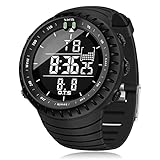
- WATCH SIZE: Case Diameter: 50mm / 1.97in, Case Thickness: 16mm / 0.63in, Band Length: 265mm / 10.4in, can suit circumference 140-220mm / 5.5-8.67in wrist to wear, Band width: 24mmm / 0.94in.
- Sports watch: Suitable for men, especially to those who like doing sports, multi-functions make it perfect for both outdoor and indoor sports, such as running, climbing, fishing and so on
- Waterproof to 50M / 164FT. In general, suitable for Swimming and cold shower,not suitable for long time underwater activities such as diving.
- Multi-functions watch: 1/100 second digital stopwatch, auto calendar, hourly alarm and alarm clock, shock resistant, 12/24 hour formats.
- High quality watch: Senior PU band, comfortable to wear. The dial window is made of acrylic mirror, high transparency, compressive and abrasion. This watch can meet your daily life, work, and sports needs.
Fenix 8: The Smart Choice for 90 Percent of Serious Users
The Fenix 8 is where Garmin’s ambition and restraint meet. It borrows heavily from the Tactix platform but strips out the niche military layers in favor of broad-spectrum outdoor competence.
In real-world use, the Fenix 8 does almost everything the Tactix does that most people will ever touch. Multi-band GPS, advanced training metrics, mapping, expedition modes, solar options, and a rugged case construction all remain intact.
The key difference is intent. The Fenix is designed to transition between trail, gym, office, and home without constantly reminding you that you’re wearing a survival instrument.
Fit and finish lean slightly more refined. Bezels are cleaner, materials feel less aggressively tactical, and sizing options are more forgiving for smaller wrists.
Battery life remains excellent, especially on solar models, but the software allows a bit more visual flair and responsiveness. It feels like a watch that expects to be used often rather than conserved.
If you’re drawn to the Tactix 8 purely because it sounds tougher, stop and reassess. The Fenix 8 will handle extreme endurance events, mountaineering, and professional guiding work without the social and ergonomic penalties.
Epix: The Performance Watch for People Who Still Like Looking at Their Watch
The Epix occupies a different psychological space altogether. Underneath, it shares much of the Fenix’s hardware and software stack, but the AMOLED display fundamentally changes how the watch feels on the wrist.
Everything is more immediate. Maps pop, data fields are easier to read at a glance, and the watch encourages interaction in a way the Tactix actively discourages.
This comes at a cost. Battery life, while still strong by smartwatch standards, cannot compete with the MIP-based Fenix or Tactix in long expeditions or multi-day field work.
The Epix is also less forgiving in harsh conditions. The display is tougher than it looks, but it’s still more exposed to scratches and glare than Garmin’s utilitarian screens.
You should buy the Epix if your activities are intense but bounded. Think training cycles, races, travel, and daily wear where charging every few days is acceptable.
You should not buy it if you expect your watch to disappear into the background for weeks at a time or function reliably in light discipline or austere environments.
Where the Tactix 8 Actually Justifies Itself
The uncomfortable truth is that the Tactix 8 exists for a very small audience. Its advantages only materialize when you actively need them, not when you admire them on a spec sheet.
If you work in aviation, security, defense, search and rescue, or remote field operations, the Tactix 8’s feature set can reduce risk and cognitive load. The watch is designed to fail quietly and predictably rather than impress.
For preparedness-minded civilians, it can make sense, but only if you genuinely train and operate with the same constraints the watch is built for. Otherwise, you’re carrying capability you’ll never deploy.
Garmin didn’t make the Tactix 8 to be aspirational. They made it to be uncompromising, and that’s precisely why it’s such a poor fit for most buyers.
The One-Line Buying Advice Garmin Won’t Give You
Buy the Tactix 8 only if you already know why you need it. Buy the Fenix 8 if you want one watch that can realistically handle everything. Buy the Epix if performance matters but so does enjoyment.
And if you’re still undecided, that hesitation alone is probably your answer.
Final Verdict: A Purpose-Built Weapon or Peak Garmin Excess?
The hesitation you feel at this point is intentional. Garmin built the Tactix 8 to provoke a binary reaction: either immediate recognition or complete confusion. There is very little middle ground, and that’s exactly the point.
The Tactix 8 Is Not a Better Fenix—It’s a Narrower One
The easiest mistake is to frame the Tactix 8 as the “ultimate” Fenix. In reality, it’s a deliberate narrowing of focus that trades versatility for predictability, discipline, and operational consistency.
Yes, it inherits the Fenix platform almost wholesale: the same GPS accuracy, the same sensor suite, the same navigation engine, and the same bombproof case architecture. But where the Fenix tries to be adaptable, the Tactix commits to restraint, prioritizing legibility, battery endurance, and low-observability over comfort features or visual flair.
This is why it feels less friendly on the wrist. The muted display, heavier case, and conservative interface aren’t oversights; they’re guardrails.
Military Features That Matter—But Only If You Live With Them
The aviation tools, stealth mode, kill switch, night vision compatibility, and ballistics support aren’t gimmicks. They are genuinely useful in specific contexts where information control and failure behavior matter more than convenience.
For pilots, operators, and tactical professionals, the Tactix 8 reduces friction rather than adding features. It does not ask for attention, it does not demand charging anxiety, and it does not introduce unnecessary visual noise when conditions deteriorate.
For everyone else, these tools quietly sit unused while you absorb the downsides: slower interaction, fewer display luxuries, and a watch that feels perpetually “on duty” even when you’re just grabbing coffee.
Daily Wear Reality: Durable, Dependable, and Emotionally Cold
As a daily wearable, the Tactix 8 is competent but joyless. Comfort is acceptable for its size, helped by well-designed straps and balanced weight, but it never disappears on the wrist the way a Fenix can.
Software stability is excellent, battery life is outstanding, and health tracking is as comprehensive as Garmin offers. But this is not a watch that rewards casual engagement or makes you want to explore its features.
It is a tool that waits patiently until needed—and that emotional distance will either reassure you or push you away within weeks.
Value Judgment: Overkill or Exactly Enough
The Tactix 8 is expensive not because it does more, but because it does less with greater intent. You are paying for omission as much as inclusion.
If your life includes long intervals without charging, environments where visibility control matters, or scenarios where reliability trumps enjoyment, the price makes sense quickly. Few wearables are as trustworthy under neglect and stress.
If your use case is training, adventure, travel, or daily life with moments of intensity, the Fenix 8 or Epix will feel more rewarding, more modern, and frankly more human.
The Final Call
The Garmin Tactix 8 is not peak Garmin excess—it’s peak Garmin discipline. That distinction matters.
It is a purpose-built weapon for a narrow audience that knows exactly what it needs and what it’s willing to give up. For everyone else, it’s an impressive reminder that more capability does not always mean a better experience.
If the Tactix 8 makes immediate sense to you, you’re probably the right buyer. If you’re still trying to justify it, Garmin already has a better watch for you.