Garmin didn’t just update a satellite messenger with the inReach Mini 3 Plus; it quietly redrew the line between what belongs on your wrist and what belongs in your pack. For years, the Fenix line has expanded outward, absorbing safety, navigation, and expedition features until the watch itself became a survival hub. This launch signals a reversal: Garmin is again prioritizing task-specific hardware when reliability, battery endurance, and consequence matter more than convenience.
If you’re weighing a Fenix 8 Pro against a Mini 3 Plus, this is no longer a simple smartwatch-versus-accessory debate. Garmin is effectively asking experienced users to separate performance tracking from true off-grid safety, and to recognize that one device cannot optimally do both without compromise. Understanding why Garmin made that call, and who it benefits, is the key to making the right buying decision in 2026.
What follows explains why the Mini 3 Plus is strategically disruptive, how it undercuts the Fenix 8 Pro’s expanding role, and why Garmin’s shift from wrist to pack is more intentional than it first appears.
Garmin is re-centering satellite safety around single-purpose reliability
The inReach Mini 3 Plus matters because Garmin is doubling down on a device that exists for one job: guaranteed satellite communication, all the time, without distraction. Unlike a Fenix 8 Pro, which must balance AMOLED brightness, multi-band GNSS tracking, sensors, and daily smartwatch duties, the Mini 3 Plus is optimized for Iridium connectivity, message delivery, and SOS integrity above all else.
🏆 #1 Best Overall

- Stylish Design, Vibrant Display: The lightweight aluminum build blends effortless style with workout durability, while the vivid 1.97" AMOLED display keeps your data easy to read, even under bright sunlight.
- All-in-One Activity Tracking: The Amazfit Bip 6 fitness tracker watch offers 140+ workout modes including HYROX Race and Strength Training, plus personalized AI coaching and 50m water resistance.
- Up to 14 Days Battery Life: The Amazfit Bip 6 smart watch powers through your training and recovery for up to two weeks at a time - no nightly charging needed.
- Accurate GPS Tracking & Navigation: Stay on course with free downloadable maps and turn-by-turn directions. Support from 5 satellite systems ensures precise tracking of every move and fast GPS connection.
- 24/7 Health Monitoring: The Amazfit Bip 6 smartwatch provides precise, real-time monitoring of heart rate, sleep, blood-oxygen and stress, empowering you with actionable insights to optimize your health and fitness.
This focus allows Garmin to prioritize battery longevity measured in days or weeks of standby and tracking, rather than hours of GPS activity mixed with daily wear. In real-world expeditions, that distinction is critical; a drained watch is an inconvenience, but a dead satellite communicator can be catastrophic. By separating these roles again, Garmin is acknowledging that redundancy and specialization beat convergence when conditions deteriorate.
The Mini 3 Plus exposes the hidden compromises of wrist-based satellite tech
On paper, the Fenix 8 Pro’s inReach integration looks compelling: SOS, message presets, and location sharing from the wrist. In practice, wrist-based satellite communication is constrained by antenna orientation, battery conservation, and user behavior that assumes daily recharging access.
The Mini 3 Plus avoids these compromises by design. Its larger internal antenna, pack-mounted orientation, and always-on readiness make it far more reliable in dense tree cover, narrow canyons, and alpine terrain where wrist positioning is inconsistent. Garmin isn’t saying the Fenix 8 Pro is unsafe, but it is implicitly acknowledging that true satellite dependability is better served by a device you clip to a shoulder strap, not one buried under a jacket cuff.
Battery strategy is the real differentiator, not features
Garmin’s strategic shift becomes obvious when you look at power management philosophy. The Fenix 8 Pro still delivers class-leading battery life for a smartwatch, but it is fundamentally optimized for daily charging cycles, mixed-use scenarios, and health tracking continuity.
The inReach Mini 3 Plus is optimized for neglect. It is built for users who may not touch a charger for a week, who may forget to turn it off, and who need predictable endurance even when temperatures drop or usage spikes. This difference alone explains why the Mini 3 Plus undercuts the idea that a high-end multisport watch can fully replace a dedicated communicator.
Garmin is segmenting users by consequence, not capability
The Mini 3 Plus exists because Garmin understands that not all outdoor users face the same stakes. Trail runners, fastpackers, and endurance athletes benefit more from the Fenix 8 Pro’s rich training metrics, navigation overlays, and wrist-based convenience.
Backcountry skiers, climbers, thru-hikers, and expedition leaders benefit more from a device whose sole purpose is staying alive and connected when everything else fails. By strengthening the Mini line instead of folding it further into the Fenix ecosystem, Garmin is making that distinction explicit and forcing buyers to choose based on risk tolerance, not feature count.
The Fenix 8 Pro doesn’t lose relevance, but it loses exclusivity
Before the Mini 3 Plus, the Fenix 8 Pro could plausibly be framed as a do-it-all solution for serious adventurers. This launch reframes it as the best performance and navigation watch Garmin makes, not the most dependable safety device.
That distinction matters because it reshapes buying logic. Instead of stretching one expensive watch to cover every scenario, Garmin is encouraging a two-device strategy for high-risk users: performance on the wrist, protection in the pack. The Mini 3 Plus doesn’t replace the Fenix 8 Pro, but it does strip away the idea that the watch alone is enough when consequences escalate.
What the inReach Mini 3 Plus Actually Delivers in the Field (and Why It’s Not Just an SOS Brick)
If the strategic takeaway so far is that Garmin is separating performance from consequence, the in-field behavior of the inReach Mini 3 Plus explains why that separation works. This device is not impressive on a spec sheet in the way a Fenix 8 Pro is, but it becomes far more impressive after three days without cell service, in bad weather, with gloves on, and no certainty about when you’ll see a wall outlet again.
The Mini 3 Plus earns its place not through feature breadth, but through reliability density. Everything it does is optimized to work when conditions, attention, and energy reserves are all degraded.
Two-way satellite messaging that behaves like a tool, not a novelty
At the core of the Mini 3 Plus is Garmin’s Iridium-based two-way messaging, and in real use it feels more mature than any smartwatch-embedded alternative. Messages send predictably, thread clearly, and maintain state even when transmission windows are intermittent due to terrain or weather.
This matters because communication in the backcountry is rarely urgent in the cinematic sense. It’s logistical, corrective, and often preventative. Updating an exit time, coordinating a pickup shift, or explaining a delay is where two-way messaging earns its keep long before SOS is ever touched.
The Mini 3 Plus also handles message composition better than prior Minis, with faster syncing through the Garmin Messenger app and fewer moments where the device feels like it’s fighting the phone. It’s still not something you’ll want to type essays on, but it’s efficient, calm, and predictable, which is exactly what you want when energy and patience are limited.
SOS is still the headline, but the escalation pathway is the real value
Yes, the SOS button is the emotional center of the inReach line, and the Mini 3 Plus keeps Garmin’s industry-leading emergency response integration intact. Activation is deliberate, protected, and immediately confirmed, which reduces both accidental triggers and user hesitation.
What’s more important is what happens after activation. The ability to communicate details, receive instructions, and update responders turns SOS from a binary panic button into an active problem-solving channel. This is a subtle but critical distinction, especially in scenarios where evacuation may not be immediately necessary but external guidance is.
Compared to relying on a watch-based SOS feature, the Mini 3 Plus feels less fragile in this role. It has fewer dependencies, fewer background processes, and fewer competing priorities. When things go wrong, it behaves like a single-purpose instrument rather than a multitasking computer.
Battery life that changes how you think about carrying electronics
The Mini 3 Plus does not just last a long time; it removes battery anxiety from the decision-making loop. In tracking modes with periodic messaging, it can realistically be trusted for multi-day to week-long outings without rationing behavior.
That endurance is paired with a power profile that tolerates neglect. Forgetting to power it down overnight, cold exposure, or extended idle time doesn’t meaningfully compromise its usefulness. This is where it fundamentally diverges from even the best multisport watches, which still reward attentive charging habits.
In practice, this means users stop treating the Mini 3 Plus as a gadget to manage and start treating it like safety equipment. That psychological shift is one of the most underappreciated advantages of a dedicated communicator.
Navigation as reassurance, not performance theater
The Mini 3 Plus offers basic navigation, breadcrumb tracking, waypointing, and course following, but it does not pretend to replace a full mapping watch or handheld GPS. The screen is small, the interface is simple, and the expectations are set accordingly.
What it does well is provide confirmation. Confirming you’re still on course, confirming a bailout route, or confirming that your last known position is logged and shareable if something goes wrong. It’s navigation designed to reduce uncertainty, not optimize pace or efficiency.
This is also where overlap with the Fenix 8 Pro becomes clear. The watch is far superior for active navigation and decision-making on the move, but the Mini 3 Plus is better as a passive recorder and fallback reference that doesn’t drain critical resources.
Physical design that favors survivability over comfort
Worn or carried, the Mini 3 Plus is unobtrusive but purpose-built. The casing prioritizes impact resistance, water sealing, and button reliability over aesthetics or thinness. Buttons are tactile, spaced for gloved use, and operate with consistent feedback even when wet or cold.
There’s no pretense of daily wear comfort here, and that’s intentional. This is a device you clip to a pack strap, lash to a harness, or bury in a jacket pocket, knowing it will still work when retrieved days later.
In contrast, a Fenix 8 Pro is designed to be worn constantly, which is a strength until it isn’t. The Mini 3 Plus accepts that sometimes the most reliable device is the one you don’t interact with very often.
Software integration that complements, rather than competes with, a watch
Garmin’s ecosystem decisions are most visible in how the Mini 3 Plus interacts with watches rather than trying to replace them. Syncing tracks, sharing location data, and managing messages through a phone creates a layered system where each device does what it’s best at.
This layered approach undermines the idea that a flagship watch should be expected to handle everything. Instead of duplicating training metrics or health data, the Mini 3 Plus focuses on communication continuity and positional awareness.
For users already invested in the Garmin ecosystem, this division of labor feels intentional rather than fragmented. The Mini 3 Plus doesn’t compete for wrist time; it competes for peace of mind.
Why this matters for buyers weighing it against the Fenix 8 Pro
In the field, the Mini 3 Plus makes a strong case that safety and performance should not share the same failure modes. A smartwatch can crash, drain, or be removed without notice. A dedicated communicator exists precisely to avoid those scenarios.
This doesn’t make the Fenix 8 Pro less capable, but it reframes its role. The watch becomes the tool for moving efficiently and intelligently through terrain, while the Mini 3 Plus becomes the tool for staying connected when efficiency stops mattering.
That reframing is why the Mini 3 Plus feels like more than a product update. It’s a quiet but firm statement from Garmin that consequence-driven users deserve hardware that assumes things will go wrong, not hardware that hopes they won’t.
The Fenix 8 Pro’s Original Pitch: Ultimate Adventure Watch or Overkill for Real Expeditions?
Garmin didn’t position the Fenix 8 Pro as just another multisport watch. It was framed as the apex predator of outdoor wearables, a single device meant to cover training, navigation, safety, and daily life without compromise.
Rank #2

- Stylish Design, Bright Display: The sleek stainless steel build blends classic style with workout durability, while the bright 1.32" AMOLED display keeps your data easy to read, even under bright sunlight.
- Precise Heart Rate and Sleep Tracking: Amazfit's BioTracker technology tracks your heart rate and sleep data with accuracy that previous sensors just can't match.
- Up to 10 Days of Battery Life: With long battery life that lasts up to 10 days with typical use, nightly recharges are a thing of the past.
- Free Maps with Turn Directions: Stay on-track with free downloadable maps, and get turn-by-turn guidance on-screen or via your Bluetooth headphones. Enjoy ski maps for global resorts, including guidance for cable cars, slopes, and more.
- Faster and More Accurate GPS Tracking: 5 satellite positioning systems ensure fast GPS connection and accurate positioning whenever you're out running, walking, cycling or hiking.
That promise matters, because the Fenix line has long been the default answer to a deceptively simple question: if you could only bring one piece of Garmin hardware into the backcountry, wouldn’t you want it on your wrist?
The “do everything” thesis behind the Fenix 8 Pro
On paper, the Fenix 8 Pro reads like the logical endpoint of smartwatch evolution for outdoor athletes. Multi-band GNSS, offline mapping with routable trails, climb metrics, solar-assisted battery life, wrist-based navigation prompts, flashlight, dive ratings, and full health tracking are all packaged into a single device.
Physically, it reinforces that positioning. The case is unapologetically large, built in titanium or DLC-coated steel, with sapphire glass and enough water resistance to survive everything from alpine storms to technical canyon descents. It wears like equipment, not jewelry, and Garmin leans into that.
The value proposition is clear: one device, zero trade-offs. No second gadget to manage, no extra charging cable, no separate subscription just to stay safe.
Where the pitch starts to strain under expedition realities
The problem isn’t capability, it’s concentration of risk. By asking the Fenix 8 Pro to be your navigator, communicator, training computer, and daily smartwatch, Garmin also makes it a single point of failure.
Battery management becomes a constant background task on long trips. Navigation accuracy, display brightness, and satellite acquisition are excellent, but they draw from the same power reserve that handles health tracking, notifications, and background sensors. Even solar models only slow depletion; they don’t remove the anxiety.
Then there’s wearability under stress. A watch is exposed hardware. It can be smashed against rock, removed for comfort, frozen, or simply forgotten in a tent at the wrong moment. Expedition users know this isn’t hypothetical; it’s routine.
The subtle mismatch between training watch and survival tool
The Fenix 8 Pro is at its best when you are actively engaging with it. You’re checking metrics, following routes, pacing climbs, and optimizing effort. That mindset aligns perfectly with trail running, fastpacking, and guided adventures.
True expeditions often demand the opposite. Long static periods, cold hands, minimal interaction, and a preference for hardware that just works in the background. In those moments, the Fenix’s strengths become less relevant than its vulnerabilities.
This is where the original pitch starts to feel slightly overextended. Not wrong, but overly optimistic about how real expeditions actually unfold.
Why the Fenix 8 Pro still makes sense for many users
None of this diminishes the Fenix 8 Pro as a product. For athletes who move fast, return to charging points frequently, and want training continuity alongside navigation, it remains unmatched.
It’s also the better daily companion. Comfort has improved despite its size, strap options are extensive, and Garmin’s software maturity means it can replace a standard smartwatch without feeling compromised. As an everyday device that occasionally ventures far from civilization, it excels.
The issue isn’t whether the Fenix 8 Pro is good enough. It’s whether it should be asked to carry responsibilities that historically belonged to dedicated, purpose-built hardware.
The opening this creates for the inReach Mini 3 Plus
Seen through this lens, the arrival of the inReach Mini 3 Plus doesn’t attack the Fenix 8 Pro head-on. It exposes the limits of the original “one device does everything” argument.
By separating communication and safety from performance and training, Garmin effectively admits that ultimate capability isn’t about stacking features onto a wrist. It’s about isolating failure modes.
That shift doesn’t dethrone the Fenix 8 Pro, but it reframes it. Not as the singular solution for all adventure scenarios, but as one half of a system that now feels more honest about what real expeditions demand.
Feature Overlap That Changes the Buying Equation: Satellite Messaging, Navigation, and Safety
The strategic tension between the Fenix 8 Pro and the inReach Mini 3 Plus becomes clearest when you look at how much functional ground they now share. Garmin hasn’t simply added redundancy for redundancy’s sake. It has allowed two very different devices to overlap in the exact areas that matter most when things stop going to plan.
What used to be a clean division—watch for performance, inReach for emergencies—has blurred into a more uncomfortable comparison.
Satellite messaging is no longer a “nice to have” on the wrist
On paper, the Fenix 8 Pro’s satellite messaging capability looks like the ultimate convenience. You can send and receive texts, share location, and trigger SOS without reaching for another device. For many users, especially those coming from earlier Fenix generations or Apple Watch Ultra, that feels like progress.
In practice, the inReach Mini 3 Plus reframes what satellite messaging is supposed to be. It is always on, always reachable, and fundamentally unconcerned with activity modes, battery profiles, or wrist interaction. Messages arrive whether you are moving, stopped, or sheltering in place with gloves on.
That difference sounds subtle until you’re several days into a trip and conserving every percentage point of battery. On the Fenix, satellite messaging competes with GPS tracking, mapping refresh, sensor polling, and the simple reality that it is also your watch. On the inReach, messaging is the job.
Navigation overlap, different priorities
The Fenix 8 Pro remains the superior navigation tool in terms of on-device experience. Its mapping is richer, route guidance is more intuitive at speed, and the visual clarity of a large AMOLED or MIP display matters when you are actively moving through complex terrain. For trail running, ski touring, or fast alpine days, it’s the better interface.
The inReach Mini 3 Plus approaches navigation from a more conservative angle. Breadcrumb tracking, waypoint navigation, and basic course following are not designed to optimize pace or efficiency. They are designed to answer one question reliably: where am I, and can someone else find me if needed?
Crucially, the Mini 3 Plus offloads much of the planning and map interaction to the Garmin Explore ecosystem. That means less fiddling in the field and fewer reasons to keep the screen active. It’s slower, but intentionally so.
Safety workflows expose the limits of “one device” thinking
Both devices can trigger SOS through Garmin Response, but the experience diverges immediately after that button is pressed. On the Fenix 8 Pro, SOS is integrated into a device that assumes constant user engagement. The watch expects you to confirm, interact, and manage the situation through a small touchscreen or buttons.
The inReach Mini 3 Plus is built around the opposite assumption. Once SOS is active, its job is to stay alive, stay connected, and keep transmitting. Physical buttons, simplified menus, and a single-minded software flow reduce the chance of user error when stress, cold, or injury are factors.
This is where overlap turns into hierarchy. The Fenix can do emergency communication. The inReach is an emergency communicator.
Battery life and failure isolation change risk math
Battery discussions often devolve into headline numbers, but the more important distinction is how that battery is spent. The Fenix 8 Pro’s endurance is impressive for a smartwatch, yet it is inherently variable. Long GPS activities, frequent screen wake-ups, and background features all chip away at reserves.
The inReach Mini 3 Plus operates on predictability. Its battery life is measured in days or weeks of standby and tracking, not hours of activity. More importantly, it is not affected by how ambitious your training plan was earlier in the trip.
This separation of power budgets matters. When navigation, communication, and safety are tied to a single rechargeable device on your wrist, every feature becomes a potential liability. By splitting those responsibilities, Garmin effectively lowers the stakes of any single failure.
Who the overlap actually favors
For users who treat satellite messaging as an occasional safety net, the Fenix 8 Pro’s overlap is liberating. It simplifies the kit list, reduces weight, and keeps everything on the wrist. If your adventures are intense but short, or supported by regular access to power, the watch-alone approach still makes sense.
For expedition users, guides, solo travelers, and anyone planning long periods without resupply, the overlap works in the opposite direction. The inReach Mini 3 Plus doesn’t just duplicate features. It removes pressure from the watch to be something it was never designed to be all the time.
That is why this overlap matters. It doesn’t just add options. It forces a clearer choice about what you expect to protect you when performance stops being the priority and survival quietly takes over.
Rank #3
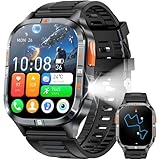
- BUILT-IN GPS & COMPASS– This military smartwatch features high-precision GPS to pinpoint your location while hiking, cycling, or traveling, keeping you safely on track without extra gear. Tap the compass icon and it locks your bearing within three seconds—engineered for pro-level outdoor adventures like camping, climbing, and trekking.
- BLUETOOTH CALLING & MESSAGES – Powered by the latest Bluetooth tech, the men’s smartwatch lets you answer or make calls right from your wrist—no need to pull out your phone. Get real-time alerts for incoming texts and app notifications so you never miss an invite. (Replying to SMS is not supported.)
- BIG SCREEN & DIY VIDEO WATCH FACE – The 2.01" military-spec display is dust-proof, scratch-resistant, and forged from high-strength glass with an aluminum alloy bezel, passing rigorous dust and abrasion tests so the screen stays crystal-clear. Upload a short family video to create a dynamic, one-of-a-kind watch face that keeps your memories alive.
- 24/7 HEALTH MONITORING – Equipped with a high-performance optical sensor, this Android smartwatch tracks heart rate and blood-oxygen levels around the clock. It also auto-detects sleep stages (deep, light, awake) for a complete picture of your health, ensuring you always know how your body is doing.
- MULTI SPORT MODES & FITNESS TRACK – Choose from running, cycling, hiking, basketball, and more to log every workout. Set goals, monitor progress, and sync data to the companion app. Bonus tools include photo gallery, weather, alarm, stopwatch, flashlight, hydration reminder, music/camera remote, find-my-phone, mini-games, and other everyday essentials.
Battery Life as the Real Differentiator: Multi-Day Expeditions vs Daily Training
The conversation naturally shifts from capability overlap to endurance reality. Once communication, navigation, and safety are in play at the same time, battery life stops being a spec and starts being a strategy.
Smartwatch endurance is elastic by design
The Fenix 8 Pro sits at the top of the smartwatch endurance curve, especially in its larger case sizes with solar assist. In day-to-day training mode, it can comfortably last over a week, and even longer if you are disciplined about screen usage and background features.
That endurance, however, is elastic. Multi-band GPS, high-frequency heart rate sampling, onboard maps, music playback, and constant sensor polling all pull from the same battery pool. The more you lean on the watch as an all-in-one tool, the faster its theoretical battery advantage compresses in real-world use.
The inReach Mini 3 Plus treats power as a safety reserve, not a performance metric
The inReach Mini 3 Plus approaches battery life from a fundamentally different philosophy. Its power draw is narrow, intentional, and largely independent of how hard you pushed earlier in the day. Tracking intervals, message checks, and SOS readiness operate on predictable curves measured in days of use and weeks of standby.
Because the device has no training load, no wrist-based optical heart rate, and no always-on display to wake accidentally under a jacket cuff, its battery behaves the same on day one as it does on day ten. That consistency is the quiet upgrade that matters most to expedition users.
Charging logistics reshape what “lightweight” really means
On paper, carrying a single Fenix 8 Pro looks like the minimalist choice. In practice, extended trips often force you to bring power banks, solar panels, or rationed charging schedules to keep the watch alive once it becomes your navigator, tracker, and communicator.
The inReach Mini 3 Plus flips that equation. Its longer intervals between charges reduce dependency on external power, which can ultimately lower total carried weight and mental overhead. When charging opportunities are scarce or unreliable, fewer charging events become more valuable than fewer devices.
Failure isolation is battery management in disguise
Battery life is not just about duration; it is about containment. When a smartwatch battery drains unexpectedly, you lose training data, navigation, and communication at the same time. That kind of cascading failure is rare, but it is exactly what planning tries to eliminate.
With the inReach Mini 3 Plus, battery isolation becomes a form of redundancy. Even if your watch is dead from days of mapping and GPS logging, your lifeline to the outside world remains intact, powered by a system designed to do almost nothing else.
Daily athletes versus expedition planners
For runners, climbers, and endurance athletes who train frequently and adventure in shorter bursts, the Fenix 8 Pro’s battery life is more than sufficient. Overnight charging, occasional top-ups, and predictable routines align perfectly with a smartwatch-first approach.
For those planning unsupported routes, guiding clients, or moving through environments where power is uncertain, the inReach Mini 3 Plus changes the buying calculus. Its battery life is not about convenience or comfort; it is about preserving communication capacity long after performance tracking becomes irrelevant.
Wearability vs Deployability: Wrist-Based Convenience or Purpose-Built Redundancy?
Once battery strategy is accounted for, the next fault line between the Fenix 8 Pro and the inReach Mini 3 Plus is not capability, but placement. Where a device lives on your body, and how intentionally it is deployed, shapes how it survives stress, weather, and human error over time.
This is where Garmin’s smallest inReach quietly challenges the assumption that wrist-based integration is always superior.
The Fenix 8 Pro as an always-on instrument
The Fenix 8 Pro is designed to disappear on the wrist. Its titanium or steel case, integrated lugs, and flexible QuickFit bands make it comfortable enough to wear 24/7, even under pack straps or gloves.
That constant presence is its greatest strength. Navigation prompts, training metrics, altitude changes, and incoming messages are surfaced instantly, without reaching for a pocket or pack.
But wearability comes with exposure. Watches take the brunt of rock scrapes, ice tool collisions, and repetitive impact, especially in alpine or scrambling environments where wrists lead the movement.
InReach Mini 3 Plus: deploy when needed, protect when not
The inReach Mini 3 Plus is not meant to be worn continuously. At roughly the size of a matchbox, it lives clipped to a shoulder strap, stowed in a hip belt, or secured inside a jacket until communication is required.
That separation is intentional. By decoupling satellite communication from constant physical exposure, Garmin reduces the risk of accidental damage to the one device meant to function when everything else has gone wrong.
In real-world expedition use, this deployability matters. You are less likely to crack a screen, shear a button, or compromise sealing on a device that spends most of its time protected rather than worn.
Redundancy is physical, not just digital
Garmin’s ecosystem encourages feature overlap, but redundancy only works if failure modes are independent. A wrist-based communicator shares the same risks as the wrist that wears it.
A fall that injures your arm can render a watch inaccessible or damaged. Gloves, swelling, or immobilization can make touchscreens and side buttons unusable when stress is highest.
The inReach Mini 3 Plus avoids that trap. Its physical buttons, high-contrast display, and one-handed operation are designed for compromised conditions, not comfort or aesthetics.
Comfort over time versus reliability over consequence
Over long days, the Fenix 8 Pro excels at comfort. Weight distribution, breathable straps, and refined case ergonomics make it easy to forget you are wearing a full-featured computer.
Yet comfort is not the same as reliability under consequence. When a device becomes mission-critical, being slightly inconvenient but consistently accessible can outweigh seamless integration.
The Mini 3 Plus trades elegance for certainty. You know exactly where it is, exactly what it does, and exactly how to activate it under pressure.
The psychological load of wrist-based dependence
There is also a cognitive element at play. Wearing a single device that tracks, navigates, and communicates can create a false sense of simplicity.
In practice, it concentrates responsibility. Every glance at battery percentage, every route recalculation, every missed charge compounds anxiety because so much depends on one object staying alive and intact.
Splitting roles between a Fenix and an inReach offloads that pressure. The watch can be optimized for performance and awareness, while the communicator exists purely as insurance.
Why this undercuts the Fenix 8 Pro’s all-in-one appeal
Garmin’s messaging around the Fenix 8 Pro leans heavily into consolidation. One device, one ecosystem, fewer compromises.
The inReach Mini 3 Plus complicates that story. By being lighter, longer-lasting, and more resilient specifically at communication, it exposes where all-in-one solutions still make trade-offs.
For users who operate in environments where failure is inconvenient, the Fenix 8 Pro is compelling. For users who operate where failure is unacceptable, the Mini 3 Plus reframes what the “right” device actually looks like.
Who the inReach Mini 3 Plus Is For (and Who It Definitely Isn’t)
Seen through that lens, the Mini 3 Plus is not trying to replace the Fenix 8 Pro so much as expose the limits of what a wrist-based computer should be responsible for. Its value only really clicks once you accept that specialization, not consolidation, is the point.
Backcountry users who treat communication as safety gear, not a feature
If you already think of satellite messaging as something closer to a PLB than a smartwatch function, the Mini 3 Plus is aimed squarely at you. This is for hikers, climbers, guides, and solo travelers who want a device whose sole job is to get messages out and rescue in, regardless of what your watch, phone, or body is doing.
Rank #4

- 【Built-in GPS & Multi-System Positioning】Stay on track with the Tiwain smartwatch’s built-in GPS. Featuring military-grade single-frequency and six-satellite support (GPS, GLONASS, Beidou, Galileo, NAVIC, QZSS), this watch offers fast and accurate location tracking wherever you go. It also includes a compass, altimeter, and barometer, giving you real-time data on your altitude, air pressure, and position.
- 【Military-Grade Durability】Engineered to withstand the toughest conditions, the Tiwain smartwatch meets military standards for extreme temperatures, low pressure, and dust resistance. Crafted from tough zinc alloy with a vacuum-plated finish, this watch is also waterproof and built to resist wear and tear. The 1.43-inch AMOLED HD touchscreen offers clear visibility in all environments, and the watch supports multiple languages for global users.
- 【170+ Sport Modes & Fitness Tracking】Track your fitness journey with 170+ sport modes, including walking, running, cycling, hiking, basketball, and more. Set exercise goals, monitor progress, and sync your data to the companion app. The smartwatch also offers smart features like music control, camera remote, weather updates, long-sitting reminders, and more.
- 【LED Flashlight for Outdoor Adventures】The Tiwain smartwatch comes equipped with a built-in LED flashlight that can illuminate up to 20 meters. Activate it with the side button for added convenience during nighttime activities or outdoor adventures.
- 【Comprehensive Health Monitoring】Monitor your health with real-time heart rate, sleep, blood pressure, and blood oxygen level tracking. The smartwatch will vibrate to alert you of any abnormal readings. You can also make and receive calls directly from the watch, and stay connected with message and app notifications (receive only, no sending capability) – perfect for when you’re driving or exercising.
The Mini 3 Plus makes sense when you clip it to a shoulder strap and largely forget about it until you need it. Its long standby life, glove-friendly buttons, and simplified interface reduce the chance of error when stress, cold, or fatigue set in.
For these users, the Fenix 8 Pro’s satellite features feel like an elegant bonus layered onto a very busy device. The Mini 3 Plus, by contrast, is psychologically categorized as emergency infrastructure, not wearable tech.
Expedition and multi-day athletes managing power over weeks, not days
Battery strategy is where the Mini 3 Plus quietly undercuts the Fenix 8 Pro’s all-in-one promise. When you are counting nights, not workouts, separating communication from performance tracking becomes a power-management advantage.
Trail runners on fastpacking routes, bikepackers crossing remote regions, and mountaineers on extended pushes can let the watch do what it does best while preserving the communicator as a sealed reserve. The Mini 3 Plus can sit dormant for days, then spring to life without you worrying about maps, music, or background health metrics draining it.
In those scenarios, the Fenix 8 Pro becomes a consumable tool. The Mini 3 Plus becomes the constant.
Professionals and leaders responsible for other people
Guides, trip leaders, and instructors sit in a different risk category altogether. When you are accountable for clients, students, or a team, redundancy is not paranoia, it is professionalism.
The Mini 3 Plus offers a clean division of responsibility. The watch handles navigation, pacing, and situational awareness, while the communicator exists as a clearly defined escalation path if something goes wrong.
Relying on a single wrist device for both roles can feel efficient, but it also concentrates failure. For leaders, the Mini 3 Plus restores a margin of safety that the Fenix 8 Pro, for all its capability, cannot fully replicate on its own.
Minimalists who distrust multifunction devices under pressure
There is a subset of experienced outdoors users who actively avoid feature density in critical gear. They prefer fewer menus, fewer modes, and fewer ways to make a mistake when adrenaline is high.
The Mini 3 Plus speaks directly to that mindset. Its limited scope is not a weakness but a form of risk control, reducing the chance of mis-taps, mode confusion, or battery mismanagement.
For these users, the Fenix 8 Pro can feel like an aircraft cockpit on the wrist. Impressive, but not something they want to rely on for emergency communication.
Who the Mini 3 Plus is not for
If you are a day hiker, urban adventurer, or fitness-first athlete who rarely leaves cellular coverage, the Mini 3 Plus will feel like overkill. You will pay for capability that sits unused, clipped to a pack, quietly justifying itself in hypotheticals.
It is also not a replacement for a multisport watch. There is no training load, no recovery metrics, no daily health context, and no attempt to be comfortable or invisible on the body over 24/7 wear.
If your priority is wearing one refined object that tracks everything, looks good at dinner, and still gives you occasional satellite reassurance, the Fenix 8 Pro remains the better fit.
The buying decision Garmin doesn’t spell out
The real choice here is not Mini 3 Plus versus Fenix 8 Pro, but whether you believe communication should live on your wrist at all. The Mini 3 Plus exists for people who answer that question with a firm no.
By launching it alongside an increasingly capable Fenix line, Garmin is implicitly admitting that consolidation has limits. The Mini 3 Plus is for users who would rather add a second device than accept a single point of failure.
If that philosophy resonates, the Mini 3 Plus does not just complement the Fenix 8 Pro. It quietly redefines which device actually matters most when the stakes rise.
Who Still Should Buy the Fenix 8 Pro Despite the Mini 3 Plus
That philosophical split cuts both ways. If the Mini 3 Plus exists because some users refuse to put everything on their wrist, the Fenix 8 Pro exists for those who see the wrist as the most reliable place for everything that matters.
Athletes who want one object to manage the entire day
If you train daily, recover intentionally, and live inside Garmin’s performance metrics, the Fenix 8 Pro remains irreplaceable. Training load, HRV trends, sleep staging, recovery guidance, and sport-specific profiles only make sense when they are continuously worn and continuously interpreted.
A clipped communicator cannot replace that lived-in context. The Fenix 8 Pro is designed to be on the body from morning alarm to overnight sleep tracking, not stowed away until something goes wrong.
Users who value wrist-based navigation over emergency-first design
The Mini 3 Plus is about contact, not guidance. It will share your location and get a message out, but it is not built for nuanced route decisions made at pace.
The Fenix 8 Pro’s full-color mapping, turn prompts, breadcrumb management, and glanceable navigation screens are for runners, skiers, and climbers who need to read terrain in motion. If navigation is something you interact with dozens of times per outing rather than once in an emergency, the watch still wins.
People who want satellite capability without adding another device
Even as the Mini 3 Plus sharpens the case for separation, many users still prefer consolidation. Carrying one charged object, syncing one app, and managing one battery strategy has real appeal, especially on shorter trips or fast-and-light missions.
The Fenix 8 Pro’s integrated satellite messaging is about convenience and immediacy. It may not match the Mini 3 Plus for expedition endurance, but it lowers friction enough that users actually turn it on and use it.
Those who care about materials, comfort, and daily wearability
The Mini 3 Plus is utilitarian by design. Its plastic housing, clipped carry, and button-first interface are optimized for survival, not presence.
The Fenix 8 Pro, with its titanium options, sapphire lens, refined case geometry, and interchangeable straps, is meant to be worn everywhere. It works with a pack, a wetsuit, office clothes, and dinner reservations in a way no dedicated communicator attempts.
Users deeply invested in Garmin’s software ecosystem
Garmin Connect, Training Readiness, Body Battery, and third-party platform syncs are central to how many athletes plan their weeks. The Fenix 8 Pro is the primary data generator that makes those tools meaningful.
The Mini 3 Plus plugs into that ecosystem, but it does not drive it. If your decision-making depends on trends rather than check-ins, the watch remains the anchor device.
Buyers prioritizing versatility over worst-case optimization
The Mini 3 Plus is optimized for the edge case: when things go wrong far from coverage. The Fenix 8 Pro is optimized for everything else, including the moments that lead up to that edge.
For users whose adventures are frequent, varied, and performance-driven rather than expeditionary, the Fenix 8 Pro still delivers more value per hour worn. It may not steal the Mini 3 Plus’s thunder in an emergency, but it continues to earn its place every other day of the year.
The Two-Device Reality: When the Smartest Setup Is inReach + a Simpler Garmin Watch
What the Mini 3 Plus really changes is not just the comparison with the Fenix 8 Pro, but the logic of the entire Garmin lineup. Once satellite communication becomes a small, long-lasting, background tool rather than a headline feature, the idea of separating roles starts to look less like redundancy and more like optimization.
Instead of asking whether a watch should do everything, the smarter question becomes which device should be responsible for what when conditions stop being forgiving.
Why separation suddenly makes more sense than consolidation
The Mini 3 Plus is designed to disappear until it is needed. Clipped to a shoulder strap or buried in a pack lid, it runs for days or weeks, maintains a constant satellite link, and handles messaging and SOS without competing for wrist space or power budget.
💰 Best Value

- Smart Watch with GPS and Offline Map: This smart watch connects to multiple satellite systems for accurate real-time positioning, and includes a professional-grade compass, altimeter, and barometer for precise data, ensuring you maintain your sense of direction in any outdoor environment. The map version supports downloading offline maps; select a route or destination to view the route even without a signal, eliminating the risk of getting lost.
- Bluetooth Call & Message Functionality: This smart watches for men allows you to make and receive calls; receive text and social media notifications (Facebook, WhatsApp, Instagram, Twitter, etc.); and reply to text messages with voice-to-text or set up quick replies (text reply functionality is available for Android phones).
- Sports & Health Monitoring: This 5ATM waterproof fitness watch supports over 100 sports modes and tracks daily activity data, calories, distance, steps, and heart rate. You can use it to monitor your health metrics (blood oxygen, heart rate, stress, and sleep), monitor your fatigue and mood, and perform PAI analysis. You can also use this smartwatch to set water intake and sedentary reminders. Stay active and healthy with this fitness tracker watch.
- Customizable Watch Faces & AI Functionality: This smart watch features a 1.46-inch HD touchscreen and over 100 downloadable and customizable watch faces. You can even use your favorite photos as your watch face. Equipped with AI technology, it supports voice descriptions in multiple languages to generate personalized AI watch faces. The watch's AI Q&A and AI translation features provide instant answers to questions and break down language barriers, making it an ideal companion for everyday life and travel.
- Large Battery & High Compatibility & More Features: This smart watch for android phones and ios phone features a large 550ml battery for extended battery life. It's compatible with iOS 9.0 and above and Android 5.0 and above. It offers a wealth of features, including an AI voice assistant, weather display, music control, camera control, calculator, phone finder, alarm, timer, stopwatch, and more. (Package Includes: Smartwatch (with leather strap), spare silicone strap, charging cable, and user manual)
That frees the watch to return to what it does best: tracking movement, time, effort, and recovery with immediacy and comfort. When satellite duty is offloaded, the compromises baked into high-end adventure watches become harder to justify for many users.
The case for pairing Mini 3 Plus with a lighter Garmin watch
Pairing the Mini 3 Plus with an Instinct 2X, Forerunner 965, Enduro, or even a base Fenix radically shifts the value equation. You get expedition-grade safety coverage without paying the size, weight, and battery penalties of a flagship satellite-enabled watch.
A Forerunner-class watch is thinner, lighter, and more comfortable for high-mileage days, sleeping, and daily wear. An Instinct offers unmatched legibility, solar-assisted longevity, and impact resistance without pretending to be a luxury object on the wrist.
Battery strategy is the quiet killer feature
Running satellite messaging on a watch forces every decision through a single battery. Track recording, navigation, optical heart rate, mapping, and inReach all draw from the same reserve, and long trips turn into power-management exercises.
With a Mini 3 Plus handling satellite duties, the watch battery becomes predictable again. You can charge or swap strategies independently, stretch watch runtime through activity settings, and keep emergency communication alive even if the watch dies or is damaged.
Redundancy that actually matters in the backcountry
Two devices are not just about convenience, they are about failure modes. A cracked watch screen, a frozen UI, or a drained battery no longer takes your lifeline with it.
In serious terrain or remote travel, redundancy is not paranoia, it is standard practice. The Mini 3 Plus acts as a dedicated safety system rather than a feature competing with training metrics for attention and power.
Comfort, wearability, and the reality of long days
Wearing a Fenix 8 Pro 24/7 is manageable, but it is not invisible. Its weight, thickness, and case diameter are the price of premium materials, onboard mapping, and satellite hardware.
A lighter watch paired with the Mini 3 Plus reduces wrist fatigue, improves sleep tracking accuracy, and makes daily wear less of a conscious choice. Over multi-day trips and year-round use, that difference adds up more than spec sheets suggest.
Cost efficiency that quietly undermines the flagship pitch
A Mini 3 Plus plus a mid-tier Garmin watch often comes in below the price of a Fenix 8 Pro with satellite capability. You end up with better satellite endurance, comparable or better comfort, and a system that scales from daily training to true expeditions.
The only thing you lose is the elegance of a single device solution. What you gain is flexibility, resilience, and a setup that can evolve as Garmin updates watches and communicators on different cycles.
Who this two-device setup is actually for
This approach favors users who train frequently, travel remotely with intent, and care more about reliability than minimalism. Backpackers, thru-hikers, climbers, guides, and endurance athletes who cross in and out of coverage benefit the most.
For them, the Mini 3 Plus does not replace a watch and the watch does not replace a communicator. Together, they quietly expose the Fenix 8 Pro’s biggest weakness: trying to be the best solution in scenarios where specialization still wins.
Bottom Line: Has the inReach Mini 3 Plus Quietly Undermined Garmin’s Own Flagship?
The uncomfortable truth for Garmin is that the inReach Mini 3 Plus does not compete with the Fenix 8 Pro head-on. It sidesteps it entirely, reframing what “flagship capability” actually means when things stop going to plan.
By making satellite communication smaller, more efficient, and easier to integrate into daily and expedition use, Garmin has strengthened the argument for separation of roles. And in doing so, it has made its most expensive all-in-one watch a harder sell for a growing segment of its most serious users.
Strategic significance, not just another update
The Mini 3 Plus matters because it is not chasing smartwatch features or training metrics. It doubles down on reliability, battery discipline, and singular purpose in a way that modern multisport watches struggle to prioritize.
Garmin has effectively said that satellite safety deserves its own hardware, its own power budget, and its own lifecycle. That message lands awkwardly next to a flagship watch whose headline upgrades increasingly compete for battery and attention.
Where the overlap starts to fracture the flagship story
On paper, the Fenix 8 Pro still looks unbeatable. AMOLED or MIP display options, premium materials, onboard mapping, training load analytics, and integrated satellite messaging make it the most capable wrist device Garmin has ever built.
In practice, the Mini 3 Plus exposes the compromise. Satellite features on a watch are, by necessity, constrained by wrist comfort, thermal limits, and daily-wear expectations, while the communicator is free to optimize purely for signal reliability and endurance.
Battery and failure modes are the real dividing line
This is where the Mini 3 Plus quietly steals thunder. When satellite messaging, tracking, and SOS are offloaded to a dedicated unit, the watch becomes what it should be: a performance and lifestyle tool, not a lifeline.
That separation reduces single points of failure. It also allows users to choose lighter, thinner watches with better sleep tracking and all-day comfort without sacrificing expedition-grade safety.
Value calculus that challenges the premium stack
The Fenix 8 Pro asks users to pay a premium for integration and elegance. The Mini 3 Plus asks them to think in systems.
When a communicator plus a mid-tier or upper-mid Garmin watch delivers equal or better real-world outcomes for less money, the flagship’s value proposition narrows. You are paying extra to simplify, not necessarily to be safer or more capable.
Who the Fenix 8 Pro still makes sense for
There is still a clear audience for the flagship watch. Athletes who prioritize minimal gear, travel mostly solo but not deep off-grid, and want everything on the wrist will appreciate its refinement and cohesion.
For them, charging more often and accepting satellite compromises is a fair trade for a single device that does nearly everything well.
Who the Mini 3 Plus quietly converts
The Mini 3 Plus speaks to users who think in contingencies. People who count battery days instead of percentages, who expect cold, impact, and long gaps between charging opportunities.
Guides, thru-hikers, expedition runners, climbers, and serious backcountry travelers are not rejecting Garmin’s flagship. They are just no longer convinced it needs to do everything.
The bigger takeaway for Garmin’s ecosystem
This is not a misstep so much as an ecosystem tension. Garmin has succeeded so well at miniaturizing satellite tech that it now challenges the logic of putting it into a watch at all.
The Mini 3 Plus does not kill the Fenix line. It simply reminds users that specialization still wins when the stakes are high.
Final verdict
Yes, the inReach Mini 3 Plus has quietly undermined the Fenix 8 Pro, but only if you measure dominance by real-world outcomes rather than spec density.
Garmin now offers two philosophies: one device that tries to do everything, and two devices that each do their job exceptionally well. For serious outdoor athletes, that second option is starting to look like the smarter flagship choice.