Garmin hasn’t dropped a glossy teaser video or a launch date, and that restraint is exactly why this story has legs. The signals that point toward a Whoop-style Garmin wearable are subtle, technical, and easy to misread if you lump confirmed evidence together with rumor. For athletes and data-driven users trying to decide whether to wait or buy into an existing platform, separating those layers matters.
What follows is a clear inventory of what Garmin has actually put into the public domain, what can be reasonably inferred from it, and where speculation has begun to outrun facts. The goal here isn’t hype, but calibration.
There Has Been No Official Product Announcement or Name
First, the most important clarification: Garmin has not formally announced a new screenless wearable, recovery band, or Whoop competitor by name. There has been no press release, no product page, and no explicit marketing language positioning a device against Whoop’s strap-plus-subscription model.
That absence is meaningful. Garmin is historically conservative with pre-announcements, especially for entirely new product categories, and tends to surface products through regulatory filings and ecosystem updates long before consumer-facing messaging appears.
🏆 #1 Best Overall

- Stylish Design, Vibrant Display: The lightweight aluminum build blends effortless style with workout durability, while the vivid 1.97" AMOLED display keeps your data easy to read, even under bright sunlight.
- All-in-One Activity Tracking: The Amazfit Bip 6 fitness tracker watch offers 140+ workout modes including HYROX Race and Strength Training, plus personalized AI coaching and 50m water resistance.
- Up to 14 Days Battery Life: The Amazfit Bip 6 smart watch powers through your training and recovery for up to two weeks at a time - no nightly charging needed.
- Accurate GPS Tracking & Navigation: Stay on course with free downloadable maps and turn-by-turn directions. Support from 5 satellite systems ensures precise tracking of every move and fast GPS connection.
- 24/7 Health Monitoring: The Amazfit Bip 6 smartwatch provides precise, real-time monitoring of heart rate, sleep, blood-oxygen and stress, empowering you with actionable insights to optimize your health and fitness.
Regulatory Filings Point to a Non-Watch Wearable Form Factor
The strongest concrete signal comes from recent FCC documentation tied to Garmin-branded devices that do not align with a traditional watch, bike computer, or handheld GPS. These filings reference compact wearable hardware with wireless radios and battery profiles inconsistent with full smartwatch displays.
While FCC filings never describe intent or market positioning, the physical constraints implied by antenna layout, charging methods, and power draw strongly suggest something smaller, lighter, and designed for continuous wear rather than interaction. That places it closer to a strap, band, or potentially a modular sensor rather than a watch replacement.
Garmin Executives Have Publicly Acknowledged Interest in Continuous Health Wear
On earnings calls and investor briefings over the past year, Garmin leadership has repeatedly emphasized expansion in “all-day health monitoring” and “non-display-dependent insights.” Those phrases are easy to gloss over, but they stand out because Garmin already sells watches with robust 24/7 tracking.
What’s notable is the emphasis on insights not requiring user interaction. That language maps cleanly onto the Whoop philosophy: passive data capture, post-processed analysis, and minimal on-device UI. It does not align with how Garmin typically describes its watches, which foreground screens, buttons, and training tools.
Garmin Connect Has Been Quietly Prepared for This Class of Device
On the software side, Garmin Connect already supports metrics that do not require a screen at all. Body Battery, HRV Status, Sleep Score, Training Readiness, and stress tracking are all computed server-side and viewed primarily in the app.
Over the last year, Garmin has continued to refine these dashboards in ways that de-emphasize the watch as the primary interface. That doesn’t confirm new hardware, but it removes a major barrier. Garmin would not need to reinvent its analytics stack to support a screenless wearable, only adapt data ingestion and device management.
No Confirmed Subscription Shift, Despite Persistent Speculation
One of the most repeated claims is that a Whoop-like Garmin device would require a Whoop-like subscription. As of now, there is zero confirmation of this. Garmin has repeatedly reaffirmed its opposition to mandatory subscriptions for core features, even as it experiments with premium services like Garmin Connect Plus.
If a new wearable does arrive, the more plausible scenario is tiered optional services layered on top of existing Connect functionality. A fully paywalled recovery platform would represent a sharp philosophical break, and there is no public evidence Garmin is prepared to make that move.
Patents Suggest Modular Sensors, Not a Disposable Strap
Garmin’s recent patent activity in the wearable space focuses on sensor placement, skin contact optimization, and multi-location wear rather than a single fixed strap design. Some filings describe wearable sensors that can be repositioned or embedded into different form factors.
That matters because it hints at a different approach than Whoop’s fabric band with a sealed core. Garmin appears more interested in flexibility, durability, and long-term ownership than in a soft-goods-centric model that depends on frequent replacement.
What Has Not Been Teased at All
There has been no confirmation of battery life targets, though expectations of multi-day or multi-week endurance are based on form factor assumptions, not official numbers. There has been no confirmation of pricing, launch timing, or regional availability.
Most importantly, there has been no confirmation that Garmin intends this device to replace a watch. All evidence points toward a companion or alternative for users who want recovery and health data without a screen, not a wholesale shift away from Garmin’s core wearables.
The picture that emerges is deliberate and incomplete by design. Garmin has laid technical groundwork and acknowledged strategic interest, but it has not crossed the line into explicit product messaging. Understanding that boundary makes it easier to judge the next signals when they appear, and to evaluate whether this potential device is truly a Whoop competitor or something more characteristically Garmin.
Why a Whoop-Style Garmin Wearable Makes Strategic Sense Right Now
Seen in context, the absence of hard product details is less a gap and more a tell. Garmin’s timing aligns with several converging pressures in the wearable market that make a screenless, recovery-first device not just plausible, but strategically attractive.
The Smartwatch Market Is Mature, but the Body Is Still Underserved
High-end GPS watches have reached a point of diminishing returns for many users. Displays are brighter, batteries are longer, and GNSS accuracy is better than ever, but the day-to-day health story has not advanced at the same pace.
Recovery, readiness, and long-term physiological trends increasingly matter more than another training metric on a wrist. A Whoop-style form factor allows Garmin to shift attention from active sessions to the 22-plus hours between them, where sleep quality, strain accumulation, and autonomic balance actually change outcomes.
Garmin Already Owns the Data Problem Whoop Had to Solve
Whoop built its reputation by translating raw signals into actionable recovery scores. Garmin, by contrast, already collects comparable or richer datasets across heart rate variability, sleep stages, respiration, pulse oximetry, temperature trends, and training load.
What it has lacked is a dedicated device optimized purely for passive, uninterrupted wear. A strapless or low-profile wearable fills that gap without forcing compromises around display size, button layout, or watch-case thickness.
Battery Life Expectations Favor a Screenless Approach
Garmin users are conditioned to expect measured battery performance. Even mid-tier watches regularly deliver a week of use, while endurance-focused models stretch well beyond that.
Removing a display, reducing onboard processing demands, and prioritizing low-energy optical sensing could allow a compact device to run for weeks rather than days. That endurance matters not just for convenience, but for data continuity, particularly for sleep and recovery metrics that degrade when users take devices off to charge.
It Expands Garmin’s Reach Without Cannibalizing Its Watches
Crucially, a Whoop-style wearable does not have to replace a watch to succeed. For triathletes, cyclists, and runners who already own a Forerunner, Fenix, or Epix, a secondary device worn overnight or during rest days solves a real friction point.
It also opens the door to users who find watches uncomfortable to sleep in, too bulky for office wear, or unnecessary outside of training. That audience has historically drifted toward Whoop, Oura, or nothing at all.
The Subscription Debate Has Shifted in Garmin’s Favor
Consumer sentiment around mandatory subscriptions has hardened. Whoop’s all-in model now feels riskier than it did five years ago, especially as competitors deliver strong health insights without locking hardware behind a monthly fee.
Garmin’s ability to offer robust recovery metrics as part of its core ecosystem, while optionally upselling advanced analytics, positions it as the “own your hardware” alternative. That distinction resonates strongly with long-term athletes who view wearables as tools, not services.
Form Factor Innovation Is Easier Than Watch Reinvention
Redesigning a watch line is slow and expensive. Developing a small, sensor-dense wearable with flexible placement is comparatively faster and less disruptive to existing product families.
It also gives Garmin room to experiment with materials, strap systems, and body placement without risking its flagship models. Whether worn on the upper arm, torso, or wrist, comfort and skin contact become the primary design constraints, not aesthetics or screen legibility.
Competitive Pressure Is Rising From Both Ends
Apple continues to dominate lifestyle health tracking, while Whoop and Oura refine passive recovery monitoring. Garmin sits between those poles, strong in performance but less visible in the “always-on health” conversation.
A Whoop-style device allows Garmin to defend that middle ground aggressively. It reinforces the brand’s credibility in serious physiology while signaling that recovery and longevity are now first-class priorities, not secondary watch features.
The Ecosystem Payoff Is Long-Term, Not Immediate
Perhaps most importantly, this move compounds over time. A dedicated recovery wearable feeds cleaner, more continuous data into Garmin Connect, improving insights across every other device a user owns.
That ecosystem effect is hard to replicate and even harder to leave. If Garmin executes carefully, the device itself becomes less important than the depth and trust of the platform it strengthens.
Form Factor Breakdown: Screenless Band, Smart Ring, or Something Entirely New?
With the strategic case established, the physical question becomes unavoidable. If Garmin is serious about a Whoop-style play, the form factor isn’t just a design choice, it’s the product.
Everything we’ve seen so far suggests Garmin is deliberately avoiding the obvious smartwatch silhouette. That narrows the field to three realistic candidates, each with very different implications for data quality, comfort, and ecosystem fit.
The Screenless Band: The Most Direct Whoop Counter
A screenless wrist or arm band is the cleanest read of Garmin’s intent. It mirrors Whoop’s core promise while letting Garmin differentiate through sensor accuracy, battery life, and software integration rather than visual hardware theatrics.
From an engineering perspective, this is Garmin’s comfort zone. The company already builds compact optical heart rate modules, multi-LED SpO2 arrays, skin temperature sensors, and accelerometers into devices like the HRM-Pro Plus and Vivosmart series, all without relying on a display.
A band also allows flexible wear locations. Upper-arm placement improves optical signal quality during high-intensity training, while wrist wear keeps it socially and ergonomically familiar for daily use.
Materials matter here. Expect soft-touch elastomers or woven performance textiles rather than silicone watch straps, with aggressive curvature to maintain skin contact during sleep. Garmin’s recent focus on lighter polymers and reinforced composites suggests durability without bulk, especially if the device is intended for 24/7 wear.
Battery life would be the real differentiator. Garmin routinely outpaces competitors on efficiency, and a display-free device could realistically target 7–14 days without heroic power compromises, particularly if GPS is excluded entirely.
The Smart Ring: Technically Possible, Strategically Unlikely
A smart ring inevitably enters the conversation, largely because Oura has normalized the category for recovery and sleep tracking. On paper, it aligns with Garmin’s physiological ambitions.
Rank #2

- Stylish Design, Bright Display: The sleek stainless steel build blends classic style with workout durability, while the bright 1.32" AMOLED display keeps your data easy to read, even under bright sunlight.
- Precise Heart Rate and Sleep Tracking: Amazfit's BioTracker technology tracks your heart rate and sleep data with accuracy that previous sensors just can't match.
- Up to 10 Days of Battery Life: With long battery life that lasts up to 10 days with typical use, nightly recharges are a thing of the past.
- Free Maps with Turn Directions: Stay on-track with free downloadable maps, and get turn-by-turn guidance on-screen or via your Bluetooth headphones. Enjoy ski maps for global resorts, including guidance for cable cars, slopes, and more.
- Faster and More Accurate GPS Tracking: 5 satellite positioning systems ensure fast GPS connection and accurate positioning whenever you're out running, walking, cycling or hiking.
In practice, it’s a harder fit. Garmin has no public hardware lineage in ultra-miniaturized form factors, and rings introduce constraints that clash with Garmin’s strength in endurance data. Finger-based optical heart rate struggles during exercise, and athletes often remove rings during training, undermining continuous load and recovery modeling.
There’s also the ecosystem challenge. Garmin Connect is built around training stress, intensity minutes, and multi-sport activity classification, all of which benefit from stable, movement-tolerant sensor placement. A ring excels at sleep and resting metrics, but becomes a partial citizen in Garmin’s performance-first data model.
If Garmin does pursue a ring, it would likely be positioned as a sleep and health companion rather than a Whoop replacement. That would make it additive, not defensive, and the current signals point toward something more confrontational.
A Modular or Multi-Placement Sensor: Garmin’s Wildcard
The most interesting possibility is also the least discussed. Garmin could leverage its experience with chest straps, pod sensors, and clip-on devices to build something modular, a single core sensor that can be worn in multiple ways.
Think of a sensor puck that snaps into a wrist band, arm sleeve, sports bra mount, or even night strap. That approach aligns with Garmin’s engineering culture and its athlete-first mentality.
This would also sidestep one of Whoop’s quiet limitations: forced wrist placement. By optimizing sensor placement per activity, Garmin could claim superior data fidelity rather than simply matching Whoop’s metrics.
It would complicate manufacturing and accessories, but it would also create a defensible ecosystem. Additional mounts become optional upsells, not mandatory subscriptions, reinforcing Garmin’s hardware-first philosophy.
What the Tease Does and Doesn’t Tell Us
Officially, Garmin has revealed very little. There’s no confirmed name, no spec sheet, and no declared category.
What can be inferred is intent. The absence of a screen, the emphasis on continuous wear, and the timing relative to rising subscription fatigue all point toward a recovery-focused device designed to live alongside, not replace, a Garmin watch.
The form factor will ultimately signal how aggressive Garmin wants to be. A simple band says “Whoop, but Garmin.” A modular sensor says something more ambitious: that recovery tracking shouldn’t be locked to a single place on the body, or a single business model.
Health & Performance Metrics: What Garmin Could Track Better Than Whoop
If Garmin is serious about challenging Whoop on its own turf, the battle will be fought less on form factor and more on physiology. Whoop’s strength has always been simplification, reducing complex biological signals into three daily scores that are easy to understand and hard to argue with. Garmin’s opportunity lies in doing the opposite, offering deeper, more actionable metrics without breaking trust in the underlying data.
Unlike Whoop, Garmin is not starting from zero. Its health and performance stack is already mature, field-tested by endurance athletes, and validated across millions of recorded activities. A screenless wearable would not need to invent new metrics so much as unlock existing ones in a more continuous, recovery-first context.
HRV Depth, Context, and Baseline Intelligence
Whoop popularised heart rate variability as a consumer metric, but Garmin has quietly gone further in how it contextualises HRV. Current Garmin devices track overnight HRV status against a rolling personal baseline, factoring in training load, illness, sleep consistency, and recent stress.
A Whoop-style Garmin device could extend this by offering true 24-hour HRV sampling rather than predominantly sleep-weighted averages. That matters for athletes who train multiple times per day or who want to see how work stress, travel, or caffeine affect autonomic balance in real time.
Just as importantly, Garmin already understands when HRV should be trusted and when it should be ignored. Its algorithms flag nights with disrupted sleep, alcohol intake, or illness, something Whoop often surfaces only indirectly through recovery scores.
Training Load, Recovery Time, and Performance Readiness
This is where Garmin could create real separation. Whoop’s recovery score is elegant, but it exists largely in isolation from external workload. It assumes that strain is accurately captured by heart rate alone, an approach that works well for endurance training but less so for strength, intervals, or mixed-sport athletes.
Garmin’s ecosystem already tracks acute and chronic training load using power, pace, heart rate, and activity-specific models. A screenless Garmin wearable could feed directly into metrics like Recovery Time, Training Readiness, and Acute Load, even on days when the athlete doesn’t wear a watch.
For users who rotate between devices or prefer to train watch-free, this would close a long-standing data gap. Recovery would no longer be a generic daily score, but a calculation grounded in what the body actually did, not just how elevated the heart rate was.
Sleep Architecture Beyond a Single Score
Whoop’s sleep tracking is strong, particularly in its consistency coaching and sleep debt framing. Where Garmin can go further is in the granularity of sleep architecture and how it ties into performance outcomes.
Garmin already breaks sleep into stages, tracks respiration, overnight stress, skin temperature trends on supported hardware, and blood oxygen saturation. A dedicated health wearable could prioritise sensor placement and battery life for even cleaner overnight data, especially if worn off-wrist.
More importantly, Garmin can correlate specific sleep disruptions with next-day performance metrics. Poor REM might affect cognitive readiness, while fragmented deep sleep may extend recovery time after hard training. That level of cause-and-effect is largely absent from Whoop’s current presentation.
Multi-Sport and Non-Endurance Sensitivity
Whoop is endurance-friendly but not endurance-native. Its strain model relies heavily on cardiovascular load, which can undervalue strength training, high-skill sports, or short, intense sessions.
Garmin has spent years refining sport-specific physiological models, from anaerobic training effect to muscle group load and neuromuscular fatigue. A screenless device could capture the physiological cost of these sessions even when no watch or chest strap is worn.
For hybrid athletes, CrossFitters, climbers, or team-sport players, this matters. It means recovery advice that reflects the actual demands placed on the body, not just how long the heart rate stayed elevated.
Health Monitoring With Medical-Adjacent Credibility
Garmin tends to be conservative in how it introduces health features, but that caution has earned it credibility. Its metrics are framed as trends and signals, not diagnoses, which resonates with users who want data without alarmism.
A Whoop competitor from Garmin could expand passive health monitoring, including resting heart rate trends, abnormal stress detection, illness onset flags, and long-term respiratory changes. None of these would be revolutionary on their own, but Garmin’s strength is in pattern recognition over months and years.
Crucially, this data would live alongside historical training records, not in a silo. That longitudinal context is something Whoop struggles to match for users who have trained with Garmin for a decade or more.
Data Ownership, Export, and Athlete Control
One quiet but meaningful difference would be how data is handled. Garmin users are accustomed to owning their data, exporting raw files, and integrating with third-party platforms without paying a monthly fee.
If this new wearable feeds into Garmin Connect as a first-class citizen, it would instantly become more flexible than Whoop for coaches, biohackers, and self-experimenters. Continuous health data could be overlaid with power curves, race calendars, and lab test results.
That level of control doesn’t make for flashy marketing, but it does build trust. For advanced users, it’s often the deciding factor between a polished lifestyle product and a serious training tool.
Where Garmin Still Has to Be Careful
More metrics are not automatically better metrics. Garmin’s challenge will be surfacing this expanded data set without overwhelming users or diluting the clarity that makes Whoop appealing.
If the teased wearable exists, it will need a distinct identity within Garmin Connect, one that prioritises recovery and health while still feeding the broader performance engine. Done well, it could offer the depth of a sports lab with the wearability of a band.
Done poorly, it risks becoming just another data source competing for attention. The difference will come down not to sensors, but to how intelligently Garmin chooses to interpret them.
Battery Life, Sensors, and Hardware DNA: Reading Between Garmin’s Engineering Lines
If software interpretation is where Garmin can win hearts, hardware execution is where it has historically buried competitors. Reading the tea leaves around this teased device means looking less at marketing hints and more at Garmin’s recent engineering decisions across its watches, bands, and cycling accessories.
This is also where a Whoop-style product lives or dies. A passive, screenless wearable is only as good as its battery life, sensor fidelity, and comfort over weeks of uninterrupted wear.
Battery Life: The Non‑Negotiable Baseline
Anything positioned against Whoop has to clear a psychological bar of at least five days, and realistically closer to ten. Garmin knows this, and its recent emphasis on low-power AMOLED modes, improved power management silicon, and solar-assisted charging suggests battery efficiency has become a core design pillar rather than a compromise.
A screenless or minimal-interface wearable immediately shifts the power budget in Garmin’s favour. No display refresh cycles, no touch digitiser, and no need for frequent user interaction means battery life becomes a question of sensor duty cycles and data sync frequency, not UI demands.
Based on Garmin’s existing sensor stacks and battery densities, a 7–14 day range is not an ambitious guess but a conservative one. Garmin has already achieved multi-week endurance in devices like the vívosmart line and cycling sensors; applying that know-how to a health-only form factor would be well within its comfort zone.
Rank #3
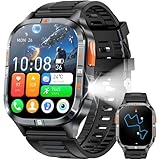
- BUILT-IN GPS & COMPASS– This military smartwatch features high-precision GPS to pinpoint your location while hiking, cycling, or traveling, keeping you safely on track without extra gear. Tap the compass icon and it locks your bearing within three seconds—engineered for pro-level outdoor adventures like camping, climbing, and trekking.
- BLUETOOTH CALLING & MESSAGES – Powered by the latest Bluetooth tech, the men’s smartwatch lets you answer or make calls right from your wrist—no need to pull out your phone. Get real-time alerts for incoming texts and app notifications so you never miss an invite. (Replying to SMS is not supported.)
- BIG SCREEN & DIY VIDEO WATCH FACE – The 2.01" military-spec display is dust-proof, scratch-resistant, and forged from high-strength glass with an aluminum alloy bezel, passing rigorous dust and abrasion tests so the screen stays crystal-clear. Upload a short family video to create a dynamic, one-of-a-kind watch face that keeps your memories alive.
- 24/7 HEALTH MONITORING – Equipped with a high-performance optical sensor, this Android smartwatch tracks heart rate and blood-oxygen levels around the clock. It also auto-detects sleep stages (deep, light, awake) for a complete picture of your health, ensuring you always know how your body is doing.
- MULTI SPORT MODES & FITNESS TRACK – Choose from running, cycling, hiking, basketball, and more to log every workout. Set goals, monitor progress, and sync data to the companion app. Bonus tools include photo gallery, weather, alarm, stopwatch, flashlight, hydration reminder, music/camera remote, find-my-phone, mini-games, and other everyday essentials.
Sensor Stack: Proven Components, Not Experimental Tech
Garmin’s recent generations of Elevate optical heart rate sensors are a strong indicator of what would sit under the hood. These sensors already support continuous heart rate, HRV sampling, pulse oximetry, respiration rate estimation, and stress scoring across its watch lineup.
Crucially, Garmin tends to refine sensors across multiple product cycles rather than chasing novel but unproven tech. That suggests this device would rely on familiar green and infrared LED arrays, improved photodiodes, and tighter skin contact rather than any radical new sensing modality.
Temperature sensing is another likely inclusion, not necessarily as a live metric but as a nightly baseline deviation tool. Garmin already uses skin temperature trends indirectly in some watches, and a strap or band worn 24/7 would provide far cleaner longitudinal data than a wristwatch taken off to charge.
Form Factor Clues: Band, Module, or Something Else?
Garmin has more form-factor experience than most people realise. Between chest straps, armbands, clip-on running pods, and wrist-based trackers, the company understands how placement affects signal quality and user compliance.
A Whoop-style fabric band with a removable sensor core would make the most sense. It allows washing, modular sizing, and long-term comfort while keeping the electronics sealed and durable.
Materials would likely skew utilitarian rather than luxurious: soft-touch polymers, matte finishes, and minimal external branding. This is not a lifestyle jewellery play, but a tool designed to disappear on the body, whether worn during sleep, training, or recovery days.
Durability, Water Resistance, and Real-World Wear
Garmin’s reputation in endurance sports means this device would need to survive sweat, saltwater, pool chlorine, and accidental impacts without fuss. Expect water resistance comfortably beyond everyday needs, likely suitable for swimming and showering without caveats.
Because there is no display to protect, durability becomes simpler and stronger by default. Fewer failure points also mean fewer warranty issues, something Garmin has historically been conservative about.
Comfort will matter more than ruggedness, though. A device that claims to track recovery and illness onset cannot afford to be taken off at night, and Garmin’s long experience with sleep tracking hardware suggests this won’t be treated as an afterthought.
Charging Strategy: Quietly Critical
One area where Whoop has set expectations is charging without data gaps. Garmin would need to match or improve on that experience, either through very fast top-ups or a clever charging accessory that doesn’t force downtime.
Garmin’s proprietary charging connectors are not loved, but they are reliable and well understood. A small puck-style charger or clip-on cradle would align with its existing ecosystem and keep costs under control.
If Garmin can enable meaningful data capture while charging, or make charging a once-a-week non-event, it removes one of the last friction points that keep users from truly passive tracking.
What Garmin’s Hardware Philosophy Signals
Taken together, Garmin’s hardware DNA points toward something deliberately conservative in appearance but deeply competent in execution. No experimental sensors, no flashy screens, and no attempt to reinvent physiology.
Instead, the play would be accuracy, endurance, and trust. For athletes and data-focused users, that matters more than novelty, and it aligns perfectly with Garmin’s long-standing approach to product design.
The real question, then, is not whether Garmin can build a credible Whoop competitor at the hardware level. All evidence suggests it can. The more interesting question is how much of this capability it chooses to expose, and how quietly it lets the hardware do its work in the background.
Subscription or Not? How Garmin’s Business Model Could Disrupt Whoop’s Biggest Moat
If Garmin’s hardware competence feels like a given, the business model is where things get genuinely disruptive. Whoop’s defining advantage has never been its sensors alone, but the subscription that gates meaningful insights behind a monthly fee. Any move Garmin makes here will signal whether this product is meant to coexist with Whoop, or quietly undermine its entire value proposition.
Whoop’s Subscription Is the Product, Not the Strap
Whoop flipped the traditional wearable equation by subsidising hardware and monetising insights. The strap itself is essentially a sensor delivery mechanism, while recovery scores, strain targets, and long-term trend analysis live behind an ongoing subscription that users cannot bypass.
That recurring revenue funds aggressive software iteration, cloud analytics, and a concierge-style relationship with the user. It also creates lock-in, because once you stop paying, your historical data loses much of its meaning.
Garmin’s Track Record: Pay Once, Keep Everything
Garmin has built its empire on the opposite philosophy. You buy the hardware, and nearly all core features remain available for the life of the device, with no monthly fee attached.
Garmin Connect has grown into one of the deepest fitness platforms on the market without charging users directly. Training load, body battery, HRV status, sleep staging, and long-term trends are already table stakes, and Garmin has shown little appetite for putting them behind a paywall.
The Quiet Power of Existing Infrastructure
This is where Garmin’s scale matters. It already runs massive cloud infrastructure, supports years of historical data retention, and serves millions of athletes without subscription income.
In practical terms, that means a screenless recovery tracker could plug straight into Garmin Connect as just another data source. For existing Garmin users, that alone could be enough to make Whoop feel redundant overnight.
Is a Garmin Subscription Actually Possible?
A subscription is not impossible, but it would be culturally awkward. Garmin has experimented with premium services in narrow niches, such as advanced mapping or satellite communication, but has avoided charging for physiological insights.
If a subscription does appear, it is more likely to be optional and layered. Think advanced coaching algorithms, deeper AI-driven health forecasting, or clinician-style reports, rather than basic recovery and readiness metrics.
Why a No-Subscription Model Would Be Devastating for Whoop
A one-time purchase Garmin recovery band would directly attack Whoop’s biggest moat. Users would be comparing a few hundred dollars upfront versus an indefinite monthly cost that often exceeds the hardware price within a year.
For athletes already invested in Garmin watches, bike computers, and scales, the math becomes even harsher. One ecosystem, one app, one dataset, and no subscription fatigue.
Value Perception and Long-Term Trust
Garmin’s brand is built on durability and longevity. Devices are expected to last years, not upgrade cycles tied to billing plans.
That expectation changes how users perceive value. A screenless Garmin wearable that quietly works for three to five years without ongoing fees aligns perfectly with how its customers already think about gear.
The Strategic Fork in the Road
This is the real inflection point. Garmin can either adopt Whoop’s model and risk alienating its core audience, or lean fully into its traditional approach and force Whoop to justify why recovery insights require a subscription at all.
Given Garmin’s conservative instincts and history of user-first pricing, the smarter bet is that it chooses disruption by omission. No subscription, no drama, and a product that quietly makes a monthly fee feel increasingly unnecessary.
Garmin Connect vs Whoop App: Ecosystem Power and Data Ownership Implications
All of this ultimately funnels into software. Hardware can be copied, sensors can be matched, and form factors can converge, but ecosystems are where long-term advantage is built or lost.
If Garmin truly is preparing a screenless, recovery-first wearable, the most consequential battle will not be silicone bands versus textile straps. It will be Garmin Connect versus the Whoop app, and the philosophies behind them.
Garmin Connect Is Already the Nervous System
For long-time Garmin users, Connect is not an add-on app. It is the central nervous system tying together watches, bike computers, chest straps, smart scales, inReach communicators, and years of training history.
That matters because recovery metrics do not live in isolation. Training readiness, body battery, HRV status, acute load, sleep quality, respiration, and stress are already cross-referenced inside Garmin Connect, often using data from multiple devices worn simultaneously.
A strapless or screenless Garmin wearable would not need to explain context from scratch. It would be ingesting data into an existing physiological model that already understands how hard you trained yesterday, what your VO2 max trend looks like over three seasons, and whether today’s fatigue is normal or anomalous.
Whoop’s App Is Focused, but Fundamentally Narrower
Whoop’s app is excellent at one thing: framing recovery, strain, and sleep as a daily decision-making loop. Its UI is opinionated, its language is consistent, and its coaching insights are easy to act on.
But it operates largely as a closed loop. Even with Apple Health and third-party integrations, Whoop remains the primary source of truth rather than one node in a broader training ecosystem.
For athletes who already log structured workouts on Garmin watches, run power on a Forerunner, rides on an Edge, and strength sessions elsewhere, Whoop often becomes a parallel dataset rather than a unifying one. That duplication is tolerable when the insights feel unique, but fragile when a platform like Garmin starts offering similar recovery intelligence natively.
Rank #4

- 【Built-in GPS & Multi-System Positioning】Stay on track with the Tiwain smartwatch’s built-in GPS. Featuring military-grade single-frequency and six-satellite support (GPS, GLONASS, Beidou, Galileo, NAVIC, QZSS), this watch offers fast and accurate location tracking wherever you go. It also includes a compass, altimeter, and barometer, giving you real-time data on your altitude, air pressure, and position.
- 【Military-Grade Durability】Engineered to withstand the toughest conditions, the Tiwain smartwatch meets military standards for extreme temperatures, low pressure, and dust resistance. Crafted from tough zinc alloy with a vacuum-plated finish, this watch is also waterproof and built to resist wear and tear. The 1.43-inch AMOLED HD touchscreen offers clear visibility in all environments, and the watch supports multiple languages for global users.
- 【170+ Sport Modes & Fitness Tracking】Track your fitness journey with 170+ sport modes, including walking, running, cycling, hiking, basketball, and more. Set exercise goals, monitor progress, and sync your data to the companion app. The smartwatch also offers smart features like music control, camera remote, weather updates, long-sitting reminders, and more.
- 【LED Flashlight for Outdoor Adventures】The Tiwain smartwatch comes equipped with a built-in LED flashlight that can illuminate up to 20 meters. Activate it with the side button for added convenience during nighttime activities or outdoor adventures.
- 【Comprehensive Health Monitoring】Monitor your health with real-time heart rate, sleep, blood pressure, and blood oxygen level tracking. The smartwatch will vibrate to alert you of any abnormal readings. You can also make and receive calls directly from the watch, and stay connected with message and app notifications (receive only, no sending capability) – perfect for when you’re driving or exercising.
Data Ownership: Subscription Access vs Platform Stewardship
One of the quiet but critical differences between Garmin and Whoop is how users access historical data. Garmin Connect allows deep exports, long-term trend analysis, and third-party platform syncing without a paywall.
Whoop users technically retain access to their data, but practically, meaningful interpretation is gated behind an active subscription. Stop paying, and the device becomes inert, even though the hardware and sensors still function.
If Garmin releases a Whoop-style wearable without a subscription, it reinforces a very different social contract. The data you generate is yours to keep, analyze, and revisit years later, independent of ongoing fees or account status.
Longevity and the Multi-Year Athlete Timeline
Endurance athletes think in seasons and multi-year arcs, not months. They care about how this year compares to last year, and how injuries, burnout, or life stress show up over time.
Garmin Connect is built for that horizon. Five-year training load charts, decade-long PR histories, and cumulative metrics are normal, not premium features.
Whoop’s model is optimized for continual engagement, which encourages recency over retrospection. That is not inherently bad, but it does shape how athletes internalize their own data and how dependent they become on daily scoring rather than longitudinal understanding.
Cross-Device Intelligence Is Garmin’s Hidden Weapon
A screenless Garmin wearable would not be an island. It could defer GPS, display, and interaction to a paired watch while focusing purely on optical HR, HRV capture, skin temperature trends, and sleep-stage fidelity.
That division of labor plays to Garmin’s strengths. Better battery life through specialization, less redundancy, and the ability to wear a lightweight band overnight while keeping a heavier watch off the wrist.
Whoop already does this well in isolation. Garmin could do it across an entire device family, letting recovery data inform watch-based training recommendations, race widgets, and even bike computer alerts without asking the user to think about which platform they are in.
Trust, Transparency, and Algorithmic Conservatism
Garmin’s software culture has historically been conservative. New metrics roll out slowly, explanations are often technical, and changes to algorithms are documented, sometimes to a fault.
Whoop is more willing to iterate aggressively, adjust scoring models, and introduce new interpretations of existing signals. That agility keeps the product fresh, but can also create a sense that yesterday’s baseline is not always comparable to today’s.
For serious athletes and data-driven users, Garmin’s approach tends to inspire long-term trust. If Garmin adds recovery scoring via a new wearable, many users will assume it has been validated internally for years before launch, even if that assumption is only partly true.
The Real Implication: Who Owns the Athlete Relationship?
This is where the stakes become existential. Whoop’s entire relationship with the user is mediated through its app and subscription. Garmin’s relationship already exists, regardless of whether a new wearable launches.
If Garmin Connect becomes the place where recovery, training load, sleep, readiness, and performance all converge without additional cost, the incentive to maintain a separate Whoop subscription weakens dramatically.
At that point, the competition is no longer about who has the best recovery score. It is about who controls the primary interface between athlete and data, and Garmin is starting that race several laps ahead.
Target Audience Reality Check: Who This Device Is (and Isn’t) For
If Garmin does launch a Whoop-style wearable, the most important question is not what it measures, but who it is actually designed to serve. The answer, based on Garmin’s product history and ecosystem logic, is narrower and more pragmatic than the hype cycle might suggest.
This would not be a mass-market wellness gadget meant to replace a smartwatch. It would be a specialist tool intended to deepen Garmin’s existing data model, not broaden its audience.
This Is for Existing Garmin Users First, Not Switchers
The clearest target is the athlete who already owns a Garmin watch but does not wear it 24/7. That includes endurance runners, cyclists, triathletes, and strength athletes who take their watch off for sleep, recovery days, or non-training hours because of comfort, size, or battery anxiety.
A lightweight, screenless band or compact wearable that passively collects HRV, resting heart rate, respiration, and sleep metrics would solve a real gap. It allows Garmin to maintain continuity of physiological data without forcing the user into constant wrist presence.
For these users, the value is not a new score on a new app. The value is better training readiness, cleaner baselines, and fewer blind spots inside Garmin Connect.
It Makes Sense for Data-Driven Athletes, Not Casual Fitness Users
This device would appeal most to athletes who already understand why HRV trends matter and how recovery influences training load. If you already use Training Readiness, Body Battery, or race predictor tools, a dedicated recovery wearable makes intuitive sense.
It is much less compelling for casual users who mainly care about step counts, workout reminders, or basic sleep duration. Without a screen, notifications, or lifestyle features, this is not a Fitbit replacement and likely not priced or marketed as one.
Garmin’s historical conservatism suggests the messaging would skew technical rather than motivational. That plays well with serious users and poorly with newcomers.
Whoop Users Considering a Jump, with Caveats
For current Whoop subscribers, this hypothetical Garmin device is both tempting and potentially disappointing. Tempting because it could eliminate a monthly fee while integrating recovery data directly into training plans, watch widgets, and bike computers.
Disappointing because Garmin is unlikely to replicate Whoop’s behavioral coaching style. Expect fewer daily narratives, less emotional framing, and more charts that assume you already know what you are looking at.
If Whoop feels like a digital coach checking in on your habits, a Garmin recovery band would feel more like an instrument panel quietly feeding data into a larger machine.
What This Is Not: A Smartwatch, a Ring, or a Fashion Play
This is almost certainly not Garmin’s answer to smart rings like Oura or Galaxy Ring. Rings prioritize comfort and invisibility, but they come with trade-offs in sensor size, battery capacity, and signal quality during movement.
Garmin has historically favored sensor stability over minimalism. A wrist or upper-arm form factor with robust optical sensors, solid materials, and conservative industrial design is far more consistent with its DNA.
Do not expect premium finishes, jewelry-adjacent styling, or lifestyle branding. Expect durability, sweat tolerance, and a design that disappears under a sleeve because it is meant to be worn, not noticed.
The Subscription Question Will Filter the Audience Hard
If Garmin launches this without a mandatory subscription, it instantly becomes attractive to long-time Garmin users who resent data paywalls. That alone would define the audience: committed athletes who already buy into the ecosystem.
If a subscription is involved, even a modest one, the appeal narrows. At that point, Garmin would need to justify why its recovery data is meaningfully different from what it already provides through watches.
Either way, this will not be a low-commitment product. It assumes the user wants deeper physiological insight and is willing to wear an additional device to get it.
The Bottom Line on Fit
This device, if it arrives, is for people who already think in terms of training blocks, recovery debt, and longitudinal trends. It is for users who see wearables as tools, not companions.
If you want motivation, coaching tone, or lifestyle integration, Whoop and mainstream trackers still make more sense. If you want quieter, more controlled data feeding into an existing Garmin setup, this is exactly the kind of product Garmin would build.
How This Fits Into Garmin’s Existing Lineup Without Cannibalizing Its Watches
The key to understanding this device is realizing that Garmin does not need it to replace anything it already sells. It only needs it to fill the growing gaps that even its most advanced watches cannot address comfortably or continuously.
Garmin’s watch lineup is already crowded, segmented, and purpose-built. From the Forerunner to the Fenix, Epix, Enduro, and Venu families, every tier is optimized around visible training, navigation, and on-wrist interaction.
A screenless recovery-focused wearable slots into a different layer entirely: passive physiology capture when wearing a full watch is either impractical or undesirable.
A Complement, Not a Replacement, for High-End Garmin Watches
Even Garmin’s most expensive watches are still watches. They have mass, thickness, rigid cases, and displays that make them less ideal for sleep, multi-day recovery monitoring, or 24/7 wear for certain users.
💰 Best Value

- Smart Watch with GPS and Offline Map: This smart watch connects to multiple satellite systems for accurate real-time positioning, and includes a professional-grade compass, altimeter, and barometer for precise data, ensuring you maintain your sense of direction in any outdoor environment. The map version supports downloading offline maps; select a route or destination to view the route even without a signal, eliminating the risk of getting lost.
- Bluetooth Call & Message Functionality: This smart watches for men allows you to make and receive calls; receive text and social media notifications (Facebook, WhatsApp, Instagram, Twitter, etc.); and reply to text messages with voice-to-text or set up quick replies (text reply functionality is available for Android phones).
- Sports & Health Monitoring: This 5ATM waterproof fitness watch supports over 100 sports modes and tracks daily activity data, calories, distance, steps, and heart rate. You can use it to monitor your health metrics (blood oxygen, heart rate, stress, and sleep), monitor your fatigue and mood, and perform PAI analysis. You can also use this smartwatch to set water intake and sedentary reminders. Stay active and healthy with this fitness tracker watch.
- Customizable Watch Faces & AI Functionality: This smart watch features a 1.46-inch HD touchscreen and over 100 downloadable and customizable watch faces. You can even use your favorite photos as your watch face. Equipped with AI technology, it supports voice descriptions in multiple languages to generate personalized AI watch faces. The watch's AI Q&A and AI translation features provide instant answers to questions and break down language barriers, making it an ideal companion for everyday life and travel.
- Large Battery & High Compatibility & More Features: This smart watch for android phones and ios phone features a large 550ml battery for extended battery life. It's compatible with iOS 9.0 and above and Android 5.0 and above. It offers a wealth of features, including an AI voice assistant, weather display, music control, camera control, calculator, phone finder, alarm, timer, stopwatch, and more. (Package Includes: Smartwatch (with leather strap), spare silicone strap, charging cable, and user manual)
Athletes often remove their Fenix or Epix at night, during strength sessions, or during recovery days. That creates blind spots in HRV trends, resting heart rate baselines, and overnight autonomic data.
A lightweight strap-style or band-style wearable can exist specifically to cover those blind spots. It feeds data into Garmin Connect without asking the user to downgrade, replace, or rethink their primary watch purchase.
Why Garmin Can Avoid the Whoop Trap of Feature Overlap
Whoop replaces the watch experience by design. It becomes the primary interface for recovery, strain, and readiness, with the app acting as the central dashboard.
Garmin does not need to do that. In fact, it should not.
A Garmin recovery wearable can remain deliberately subordinate in the hierarchy, acting as a sensor-first device rather than a decision-maker. The watch still owns workouts, navigation, pace, power, and race execution, while the strap quietly improves the quality of the background data.
That separation keeps Garmin from undermining its watch value proposition while still competing directly with Whoop on physiological depth.
Targeting the “Second Device” User Garmin Already Has
Garmin users are already accustomed to owning multiple devices. Cyclists pair head units with watches, runners rotate between daily trainers and race watches, and triathletes stack sensors without hesitation.
This wearable fits naturally into that mindset. It is not a lifestyle upgrade but a data augmentation tool.
By positioning it as optional but powerful, Garmin avoids forcing a choice. Users do not have to decide between a watch and a recovery band; they decide whether their training benefits from more continuous inputs.
Software Is Where Cannibalization Is Actually Avoided
The real protection against lineup overlap happens in Garmin Connect, not hardware. Garmin can gate certain insights by context rather than by device exclusivity.
For example, recovery scores, stress load, or HRV confidence metrics could improve in accuracy when the wearable is present, without being inaccessible on watches alone. The watch remains fully functional, but the data becomes richer with the additional sensor stream.
This reinforces the watch as the command center while making the new wearable feel additive rather than competitive.
Why This Makes Sense Across Price Tiers
Entry-level Garmin watches already struggle with recovery metrics due to limited sensors and battery constraints. A dedicated recovery wearable could quietly raise the floor for those users without pushing them into more expensive watch models.
At the high end, Fenix and Epix owners gain better sleep and off-watch recovery tracking without sacrificing battery life or comfort. That strengthens loyalty rather than encouraging churn.
Crucially, this approach allows Garmin to sell an additional product without compressing its existing margins or confusing its lineup.
A Strategic Hedge Against Changing Wear Habits
Consumer behavior is shifting toward wearing less hardware at certain times of day. Sleep, recovery, and non-training hours are increasingly screen-free.
If Garmin does not offer an option for those hours, competitors will continue to own that data. This wearable is a way to keep users inside the ecosystem even when the watch comes off.
That is not cannibalization. It is containment.
Garmin is not trying to replace its watches with this device. It is trying to make sure that no part of an athlete’s physiology ever has to leave the Garmin ecosystem to be understood.
What to Expect Next: Likely Launch Timeline, Pricing Signals, and Open Questions
If the strategic logic is containment rather than replacement, the remaining questions are practical ones. When does this arrive, how does Garmin price it without breaking its own ecosystem logic, and what still feels unresolved based on what we have seen so far.
This is where Garmin’s history, cadence, and business model offer useful clues, even if official confirmation remains thin.
Launch Timing: Reading Garmin’s Product Rhythm
Garmin rarely teases hardware far in advance without a clear release window in mind. When it does surface early visuals or regulatory filings, launches typically follow within one to two quarters rather than a full year out.
Based on that pattern, a late spring to early autumn launch window looks plausible, aligning with Garmin’s traditional mid-year and pre-holiday product cycles. This timing would also allow the device to mature inside Garmin Connect before peak winter training blocks, when recovery metrics matter most.
Another signal is software readiness. If Garmin is already preparing Connect-side changes that reference continuous recovery inputs or off-watch physiology streams, the hardware likely exists in near-final form.
Pricing Signals: Hardware Margin Over Monthly Fees
Garmin’s business DNA strongly suggests a one-time hardware purchase rather than a mandatory subscription. The company has repeatedly positioned Garmin Connect as a value-add platform, not a toll booth, and reversing that stance would be culturally and commercially disruptive.
A realistic price band would likely sit between $129 and $249, depending on materials, battery life, and sensor density. That places it above basic fitness bands but below premium watches, preserving Garmin’s margin ladder without stepping on Fenix or Epix territory.
If there is a subscription element, it is more likely to be optional and layered. Advanced analytics packs, deeper coaching insights, or experimental metrics could live behind a paid tier without locking users out of core recovery data.
Battery Life and Wearability: The Quiet Differentiators
Whoop’s strongest asset has never been its sensors alone; it is the freedom to wear it continuously without friction. Garmin will need to match or exceed that standard, particularly around multi-day battery life and comfort during sleep.
Expect a device that prioritizes soft-touch materials, minimal thickness, and flexible strap integration over visual flair. Charging frequency will be a headline spec, with anything under five days likely viewed as a miss by the target audience.
Durability will matter too. Sweat resistance, swim safety, and long-term strap comfort are table stakes for endurance athletes who do not baby their gear.
Software Questions Garmin Still Needs to Answer
The biggest unknown is how transparently Garmin explains the value of this device inside Connect. If the benefits feel incremental or vaguely defined, adoption will stall outside the most data-obsessed users.
Clear articulation around improved HRV confidence, sleep staging accuracy, and recovery trend stability will be essential. Garmin will need to show not just more data, but cleaner data, with fewer gaps and fewer edge-case inaccuracies.
Compatibility is another open question. Ideally, this wearable works across Garmin’s entire watch lineup, including older and entry-level models, reinforcing the idea that it raises the ecosystem floor rather than rewarding only flagship owners.
The Whoop Comparison Garmin Cannot Avoid
Whether Garmin wants the label or not, this device will be judged against Whoop immediately. The difference is that Garmin does not need to win on lifestyle branding or influencer momentum.
Its advantage is credibility with serious athletes and a decade-plus archive of training data already living in Connect. If Garmin can fuse continuous recovery inputs with that historical context, the result could feel meaningfully more grounded than Whoop’s often opaque readiness scores.
The risk is complexity. Garmin must resist the urge to overexplain or over-segment metrics that should feel intuitive at a glance.
Why This Moment Matters
This teased wearable is not about chasing a trend; it is about closing a gap Garmin can no longer ignore. Recovery, sleep, and physiology do not pause when a watch comes off, and Garmin’s competitors have built entire businesses around that truth.
If executed well, this device becomes invisible in daily life but foundational in data quality. It strengthens watches rather than replacing them and keeps users anchored to Garmin even during screen-free hours.
For athletes and biohackers already living inside Garmin Connect, that may be the most compelling upgrade Garmin has offered in years, not because it adds something flashy, but because it quietly fills in everything that was missing.