Meta has been trying to put a camera on your wrist for so long that the idea now feels like a rumor that never quite resolves. Every couple of years it resurfaces, gets far enough along to alarm privacy advocates and excite hardware watchers, then quietly disappears inside Meta’s product labs. The fact that it keeps coming back is the story, because very few canceled wearables inside Big Tech ever earn a second or third resurrection.
To understand why this project refuses to die, you have to look at what Meta keeps trying to solve rather than the specific watch itself. This has never been about competing with the Apple Watch on heart-rate accuracy, battery life, or third-party apps. It has always been about creating a body-worn capture device that feeds Meta’s social, spatial, and AI ambitions in a way phones and headsets can’t quite manage.
What follows is not a straight line to a product launch, but a pattern of ambition, retreat, and recalibration that mirrors Meta’s broader hardware strategy over the past half decade.
The first incarnation: a watch that wasn’t really a watch
The original Meta smartwatch project emerged publicly around 2021, when leaks described a detachable, camera-equipped wearable that looked more like a wrist-mounted module than a traditional watch. It was reportedly designed with dual cameras, one front-facing for video calls and one outward-facing for capturing the world, paired with a display that could pop off the band.
🏆 #1 Best Overall
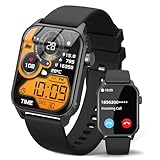
- 【1.83" HD Display & Customizable Watch Faces】Immerse yourself in a vibrant 1.83-inch IPS display, boasting a sharp resolution of 240*284 for crystal-clear visuals. Effortlessly personalize your smart watch with a wide array of customizable watch faces to suit your personal style for every occasion—whether trendy, artistic, or minimalist—ideal for casual, sporty, or professional. Its sleek, modern design complements any outfit, blending technology and fashion seamlessly for everyday wear
- 【120 Sports Modes & Advanced Health Tracking】Our TK29 smart watches for women men come equipped with 120 sports modes, allowing you to effortlessly track a variety of activities such as walking, running, cycling, and swimming. With integrated heart rate and sleep monitors, you can maintain a comprehensive overview of your health, achieve your fitness goals, and maintain a balanced, active lifestyle with ease. Your ideal wellness companion (Note: Step recording starts after exceeding 20 steps)
- 【IP67 Waterproof & Long-Lasting Battery】Designed to keep up with your active lifestyle, this smartwatch features an IP67 waterproof rating, ensuring it can withstand splashes, sweat, and even brief submersion, making it perfect for workouts, outdoor adventures, or rainy days. Its reliable 350mAh battery offering 5-7 days of active use and up to 30 days in standby mode, significantly reducing frequent charging. Ideal for all-day wear, whether you’re at the gym, outdoors, or simply on the go
- 【Stay Connected Anytime, Anywhere】Stay informed and in control with Bluetooth call and music control features. Receive real-time notifications for calls, messages, and social media apps like Facebook, WhatsApp, Twitter, and Instagram directly on your smartwatch. Easily manage calls, control your music playlist, and stay updated without needing to reach for your phone. Perfect for work, workouts, or on-the-go, this watch keeps you connected and never miss important updates wherever you are
- 【Multifunction & Wide Compatibility】Seamlessly handle heart rate monitoring, sleep tracking, and enjoy conveniences like camera/music control, Seamlessly handle heart rate monitoring, sleep tracking, and more-all directly from your wrist. This 1.83 inches HD smartwatch is compatible with iPhone (iOS 9.0+) & Android (5.0+), ensuring smooth daily connectivity and convenience throughout your day. More than just a timepiece, it’s a stylish, all-in-one wearable for smarter, healthier living
From a watch perspective, it already felt compromised. Battery life was expected to be measured in hours rather than days, fitness tracking was secondary, and the design sacrificed comfort and water resistance in favor of camera placement and modularity. This was less Apple Watch competitor and more Facebook Portal for your wrist, optimized for communication and content creation rather than daily wearability.
Even then, the problem wasn’t technical feasibility. It was that a camera-first smartwatch landed in an awkward cultural moment, where always-on cameras were becoming more controversial, not less.
Why Meta pulled the plug the first time
By 2022, the project was effectively shelved, and the reasons were as much reputational as they were practical. Meta was facing intense scrutiny over privacy, data use, and trust, and launching a wrist-worn camera under the Facebook-to-Meta rebrand risked amplifying exactly the wrong conversations. A watch that might discreetly record bystanders was a liability the company couldn’t easily explain away.
There were also basic product issues. A camera smartwatch struggles with physics: small batteries, thermal limits, and the reality that wrists are terrible camera platforms for stable, high-quality footage. When combined with unclear consumer demand, the project became an easy cut during Meta’s cost-trimming and refocus period.
Importantly, Meta didn’t abandon the idea of body-worn cameras. It simply moved them somewhere less socially radioactive.
The detour through smart glasses changed everything
Ray-Ban Meta smart glasses proved that Meta could ship a camera-equipped wearable without immediate backlash, provided the form factor felt familiar and the use cases were constrained. Glasses made intuitive sense for quick photos, short videos, and first-person capture, and their cameras were visible enough to signal intent to others.
This success reframed the smartwatch question. Instead of asking whether a watch should have a camera, Meta could ask whether a wrist device could complement glasses by handling capture control, contextual sensing, or AI interaction. In that framing, the watch becomes a peripheral in a larger wearable system rather than a standalone device fighting Apple and Samsung head-on.
It also helped that Meta’s AI push accelerated dramatically, making always-available sensors and inputs more strategically valuable than they were in 2021.
The current revival: quieter, narrower, more calculated
Reports of the project’s return suggest a more restrained concept than the original detachable-camera watch. Rather than dual cameras and overt video calling ambitions, the revived design appears focused on lightweight capture, gesture-based control, and acting as an input surface for other Meta devices.
This aligns with Meta’s current hardware philosophy, which prioritizes ecosystem roles over single-device dominance. Battery life, comfort, and everyday usability now matter more, because a watch that only works as a novelty capture device won’t survive long on a wrist that already hosts fitness tracking, notifications, and payments.
Crucially, this version seems designed to coexist with existing smartwatches rather than replace them. That alone explains why Meta is willing to try again.
Why Meta keeps coming back to the wrist
The wrist remains one of the few places where Meta doesn’t have a meaningful presence, yet it offers constant proximity, rich biometric signals, and low-friction interaction. A camera smartwatch, even a limited one, could serve as a bridge between Meta’s glasses, headsets, and AI services without asking users to pull out a phone.
That strategic value hasn’t changed, even if the hardware has. Each revival reflects a shift in how Meta thinks it can responsibly, convincingly, and profitably put cameras closer to the body. The watch keeps returning because the problem it’s meant to solve remains unsolved, and Meta is betting that timing, not technology, was the missing piece.
What Meta Is Actually Building This Time: Cameras, Sensors, and the Expected Hardware Concept
Seen in that light, the revived Meta smartwatch isn’t a resurrection of the flashy, camera-first prototype from the early 2020s. It’s a quieter piece of hardware, designed less as a wrist-mounted phone replacement and more as a sensing and control node within Meta’s broader wearable stack.
The difference matters, because it reshapes almost every hardware decision—from camera placement to materials, battery priorities, and even how much “watch” functionality Meta is willing to ship at all.
A single, situational camera—not a wrist camcorder
The most important shift is the apparent move away from dual cameras and overt video calling. Instead of front- and rear-facing sensors, current reporting points to a single outward-facing camera integrated into the watch case or bezel.
This suggests lightweight capture rather than continuous recording. Think quick photo snaps, short contextual video clips, or visual input for AI features, not FaceTime-on-the-wrist or livestreaming.
From a wearability perspective, that’s critical. A single small sensor reduces thickness, heat, and power draw, and avoids the awkward bulk that doomed earlier concepts. It also lowers the social friction that comes with wearing an obvious recording device on your arm.
Cameras as AI input, not social media output
What makes the camera viable this time is Meta’s AI roadmap. The camera isn’t there primarily to post content to Instagram or Facebook; it’s there to see what you see.
In practice, that means visual context for on-device or cloud-based AI: identifying objects, reading signs, capturing reference images, or feeding data to connected smart glasses. The watch becomes a trigger and conduit, not the destination for the content itself.
That positioning neatly sidesteps one of the original watch’s biggest problems: nobody really wanted to shoot video from their wrist, but many people do want frictionless ways to give AI systems visual input.
Sensor stack: biometrics meet spatial awareness
Beyond the camera, Meta’s expected sensor array looks closer to a modern fitness-focused smartwatch. Heart rate, motion tracking, and basic health metrics are almost a given, if only because they anchor the device as something you can justify wearing all day.
What’s more interesting is the likely emphasis on spatial and gesture-related sensors. Accelerometers, gyroscopes, and potentially additional proximity or gesture-detection hardware would allow the watch to act as a controller for glasses, headsets, or AI interfaces.
This is where Meta’s VR and AR DNA shows through. Rather than competing with Apple Watch on ECG depth or Samsung on body composition, Meta seems more interested in how the wrist can help interpret intent and movement in three-dimensional space.
Design constraints: thinner, lighter, and less “watch-like”
All of this points toward a device that may deliberately avoid traditional watch cues. Expect a relatively compact case, likely in aluminum or composite materials rather than steel, with an emphasis on lightness and comfort over visual presence.
Finishing and materials will matter, but not in the luxury-watch sense. This isn’t about polished chamfers or bracelet articulation; it’s about something you forget you’re wearing until you need it.
Straps are likely to skew sporty and modular, optimized for sensor contact and long-term comfort. A camera-equipped watch that feels awkward or heavy simply wouldn’t survive real-world wear, especially alongside another smartwatch.
Battery life as a strategic limiter
Battery life remains the hardest constraint, and Meta appears to be designing around that reality instead of fighting it. By limiting camera usage to short bursts and offloading heavy processing elsewhere, the company can keep the watch in the one- to two-day range without ballooning the case.
That’s still behind the best fitness watches, but acceptable for a device positioned as a secondary wearable. Crucially, it avoids the worst-case scenario of a watch that dies by mid-afternoon because someone took a few videos.
Charging is likely to be daily and predictable, not an endurance play. That alone signals Meta understands this product’s role is assistive, not foundational.
Software: deliberately incomplete on its own
Perhaps the most telling detail is what this watch is unlikely to be. It probably won’t offer a full-featured smartwatch OS experience with deep app ecosystems, rich third-party complications, or standalone LTE ambitions.
Notifications, basic controls, health summaries, and camera triggers make sense. Replacing your Apple Watch or Galaxy Watch does not.
Instead, the software experience will likely feel intentionally constrained unless paired with Meta glasses, a headset, or a phone. That’s not a weakness; it’s a declaration that the watch is designed as part of a system, not as a hero product.
A watch that only makes sense in Meta’s ecosystem
Taken together, the hardware concept starts to look coherent in a way earlier versions never did. A single camera for contextual capture, a sensor stack tuned for gesture and intent, conservative battery expectations, and a design that prioritizes comfort over statement.
On its own, it would be an odd smartwatch. Inside Meta’s growing constellation of AI-powered glasses and mixed-reality devices, it becomes a missing input layer the company has never quite had.
Rank #2
![Apple Watch Series 11 [GPS 46mm] Smartwatch with Jet Black Aluminum Case with Black Sport Band - M/L. Sleep Score, Fitness Tracker, Health Monitoring, Always-On Display, Water Resistant](https://m.media-amazon.com/images/I/312K597M2uL._SL160_.jpg)
- HYPERTENSION NOTIFICATIONS — Apple Watch Series 11 can spot signs of chronic high blood pressure and notify you of possible hypertension.*
- KNOW YOUR SLEEP SCORE — Sleep score provides an easy way to help track and understand the quality of your sleep, so you can make it more restorative.
- EVEN MORE HEALTH INSIGHTS — Take an ECG anytime.* Get notifications for a high and low heart rate, an irregular rhythm,* and possible sleep apnea.* View overnight health metrics with the Vitals app* and take readings of your blood oxygen.*
- STUNNING DESIGN — Thin and lightweight, Series 11 is comfortable to wear around the clock — while exercising and even when you’re sleeping, so it can help track your key metrics.
- A POWERFUL FITNESS PARTNER — With advanced metrics for all your workouts, plus features like Pacer, Heart Rate Zones, training load, Workout Buddy powered by Apple Intelligence from your nearby iPhone,* and more. Series 11 also comes with three months of Apple Fitness+ free.*
Whether consumers will accept that trade-off is still an open question. But this time, at least, Meta appears to know exactly what it’s building—and just as importantly, what it’s choosing not to.
Why the Original Meta Smartwatch Was Canceled: Technical Limits, Privacy Fears, and Strategic Confusion
To understand why Meta’s camera-equipped smartwatch keeps resurfacing, it helps to remember why the first serious attempt quietly died. The original project wasn’t canceled because the idea was bad on paper; it was shelved because the surrounding technology, public tolerance, and Meta’s own hardware strategy weren’t ready to support it.
What’s changed now isn’t just better silicon or smaller cameras. It’s a recognition of where a watch with a camera actually fits—and where it absolutely does not.
Battery life and thermals were deal-breakers, not footnotes
The most immediate problem was power. Early prototypes reportedly combined dual cameras, gesture sensors, and always-on contextual awareness in a form factor that was already fighting physics.
Even without a camera, mainstream smartwatches struggle to balance thin cases, comfortable weight, bright displays, and one- to two-day battery life. Add image sensors, ISP workloads, and background processing, and the result was either a bulky case that wore poorly or a watch that couldn’t survive a full day of real-world use.
Thermals compounded the issue. A wrist-mounted device has limited surface area for heat dissipation, and sustained camera or computer vision workloads risked discomfort, throttling, or both. At the time, Meta couldn’t deliver acceptable battery life without sacrificing comfort, and comfort is non-negotiable for something worn all day.
The camera problem wasn’t just technical—it was social
If battery life was the internal blocker, privacy was the external one. A smartwatch with a camera triggers a much stronger reaction than glasses, phones, or earbuds because it’s harder to see when it’s active and easier to forget it’s there.
This was shortly after the backlash against Google Glass, when public tolerance for always-available cameras was at its lowest. Meta, already under intense scrutiny for data practices, was uniquely ill-positioned to ask consumers and bystanders to trust a wrist-worn camera.
The optics were especially bad because the original designs reportedly included outward-facing cameras integrated into the watch body itself. Unlike a phone, there’s no obvious “I’m recording” posture, and unlike glasses, there’s no clear line of sight cue. The risk of social rejection wasn’t theoretical; it was inevitable.
A smartwatch without a clear job description
Perhaps the biggest issue was strategic confusion. The early Meta smartwatch was being built at a time when the company hadn’t yet committed to its current AR-first hardware roadmap.
Was it meant to compete with the Apple Watch as a general-purpose smartwatch? If so, it was already behind on health tracking maturity, third-party app ecosystems, and OS polish. Was it an input device for VR? At the time, Meta’s headsets weren’t designed for persistent, everyday use that justified a companion watch.
That left the product stranded in the middle. It wasn’t good enough to replace an Apple Watch or Galaxy Watch for notifications, fitness, and daily reliability, and it didn’t yet have an ecosystem where its unique sensors clearly mattered.
Health, fitness, and daily wearability lagged behind expectations
Compared to established smartwatches, the original Meta watch concept also struggled on fundamentals that buyers take for granted. Health tracking accuracy, sensor calibration, and long-term reliability matter more to most users than experimental features.
Comfort and wearability were concerns as well. Early reports suggested thicker cases and unconventional layouts to accommodate cameras and sensors, which risked poor balance on the wrist and limited strap compatibility. A watch that feels awkward during sleep tracking, workouts, or all-day wear quickly becomes a novelty rather than a habit.
In a market where Apple, Samsung, and Garmin refine millimeters and grams year over year, Meta’s prototype looked like a research device trying to pass as a consumer product.
Timing, not ambition, ultimately killed it
None of these problems were insurmountable in isolation. Together, they made launching the product irresponsible by Meta’s own standards.
The company was asking consumers to accept worse battery life, unclear utility, and heightened privacy concerns without offering a must-have experience in return. Canceling the project was less an admission of failure than a recognition that the watch didn’t yet have a reason to exist.
What’s different now is that Meta no longer seems interested in making a camera watch that stands on its own. By repositioning it as a secondary, assistive device within a broader ecosystem of AI glasses and mixed-reality hardware, the same idea suddenly looks less reckless—and far more intentional.
What Has Changed in 2024–2026: AI, On‑Device Processing, and Meta’s New Hardware Priorities
The camera watch idea only makes sense now because Meta itself has changed. The company of 2021–2022 was still building hardware as endpoints; the Meta of 2024–2026 is building hardware as sensors and interfaces for an AI-first platform.
That shift reframes the smartwatch from a compromised Apple Watch alternative into something closer to a contextual input device. It does not need to be perfect at everything anymore, only essential at a few things Meta cares deeply about.
AI is no longer cloud-only—and that matters on the wrist
The biggest technical difference is where intelligence lives. In the early 2020s, meaningful computer vision and multimodal AI required constant cloud access, high latency tolerance, and heavy power draw.
By 2024, Meta’s Llama models and vision pipelines have been aggressively optimized for on-device and near-device inference. That allows a wrist-worn camera to do lightweight scene recognition, object identification, and gesture context locally, handing off only what matters to a paired phone or glasses.
For a watch, this is critical. Battery life measured in days, not hours, demands selective intelligence rather than continuous streaming. A camera that wakes intelligently, processes locally, and sleeps most of the time is fundamentally different from one that is always watching.
From “watch with a camera” to contextual companion for smart glasses
Meta’s current hardware roadmap makes its priorities clear. Ray-Ban Meta smart glasses are no longer a side project; they are the company’s most credible consumer hardware success outside Quest.
In that ecosystem, a watch does not need to compete with Apple Watch on notifications, ECG accuracy, or marathon battery life. Its value comes from being a secondary sensor and control surface that glasses lack.
A wrist camera can capture angles glasses miss, enable discreet visual input without lifting your head, and act as a fallback when glasses are not worn. Combined with haptics, a microphone, and simple touch controls, the watch becomes an invisible mediator between user, AI, and environment.
On-device processing reduces—but does not eliminate—privacy friction
Privacy was a deal-breaker for the original project, and it remains the biggest risk today. The difference is that Meta now has a more defensible technical story.
On-device vision processing allows Meta to argue that raw imagery does not need to leave the watch unless explicitly requested. Context can be abstracted into metadata, intent, or short-lived buffers rather than stored photos or video.
That does not automatically earn trust, especially for a company with Meta’s history. But it shifts the conversation from “always-recording surveillance device” to “selectively aware assistant,” which is a much more survivable position in 2026.
Hardware expectations have also evolved
Smartwatch buyers in 2026 expect maturity, even from experimental devices. That means reasonable thickness, balanced weight, comfortable curvature, and strap compatibility that does not lock users into proprietary systems.
Meta appears more willing now to accept trade-offs openly. The watch does not need a luxury finish, sapphire glass, or ultra-thin profiles if it is framed honestly as an assistive device rather than a status object.
Materials, battery size, and case proportions can be optimized for durability and sensor placement instead of aesthetics alone. That realism was missing from the original effort, which tried to look like a mainstream smartwatch while behaving like a prototype.
Health and fitness are no longer the primary justification
One subtle but important change is what Meta is no longer trying to do. Apple, Samsung, Garmin, and Fitbit have turned health tracking into a high-bar, regulation-heavy arms race.
Meta does not need to win that fight. Basic activity tracking, heart rate trends, and sleep detection are enough if the watch’s real job is contextual awareness and AI interaction.
This lowers the risk of overpromising accuracy while freeing internal teams to focus on sensors that serve vision, gesture, and intent rather than clinical-grade health metrics.
Rank #3

- Bluetooth Call and Message Alerts: Smart watch is equipped with HD speaker, after connecting to your smartphone via bluetooth, you can answer or make calls, view call history and store contacts through directly use the smartwatch. The smartwatches also provides notifications of social media messages (WhatsApp, Twitter, Facebook, Instagram usw.) So that you will never miss any important information.
- Smart watch for men women is equipped with a 320*380 extra-large hd full touch color screen, delivering exceptional picture quality and highly responsive touch sensitivity, which can bring you a unique visual and better interactive experience, lock screen and wake up easily by raising your wrist. Though “Gloryfit” app, you can download more than 102 free personalised watch faces and set it as your desktop for fitness tracker.
- 24/7 Heart Rate Monitor and Sleep Tracker Monitor: The fitness tracker watch for men has a built-in high-performance sensor that can record our heart rate changes in real time. Monitor your heart rate 26 hours a day and keep an eye on your health. Synchronize to the mobile phone app"Gloryfit", you can understand your sleep status(deep /light /wakeful sleep) by fitness tracker watch develop a better sleep habit and a healthier lifestyle.
- IP68 waterproof and 110+ Sports Modes: The fitness tracker provides up to 112+ sports modes, covering running, cycling, walking, basketball, yoga, football and so on. Activity trackers bracelets meet the waterproof requirements for most sports enthusiasts' daily activities, such as washing hands or exercising in the rain, meeting daily needs (note: Do not recommended for use in hot water or seawater.)
- Multifunction and Compatibility: This step counter watch also has many useful functions, such as weather forecast, music control, sedentary reminder, stopwatch, alarm clock, timer, track female cycle, screen light time, find phone etc. The smart watch with 2 hrs of charging, 5-7 days of normal use and about 30 days of standby time. This smart watches for women/man compatible with ios 9.0 and android 6.2 and above devices.
Strategically, Meta now knows why the watch exists
The original camera watch failed because it had no clear role in a fragmented ecosystem. In 2026, Meta’s hardware stack is more coherent: glasses for seeing and hearing, headsets for immersion, and a watch for sensing and subtle interaction.
That does not guarantee consumer success, but it does mean the product is no longer searching for a purpose. If it launches, it will not be asking users to replace their Apple Watch—it will be asking them to add something small, specific, and quietly powerful.
Whether consumers accept that proposition will say less about smartwatches and more about how willing people are to wear AI on their bodies at all.
How a Camera Smartwatch Would Really Be Used: First‑Person Capture, AI Assistance, and Social Utility
If Meta’s revived camera smartwatch makes sense at all, it is because its use cases are narrower and more grounded than before. This is not a wrist-mounted GoPro or a replacement for a phone camera, but a sensor that captures moments, context, and intent in ways other wearables cannot.
The watch earns its place only when it does things that glasses, phones, and earbuds cannot do as efficiently or discreetly.
First‑person capture without the friction of a phone
A wrist-mounted camera is not about image quality so much as immediacy. Raising your wrist is faster and more socially acceptable than pulling out a phone, especially for quick reference shots rather than share-worthy photography.
Think of snapping a photo of a whiteboard, a parking location, a product label, or a sign while your hands are already occupied. Resolution can be modest, sensors can be small, and low-light performance can be limited, because the value lies in capturing context, not aesthetics.
From a hardware perspective, this favors a fixed-focus wide-angle lens, aggressive electronic stabilization, and a camera placement that works naturally with a bent wrist. The case will almost certainly be thicker than mainstream watches, but comfort matters more than thinness if the weight is well balanced and the strap attachment allows standard 20mm or 22mm bands.
AI assistance driven by what the watch sees
The more important function is not recording, but interpretation. A camera smartwatch becomes interesting when images are processed immediately by on-device or cloud-based AI to answer questions, identify objects, or trigger actions.
This could mean recognizing a transit sign and surfacing directions, identifying a piece of equipment during a repair, or scanning a menu and logging a meal without manual input. Unlike phones, the watch can do this passively, activated by gesture, voice, or contextual cues rather than deliberate camera use.
Battery life becomes the real constraint here. Continuous vision processing is unrealistic on a wrist-sized battery, so Meta would need to rely on short bursts, intelligent wake triggers, and tight integration with a paired phone or glasses to offload compute without destroying day-long usability.
A companion to smart glasses, not a standalone star
On its own, a camera smartwatch is awkward. As part of a multi-device system, it starts to make sense.
Meta’s glasses handle seeing and hearing, but they are not always worn and are still socially sensitive in some environments. The watch fills the gaps, offering occasional vision input and acting as a tactile control surface for AI interactions that would feel unnatural through glasses alone.
This also explains why health tracking fades into the background. Heart rate, steps, and sleep data can exist as baseline features, but the watch’s primary job is to feed situational awareness into Meta’s broader AI layer rather than compete with Apple or Garmin on fitness depth.
Social utility depends on trust and restraint
Any camera on the body raises immediate privacy concerns, and a wrist camera is no exception. Meta’s previous attempt failed partly because it felt intrusive without delivering enough value to justify the discomfort it created.
Clear indicators, physical shutters, obvious camera orientation, and strict limits on background recording are not optional here. If people around the wearer cannot instantly understand when the camera is active, the product risks rejection regardless of how useful it is to the owner.
Ironically, the watch format may help. A wrist camera is easier to notice than glasses, and its natural shooting posture makes intent more legible, which could make it more socially acceptable if Meta gets the design right.
Why this is not a replacement smartwatch
This device does not replace an Apple Watch or Galaxy Watch for most users. Notifications, payments, workouts, and health insights will likely be secondary, both to preserve battery life and to avoid feature bloat.
Instead, the value proposition is additive. Users who already wear a mainstream smartwatch are unlikely to switch, but some may be willing to wear a second device if it is light enough, comfortable over long days, and clearly useful in specific moments.
Whether that audience is large enough remains an open question. What is clear is that Meta is no longer trying to win the smartwatch market on its own terms, but to redefine what a watch can be when vision and AI, not time and fitness, are the organizing principles.
Wearability Reality Check: Size, Battery Life, Heat, and Why This Isn’t an Apple Watch Clone
All of that ambition runs headlong into a more unforgiving constraint: the human wrist. Once you add cameras, AI silicon, and always-on contextual awareness to something meant to be worn all day, the hard physics of size, heat, and battery life start dictating what is actually possible.
Thickness is the real enemy, not diameter
A camera-equipped smartwatch does not fail because it is 44mm instead of 40mm. It fails when it becomes tall, top-heavy, and constantly reminds you that it is there.
Cameras need depth for sensors, lenses, and stabilization, and that depth stacks quickly on a wrist-sized device. Meta’s earlier prototypes reportedly ballooned into something closer to a small action camera strapped to your arm, which immediately broke the illusion of a watch and crossed into gadget territory.
If this revived version exists at all, expect compromises Apple has never had to make. Smaller sensors, fixed-focus optics, and aggressive miniaturization will be chosen not for image quality but for keeping thickness within a range that does not catch on sleeves or fatigue the wrist over long days.
Battery life will be situational, not all-day by default
This is where expectations need a reset. A wrist camera paired with on-device AI inference is fundamentally incompatible with the “36 hours on a charge” mindset that modern smartwatch buyers have been trained to expect.
Camera usage, even in short bursts, is one of the fastest ways to drain a small battery. Add neural processing, constant sensor polling, and wireless handoff to glasses or a phone, and you are looking at a device designed for opportunistic use, not continuous operation.
The likely reality is a watch that lasts a full day only if the camera is used sparingly, with heavy reliance on standby states and aggressive power gating. That puts it closer to early-generation Wear OS behavior than to Apple Watch Ultra endurance, and Meta appears willing to accept that trade-off because the device is not meant to be checked every five minutes.
Heat management is the silent deal-breaker
Thermals killed more than one ambitious wearable before it ever reached store shelves, and Meta’s previous cancellation reportedly ran straight into this wall. When cameras, processors, and radios all spin up at once, heat has nowhere to go.
Unlike a phone, a watch cannot comfortably dissipate heat without the wearer feeling it immediately. Even mild warmth becomes distracting when it sits against skin for hours, especially during summer use or physical activity.
This almost certainly explains why health and fitness tracking take a back seat. Sustained workouts generate body heat, and adding compute-heavy vision tasks on top of that is a recipe for discomfort, throttling, or both. A device optimized for short, intentional interactions avoids that thermal cliff.
Camera placement dictates how the watch is worn
A wrist camera sounds simple until you consider angles. A forward-facing camera requires unnatural wrist rotation, while a side-mounted camera changes how the watch sits and how straps need to anchor the case.
Meta’s challenge is making the camera usable without forcing exaggerated gestures that draw attention or strain the wrist. That has implications for lug placement, strap flexibility, and even materials, since a heavier case needs better load distribution to remain comfortable over long wear.
This is also why luxury finishing, slim cases, and premium bracelets are irrelevant here. Comfort, balance, and durability matter more than polished chamfers or sapphire bragging rights when the device’s value is tied to how naturally you can use it in motion.
Why cloning the Apple Watch would miss the point entirely
It is tempting to frame this as a strange Apple Watch competitor with a camera bolted on, but that comparison collapses under scrutiny. Apple’s watch is built around glanceability, health metrics, and predictable daily rhythms.
Meta’s concept lives in irregular moments. It is about capturing visual context, augmenting perception, and acting as a physical anchor for AI-driven experiences that extend beyond the wrist.
Rank #4
![Apple Watch Series 11 [GPS 42mm] Smartwatch with Rose Gold Aluminum Case with Light Blush Sport Band - S/M. Sleep Score, Fitness Tracker, Health Monitoring, Always-On Display, Water Resistant](https://m.media-amazon.com/images/I/31J+F-pXaWL._SL160_.jpg)
- HYPERTENSION NOTIFICATIONS — Apple Watch Series 11 can spot signs of chronic high blood pressure and notify you of possible hypertension.*
- KNOW YOUR SLEEP SCORE — Sleep score provides an easy way to help track and understand the quality of your sleep, so you can make it more restorative.
- EVEN MORE HEALTH INSIGHTS — Take an ECG anytime.* Get notifications for a high and low heart rate, an irregular rhythm,* and possible sleep apnea.* View overnight health metrics with the Vitals app* and take readings of your blood oxygen.*
- STUNNING DESIGN — Thin and lightweight, Series 11 is comfortable to wear around the clock — while exercising and even when you’re sleeping, so it can help track your key metrics.
- A POWERFUL FITNESS PARTNER — With advanced metrics for all your workouts, plus features like Pacer, Heart Rate Zones, training load, Workout Buddy powered by Apple Intelligence from your nearby iPhone,* and more. Series 11 also comes with three months of Apple Fitness+ free.*
Trying to match Apple on battery life, fitness depth, or app ecosystems would only make the compromises feel worse. By deliberately not competing on those axes, Meta is acknowledging that this device succeeds or fails on a different question entirely: whether people will tolerate a slightly worse “watch” experience in exchange for capabilities no mainstream smartwatch even attempts to offer.
That makes the wearability bar paradoxically higher, not lower. If the device is uncomfortable, short-lived, or awkward to use, there is no familiar smartwatch utility to fall back on. The wrist has no patience for experiments that forget it is still a wrist.
Privacy, Social Acceptance, and the Specter of Glasshole 2.0
If wearability is the physical hurdle Meta has to clear, social acceptance is the psychological one. A camera on the wrist does not just change how the device is used; it changes how everyone else in the room feels about it.
This is where Meta’s past comes back into the conversation whether the company likes it or not. The failure of Google Glass still looms over any always-available camera, and the cultural shorthand of the “Glasshole” remains a warning label the industry never fully peeled off.
The difference between “can record” and “is recording”
Smartphones normalized cameras by making the act of recording obvious. You raise a slab of glass, frame a shot, and everyone nearby understands what is happening.
A wrist camera collapses that social signaling. A casual gesture, a glance at a notification, or even resting your hands on a table could plausibly look like recording, and that ambiguity is what makes people uncomfortable.
Meta is acutely aware of this problem, which is why every known prototype and patent trail points to aggressive visual indicators. Expect hardwired LED lights, on-screen recording banners, and possibly even audible cues that cannot be disabled at the software level.
The company learned this lesson with Ray-Ban Meta smart glasses, where physical capture lights were not optional flourishes but non-negotiable design constraints. A watch would likely go further, because wrists naturally point at people far more often than faces wearing glasses.
Why wrist-mounted cameras feel more intrusive than glasses
At first glance, a watch camera might seem less creepy than a face-mounted one. In practice, the opposite may be true.
People expect eye-level devices to “see” roughly what their wearer sees. A wrist, however, points everywhere: across tables, under doors, toward laps, screens, and private spaces people assume are out of frame.
That unpredictability is socially destabilizing. Even if the camera quality is modest, even if recording is limited to short bursts, the perceived loss of control matters more than the actual data being captured.
This is also where materials and form factor quietly matter. A bulky, overtly technical case with visible sensors communicates intent more honestly than a sleek, stealthy design that blends into a normal watch silhouette. Ironically, trying too hard to make the camera invisible could make the product less socially acceptable, not more.
Trust, Meta, and the burden of history
Any company shipping a camera wearable would face scrutiny, but Meta carries extra weight. Privacy controversies around Facebook, Instagram, and data handling mean the company does not get the benefit of the doubt.
Even if all processing is local, even if footage is ephemeral, even if users have granular controls, skepticism will be baked in. For many potential buyers, the question will not be “what does this device do,” but “what does Meta eventually want it to do.”
This has direct implications for software experience. Clear permissions, transparent on-device processing, and strict limitations on background capture are not just regulatory checkboxes; they are product features that determine whether the device ever leaves the house.
Battery life intersects with this trust issue as well. A watch that lasts only a day, with visible drains tied to camera use, reinforces the idea that capture is intentional rather than ambient. Paradoxically, shorter endurance may feel safer than all-day, always-on potential.
Social friction as a feature, not a bug
Meta may be betting that some degree of awkwardness is unavoidable and even acceptable. Early adopters of unconventional wearables have historically tolerated social friction in exchange for new capabilities, from Bluetooth headsets to early smart glasses.
The key difference is scope. This cannot be a mass-market Apple Watch alternative if it triggers suspicion in meetings, gyms, classrooms, or public transport. Its realistic audience is smaller, more intentional, and more willing to explain what is on their wrist.
That aligns with Meta’s broader hardware trajectory. This watch does not need universal acceptance to be strategically valuable; it needs to exist as a learning platform for human-computer interaction, capture ergonomics, and AI-mediated context.
Whether it ever escapes the shadow of Glasshole 2.0 will depend less on what the camera can see and more on how clearly everyone else knows when it is looking.
How It Compares to Existing Devices: Apple Watch, Galaxy Watch, Pixel Watch, Ray‑Ban Meta Glasses, and Body Cams
To understand where a camera-equipped Meta smartwatch might land, it helps to frame it less as a rival to today’s flagship watches and more as an outlier testing the edges of what wrist-worn hardware can reasonably do. The comparison set reveals not just feature gaps, but fundamentally different assumptions about comfort, trust, and daily use.
Apple Watch: The anti-camera reference point
Apple Watch defines the modern smartwatch baseline: thin enough to disappear under a cuff, light enough for all-day wear, and optimized around health, notifications, and frictionless integration with a phone. Its materials, from aluminum to stainless steel to titanium, emphasize polish and familiarity rather than experimentation.
The absence of a camera is not a technical limitation; it is a deliberate product stance. Apple has repeatedly chosen environmental sensors, health optics, and safety features over anything that could imply ambient capture, reinforcing the watch as a private, personal device rather than a recording tool.
A Meta watch with a camera would diverge sharply from this philosophy. Even if it matched Apple on display quality, haptics, or app fluidity, the moment a lens is visible, it becomes a different category of object, one that trades universal social acceptability for situational capability.
Samsung Galaxy Watch: Feature-rich, still socially conservative
Samsung’s Galaxy Watch line pushes hardware ambition further than Apple in some areas, with larger cases, rotating bezels, and more aggressive sensor experimentation. Yet it still operates within the same social contract: a watch should never make bystanders wonder if they are being recorded.
Battery life on Galaxy Watch models already feels stretched by always-on displays, LTE radios, and health tracking. Adding a camera would force compromises in thickness, thermal management, or endurance that run counter to Samsung’s current emphasis on refinement and balance.
This highlights a key distinction. Mainstream smartwatch makers optimize for daily wearability first and features second. Meta’s rumored approach reverses that order, prioritizing a novel input method even if it narrows the audience.
Pixel Watch: Software intelligence without hardware risk
Google’s Pixel Watch leans heavily on software differentiation: Fitbit-driven health insights, contextual notifications, and deep ties into Google services. Its domed design and relatively compact dimensions emphasize comfort and approachability over raw capability.
A camera would clash with the Pixel Watch’s core value proposition. Google has spent years untangling its consumer hardware from surveillance anxieties, and a wrist camera would reopen questions it has deliberately tried to close.
In contrast, Meta appears more willing to accept reputational risk in exchange for data-rich interaction experiments. The Pixel Watch shows how far software intelligence can go without visual capture, implicitly questioning whether a camera on the wrist is necessary at all.
Ray‑Ban Meta Glasses: The closest sibling, not a substitute
Ray‑Ban Meta smart glasses are the most relevant comparison because they already embody Meta’s philosophy around visible, intentional capture. Cameras are front-facing, indicator LEDs are prominent, and usage is episodic rather than continuous.
Glasses, however, benefit from a natural alignment between human vision and camera perspective. Recording what you see feels intuitive, and the physical form factor makes the presence of a camera easier to understand at a glance.
A smartwatch camera lacks that clarity. Wrist orientation is ambiguous, framing is awkward, and the act of raising an arm to record is more conspicuous. Where the glasses feel like an extension of perception, the watch feels like an instrument, something you deliberately deploy rather than wear passively.
Body cams and action cams: Functionally similar, culturally distant
In pure capability terms, a camera-equipped watch sits closer to body cams and compact action cameras than to traditional smartwatches. These devices prioritize capture reliability, wide-angle lenses, and durability over comfort or aesthetics.
The difference is intent. Body cams are worn in contexts where recording is expected, often mandated, and their presence is meant to be obvious. Action cams are tools, taken out when needed and put away when not.
💰 Best Value
![Apple Watch Series 11 [GPS 42mm] Smartwatch with Jet Black Aluminum Case with Black Sport Band - S/M. Sleep Score, Fitness Tracker, Health Monitoring, Always-On Display, Water Resistant](https://m.media-amazon.com/images/I/31ybzrJZckL._SL160_.jpg)
- HYPERTENSION NOTIFICATIONS — Apple Watch Series 11 can spot signs of chronic high blood pressure and notify you of possible hypertension.*
- KNOW YOUR SLEEP SCORE — Sleep score provides an easy way to help track and understand the quality of your sleep, so you can make it more restorative.
- EVEN MORE HEALTH INSIGHTS — Take an ECG anytime.* Get notifications for a high and low heart rate, an irregular rhythm,* and possible sleep apnea.* View overnight health metrics with the Vitals app* and take readings of your blood oxygen.*
- STUNNING DESIGN — Thin and lightweight, Series 11 is comfortable to wear around the clock — while exercising and even when you’re sleeping, so it can help track your key metrics.
- A POWERFUL FITNESS PARTNER — With advanced metrics for all your workouts, plus features like Pacer, Heart Rate Zones, training load, Workout Buddy powered by Apple Intelligence from your nearby iPhone,* and more. Series 11 also comes with three months of Apple Fitness+ free.*
A Meta smartwatch would blur these boundaries. It would be a capture device that is always present, yet not always appropriate, raising questions that neither category has to answer. The trade-off is immediacy; no other camera is as instantly accessible as one on your wrist.
What this comparison really reveals
Across Apple, Samsung, and Google, the modern smartwatch has converged on a shared understanding of what belongs on the wrist. Cameras have consistently failed that test, not because they are useless, but because they disrupt the delicate balance between utility, comfort, and social trust.
Meta’s willingness to revisit the idea suggests it is optimizing for learning rather than scale. In that sense, this watch is less a competitor to the Apple Watch than a companion experiment to Ray‑Ban Meta Glasses, probing different angles of human-camera interaction.
The real comparison, then, is not spec sheets or app ecosystems. It is whether users are willing to accept a watch that behaves less like jewelry and more like equipment, and whether Meta can turn that acceptance into insight without crossing the line that keeps the device on the wrist instead of in a drawer.
Who This Watch Is Actually For—and Who It Isn’t
If Meta’s camera-equipped smartwatch ever reaches consumers, it will not be aiming for the broad, lifestyle-driven smartwatch audience that Apple, Samsung, and Google fight over. Instead, it targets a far narrower set of users who are willing to trade social subtlety, traditional comfort, and even battery longevity for a very specific kind of capability.
Understanding that distinction is critical, because judged by mainstream smartwatch expectations, this device would almost certainly feel compromised. Judged by the needs of certain edge-case users, it may make more sense than it first appears.
Early adopters who treat wearables as sensors, not accessories
This watch is for people who see wearables less as jewelry and more as data-gathering nodes. These users already tolerate thicker cases, asymmetrical designs, and non-traditional materials if the hardware enables new forms of capture or interaction.
Comfort will likely be acceptable rather than luxurious, with a chunkier chassis to house a camera module, reinforced lenses, and possibly additional heat management. Expect something closer to a rugged smartwatch or developer hardware than a polished aluminum Apple Watch, with strap choices that favor stability over elegance.
For this group, the appeal is not photography quality but immediacy. The ability to capture a moment without reaching for a phone, opening an app, or adjusting glasses fits their mental model of computing as ambient and reactive.
Developers, researchers, and Meta’s internal learning loop
More than any consumer segment, this watch is for Meta itself and the ecosystem orbiting its AR ambitions. A wrist-mounted camera provides different data than head-mounted cameras, offering insight into hand movement, object interaction, and contextual intent that glasses alone cannot capture.
Developers working on spatial computing, AI-driven perception, or multimodal input would gain a new reference device, even if it never sells at scale. Battery life may be measured in a day rather than multiple days, and software polish may lag consumer expectations, but that is tolerable in an experimental platform.
In that sense, the watch functions as a research instrument disguised as a product. Its success would be measured less by unit sales and more by what it teaches Meta about where cameras belong on the body.
Content creators who value perspective over discretion
There is a subset of creators for whom conspicuous recording is not a downside. Vloggers, live-streamers, and behind-the-scenes documentarians already accept that wearing visible tech changes how people react to them.
For these users, a wrist camera offers a distinct angle that phones and glasses cannot easily replicate, especially for hands-on activities like building, cooking, or demonstrating physical processes. The framing may be imperfect, but the point of view is authentic and continuous.
That said, this is not a replacement for action cameras or phones. Image stabilization, sensor size, and low-light performance will almost certainly lag behind dedicated capture devices, making this a supplementary tool rather than a primary one.
Who it very clearly is not for
This watch is not for buyers who want a refined daily smartwatch that disappears on the wrist. Anyone who prioritizes slimness, long battery life, subtle aesthetics, or traditional watch ergonomics will find the trade-offs hard to justify.
It is also not for users uncomfortable with the social friction of wearing a visible camera. Even if recording indicators are obvious and privacy controls are robust, the presence of a lens changes how others perceive the device and the wearer, especially in shared or professional spaces.
Most importantly, it is not for people who expect their smartwatch to be an extension of their phone first and foremost. Health tracking, notifications, and fitness features may be present, but they will not be the reason this device exists.
Why that narrow focus may be intentional
Seen through this lens, the limited audience is not a failure but a feature. Meta does not need this watch to outsell the Apple Watch; it needs it to answer questions about how cameras, AI, and human behavior intersect outside of the face.
If users accept a camera on the wrist only in specific contexts and for specific tasks, that insight is valuable. If they reject it outright, that signal is just as important for shaping Meta’s future hardware roadmap.
This is a watch designed to test boundaries, not redefine the category. Whether it earns a place on anyone’s wrist depends entirely on how much they value experimentation over comfort, and capability over convention.
What Success or Failure Would Signal About Meta’s Long‑Term Wearables and AR Strategy
If this watch exists to test boundaries rather than chase volume, then its outcome matters less as a product and more as a signal. Success or failure here would not be measured in unit sales alone, but in what Meta learns about human tolerance for cameras, context-aware AI, and always-on sensing worn on the body.
The stakes are bigger than a single oddball smartwatch. This is about whether Meta’s vision for ambient computing can move beyond faces and into the rest of the body without triggering rejection.
If it succeeds: validation of cameras as everyday inputs
A successful launch would suggest that cameras can become accepted as passive inputs rather than explicit recording tools. That distinction matters enormously for Meta’s AR ambitions, where visual context is the foundation for real-time AI assistance.
If users find genuine value in wrist-based capture for tasks like step-by-step guidance, object recognition, or hands-busy communication, it reinforces Meta’s belief that vision-first wearables can coexist with social norms when designed carefully. That lesson would directly inform future smart glasses, rings, and other distributed sensor devices.
It would also validate Meta’s approach of prioritizing context over polish. Even if the watch is thick, awkward, or short-lived on battery, sustained usage would prove that capability can outweigh comfort in specific scenarios, at least for early adopters.
If it fails: a hard ceiling on visible cameras
A poor reception would not mean Meta’s wearables strategy is dead, but it would draw a clear boundary. It would suggest that cameras placed anywhere other than the face remain socially and ergonomically difficult to normalize, regardless of safeguards or utility.
That outcome would likely push Meta to concentrate camera-based intelligence back into eyewear, where intent is more legible and framing aligns with human perception. The wrist could remain a control surface and sensor hub, but not a primary visual input.
Failure would also reinforce the idea that smartwatches are fundamentally conservative devices. Buyers tolerate incremental changes in health tracking, battery life, materials, and comfort, but resist radical shifts that challenge why a watch exists in the first place.
What it reveals about Meta’s hardware philosophy
Either outcome clarifies Meta’s willingness to use consumer hardware as a research instrument. This is not Apple’s model of refinement through iteration, nor Samsung’s approach of feature parity with broad appeal.
Meta is probing behavior, not perfecting a category. The camera watch fits the same pattern as early Quest headsets and first-generation Ray-Ban smart glasses: imperfect, sometimes awkward, but designed to surface truths that software simulations cannot.
That approach carries risk, especially in a market conditioned to expect maturity from wrist-worn devices. But it also allows Meta to move faster in areas where competitors are constrained by brand expectations and existing user bases.
Why this matters beyond this one device
The real question is not whether anyone should buy this watch. It is whether people are willing to live with cameras as ambient companions rather than deliberate tools.
If the answer is yes, even narrowly, Meta gains confidence to keep distributing vision, AI, and sensing across multiple wearables rather than betting everything on a single form factor. If the answer is no, Meta learns where to stop, and where to redirect investment before its AR endgame fully arrives.
In that sense, this watch is less a product than a fork in the road. It tells us whether Meta’s future wearables will be bold but niche experiments, or whether one of these experiments might finally cross the line into something people genuinely want to wear every day.
Either way, the return of Meta’s camera-equipped smartwatch is not about resurrecting a canceled device. It is about testing how far the definition of a wearable can stretch before it snaps, and what that tension reveals about the next decade of AR-driven hardware.