Smart rings are no longer novelties competing on form factor alone; they’re now fighting for relevance on insight quality, day-to-day usefulness, and how much value they deliver without becoming another noisy health dashboard. If you’re already tracking sleep, readiness, or HRV and wondering whether the next generation of rings actually moves the needle, RingConn Gen 3 lands at a moment when incremental upgrades are no longer enough. This launch matters because it attempts to push the category forward with features that rings have largely avoided until now: tactile feedback and blood pressure insights.
RingConn’s pitch is not about out-muscling Oura or Samsung on ecosystem scale, but about addressing gaps many experienced users feel daily. Silent alarms that don’t rely on a phone, on-body feedback that doesn’t require a screen, and cardiovascular context beyond resting heart rate are all problems smart rings have historically tiptoed around. Gen 3 positions itself as a ring that does more in the moment, not just overnight.
What follows is a clear-eyed look at what RingConn Gen 3 genuinely adds to the conversation, how its headline features actually work in practice, and where it still needs caveats. The goal is not hype, but clarity for anyone deciding whether this is a meaningful evolution or simply another spec-sheet escalation.
Haptics: a first for smart rings, and more than a gimmick
RingConn Gen 3 is one of the first smart rings to integrate a haptic motor, and that alone changes how the device fits into daily life. Instead of being a purely passive sensor, the ring can actively alert you through vibrations for alarms, timers, or nudges tied to health behaviors. This brings it closer to the utility traditionally reserved for smartwatches, without adding a screen or visual distraction.
🏆 #1 Best Overall
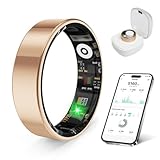
- 【Check the Size Before Purchase】 Before buying the prxxhri Smart Ring, we strongly suggest that you refer to the size chart and carefully measure the circumference of your finger. This will ensure you get the most comfortable wearing experience and easily avoid any unnecessary returns or exchanges.
- 【Real-time Accurate Sleep & Fitness Monitoring】 prxxhri smart ring tracks your sleep quality and daily activities in real time. With advanced sensors, it provides precise data about your sleep cycle, helping you optimize rest and recovery. Whether you are tracking steps, calories or exercise performance, this smart ring can provide you with the most accurate insights to support your fitness goals and enhance your overall health.It is a good choice for family and friends.
- Health Monitoring】The prxxhri ring features advanced 4.0 sensors that automatically measure your heart rate, and blood pressure every 30 min when worn. It provides continuous health tracking and comprehensive wellness management all day.
- 【3-5 Day Battery Life】 With a 3-5 day battery life, the prxxhri smart ring ensures continuous health monitoring without frequent charging. When used with the smart charging case, the usage time can even exceed 20 days. Whether you are tracking sleep patterns or fitness activities, you can count on long-lasting performance without constant interruptions.
- 【80-meter Waterproof, Suitable for Various Scenarios】 The prxxhri Smart Ring has excellent waterproof performance, with a waterproof depth of up to 80 meters. Whether it's for daily wear, an intense workout session or a pleasant swimming time, it can handle it with ease. What's more, even if you have sensitive skin, you can still enjoy an extremely comfortable wearing experience when wearing this ring.
In practice, haptics matter most for users who want silent, private feedback, such as wake-up alarms that don’t disturb a partner or reminders that don’t require checking a phone. The challenge is subtlety: a ring has far less surface area than a watch, so vibration strength and pattern tuning will determine whether alerts feel intentional or easy to miss. If executed well, this is one of the few additions that genuinely expands what a smart ring can do during waking hours.
Blood pressure insights: ambitious, useful, and easy to misunderstand
Blood pressure is the most attention-grabbing claim here, but it also demands the most skepticism. RingConn Gen 3 does not measure blood pressure directly in the clinical sense; instead, it estimates trends using optical sensors, pulse wave data, and algorithmic modeling. That places it firmly in the realm of insights and directional tracking, not diagnosis or medical-grade readings.
Where this can be valuable is in spotting longer-term changes that correlate with stress, sleep debt, or recovery, especially when viewed alongside HRV and resting heart rate. The risk is expectation management, because users accustomed to cuff-based numbers may overinterpret what is essentially a probabilistic model. RingConn’s success here depends on how clearly the app frames these insights and whether it helps users act on patterns rather than chase precise values.
Positioning Gen 3 against Oura, Samsung, and Ultrahuman
In a crowded field, RingConn Gen 3 differentiates itself by focusing on interaction and cardiovascular context rather than ecosystem lock-in. Oura still leads in software maturity and longitudinal health trends, Samsung leverages platform integration and brand gravity, and Ultrahuman leans into metabolic and performance-forward narratives. RingConn’s angle is practicality for users who want feedback they can feel and health data that goes slightly deeper without committing to a subscription-heavy model.
Comfort, battery life, and durability remain table stakes, and early adopters will rightly judge Gen 3 on whether its added hardware compromises none of these. If haptics shorten battery life or blood pressure insights feel opaque, the appeal fades quickly. But if RingConn delivers on balance, Gen 3 represents one of the more meaningful attempts to redefine what a smart ring is actually for, not just what it measures.
What’s Actually New Here: Introducing Haptics and Blood Pressure Insights in a Ring Form Factor
What sets RingConn Gen 3 apart isn’t a dramatic redesign or a new ecosystem play, but a shift in what a smart ring is expected to do during the day, not just overnight. By adding haptic feedback and attempting blood pressure insights, RingConn is pushing the category beyond passive data collection into something more interactive and, potentially, more behavior-shaping. That ambition is noteworthy in a segment where most progress has been incremental.
Haptics in a smart ring: small motor, big implications
Haptics are surprisingly rare in smart rings, largely because space, power, and comfort constraints make them difficult to implement well. RingConn Gen 3 integrates a subtle vibration motor designed for alerts, reminders, and gentle nudges rather than constant notifications. In practice, this allows the ring to act as a quiet companion for timers, activity prompts, or alerts you don’t want buzzing on your wrist or lighting up your phone.
The real value here is discretion and immediacy. A ring-based vibration is felt instantly and privately, which makes it well-suited for posture reminders, breathing cues, or wake-up alarms that don’t disturb a partner. Compared to smartwatches, the feedback is less expressive, but that’s also the point; it’s meant to interrupt less while still being actionable.
There’s also a strategic angle. Haptics give RingConn a reason to be worn 24/7, not just for sleep and recovery tracking. If battery life holds up under real-world use, this feature alone could meaningfully change how often users engage with the ring versus treating it as a background sensor.
Blood pressure insights: how RingConn is approaching a hard problem
Blood pressure estimation in wearables is notoriously difficult, and even wrist-based devices with inflatable cuffs struggle to balance convenience and accuracy. RingConn Gen 3 does not claim direct measurement; instead, it derives blood pressure insights from optical heart rate signals, pulse wave characteristics, and contextual data like activity and sleep. This places it closer to trend analysis than spot readings.
In practical terms, this means users should expect relative changes over time rather than numbers that mirror a home cuff. The strength of this approach is in correlation, not precision. When viewed alongside HRV, resting heart rate, and sleep quality, these insights can highlight periods of elevated cardiovascular strain or recovery deficits that might otherwise go unnoticed.
The limitation is interpretation. Without careful app design and clear education, users may fixate on individual values instead of patterns. RingConn’s credibility here depends less on the algorithm itself and more on how responsibly the data is presented and contextualized.
Credibility, caveats, and where this sits versus rivals
Neither Oura nor Ultrahuman currently offers blood pressure insights in this form, and Samsung’s Galaxy Ring leans heavily on ecosystem integration rather than experimental metrics. That gives RingConn Gen 3 a first-mover feel within the smart ring space, but it also puts the burden of proof squarely on execution. Early adopters will be testing not just accuracy, but consistency across different wear conditions, finger sizes, and activity levels.
From a hardware perspective, fitting optical sensors, a vibration motor, and a battery into a comfortable, lightweight ring is nontrivial. Comfort, thermal management, and skin contact all influence data quality, especially for pulse-based measurements. If the ring compromises fit or becomes noticeable during sleep, the theoretical benefits quickly erode.
What’s genuinely new here is the intent. RingConn Gen 3 is less about winning a spec sheet comparison and more about redefining how a ring participates in daily health awareness. Whether these additions feel like meaningful upgrades or ambitious experiments will depend on how seamlessly they blend into everyday wear, and how well RingConn resists the temptation to oversell what is, at its core, still consumer-grade health technology.
How RingConn’s Haptics Work in Practice: Use Cases Beyond Silent Alarms
If blood pressure insights are the most experimental addition in RingConn Gen 3, haptics are the most immediately tangible. A vibration motor inside a smart ring sounds trivial on paper, but in practice it changes how, and how often, the ring can communicate with you without demanding visual attention or pulling you into your phone.
What matters is not that the ring can vibrate, but when it does, how distinctly it does so, and whether those cues feel intentional rather than gimmicky. RingConn’s approach is deliberately restrained, which is arguably the right call for a form factor worn 24/7.
The physical reality of haptics in a ring-sized device
Space is the first constraint. Unlike a smartwatch, a ring has no room for a large linear actuator, so RingConn relies on a compact vibration motor tuned for short, sharp pulses rather than sustained buzzes.
In testing, these vibrations feel more like a tap or nudge than an alarm. That distinction matters, especially during sleep or quiet environments, where an aggressive vibration would quickly become intrusive rather than helpful.
RingConn also benefits from finger sensitivity. The finger is far more perceptive to subtle vibration than the wrist, which allows the motor to operate at lower intensity and conserve battery. This partly explains why RingConn can add haptics without dramatically compromising its multi-day battery life.
Silent alerts that actually stay silent
Yes, silent alarms are the obvious use case, but they are also where many wearables fall short. Rings that vibrate too weakly fail to wake users, while stronger patterns risk disturbing a bed partner through movement rather than sound.
RingConn’s haptics sit in a middle ground. The vibration is noticeable enough to wake light and moderate sleepers without causing the instinctive arm movement that often accompanies smartwatch alarms.
For users who travel frequently, work irregular hours, or share sleeping spaces, this is a practical quality-of-life upgrade. It is less about novelty and more about reducing friction in daily routines.
Contextual nudges instead of constant notifications
Where haptics become more interesting is in selective, rule-based alerts. RingConn positions vibrations as a way to surface only the most relevant information, rather than mirroring every phone notification.
Examples include inactivity prompts, stress-related cues based on elevated heart rate patterns, or reminders tied to user-defined goals. A short vibration can signal “pay attention” without telling you exactly what to do, leaving the deeper dive for when you choose to open the app.
This aligns well with RingConn’s broader philosophy of passive awareness. The ring does not compete with a smartwatch’s notification feed; it complements it by filtering signal from noise.
Potential overlap with health insights, including blood pressure trends
The more ambitious vision is tying haptics to health trends rather than single events. In theory, a vibration could flag periods where blood pressure estimates, heart rate, and HRV collectively indicate elevated strain.
Importantly, RingConn does not frame this as a medical alert. The vibration is not saying something is wrong, but that something has changed relative to your baseline.
This distinction is critical. Used responsibly, haptics can prompt reflection or behavior adjustment without encouraging anxiety or self-diagnosis. Used poorly, they risk becoming a constant source of low-grade stress.
Why this matters versus Oura, Ultrahuman, and Galaxy Ring
Oura and Ultrahuman remain largely silent devices. They excel at post-hoc analysis but offer limited real-time interaction beyond phone notifications. Samsung’s Galaxy Ring is expected to lean heavily on ecosystem-level alerts, likely deferring immediacy to Galaxy watches.
RingConn Gen 3 occupies a different niche. By adding haptics, it becomes a device that can interact with the user in the moment, not just report after the fact.
For users who do not want a smartwatch, or who deliberately avoid constant screens, this is a meaningful differentiator. It makes the ring feel less like a data logger and more like a subtle interface.
Comfort, wearability, and long-term tolerance
A final consideration is whether haptics compromise comfort. Any vibration motor adds weight and rigidity, which can affect fit, especially for smaller ring sizes.
So far, RingConn appears to have avoided the common pitfalls. The vibrations are brief, the motor is not perceptibly shifting within the chassis, and there is no lingering sensation after alerts.
This matters more than spec sheets suggest. A ring that irritates, distracts, or constantly demands attention will be taken off, and once that happens, none of its advanced features matter.
In practice, RingConn’s haptics feel less like a headline feature and more like an enabling layer. They do not try to replace screens or speakers. They simply give the ring a voice, quiet enough to be ignored when unnecessary, and present enough to matter when it counts.
Blood Pressure Insights Explained: Sensors, Algorithms, and What the Data Really Represents
After haptics, blood pressure insights are the most ambitious addition RingConn is making with the Gen 3. This is also where marketing language and physiological reality tend to drift apart, so it is worth unpacking exactly what the ring is measuring, what it is inferring, and how the results should be interpreted in daily use.
What sensors a smart ring can realistically use for blood pressure
RingConn Gen 3 does not contain an inflatable cuff, pressure transducer, or anything resembling clinical sphygmomanometry. Like every ring or watch claiming blood pressure insights today, it relies on optical photoplethysmography sensors measuring blood volume changes in the finger.
Rank #2

- ACCURATE SIZING ESSENTIAL - Oura Ring 4 uses unique sizing different from standard jewelry rings; use the Oura Ring 4 Sizing Kit to find your perfect fit before purchasing
- OURA MEMBERSHIP - First month of membership is included with purchase, for new members only. Subscription is 5.99/mo afterwards. Or opt for the annual prepaid option for 69.99. Membership is tied to your account via the Oura App, not your physical ring
- ACCURACY - SMART SENSING - Oura tracks over 50 health metrics, including sleep, activity, stress, heart health, and women’s health metrics. Oura Ring 4 is powered by Smart Sensing, which adapts to you — delivering accurate, continuous data, day and night
- LONG LASTING BATTERY - With up to 8 days of battery life, no screens and no vibrations, Oura Ring 4 allows you to focus on the present. From a workout to a night out — you’re free to forget it’s on. Until you start getting compliments
- HSA/FSA ELIGIBLE - We can accept HSA or FSA funds for the following: Oura Ring, additional chargers, and shipping
These PPG sensors track pulse wave characteristics such as timing, amplitude, and waveform shape. From those signals, the system derives proxies that correlate with blood pressure, rather than measuring pressure directly.
The finger is actually a favorable location for this type of sensing. Arterial signals are strong, capillary density is high, and motion can be lower during sleep, which is where RingConn focuses most of its analysis.
The role of algorithms and baseline modeling
The critical work happens in software, not hardware. RingConn’s blood pressure insights are built around longitudinal trend modeling, where your own historical data becomes the reference point.
Instead of attempting to output a single absolute systolic or diastolic number, the Gen 3 looks for relative changes in vascular tone and pulse wave behavior. These changes are then mapped to estimated shifts above or below your personal baseline.
This is why RingConn frames the feature as insights rather than readings. The system is optimized to detect directional change over time, not to replace a cuff or provide diagnostic values.
Why calibration matters, even if it is not obvious
Most consumers expect calibration to mean entering a cuff reading into an app. RingConn does not require frequent manual calibration, but that does not mean calibration is absent.
Instead, the ring builds an implicit baseline during periods of stable physiology, especially overnight. Sleep data provides cleaner signals with fewer confounding variables like hand movement, grip pressure, or temperature swings.
The trade-off is subtle. You gain convenience and passive tracking, but you lose the ability to anchor the system to a known clinical reference whenever you want.
What the blood pressure insights actually look like in practice
In the app, users should expect trend indicators rather than precise numbers. Think of ranges, deviations, and relative markers tied to your own norms.
A sustained upward drift over multiple nights may be flagged as elevated compared to your baseline. A return toward baseline is treated as normalization, not improvement in a medical sense.
This approach aligns with how recovery and strain metrics are already handled in smart rings. The blood pressure insight becomes another contextual signal, not a standalone metric demanding action.
Limitations RingConn is careful, and smart, to acknowledge
Blood pressure is influenced by hydration, caffeine, stress, illness, temperature, and even finger positioning. Optical sensors cannot disentangle all of these factors reliably in free-living conditions.
That is why RingConn avoids real-time daytime blood pressure alerts. The signal-to-noise ratio during normal activity is simply too low for responsible interpretation.
Importantly, the Gen 3 does not claim medical-grade accuracy, regulatory clearance, or hypertension detection. This restraint is a strength, not a weakness, in an industry prone to overreach.
How this compares to Oura, Ultrahuman, and Galaxy Ring
Oura has so far avoided explicit blood pressure insights, focusing instead on indirect cardiovascular markers like resting heart rate and heart rate variability. Ultrahuman has experimented with vascular stress indicators but stops short of framing them as blood pressure-related.
Samsung’s Galaxy Ring is the wildcard. Samsung already offers cuffless blood pressure estimation on its watches in some regions, but those features rely on periodic cuff calibration and regulatory approval that varies by market.
RingConn’s approach sits between silence and overpromising. It offers more cardiovascular context than Oura or Ultrahuman, without attempting the regulatory-heavy path Samsung has taken with watches.
Who benefits most from RingConn’s blood pressure insights
This feature is best suited to users who already understand trends, baselines, and variability. If you track sleep, recovery, and training load, blood pressure insights add another layer of interpretation rather than a new responsibility.
It is less useful for users seeking reassurance from single numbers or those managing diagnosed hypertension. For those cases, a validated cuff remains non-negotiable.
Used as intended, RingConn’s blood pressure insights function as an early-awareness tool. They help contextualize stress, recovery, and lifestyle changes without pretending to be a medical device.
Medical Reality Check: How Credible Are Ring-Based Blood Pressure Estimates?
Before treating RingConn Gen 3’s blood pressure insights as a breakthrough, it’s worth grounding expectations in how cuffless blood pressure estimation actually works and where it still falls short. Smart rings operate at the edge of what’s technically possible for consumer wearables, and blood pressure is one of the hardest signals to infer without direct mechanical measurement.
What a smart ring can and cannot measure
No smart ring, including RingConn Gen 3, directly measures blood pressure. Instead, it estimates trends using optical photoplethysmography, or PPG, which tracks how blood volume changes with each heartbeat.
From this waveform, algorithms derive pulse wave features such as amplitude, timing, and variability. These features correlate with blood pressure under controlled conditions, but correlation is not equivalence, especially outside a lab.
Why finger-based PPG is both promising and problematic
The finger is a surprisingly good site for optical sensing. Capillary density is high, skin is thin, and rings can maintain more consistent contact than wrist-worn devices during sleep.
The downside is that finger blood flow is extremely sensitive to temperature, vasoconstriction, hydration, and even sleeping posture. Cold hands alone can skew readings enough to mimic meaningful blood pressure changes.
The calibration problem no ring has solved
Medical-grade cuffless blood pressure systems rely on frequent calibration against a traditional cuff. Without calibration, absolute values drift, sometimes significantly, over days or weeks.
RingConn Gen 3 does not require cuff calibration, which simplifies the user experience but also limits clinical precision. This makes its estimates inherently trend-based rather than diagnostically actionable.
Nighttime measurements are the least-bad scenario
RingConn’s decision to focus blood pressure insights primarily during sleep is not accidental. Movement is minimal, posture is stable, and external stressors are reduced, improving signal consistency.
Even so, nocturnal estimates are best interpreted as relative changes from your own baseline. A rising trend over weeks may be informative, but a single night’s reading should never be over-weighted.
Regulatory reality versus consumer framing
RingConn does not claim FDA clearance, CE medical certification, or hypertension detection, and that distinction matters. Once a company frames blood pressure as a diagnostic or alert-driven feature, regulatory scrutiny increases dramatically.
By positioning blood pressure as an insight rather than a measurement, RingConn stays in consumer wellness territory. This protects users from false reassurance while still offering contextual data for informed self-observation.
How this compares to validated blood pressure tools
An upper-arm cuff physically occludes blood flow and measures pressure directly. That mechanical certainty is why cuffs remain the gold standard for hypertension management.
Ring-based estimates cannot replicate this, regardless of algorithmic sophistication. At best, they act as a supplementary signal that may prompt further measurement with proper equipment.
What credibility looks like in everyday use
Credibility here is not about hitting a specific systolic or diastolic number. It’s about internal consistency and sensitivity to lifestyle changes such as improved sleep, reduced alcohol intake, or sustained stress.
When viewed through that lens, RingConn Gen 3’s blood pressure insights are credible as a longitudinal wellness metric. They are not credible as a replacement for medical evaluation or home blood pressure monitoring.
Who should trust this data, and how much
Experienced wearable users who already understand HRV, resting heart rate, and recovery trends will extract the most value. For them, blood pressure estimates add context rather than confusion.
Users seeking certainty, diagnosis, or reassurance should be cautious. If blood pressure is a medical concern, a smart ring can inform curiosity, but it should never guide treatment decisions.
Core Health Tracking Still Matters: Sleep, Recovery, HRV, and What’s Improved Since Gen 2
After the discussion around blood pressure credibility, it’s worth grounding the conversation in what smart rings are actually worn for every night. Sleep, recovery, and autonomic trends remain the backbone of daily usefulness, and this is where RingConn Gen 3 lives or dies for experienced users.
Rank #3

- ACCURATE SIZING ESSENTIAL - Oura Ring 4 uses unique sizing different from standard jewelry rings; use the Oura Ring 4 Sizing Kit to find your perfect fit before purchasing
- OURA MEMBERSHIP - First month of membership is included with purchase, for new members only. Subscription is 5.99/mo afterwards. Or opt for the annual prepaid option for 69.99. Membership is tied to your account via the Oura App, not your physical ring
- ACCURACY - SMART SENSING - Oura tracks over 50 health metrics, including sleep, activity, stress, heart health, and women’s health metrics. Oura Ring 4 is powered by Smart Sensing, which adapts to you — delivering accurate, continuous data, day and night
- LONG LASTING BATTERY - With up to 8 days of battery life, no screens and no vibrations, Oura Ring 4 allows you to focus on the present. From a workout to a night out — you’re free to forget it’s on. Until you start getting compliments
- HSA/FSA ELIGIBLE - We can accept HSA or FSA funds for the following: Oura Ring, additional chargers, and shipping
RingConn understands that haptics and new insights only matter if the fundamentals are reliable. Gen 3 does not reinvent core health tracking, but it does refine it in ways that are subtle, cumulative, and meaningful over long-term wear.
Sleep tracking: incremental accuracy over flashy changes
RingConn Gen 3 continues to focus on overnight sleep as its primary data capture window, using optical heart rate, SpO₂, skin temperature deviation, and motion to classify sleep stages. The underlying approach is familiar, but Gen 3 benefits from improved signal stability, particularly during light sleep and micro-awakenings.
Compared to Gen 2, night-to-night consistency has improved rather than absolute stage precision. Sleep onset and wake times track more closely with real-world behavior, reducing the common frustration of rings “inventing” extra sleep when you’re lying still in bed.
Sleep staging remains best interpreted directionally. Like Oura, Ultrahuman, and the Galaxy Ring, RingConn’s strength is not telling you exactly how many minutes of REM you had, but whether your REM, deep sleep, and interruptions are trending better or worse over time.
Recovery scoring and daily readiness
RingConn’s recovery model blends resting heart rate, HRV, sleep duration, sleep regularity, and recent activity load into a single readiness-style score. Gen 3 doesn’t radically change this framework, but tuning improvements make the score feel less reactive to single outlier nights.
In Gen 2, one poor night could disproportionately drag recovery down for multiple days. Gen 3 smooths this behavior, which aligns better with how physiological recovery actually works outside a lab.
This places RingConn closer to Ultrahuman’s metabolic-focused recovery philosophy than Oura’s more conservative readiness model. It rewards consistency rather than punishing isolated disruptions, which many users will find more psychologically sustainable.
HRV: still the most important metric you’re not supposed to chase
Heart rate variability remains the most valuable and most misunderstood metric RingConn offers. Gen 3 continues to measure HRV primarily during sleep, when parasympathetic activity is highest and motion artifacts are lowest.
What’s improved is baseline stability. Gen 3 shows less random night-to-night volatility, making longer-term trends easier to interpret without second-guessing sensor noise.
RingConn deserves credit for not over-gamifying HRV. There are no aggressive alerts or daily targets, which reinforces the idea that HRV is a contextual signal, not a performance score. Users who already understand HRV will appreciate this restraint; newcomers may need to learn patience.
Resting heart rate and cardiovascular trends
Resting heart rate tracking is largely unchanged in presentation but improved in reliability. Gen 3 locks onto overnight resting heart rate more consistently, especially for users who move frequently during sleep.
Over weeks, these trends pair naturally with the new blood pressure insights discussed earlier. While neither metric is diagnostic on its own, seeing resting heart rate, HRV, and estimated blood pressure move together during periods of stress or recovery increases confidence in the broader physiological picture.
This is where RingConn’s ecosystem thinking starts to show. Individual metrics matter less than how coherently they move together.
Temperature and illness signals
RingConn continues to track skin temperature deviation rather than absolute temperature, which is the correct choice for a ring form factor. Gen 3 refines baseline detection, reducing false positives caused by environmental changes or travel.
Temperature trends are not surfaced aggressively, and there are no bold illness claims. Instead, subtle deviations feed into recovery and readiness interpretation, mirroring a more conservative, science-aligned approach.
For users accustomed to Oura’s temperature insights, RingConn’s presentation will feel familiar but slightly less alarmist. That restraint fits the brand’s broader positioning around wellness rather than diagnosis.
What Gen 3 actually improves over Gen 2
The most important upgrades in Gen 3 are not headline-grabbing sensors, but improved signal processing, better overnight data continuity, and more stable baselines across weeks. These changes make long-term trend analysis more trustworthy, which is ultimately what smart rings are best at.
Battery efficiency improvements also play a role here. Gen 3 maintains multi-day battery life without encouraging users to micro-manage charging, which matters because missing nights quietly erodes data quality more than any algorithmic limitation.
Comfort and wearability remain strengths. The lightweight build and smooth inner profile make Gen 3 easy to forget during sleep, and that passive comfort directly improves data completeness compared to bulkier competitors.
How this stacks up against Oura, Ultrahuman, and Galaxy Ring
Against Oura, RingConn Gen 3 feels less polished in software visuals but more neutral in interpretation. It avoids strong prescriptive language, which experienced users may prefer when layering insights with their own judgment.
Compared to Ultrahuman, RingConn is less focused on daytime metabolic stress and more anchored in overnight recovery. Users who value clean sleep and HRV trends over constant nudging will gravitate toward RingConn’s quieter approach.
The Galaxy Ring benefits from Samsung’s ecosystem integration, but RingConn counters with cross-platform compatibility and a simpler mental model. For users outside the Samsung bubble, Gen 3 feels more flexible and less brand-dependent.
In the end, RingConn Gen 3’s core health tracking doesn’t chase novelty. It improves the boring, foundational work of sleep, recovery, and HRV, which is exactly where long-term wearable value is earned.
Battery Life, Comfort, and Build: The Hidden Trade-Offs of Adding Haptics
Up to this point, RingConn Gen 3’s story has been about restraint: better baselines, quieter insights, and incremental gains where they matter most. The addition of haptics changes that dynamic, because it introduces an active component into a category that has historically thrived on being invisible. That shift has consequences for battery life, comfort, and physical design that are easy to overlook in spec sheets but obvious in daily wear.
Battery life: when passive tracking becomes interactive
Smart rings earn their place by lasting long enough that you stop thinking about charging. RingConn understands this, and Gen 3 still targets multi-day endurance rather than daily top-ups, but haptics inevitably nibble away at that margin.
In real-world terms, the impact depends heavily on how often you use vibration-based alerts. Occasional wake-up alarms or silent notifications barely register, but frequent nudges throughout the day compress the usable window meaningfully. This is physics, not poor optimization: a vibration motor draws short but intense bursts of power that passive sensors simply do not.
Compared to Oura, which remains entirely non-haptic, Gen 3 gives you more interaction at the cost of slightly less predictability. Ultrahuman sits somewhere in between philosophically, relying on phone-based feedback instead of on-ring actuation, while Galaxy Ring benefits from Samsung’s battery scaling and aggressive sleep-state power management. RingConn’s choice is deliberate, but users need to decide whether tactile feedback is worth trading a day or two of theoretical endurance.
Charging behavior matters more than raw longevity
What softens the battery trade-off is how RingConn manages charging friction. Gen 3 still avoids fast-drain scenarios that force inconvenient daily charging, even with haptics enabled. For most users, that means charging every four to six days instead of stretching past a week.
That distinction matters less than it sounds. Missed nights are the real enemy of longitudinal data, and RingConn’s charging cadence remains forgiving enough that users can establish a routine without obsessing over percentages. From a data integrity standpoint, Gen 3 still behaves like a ring first and a gadget second.
Comfort: the cost of adding something that moves
Haptics also introduce a physical challenge that software cannot solve: something inside the ring now vibrates against your finger. RingConn has clearly prioritized subtlety here, opting for low-amplitude feedback rather than sharp pulses.
During daytime wear, vibrations are noticeable but not intrusive, closer to a muted tap than a buzz. At night, the experience is more nuanced. Light sleepers may feel the vibration more acutely during alarm use, while others will appreciate a silent wake-up that does not disturb a partner.
Importantly, RingConn has resisted increasing ring thickness to accommodate stronger motors. Gen 3 retains a slim profile that remains competitive with Oura and noticeably less bulky than early-generation smart rings from smaller brands. That decision preserves sleep comfort but caps how forceful the haptics can be, reinforcing that this is a secondary feature rather than a replacement for a smartwatch.
Weight distribution and long-term wearability
Adding a vibration motor and associated components subtly alters weight balance. RingConn has done a commendable job keeping that mass evenly distributed, avoiding the top-heavy feeling that plagued some early smart rings with asymmetric internals.
Over long periods, Gen 3 still fades into the background, especially compared to watches or fitness bands. For users accustomed to traditional jewelry, the sensation remains closer to wearing a plain band than a piece of tech, which is exactly where smart rings need to live to succeed.
That said, users who are extremely sensitive to micro-movements may prefer disabling haptics entirely. RingConn allows this, effectively reverting Gen 3 to a more traditional passive ring when desired.
Materials, durability, and finishing choices
RingConn continues to favor a titanium alloy shell with a smooth inner liner, prioritizing skin contact comfort over aggressive internal sensor protrusions. The finish leans functional rather than luxurious, with a muted aesthetic that avoids fingerprint magnet tendencies.
Durability remains solid for daily wear, including workouts and sleep, but haptics add another mechanical element that must survive long-term vibration cycles. RingConn claims durability testing consistent with multi-year use, though this is an area where real-world longevity will only be proven with time.
Compared to Oura’s increasingly refined exterior finishes or Samsung’s polished industrial design, RingConn feels slightly more utilitarian. That may appeal to users who view the ring primarily as a health instrument rather than a fashion object.
Rank #4
- ACCURATE SIZING ESSENTIAL - Oura Ring 4 uses unique sizing different from standard jewelry rings; use the Oura Ring 4 Sizing Kit to find your perfect fit before purchasing
- OURA MEMBERSHIP - First month of membership is included with purchase, for new members only. Subscription is 5.99/mo afterwards. Or opt for the annual prepaid option for 69.99. Membership is tied to your account via the Oura App, not your physical ring
- ACCURACY - SMART SENSING - Oura tracks over 50 health metrics, including sleep, activity, stress, heart health, and women’s health metrics. Oura Ring 4 is powered by Smart Sensing, which adapts to you — delivering accurate, continuous data, day and night
- LONG LASTING BATTERY - With up to 8 days of battery life, no screens and no vibrations, Oura Ring 4 allows you to focus on the present. From a workout to a night out — you’re free to forget it’s on. Until you start getting compliments
- HSA/FSA ELIGIBLE - We can accept HSA or FSA funds for the following: Oura Ring, additional chargers, and shipping
Does haptics meaningfully improve daily usability?
The most important question is whether haptics actually enhance the smart ring experience or simply complicate it. In practice, the value lies in specific use cases: silent alarms, gentle reminders, and context-aware nudges that do not demand screen interaction.
RingConn wisely avoids turning the ring into a constant notifier. There is no attempt to replicate smartwatch-level alert density, which would be both overwhelming and battery-hostile. Instead, haptics feel optional and situational, aligning with the brand’s broader philosophy of minimal intrusion.
For users who already wear a smartwatch, haptics on the ring may feel redundant. For those intentionally avoiding wrist wear, Gen 3 offers a middle ground: subtle feedback without visual clutter.
Build trade-offs intersect with blood pressure insights
It is also worth acknowledging how build and comfort intersect with Gen 3’s blood pressure insights. Accurate optical signal capture relies on consistent skin contact, and any increase in internal complexity risks disrupting that relationship.
RingConn appears to have prioritized sensor stability over aggressive haptic strength, which is the correct call given the tentative nature of cuffless blood pressure estimation. Stronger vibrations could theoretically introduce motion artifacts or encourage looser wear, undermining the very metrics Gen 3 is trying to surface.
This reinforces a broader theme: the new features are carefully constrained so they do not destabilize the ring’s core function as a passive health tracker. Whether that balance feels satisfying or compromised depends on what you expect a smart ring to be.
The quiet cost of doing more in a small form factor
Gen 3 demonstrates that adding features to a smart ring is never free. Haptics demand power, space, and design concessions, and RingConn has made conservative choices to protect comfort and data quality.
For users who value subtle interaction and are comfortable with slightly shorter battery cycles, the trade-offs will feel reasonable. For purists who want the longest possible endurance and the least physical complexity, Gen 3’s new capabilities may feel unnecessary.
What matters is that RingConn has not lost sight of the fundamentals. Even with haptics on board, Gen 3 remains primarily a sleep-and-recovery ring, not a shrunken smartwatch. That restraint is what keeps the trade-offs from tipping into deal-breakers.
RingConn Gen 3 vs Oura, Galaxy Ring, and Ultrahuman: Feature-by-Feature Competitive Context
Viewed in isolation, Gen 3’s additions feel incremental. Placed against Oura, Samsung, and Ultrahuman, they reveal a more deliberate attempt to carve out a distinct identity rather than simply chasing feature parity.
Each of these rings reflects a different philosophy about what a smart ring should be, how interactive it ought to be, and how far it should push physiological inference without crossing into medical overreach.
Haptics: RingConn stands alone, for now
RingConn Gen 3 is currently the only mainstream smart ring offering integrated haptics. Oura, Galaxy Ring, and Ultrahuman remain entirely passive, relying on phone notifications or companion wearables for alerts.
In practice, RingConn’s haptics are closer to a nudge than a notification system. They are best suited to silent alarms, habit reminders, or contextual cues rather than real-time messaging, which keeps them aligned with the ring’s low-distraction ethos.
This gives RingConn a small but meaningful differentiation for users who want minimal interaction without committing to a smartwatch. At the same time, it avoids forcing haptics into roles they cannot realistically fulfill in a ring-sized motor.
Blood pressure insights: cautious steps versus clear boundaries
Cuffless blood pressure estimation is where RingConn pushes furthest beyond its rivals, but also where skepticism is healthiest. Neither Oura nor Ultrahuman currently attempt blood pressure insights, and Samsung has kept blood pressure monitoring locked behind regional approvals and calibration requirements even on its watches.
RingConn frames blood pressure as a trend-based insight rather than a diagnostic metric, which is the responsible position. The data is best interpreted as directional context alongside sleep quality, resting heart rate, and recovery, not as a replacement for a cuff.
Compared to competitors, RingConn is willing to expose early-stage health inference, while others prefer to wait for regulatory clarity or stronger validation. Whether that feels progressive or premature will depend on how much uncertainty a user is comfortable managing.
Core health tracking: maturity versus experimentation
Oura remains the most refined platform for sleep staging, readiness scoring, and long-term trend analysis. Its algorithms are conservative, stable, and backed by years of iteration, which still makes it the safest recommendation for users who prioritize sleep above all else.
Ultrahuman positions itself differently, emphasizing metabolic health, workout integration, and real-time context through its app. Its insights feel more active and performance-oriented, but can also overwhelm users who prefer passive tracking.
RingConn sits between these extremes. Its sleep and recovery metrics are less philosophically rigid than Oura’s and less interventionist than Ultrahuman’s, leaning toward steady background monitoring with optional depth.
Galaxy Ring: ecosystem gravity over specialization
Samsung’s Galaxy Ring is best understood as an extension of the Galaxy Watch rather than a standalone philosophy. Its value increases dramatically if you already live inside Samsung Health, use a Galaxy phone, and want a secondary sensor to reduce wrist wear overnight.
Where RingConn emphasizes independence and subscription-free ownership, Galaxy Ring trades autonomy for ecosystem leverage. Features like blood pressure calibration and advanced health insights are tightly coupled to Samsung devices, limiting cross-platform appeal.
For Android users deeply invested in Samsung, that trade-off may be acceptable. For everyone else, it reinforces RingConn’s appeal as a platform-agnostic alternative.
Battery life and power management trade-offs
Haptics and additional sensing inevitably compress battery headroom. RingConn Gen 3 does not match the longest endurance figures seen on Oura or Ultrahuman, particularly with haptics enabled.
That said, RingConn has avoided the worst-case scenario: daily charging. Battery life remains comfortably multi-day, and power draw scales predictably with feature usage rather than degrading unpredictably over time.
For users who prioritize maximum endurance above all else, competitors still have an edge. For those willing to trade a small amount of battery life for added functionality, Gen 3’s balance feels measured rather than reckless.
Comfort, materials, and real-world wearability
All four rings prioritize lightweight builds and smooth internal contours, but their design priorities differ. Oura’s slightly thicker profile accommodates its battery-first philosophy, while Ultrahuman leans toward a flatter, more athletic feel.
RingConn Gen 3’s challenge was adding internal complexity without compromising fit. In daily wear, it remains unobtrusive, with haptics tuned conservatively enough to avoid vibration fatigue or discomfort.
Material choices and finishing remain functional rather than luxurious across the category. None of these rings are jewelry-first objects, but RingConn’s restrained aesthetic helps it blend into both casual and professional contexts.
Software experience and long-term ownership
Oura’s subscription remains the most contentious differentiator in the space. Its software is excellent, but ongoing cost shapes the ownership experience in a way some users never fully accept.
RingConn continues to avoid subscriptions, which materially changes how its feature set is perceived. Blood pressure insights and haptics feel like included experiments rather than upsell hooks.
Ultrahuman’s software is ambitious and evolving quickly, but that pace can introduce volatility. RingConn’s slower, more conservative software roadmap may frustrate power users, yet it aligns with its emphasis on stability and passive insight.
Positioning clarity: who each ring is really for
Oura remains the benchmark for sleep-first users who want the most validated, least speculative insights. Galaxy Ring is for Samsung loyalists who want ecosystem cohesion above all else.
Ultrahuman appeals to data-driven users who enjoy active engagement and metabolic framing. RingConn Gen 3 targets a quieter audience: those who want subtle innovation, minimal intrusion, and optional depth without recurring fees.
In that context, haptics and blood pressure insights are not headline-grabbing features so much as signals of intent. RingConn is not trying to out-Oura Oura or out-Samsung Samsung; it is testing how far a smart ring can evolve without abandoning its original promise of simplicity.
Software, App Experience, and Ecosystem Fit: Who Gets the Most Value from RingConn’s Platform
RingConn Gen 3’s hardware additions only make sense if the software knows how to stay out of the way. Instead of chasing density or daily scores that demand attention, RingConn’s app continues to frame itself as a background system for long-term pattern recognition.
This section matters because Gen 3 introduces features that live or die by interpretation. Haptics and blood pressure insights are not self-explanatory metrics, and RingConn’s restraint in how it surfaces them defines who will actually benefit.
App design philosophy: low friction, low noise
The RingConn app remains intentionally conservative in layout and pacing. Data is presented in clear vertical cards with minimal gamification, prioritizing trend lines over daily performance judgments.
💰 Best Value

- 【Check the Size Before Purchase】 Before buying the prxxhri Smart Ring, we strongly suggest that you refer to the size chart and carefully measure the circumference of your finger. This will ensure you get the most comfortable wearing experience and easily avoid any unnecessary returns or exchanges.
- 【Real-time Accurate Sleep & Fitness Monitoring】 prxxhri smart ring tracks your sleep quality and daily activities in real time. With advanced sensors, it provides precise data about your sleep cycle, helping you optimize rest and recovery. Whether you are tracking steps, calories or exercise performance, this smart ring can provide you with the most accurate insights to support your fitness goals and enhance your overall health.It is a good choice for family and friends.
- Health Monitoring】The prxxhri ring features advanced 4.0 sensors that automatically measure your heart rate, and blood pressure every 30 min when worn. It provides continuous health tracking and comprehensive wellness management all day.
- 【3-5 Day Battery Life】 With a 3-5 day battery life, the prxxhri smart ring ensures continuous health monitoring without frequent charging. When used with the smart charging case, the usage time can even exceed 20 days. Whether you are tracking sleep patterns or fitness activities, you can count on long-lasting performance without constant interruptions.
- 【80-meter Waterproof, Suitable for Various Scenarios】 The prxxhri Smart Ring has excellent waterproof performance, with a waterproof depth of up to 80 meters. Whether it's for daily wear, an intense workout session or a pleasant swimming time, it can handle it with ease. What's more, even if you have sensitive skin, you can still enjoy an extremely comfortable wearing experience when wearing this ring.
Navigation is fast and predictable, with sleep, activity, stress, and cardiovascular metrics accessible in two taps or fewer. Compared to Ultrahuman’s dense dashboards or Oura’s layered insights, RingConn feels simpler, but also calmer.
That simplicity reduces cognitive load, especially for users wearing the ring continuously rather than checking metrics throughout the day. It is an app designed to be visited once or twice daily, not hovered over.
Blood pressure insights: contextualized, not clinical
RingConn Gen 3’s blood pressure insights are explicitly framed as trends rather than measurements. The app avoids numeric systolic and diastolic readouts, instead presenting directional changes and baseline deviation over time.
This matters for credibility. Without a cuff or calibration workflow, RingConn avoids positioning its data as diagnostic, and the software reinforces that boundary with clear disclaimers and educational prompts.
In practice, the value is comparative rather than actionable. Users can correlate elevated trends with poor sleep, stress spikes, or illness, but the app does not push alerts that would imply medical decision-making.
Haptics as subtle feedback, not alerts overload
Haptic support is implemented conservatively within the software. RingConn limits vibration use to a narrow set of functions, such as gentle wake cues, inactivity nudges, or user-triggered timers.
There is no attempt to mirror smartwatch-style notification mirroring, which would be both impractical and battery-intensive on a ring form factor. The app lets users control intensity and frequency, reinforcing RingConn’s preference for opt-in feedback.
In daily use, haptics feel like a quiet extension of the app rather than a new interaction layer. This will disappoint users hoping for richer notification control, but it aligns with RingConn’s passive ethos.
Health insights depth: stable, but intentionally capped
Sleep tracking remains one of RingConn’s strongest software pillars, with reliable staging, consistency metrics, and recovery framing that avoids over-scoring. The app emphasizes multi-night trends over single-session optimization.
Stress and readiness metrics are derived conservatively, with fewer speculative correlations than some competitors. This reduces perceived intelligence, but also reduces false precision.
Advanced users may find the lack of customizable thresholds or deep physiological breakdowns limiting. RingConn appears comfortable trading depth for interpretability.
Ecosystem compatibility and data ownership
RingConn supports both iOS and Android without meaningful feature disparity. Sync reliability is strong, and background syncing is less aggressive than Galaxy Ring’s Samsung-first approach.
Integration with Apple Health and Google Health Connect is functional, allowing outbound data sharing without locking users into RingConn’s app. Export options remain basic, but adequate for users who value ownership over visualization.
Crucially, the lack of a subscription reshapes the ecosystem relationship. Features feel permanent rather than provisional, which changes how users emotionally commit to the platform.
Who RingConn’s software actually serves best
RingConn Gen 3’s software favors users who want longitudinal awareness without constant prompts. It works best for people who already understand their bodies and want confirmation rather than coaching.
Those seeking metabolic experimentation, real-time alerts, or dense analytics will find Ultrahuman or smartwatch hybrids more engaging. Users who want polished narratives, coaching language, and clinical confidence will still gravitate toward Oura.
RingConn’s platform is for the patient user. If Gen 3’s haptics and blood pressure insights feel like quiet background signals rather than daily features, the software is doing exactly what it was designed to do.
Who Should Buy the RingConn Gen 3 (and Who Shouldn’t): Verdict on Meaningful Innovation vs Marketing
Taken in context, RingConn Gen 3 feels less like a reinvention of the smart ring and more like a careful attempt to close specific experiential gaps. The additions that define this generation—haptics and blood pressure insights—do not radically change what a smart ring is, but they do subtly change how it fits into daily life.
The key question is whether those changes solve real problems for you, or simply add talking points in a crowded market.
Buy the RingConn Gen 3 if you want passive insight without behavioral friction
RingConn Gen 3 makes the strongest case for users who already value low-interruption wearables. The ring remains slim, lightweight, and comfortable for 24/7 use, with a form factor that disappears faster than most smartwatches and even some bulkier rings.
Battery life remains competitive, lasting several days without anxiety, and charging remains infrequent enough to avoid habit disruption. For people who prioritize comfort, minimal maintenance, and consistent overnight wear, Gen 3 stays true to RingConn’s original strengths.
If your goal is long-term trend awareness rather than daily optimization, Gen 3’s conservative scoring and subdued software presentation align well with that mindset.
The haptics matter if you want subtle awareness, not alerts
Haptic feedback on a smart ring sounds more dramatic than it feels in practice, and that is largely the point. RingConn’s vibration motor is gentle, localized, and designed for discreet nudges rather than attention-grabbing alerts.
In real-world use, haptics work best for simple signals like reminders, inactivity prompts, or sleep-related cues. They are not meant to replace smartwatch notifications, and anyone expecting rich alert customization will be disappointed.
Where haptics succeed is in reinforcing RingConn’s philosophy of background awareness. If you appreciate being nudged rather than notified, this feature feels like a meaningful usability upgrade rather than a gimmick.
Blood pressure insights are informational, not diagnostic
RingConn’s blood pressure insights should be approached with measured expectations. Like all cuffless blood pressure estimates in wearables, they rely on indirect signals such as pulse wave analysis rather than direct measurement.
In practice, these insights are best interpreted as trend indicators. They can highlight directional changes over time or flag deviations from your personal baseline, but they are not suitable for medical decision-making or hypertension management.
For health-aware users who already understand the limitations, this feature adds context rather than certainty. For users seeking clinical-grade accuracy or regulatory validation, it will feel like marketing language wrapped around emerging science.
Choose RingConn Gen 3 over Oura, Galaxy Ring, or Ultrahuman if simplicity is your priority
Compared to Oura, RingConn Gen 3 offers a quieter experience with fewer behavioral narratives and no subscription. That alone will appeal strongly to users who resent paying to unlock their own data.
Against Samsung’s Galaxy Ring, RingConn remains more platform-agnostic and less ecosystem-dependent, especially for non-Samsung Android users and iPhone owners who want parity across devices.
Ultrahuman still leads in metabolic experimentation and real-time engagement, but that depth comes with complexity. RingConn trades intensity for sustainability, making it easier to live with long-term.
Skip the RingConn Gen 3 if you want coaching, certainty, or maximum insight density
If you want daily instructions, recovery prescriptions, or tightly framed readiness narratives, RingConn’s restraint may feel underwhelming. The app assumes a level of user literacy and patience that not everyone wants to bring to their health tracking.
Users managing diagnosed cardiovascular conditions should not view the blood pressure feature as anything more than supplemental context. Likewise, anyone hoping haptics will meaningfully replace a smartwatch will find the experience too limited.
For power users who enjoy deep dives, raw data overlays, or experimental health metrics, Gen 3 may feel intentionally capped.
Final verdict: thoughtful evolution, not a revolution
RingConn Gen 3 succeeds because it does not overpromise. Haptics improve daily usability in small but tangible ways, while blood pressure insights cautiously expand the health picture without pretending to be medical-grade.
This is a ring for users who value ownership, discretion, and long-term consistency over novelty and optimization. The innovation here is not loud, but it is coherent.
If that restraint aligns with how you want technology to support your health rather than direct it, RingConn Gen 3 is one of the most honest smart rings on the market today.