Long before “Glass” became shorthand for ambition, backlash, and premature futurism, Google was quietly assembling a portfolio of ideas that treated the human head as the next computing surface. These ideas did not begin as lifestyle gadgets or fashion provocations, but as engineering problems rooted in optics, latency, and human factors. To understand why Google Glass looked the way it did—and why it failed where the smartwatch succeeded—you have to start in the patent filings and research lineage that predated its name.
This section traces Google’s earliest head‑mounted display patents, many filed years before the Explorer Edition reveal, and places them in the context of DARPA‑era augmented reality research that shaped how engineers thought about “always‑on” computing. What emerges is not a rogue moonshot, but a surprisingly orthodox attempt to miniaturize military and academic AR concepts into something that could be worn all day, like a watch. The tension between those origins and consumer reality would define Glass’s trajectory from day one.
From Battlefield Optics to Everyday Vision
The conceptual DNA of Google Glass can be traced back to head‑up display systems developed for pilots and soldiers in the 1980s and 1990s, where DARPA funding accelerated research into monocular optics, see‑through waveguides, and contextual information overlays. These systems prioritized situational awareness, low latency, and minimal obstruction of natural vision, often at the expense of comfort, aesthetics, and cost. Google’s earliest internal explorations essentially asked whether those trade‑offs could be reversed without breaking the underlying physics.
By the mid‑2000s, DARPA‑backed university labs were publishing work on lightweight optical combiners, micro‑displays, and head‑tracking algorithms designed for prolonged wear. Google’s founders and early engineers were well aware of this research ecosystem, and several Glass patents mirror academic language around “peripheral display placement” and “glanceable information.” The goal was not immersion, but augmentation—information that stayed out of the way until summoned, much like a complication on a mechanical watch rather than a full dial replacement.
🏆 #1 Best Overall
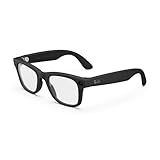
- #1 SELLING AI GLASSES - Tap into iconic style for men and women, and advanced technology with the newest generation of Ray-Ban Meta glasses. Capture photos and videos, listen to music, make hands-free calls or ask Meta AI questions on-the-go.
- UP TO 8 HOURS OF BATTERY LIFE - On a full charge, these smart AI glasses can last 2x longer than previous generations, up to 8 hours with moderate use. Plus, each pair comes with a charging case that provides up to 48 hours of charging on-the-go.
- 3K ULTRA HD: RECORD SHARP VIDEOS WITH RICH DETAIL - Capture photos and videos hands-free with an ultra-wide 12 MP camera. With improved 3K ultra HD video resolution you can record sharp, vibrant memories while staying in the moment.
- LISTEN WITH OPEN-EAR AUDIO — Listen to music and more with discreet open-ear speakers that deliver rich, quality audio without blocking out conversations or the ambient noises around you.
- ASK YOUR GLASSES ANYTHING WITH META AI - Chat with Meta AI to get suggestions, answers and reminders straight from your smart AI glasses.
Google’s Pre‑Glass Patent Trail
One of the earliest signals of intent appears in Google patents filed around 2008–2010 describing head‑mounted displays with asymmetric optics, where a single display module sits above or beside the dominant eye. These filings focus heavily on optical alignment, eye box tolerance, and mechanical adjustability, acknowledging that human faces vary far more than wrists. Unlike VR headsets, these designs assumed constant movement, blinking, and refocusing between near and far objects throughout the day.
Notably, these patents already framed the device as a node within a broader ecosystem rather than a standalone computer. References to wireless tethering, sensor fusion with smartphones, and cloud‑based processing appear repeatedly, foreshadowing Glass’s eventual dependence on Android phones for battery life and connectivity. In wearability terms, this was closer to how early smartwatches offloaded computation to phones, trading independence for all‑day comfort and reduced heat on the body.
Optics, Power, and the Limits of Miniaturization
A recurring theme in Google’s early filings is power management, an issue that would haunt Glass in practice. Patents describe aggressive duty‑cycling of displays, eye‑triggered wake mechanisms, and reliance on brief interaction bursts rather than continuous output. This design philosophy mirrors later smartwatch strategies, where always‑on displays only became viable after years of OLED efficiency gains.
The optical stack itself was another inherited constraint from DARPA‑era systems. Waveguides and prism‑based combiners allowed for transparent overlays but introduced narrow fields of view and visible artifacts. Google’s choice to keep the display small and off to the side was not merely aesthetic minimalism; it was a pragmatic response to optical physics, thermal limits, and the desire to keep total weight under what the human nose and ears could comfortably support for an entire day.
Human Factors: Wearing Data on Your Face
Where military AR assumed trained users operating in high‑stakes environments, Google’s patents began to grapple with something far more elusive: social acceptability. Several filings explicitly mention minimizing occlusion, avoiding direct eye contact interference, and enabling quick removal or repositioning. These concerns rarely appear in defense research, but they became central to Glass’s consumer framing as something you could wear in a café, not just a lab.
Yet the patents also reveal a blind spot. While adjustability and weight distribution were addressed mechanically, there was little anticipation of how a visible camera and illuminated prism would alter social dynamics. In watch terms, it was akin to designing a perfectly engineered case without considering whether anyone would want to wear a 52 mm chronograph to a dinner party.
Laying the Groundwork for the Next Wave
Despite Glass’s commercial failure, these early patents seeded much of what followed in the AR and smart glasses space. Concepts like glanceable notifications, asymmetric displays, and context‑aware overlays reappear in enterprise AR, cycling HUD glasses, and even automotive head‑up displays. Google’s IP quietly influenced how the industry learned to scale AR down, not up, long before spatial computing became fashionable again.
Understanding this pre‑Glass period reframes the product not as a naïve experiment, but as an early translation of military‑grade AR into consumer wearability. The next section will examine how that translation collided with reality once Glass left the patent office and entered the public eye, and why timing—not just technology—ultimately decided its fate.
The Optical Core: Prism Displays, Waveguides, and the Patented See‑Through HUD That Defined Google Glass
If the industrial design of Glass shaped how it felt on the face, its optical system determined whether it could exist at all. Google’s most consequential patents sit squarely in this domain, outlining how digital information could be injected into a user’s field of view without turning eyewear into a helmet or a medical device. The result was a fragile balance between visibility, comfort, and the limits of miniaturized optics in the early 2010s.
The Off‑Axis Display: Why Glass Looked Where It Looked
One of the defining choices in Glass’s patents was the off‑axis monocular display, positioned slightly above and to the right of the user’s dominant eye. Rather than attempting a full binocular overlay, Google focused on a single, glanceable image plane that could be ignored until needed. This was not a stylistic decision; it was a concession to weight, power consumption, and the difficulty of precise optical alignment across two eyes.
Patent filings describe this approach as a “peripheral virtual image,” explicitly designed to avoid constant focal rivalry with the real world. In practice, it behaved more like a notification window than a cinematic AR layer. For wearable veterans, the logic mirrors early smartwatch displays: limited real estate, intentionally constrained, in service of all‑day wearability rather than immersion.
Prism Optics: Turning Microdisplays Into Floating Information
At the heart of Glass was its prism-based combiner, a small block of specially shaped and coated material that both reflected and transmitted light. The microdisplay projected an image into the prism, which then redirected that light into the eye while remaining largely transparent. Multiple patents detail how reflective coatings and geometric angles were tuned to keep brightness legible outdoors without turning the prism into a visible mirror.
This approach avoided the bulk of traditional head‑up displays but introduced its own compromises. Brightness had to fight ambient light, especially in direct sunlight, while color reproduction was limited by the display technology of the time. Much like early OLED smartwatch panels, Glass’s display excelled at contrast in controlled conditions but struggled at the extremes of real‑world use.
Waveguides in Theory, Prisms in Practice
Google’s patent portfolio shows clear awareness of waveguide-based optics years before they became commercially viable. Several filings reference light pipes, diffractive elements, and planar waveguides capable of spreading an image across a thin lens. However, the Glass hardware itself relied on a simpler prism solution, reflecting the state of manufacturing and yield constraints at the time.
Waveguides promised thinner lenses and more natural placement of imagery, but early versions suffered from low efficiency and color distortion. For a consumer device already pushing thermal and battery limits, the prism was the safer choice. In hindsight, Glass arrived in the gap between optical ambition and optical readiness, a recurring theme in wearable history.
Focal Distance and Eye Comfort: The Invisible Constraint
Another underappreciated aspect of Glass’s optical patents is their attention to focal distance. The virtual image was set to appear several feet away, reducing eye strain by avoiding constant refocusing between the display and the real world. This decision aligned Glass more closely with automotive HUDs than with later mixed‑reality headsets.
Even so, prolonged use revealed subtle fatigue, especially during frequent notification bursts. The experience echoed early smartwatch ergonomics, where wrist position and glance frequency mattered as much as screen quality. Glass’s optics were technically sound, but human tolerance proved narrower than lab models predicted.
Why the HUD Stayed Minimal by Design
The limited field of view often criticized in Glass reviews was not a failure of imagination. Patents explicitly frame the display as informational rather than immersive, optimized for text, icons, and simple navigation cues. Expanding the image would have required larger optics, more power, and heavier mounting hardware, quickly breaking the comfort equation.
In watch terms, this was the equivalent of choosing legibility and battery life over complications and animations. Glass prioritized being worn all day over being visually impressive for five minutes. The problem was not the choice itself, but that consumers expected more spectacle from something worn on the face.
Patented Foundations and Their Long Shadow
While Glass hardware froze these ideas in an early state, its optical IP did not. Variations on Google’s prism combiners and peripheral HUD concepts reappear in enterprise smart glasses, cycling and running HUD eyewear, and even some current-generation industrial waveguide designs. The idea that AR does not need to dominate vision to be useful traces directly back to these patents.
Ironically, as modern waveguides improve and microLED displays mature, the original Glass optical philosophy looks increasingly prescient. The technology has finally begun to catch up to the constraints Google documented over a decade ago, suggesting that the core problem was never vision, but timing.
Computing on the Face: Sensors, Cameras, Voice Control, and the System Architecture Hidden Inside the Frame
If the display defined how Glass was seen, the computing stack defined how it behaved. Beneath the minimal HUD philosophy sat a surprisingly dense system architecture, compressed into a frame that had to balance weight, heat, battery life, and constant on-body comfort. This was not a shrunken smartphone strapped to the head, but an early attempt at ambient computing that behaved more like a networked sensor than a personal computer.
Seen through a wearable lens, Glass was closer to a smartwatch without a wrist than to later AR headsets. Its intelligence lived in how it sensed, listened, and selectively surfaced information, rather than how much it could render at once.
The Camera as Both Sensor and Social Fault Line
The outward-facing camera became the most visible and controversial component, but patents show Google never treated it as a primary imaging tool. Early filings describe the camera as a contextual sensor, used for visual search, scene recognition, barcode scanning, and quick-reference capture rather than long-form photography. Resolution and optics were deliberately modest to limit storage, processing, and power draw.
From a system perspective, the camera fed into Google’s cloud-first model. Images were intended to be analyzed remotely, with Glass acting as a capture node rather than a creative device. This is analogous to early smartwatch cameras that existed more for novelty and input than for meaningful photography.
The social backlash came from perception rather than capability. The always-visible lens suggested constant recording, even though battery constraints made continuous capture impractical. In hindsight, this mirrors how early smartwatches faced criticism for health sensors long before people understood how infrequently they actually sampled data.
Inertial Sensors and the Birth of Head-Based Interaction
Glass relied heavily on inertial measurement units, typically combining accelerometers and gyroscopes, to understand head movement and wearer intent. Patents outline gesture detection through subtle nods, tilts, and orientation changes, allowing Glass to infer attention without explicit input. This was an early form of passive interaction design that would later become central to AR and VR headsets.
Unlike wrist-based wearables, where arm motion creates constant noise, head movement offered cleaner signals with less ambiguity. A slight upward tilt could wake the display, while prolonged downward angles could signal disengagement. These ideas predate modern “attention-aware” interfaces now common in XR research.
The challenge was calibration and fatigue. Humans move their heads constantly, and distinguishing intent from natural motion required aggressive filtering. Much like early smartwatch raise-to-wake features, Glass’s head gestures worked best in controlled conditions and less reliably in daily life.
Touch, Bone Conduction, and the Limits of Physical Input
The capacitive touchpad along the temple provided the most reliable input method, functioning like a linear trackpad for swipes and taps. Patents emphasize one-handed, eyes-up interaction, minimizing the need for precise targeting. In wearability terms, this was a pragmatic choice, trading expressive input for consistency and low error rates.
Audio output relied on bone-conduction transducers rather than traditional speakers. This allowed Glass to deliver prompts and notifications without fully isolating the wearer from ambient sound. It was an elegant solution for safety and awareness, especially compared to earbuds or headphones.
However, both systems highlighted the physical limits of face-worn computing. Extended touch interaction caused arm fatigue, while bone conduction struggled in noisy environments. As with early smartwatch haptics and tiny touchscreens, Glass exposed how constrained input becomes when the device must disappear into the body rather than demand attention.
Voice Control as the Primary Interface, Not a Backup
“OK Glass” was not a marketing gimmick but the core interaction model. Patents describe voice as the default command layer, with touch and gestures serving as secondary confirmation tools. This inverted the smartphone hierarchy, where touch is primary and voice is optional.
Technically, this aligned perfectly with Glass’s limited display and processing power. Voice commands reduced the need for complex menus and allowed tasks to be completed without visual scanning. In concept, this foreshadowed today’s voice-first assistants embedded in earbuds, watches, and cars.
In practice, latency and context awareness lagged behind the vision. Cloud dependency meant delays, and public use raised social friction. Much like early smartwatch voice assistants, the technology worked best in isolation, not in the environments where wearables are most useful.
The Processor, Battery, and Thermal Balancing Act
Inside the frame, Glass used a smartphone-class system-on-chip of its era, paired with limited RAM and onboard storage. Patents repeatedly reference dynamic power management, selectively activating sensors and radios only when needed. The system was designed around micro-interactions measured in seconds, not continuous engagement.
Battery capacity was constrained by weight and heat dissipation. Unlike a watch, which can spread mass across the wrist, Glass concentrated electronics near the temple, where even small temperature increases are noticeable. Thermal limits dictated performance ceilings more than raw silicon capability.
This explains why Glass often felt underpowered compared to phones of the same generation. The trade-off mirrored early thin smartwatches that sacrificed speed and brightness to remain wearable. Comfort, not benchmarks, set the upper limit.
A Distributed Computer, Not a Standalone Device
Perhaps the most misunderstood aspect of Glass was its reliance on companion devices and cloud services. Patents frame Glass as a node within a larger ecosystem, offloading heavy computation to smartphones or servers whenever possible. Connectivity was not optional; it was foundational.
Rank #2
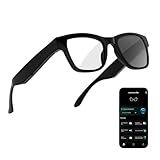
- 3-in-1 AI Glasses: Enjoy ① AI Voice Assistant (Powered by ChatGPT, Gemini & Deepseek), ② Stylish Photochromic Lenses Glasses, and ③ Bluetooth Open-Back Headphones, all in one.
- Free Talk Translation: Automatically detects and translates over 160 languages in real-time, allowing seamless work and translation without touching your phone or glasses.
- Voice, Video & Photo Translation: Supports over 98% of global languages, offering fast and accurate translations—ideal for international travel, business meetings, or cross-cultural communication.
- AI Meeting Assistant: Converts recordings from smart glasses into text and generates mind maps, making it easier to capture and organize meeting insights.
- Long Battery Life, Bluetooth 5.4 & Eye Protection: Up to 10 hours of music and 8 hours of talk time, with easy Type-C charging. Bluetooth 5.4 ensures stronger, stable connections, while photochromic lenses block UV rays and blue light, protecting your eyes in any environment.
This architecture reduced on-device complexity but increased friction when networks were slow or unavailable. Users accustomed to self-contained gadgets found the experience fragile. Yet this same model now underpins modern wearables, from LTE-enabled watches to lightweight AR viewers tethered to phones.
In retrospect, Glass anticipated a world where personal computing is fragmented across body-worn devices. The problem was that the ecosystem arrived years before consumers were ready to accept invisible computers stitched together by software.
Why the Architecture Still Matters Today
Many of Glass’s architectural decisions now look less like failures and more like early constraints. Sensor fusion, voice-first interaction, cloud offloading, and minimal displays are all central to current smart glasses and XR roadmaps. The difference is that silicon efficiency, batteries, and AI inference have finally caught up.
Just as early smartwatches struggled before finding their rhythm, Glass revealed what face-worn computing demands from both technology and users. The system hidden inside the frame was not flawed so much as premature, built for a future that had not yet stabilized around it.
From Patent Drawings to Product Reality: Google Glass Explorer Edition (2013) as a Hardware Compromise
If the patents outlined an idealized vision of face-worn computing, the Explorer Edition was where those ideas collided with physics, manufacturing limits, and human tolerance. Google Glass in 2013 was not a pure expression of its IP portfolio, but a negotiated truce between what the patents promised and what could actually ship on a human face.
The result was a device that looked deceptively simple yet embodied dozens of unresolved trade-offs. Weight distribution, thermal management, optical clarity, and battery endurance all fought for priority inside a frame that could not afford excess in any direction.
The Frame as a Chassis, Not an Accessory
Unlike watches, where the case can be thickened and balanced with a strap, Glass had no such luxury. The titanium alloy frame was doing structural, aesthetic, and thermal work simultaneously, acting as both eyewear and heatsink. This material choice aligned closely with early patents emphasizing lightweight rigidity, but it also revealed how little margin there was for iteration.
At roughly 50 grams, Explorer Edition Glass was light on paper but heavy in perception. Most of that mass sat over the right temple, creating a constant asymmetrical load that users noticed within minutes. Even minor shifts in component placement could be felt immediately, a reminder that facial wearables punish imbalance far more than wrist-based devices.
Optics: The Reality Behind the Floating Screen
Patent illustrations often depicted expansive, immersive visual overlays, but the shipped display was intentionally constrained. The prism-projected image measured the equivalent of a 25-inch screen viewed from eight feet away, positioned just above the user’s natural line of sight. This was less about ambition and more about survival.
A larger or brighter display would have increased power draw, heat output, and eye fatigue. The compromise preserved glanceability but limited immersion, reinforcing Glass’s role as a notification surface rather than a full visual workspace. In practice, it behaved more like a persistent heads-up ticker than an AR window.
Battery Life as the Hard Ceiling
Explorer Edition’s most defining limitation was endurance. The internal battery, roughly 570 mAh, struggled to deliver more than three to five hours of mixed use, and significantly less with video recording or navigation. This constraint shaped nearly every software decision layered on top.
Patents envisioned always-on contextual awareness, but the product enforced disciplined, almost cautious interaction. Short bursts of use were encouraged not by design philosophy, but by necessity. Like early mechanical watches with short power reserves, Glass demanded restraint from its wearer to remain functional.
Thermals, Performance, and the Invisible Throttle
Glass ran on a dual-core TI OMAP processor that was already conservative by smartphone standards in 2013. Even so, sustained workloads triggered noticeable warmth along the temple, a sensation far more intrusive than heat on a wrist or in a pocket. This made thermal throttling unavoidable.
Performance ceilings were therefore defined less by silicon capability and more by skin comfort. Voice recognition lag, UI stutter, and delayed camera response were not merely software immaturity; they were symptoms of a system operating under strict thermal probation.
Input Methods: Voice First, Touch Second, Always Limited
Glass’s side-mounted capacitive touchpad translated patent concepts of gesture input into a narrow, linear surface. Swipes and taps worked reliably, but the interaction vocabulary was shallow. There was no room for complex gestures without increasing accidental input.
Voice control, activated by the now-famous wake phrase, was intended to carry most of the load. In quiet environments it felt futuristic; in public or noisy spaces it felt socially awkward and technically fragile. The hardware demanded voice, but the world was not yet optimized for it.
Camera Placement and the Social Cost of Hardware Decisions
The forward-facing camera was a triumph of miniaturization and a liability of perception. Technically, it delivered respectable stills and 720p video from a module small enough to fit beside the display prism. Socially, it became the symbol of Glass’s overreach.
Patents treated always-available capture as a feature of ambient computing. In reality, the visible hardware triggered privacy concerns that no software indicator could fully offset. This disconnect between engineering intent and cultural reception would haunt Glass more than any spec sheet weakness.
Software Experience Shaped by Hardware Boundaries
The card-based UI was not just a design preference; it was a hardware concession. Limited display resolution, narrow field of view, and constrained input made linear navigation the only viable option. Multitasking, depth, and visual richness were casualties of the form factor.
Compatibility leaned heavily on Android phones, reinforcing the distributed architecture described in Google’s patents. Without a paired device and reliable connectivity, Glass felt incomplete. The hardware simply could not support the autonomy that consumers subconsciously expected from a $1,500 device.
A Prototype Sold as a Product
Explorer Edition was never truly a consumer device in the traditional sense. It was a public hardware experiment, priced to deter mass adoption while seeding real-world feedback. In that respect, it behaved more like an early developer kit than a finished wearable.
For historians of technology, this is where Glass becomes most interesting. It froze a moment in time where patented ambition exceeded industrial readiness, and the compromise itself became the lesson. The hardware did not fail because it was poorly conceived, but because it faithfully revealed how far the ecosystem still had to go.
Why the Consumer Vision Failed: Social Backlash, Battery Life, Privacy Optics, and the Limits of First‑Gen Wearability
If Explorer Edition exposed how far the ecosystem still had to go, its public reception made that gap impossible to ignore. The moment Glass left controlled demos and entered cafés, sidewalks, and offices, the constraints of first‑generation wearability stopped being theoretical and became social, practical, and deeply human.
Social Backlash Was Not a Side Effect, It Was a Core Failure Mode
Glass asked society to renegotiate eye contact, attention, and consent without offering a clear upside to everyone involved. The wearer gained ambient information, but bystanders absorbed the discomfort of uncertainty. That imbalance proved fatal in everyday settings.
Nicknames like “Glasshole” were not media inventions; they emerged organically as shorthand for a new kind of social friction. Unlike a phone or smartwatch, Glass placed technology directly in the line of sight, collapsing the boundary between presence and mediation in a way people were not ready to normalize.
Patents assumed social adaptation would follow capability. In practice, etiquette lagged hardware, and Glass wearers paid the reputational cost while Google learned the lesson in public.
Battery Life and Thermal Reality Undermined Daily Wearability
On paper, Glass’s battery capacity aligned with its lightweight goals. In use, always‑on sensors, Wi‑Fi, Bluetooth, audio output, and camera readiness created a power draw that clashed with all‑day expectations.
Real‑world battery life often landed closer to a few hours of active use, not a full waking day. Recording video or navigating with GPS could drain the device rapidly, forcing users to ration functionality or carry external chargers, an admission of immaturity for something worn on the face.
Heat compounded the issue. Concentrated electronics near the temple created noticeable warmth during extended use, an ergonomic penalty that wrist‑based wearables avoid through distribution and distance from the head.
Privacy Optics Trumped Technical Safeguards
Google attempted to address privacy through software cues like screen activation and LED indicators. These solutions satisfied engineers but failed to reassure the public, because they required trust in a system outsiders could not verify.
The problem was not what Glass could do, but what it appeared capable of doing at any moment. A visible camera, positioned near the eye, carried an implicit promise of recording whether or not it was active.
This is where Glass collided with the limits of design signaling. Hardware form communicated surveillance more loudly than software could communicate restraint, and no firmware update could undo that visual message.
Ergonomics, Aesthetics, and the Burden of Facial Wear
Glass was impressively light for its components, but facial wear has a narrower comfort tolerance than wrists or pockets. Asymmetrical weight distribution created subtle pressure points over time, especially for users without prescription lens integration.
Fit adjustments were limited, and compatibility with existing eyewear added complexity rather than elegance. For a device intended to be worn continuously, the experience demanded too much physical and cognitive accommodation.
Aesthetically, Glass lived in an uncomfortable middle ground. It was neither invisible enough to disappear nor expressive enough to be fashion, leaving it exposed to scrutiny from all angles.
Price and Perceived Value Broke the Consumer Contract
At $1,500, Explorer Edition implicitly invited comparison with smartphones, laptops, and luxury watches. Unlike those categories, Glass did not deliver autonomy, longevity, or craftsmanship that justified emotional or financial investment.
The value proposition relied on future potential rather than present utility. Consumers were asked to fund a vision still constrained by battery, software depth, and social acceptance.
In watch terms, it was a prototype priced like a finished complication. Enthusiasts might tolerate that gap, but mainstream buyers will not.
The Limits of First‑Generation Wearability Revealed Themselves Early
Glass arrived before complementary technologies matured. Battery density, on‑device AI, low‑power displays, and social norms all needed another cycle, if not several.
Rank #3

- 【AI Real-Time Translation & ChatGPT Assistant】AI glasses break language barriers instantly with AI real-time translation. The built-in ChatGPT voice assistant helps you communicate, learn, and handle travel or business conversations smoothly—ideal for conferences, overseas trips, and daily use.
- 【4K Video Recording & Photo Capture 】Smart glasses with camera let you capture your world from a first-person view with the built-in 4K camera. Take photos and record videos hands-free anytime—perfect for travel moments, vlogging, outdoor adventures, and work documentation.
- 【Bluetooth Music & Hands-Free Calls 】Camera glasses provide Bluetooth music and crystal-clear hands-free calls with an open-ear design. Stay aware of your surroundings while listening—comfortable for long wear and safer for commuting, cycling, and outdoor use.
- 【IP65 Waterproof & Long Battery Life】 Recording glasses are designed for daily wear with IP65 waterproof protection against sweat, rain, and dust. The built-in 290mAh battery provides reliable performance for workdays and travel—no anxiety when you’re on the go.
- 【Smart App Control & Object Recognition】Smart glasses connect to the companion app for easy setup, file management, and feature control. They support AI object recognition to help identify items and improve your daily efficiency—perfect for travel exploration and a smart lifestyle.
What failed was not the idea of smart glasses, but the assumption that ambient computing could be introduced without gradual acclimation. Glass tried to leapfrog from zero to omnipresent in a single generation.
In doing so, it clarified a boundary the industry now respects: wearables succeed when they minimize social friction first and expand capability second.
The IP Afterlife of Google Glass: How Its Patents Shaped Enterprise AR, Smart Glasses, and Competitor Designs
When Glass retreated from consumer view, it did not disappear so much as invert itself. The product faded, but the intellectual property quietly began influencing a more pragmatic generation of wearables that treated faces as workplaces rather than stages.
What followed was less a resurrection than a redistribution, with Google’s early filings seeding enterprise AR, informing competitors’ optical architectures, and setting constraints that still shape how smart glasses are designed today.
The Core Glass Patent Stack: Optics, Input, and Contextual Awareness
At the heart of Google Glass was a dense cluster of patents filed between roughly 2010 and 2014, covering near‑eye displays, optical waveguides, and the mechanical alignment of micro‑projectors relative to the eye. These filings focused on projecting a virtual image at optical infinity while keeping the hardware light enough for all‑day wear.
Equally important were patents around head‑referenced UI, where content remained spatially stable relative to gaze and head orientation rather than floating like a phone notification. This distinction became foundational for later AR systems, especially those prioritizing glanceable, non‑immersive information.
Google also patented multimodal input schemes that combined voice, touch gestures along the temple, and inertial sensing. While Glass’s “OK Glass” voice trigger became a cultural punchline, the underlying work on low‑latency, always‑listening systems anticipated today’s on‑device wake‑word processing and contextual assistants.
From Consumer Misstep to Enterprise Blueprint
The pivot to Glass Enterprise Edition was not merely a business decision; it was an IP realignment. In industrial, medical, and logistics settings, many of Glass’s patented features finally made sense, especially hands‑free information delivery and first‑person video capture.
Patents covering camera placement, thermal management, and modular frame integration proved especially valuable here. Enterprise Glass units added thicker frames, improved heat dissipation, and longer battery life, trading fashion ambiguity for durability and shift‑length usability.
In these environments, social friction evaporated. A warehouse picker or field technician values uptime, comfort over eight to ten hours, and predictable software behavior more than aesthetics, allowing Google’s early technical assumptions to function as originally intended.
Quiet Influence on Competitor Smart Glasses
Even companies that positioned themselves as “post‑Glass” inevitably designed around Google’s prior art. Waveguide display approaches from Microsoft HoloLens, Vuzix, Epson, and North all navigated similar optical constraints first explored in Glass patents.
This influence often appeared indirectly. Competitors shifted display modules lower in the lens, widened frames to distribute weight more symmetrically, or adopted monocular designs to avoid both patent overlap and social discomfort.
Touch input along the temple, now common across enterprise and consumer smart glasses, echoes Glass’s original interaction model. Even when implementations differ, the ergonomic logic of that placement traces back to Google’s early filings.
Licensing, Defensive Patents, and Strategic Containment
Google’s Glass portfolio also functioned defensively, shaping what others could not easily do. By establishing early claims around head‑mounted notification systems and context‑aware overlays, Google constrained how aggressively competitors could pursue consumer AR without rethinking interface metaphors.
This defensive posture benefited Google even as it stepped back from consumer hardware. It allowed the company to focus on software platforms, computer vision, and cloud‑assisted perception while keeping leverage in any future hardware resurgence.
Notably, many startups chose to avoid direct competition by narrowing their scope to audio‑first glasses, camera‑only devices, or fully immersive headsets. Each of those paths reflects an attempt to sidestep Glass’s IP gravity rather than confront it head‑on.
How Glass Patents Informed Today’s “Invisible Tech” Philosophy
One of Glass’s most enduring contributions is negative knowledge: what not to foreground. Patents around ambient displays and peripheral awareness underscored that smart glasses work best when they demand minimal attention.
Modern devices increasingly hide their intelligence behind traditional eyewear silhouettes, using subtler displays, lower‑power electronics, and shorter interaction loops. The industry learned that battery life measured in days, not hours, matters more than raw capability for facial wear.
In wearable terms, this mirrors the difference between a bulky experimental watch and a refined daily wearer. Comfort, balance, and restraint define long‑term adoption far more reliably than feature lists.
The Long Tail: Glass IP in a Post‑Phone World
As on‑device AI improves and components shrink, many of Glass’s early patents are finding new relevance. Contextual awareness, gaze‑aligned information, and seamless transitions between passive and active states align closely with today’s push toward ambient computing.
Google’s own trajectory, folding Glass learnings into broader AR research rather than standalone products, suggests patience rather than retreat. The IP groundwork is already laid for a future where smart glasses act less like screens and more like companions.
In that sense, Google Glass did not fail so much as it arrived early and taught the industry where the edges were. Its patents remain the quiet scaffolding beneath today’s smart glasses, shaping what feels possible, acceptable, and wearable on the human face.
Glass at Work: Enterprise Edition, Industrial Use Cases, and the Quiet Redemption of the Platform
If Glass was early for consumers, it turned out to be almost perfectly timed for industry. The same qualities that felt awkward in cafés and boardrooms—always-on awareness, a head‑mounted camera, glanceable data—made immediate sense in environments where hands, attention, and safety were already constrained.
Google’s pivot to enterprise was not a retreat so much as a reframing of the original thesis. In controlled workplaces, the patents around peripheral displays, voice-first interaction, and context-aware prompts stopped being socially controversial and started being economically useful.
From Explorer to Enterprise: What Actually Changed
Glass Enterprise Edition, launched quietly in 2017 and refined again in 2019, looked similar at a glance but differed meaningfully in intent and execution. The hardware shifted toward durability and balance, with reinforced frames, improved thermal management, and better weight distribution for all‑day wear.
Battery life, never competitive in the consumer version, became predictable rather than aspirational. A typical shift could be covered with intermittent use, assisted by hot‑swappable external battery packs and more conservative display activation policies.
On the software side, Glass shed its app‑store ambitions in favor of single‑purpose workflows. Most enterprise deployments ran one or two custom applications, tightly integrated with backend systems rather than generalized consumer platforms.
Industrial Use Cases Where Glass Actually Excelled
In manufacturing and logistics, Glass found traction as a guided workflow tool. Pick‑and‑pack operations, quality assurance checks, and assembly instructions benefited from head‑up prompts that reduced errors without forcing workers to consult handheld screens.
Remote assistance became one of the most compelling applications. A technician wearing Glass could stream live video to an expert elsewhere, receiving annotations and instructions aligned directly to their field of view, a near textbook use of Glass’s original camera and display patents.
Healthcare, particularly in hospital logistics and training contexts, also emerged as a stronghold. Surgeons and nurses used Glass for checklists, patient data verification, and hands‑free documentation, often paired with strict privacy controls that would have been untenable in a consumer setting.
The Software Stack: Quietly Mature, Intentionally Invisible
Glass Enterprise Edition ran on Android at its core, but the experience was deliberately stripped back. Voice commands, simple touch gestures on the temple, and automatic context triggers replaced exploratory interaction.
This minimalism aligned closely with Glass’s earliest patent language around reduced cognitive load and glanceable information. In enterprise, those ideas were not aspirational design goals; they were requirements tied to safety, efficiency, and compliance.
Importantly, Glass was rarely positioned as the star of the system. It functioned more like a specialized instrument, closer in spirit to a torque wrench or inspection camera than a personal computer.
Partners, Not Products: The Ecosystem Strategy
Rather than sell Glass directly at scale, Google leaned on solution partners like Vuzix, AGCO, Boeing suppliers, and healthcare integrators to adapt the platform. These partners handled hardware mounting options, prescription integration, ruggedization, and custom software layers.
This approach mirrored the industrial tooling world more than consumer electronics. Glass became a module within a larger system, valued for reliability and IP pedigree rather than brand aspiration.
Pricing reflected this shift. Enterprise Glass deployments were expensive compared to consumer wearables, but inexpensive relative to training costs, error reduction, and downtime savings.
Why Enterprise Succeeded Where Consumer Failed
The enterprise redemption of Glass highlights a core lesson of wearable design: context defines acceptability. In factories and hospitals, cameras are expected, data capture is routine, and uniform equipment minimizes social friction.
Comfort also mattered differently. Workers tolerated a slightly heavier frame or visible module because the value exchange was explicit and immediate, much like wearing a professional dive watch or a thick pilot’s chronograph for function rather than elegance.
Most critically, enterprise users did not expect Glass to replace a phone, laptop, or watch. It did one job extremely well, and then stayed out of the way.
Rank #4
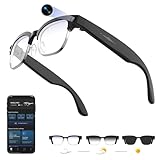
- 【8MPW Camera & 1080P Video and Audio】:These camera glasses feature an 800W camera that outputs sharp 20MP photos and smooth 1080P 30fps videos. Ultra-Clear Video + Powerful Anti-Shake tech+ Built-in dual microphones, you can capture crystal-clear video and audio together -sharply restoring details, perfect for vlogging, travel, and everyday moments
- 【Real-time AI translation Smart Glasses with Camera】:Instantly translate multiple major languages, breaking down language barriers in an instant—no phone required. Ideal for office settings, travel, academic exchanges, international conferences, watching foreign videos, and more
- 【Voice Assistant Recognition and Announcement】:Powered by industry-leading AI large models such as Doubao AI and OpenAI's GPT-4.0. AI voice wake-up lets you ask questions, recognize objects, and get answers on the go. Automatically recognizes objects, menus, landmarks, plants, and more, quickly analyzing the results and announcing them in real time. It instantly becomes your mobile encyclopedia on the go
- 【Bluetooth 5.3 Connection and Automatic Sync to Phone】:Equipped with a low-power BT5.3 chip and Wi-Fi dual transmission technology, offering ultra-low power and high-speed transmission. Captured images and videos are transferred to your phone in real time, eliminating manual export and eliminating storage worries
- 【290mAh Ultra-Long Battery Life】:Ultra-light at 42g, it's made of a durable, skin-friendly material, as light as a feather. Lenses are removable. Its simple, versatile design makes it a comfortable and comfortable wearer. 290mAh ultra-long battery life, 12 hours of music playback and 2 hours of photo or video recording, making it a perfect travel companion
The Legacy of Glass at Work
While Google formally sunset Glass Enterprise Edition in 2023, the platform’s influence did not disappear. Many of its partners migrated workflows to newer AR devices, often carrying over interaction models and software logic first developed for Glass.
The quiet success of Glass at work reframed its historical narrative. Instead of a failed consumer gadget, it became a proof point that head‑mounted displays could deliver real value when aligned with the right environment and incentives.
In the broader wearable landscape, Glass Enterprise Edition stands as an early example of how smart glasses can mature not through mass adoption, but through disciplined, purpose‑built integration.
The Competitive Landscape Glass Helped Create: From HoloLens and Magic Leap to Meta, Snap, and Apple Vision
By the time Glass found its footing in enterprise, it had already reshaped how the broader industry thought about head‑mounted computing. Even its consumer missteps clarified which problems were truly hard: optics, comfort, social acceptability, and sustained utility beyond novelty.
Glass did not spark the AR race alone, but it forced competitors to confront the full stack early, from waveguides and sensors to operating systems and developer tooling. What followed was not a single lineage, but several distinct interpretations of what wearable computing should become.
Microsoft HoloLens: From Heads‑Up Display to Spatial Computer
Microsoft’s HoloLens took many lessons from Glass and deliberately rejected its minimalism. Where Glass focused on glanceable information in the periphery, HoloLens pursued fully anchored holograms mapped into physical space.
This shift required fundamentally different hardware. HoloLens integrated depth sensors, inside‑out tracking cameras, and a dedicated holographic processing unit, trading the lightness of Glass for a helmet‑like form factor closer to industrial headgear than eyewear.
In practice, HoloLens succeeded in similar contexts to Glass Enterprise Edition: manufacturing, defense, design visualization, and medical planning. Battery life hovered in the low single‑digit hours, but like a professional instrument watch, it was worn for a task, not a day.
The key divergence was philosophical. Glass treated AR as an accessory to reality; HoloLens treated it as a spatial layer replacing monitors, manuals, and even laptops. Both approaches owe their legitimacy to Glass proving that head‑worn displays could be operationally viable.
Magic Leap: Optics First, Reality Later
Magic Leap emerged as the most ambitious response to Glass, promising lightweight glasses with cinema‑grade visuals and seamless blending of digital and physical worlds. Its early patents and demos leaned heavily on advanced waveguides, light field concepts, and retinal comfort.
The resulting products, however, revealed the same trade‑offs Glass had exposed years earlier. To achieve acceptable field of view and brightness, Magic Leap required a tethered compute puck, adding friction and limiting everyday usability.
Like Glass, Magic Leap ultimately found more traction in enterprise and research than in consumer life. Developers appreciated its spatial mapping and hand tracking, but the device remained something you scheduled time to wear, not something you forgot you were wearing.
The parallel with Glass is instructive. Both companies underestimated how unforgiving the face is as a platform, and how quickly even small ergonomic compromises erode adoption outside controlled environments.
Meta and the Shift Toward Social and Camera‑First Wearables
Meta’s response to Glass took a more indirect path. Instead of leading with AR overlays, it prioritized social presence, cameras, and connectivity, most visibly with Ray‑Ban Meta smart glasses.
These devices echo Glass more than Meta’s own VR headsets. They are light, all‑day wearable, and designed to disappear into familiar eyewear silhouettes. Battery life remains limited, often measured in hours of active use, but standby endurance and charging cases mitigate daily friction.
Critically, Meta deferred visual AR altogether. By focusing on audio, capture, and AI‑driven assistance, it avoided the optical constraints that haunted Glass while still training users to accept cameras and sensors on their faces.
This strategy mirrors Glass’s early ambition but benefits from a decade of social normalization, better miniaturization, and vastly more capable on‑device and cloud AI. It is an evolutionary path that Glass pioneered but could not complete.
Snap Spectacles and the Developer‑First Experiment
Snap’s Spectacles occupy a niche that Glass never fully embraced: deliberately limited, deliberately playful, and explicitly experimental. Each generation has targeted developers and creators rather than mass consumers.
The AR‑enabled Spectacles integrate waveguide displays, multiple cameras, and spatial tracking, yet remain bulky and short‑lived on battery. Comfort is acceptable for sessions, not days, reinforcing their role as a creative tool rather than a personal device.
Where Glass struggled with identity, Snap defined its own. Spectacles are not replacements for phones or watches; they are portals for prototyping future interaction models. Many gestures, UI metaphors, and camera‑centric workflows trace conceptual roots back to Glass’s early design language.
Apple Vision: Learning From Glass by Going Bigger
Apple’s Vision platform represents perhaps the most strategic response to Glass’s legacy. Instead of attempting subtlety, Apple embraced scale, weight, and cost to deliver a no‑compromise experience.
Vision Pro is not eyewear in the traditional sense. It is closer to a wearable computer strapped to the face, with dual micro‑OLED displays, eye tracking, hand tracking, and a separate battery pack. Comfort is managed through materials, weight distribution, and modular straps rather than invisibility.
This approach sidesteps nearly every consumer problem Glass faced. Vision Pro does not pretend to be socially invisible or all‑day wearable. Like a high‑end mechanical chronograph, it is purposeful, expensive, and unapologetically specialized.
Yet many of its interaction principles echo Glass patents: glance‑based UI, context‑aware notifications, and the idea that head‑mounted computing should feel ambient rather than immersive when used correctly. Apple simply waited until the technology could deliver on that promise without compromise.
The Market Glass Made Inevitable
Taken together, these competitors reveal how Glass reframed the problem space. The industry no longer debates whether smart glasses are possible, but which compromises are acceptable for which users.
Enterprise devices prioritize capability over comfort. Consumer audio‑camera glasses prioritize wearability over visuals. High‑end spatial computers prioritize experience over portability. Each path traces back to Glass exposing the limits of trying to do everything at once.
Glass’s most enduring competitive impact may be this fragmentation. By failing loudly in one form, it allowed successors to succeed by choosing their constraints carefully, setting the stage for a more nuanced and sustainable wearable ecosystem.
Is the Technology Finally Ready? Power Efficiency, AI Assistants, and Display Advances That Change the Equation
If Glass’s failure taught the industry anything, it was that ambition alone cannot overcome physics. Battery density, thermal limits, optics, and social acceptability all imposed constraints that early 2010s silicon simply could not bend.
What has changed is not a single breakthrough, but a convergence. Power-efficient compute, on-device AI, and dramatically better micro-displays have shifted the trade-offs that once doomed Glass from day one.
Power Efficiency: From Smartphone-Class Silicon to Purpose-Built Wearable Compute
Original Google Glass relied on smartphone-era processors scaled down to fit a face-worn form factor. The result was predictable: heat buildup, limited battery life measured in hours, and aggressive performance throttling that undercut the experience.
Today’s wearable silicon looks very different. ARM-based architectures optimized for always-on sensing, combined with heterogeneous cores and dedicated neural processing units, allow modern smart glasses to idle at milliwatt levels and spike performance only when needed.
This mirrors the evolution of smartwatch chipsets, where Apple’s S-series and Qualcomm’s W-series separated wearable needs from phone-class expectations. Glass lacked that separation; modern designs start with it.
Battery Reality: Smaller Cells, Smarter Usage
Battery chemistry has improved incrementally, not exponentially, but usage models have changed dramatically. Early Glass attempted persistent display activity, continuous camera readiness, and near-constant wireless communication.
Contemporary smart glasses assume burst usage. Displays sleep aggressively, cameras wake only when explicitly invoked, and AI inference often replaces cloud calls, reducing radio power draw and latency.
In practical terms, this shifts wearability from “dies before lunch” to something closer to a modern smartwatch: not all-day immersive, but viable as an always-available companion.
AI Assistants: The Missing Interface Layer Glass Never Had
Glass launched before voice assistants were genuinely useful. Google Now was context-aware in theory, but brittle in execution, heavily cloud-dependent, and poorly suited to real-world noise and latency.
Modern AI assistants fundamentally change the interaction model. On-device speech recognition, multimodal understanding, and context retention allow smart glasses to function as ambient interfaces rather than notification mirrors.
This is critical for social acceptability. A glasses-based assistant that whispers directions, summarizes messages, or identifies objects without demanding visual attention solves a problem Glass never could articulate clearly.
From Commands to Companionship
The deeper shift is not voice control, but intent inference. AI systems can now anticipate when information is useful rather than waiting to be summoned.
💰 Best Value

- #1 SELLING AI GLASSES - Move effortlessly through life with Ray-Ban Meta glasses. Capture photos and videos, listen to music, make hands-free calls or ask Meta AI* questions on-the-go. Ray-Ban Meta glasses deliver a slim, comfortable fit for both men and women.
- CAPTURE WHAT YOU SEE AND HEAR HANDS-FREE - Capture exactly what you see and hear with an ultra-wide 12 MP camera and a five-mic system. Livestream it on Facebook and Instagram.
- LISTEN WITH OPEN-EAR AUDIO — Listen to music and more with discreet open-ear speakers that deliver rich, quality audio without blocking conversations or the ambient noises around you.
- GET REAL-TIME ANSWERS FROM META AI — The Meta AI* built into Ray-Ban Meta’s wearable technology helps you flow through your day. When activated, it can analyze your surroundings and provide context-rich suggestions - all from your smart AI glasses.
- CALL AND MESSAGE HANDS-FREE — Take calls, text friends or join work meetings via bluetooth straight from your glasses.
For smart glasses, this reduces the need for constant UI presence. The display becomes secondary, invoked selectively, much like a mechanical watch’s complication is glanced at rather than stared into.
Glass was designed around explicit commands and visual feedback. The next generation is designed around restraint.
Display Technology: The End of the Compromise Prism
Glass’s optical display was a marvel for its time and a liability almost immediately. The prism-based projector was bulky, had limited brightness outdoors, and forced awkward industrial design compromises.
Micro-LED and micro-OLED waveguide displays now offer higher brightness, better color accuracy, and significantly improved efficiency in dramatically smaller packages. Crucially, they also support true binocular designs without the weight penalties Glass could not avoid.
This matters for comfort as much as visuals. Balanced optics reduce eye strain, allow more natural glance behavior, and make long-term wear plausible rather than fatiguing.
Resolution Is No Longer the Point
Early smart glasses chased resolution to justify their existence. Modern designs prioritize legibility, contrast, and focal comfort over raw pixel counts.
This reflects a maturation of the category. Just as watch dials value clarity over complication density, head-up displays succeed when they present exactly the right information at exactly the right moment.
Glass tried to be a screen on your face. Today’s displays aim to disappear until needed.
Thermals, Materials, and Wearability: Lessons Borrowed From Watches
Thermal management remains a defining constraint. Modern smart glasses increasingly rely on passive heat spreading through frame materials, hinge structures, and nose bridge contact points.
This parallels watch case engineering, where materials, thickness, and contact surfaces dictate comfort as much as movement efficiency. Lightweight alloys, advanced polymers, and carbon-reinforced frames now do work Glass’s plastic and aluminum shells never could.
Comfort is no longer an afterthought. It is a design input from the first CAD sketch.
Connectivity Without Dependence
Glass assumed persistent connectivity to justify its existence. When networks lagged or failed, the product felt incomplete.
Modern smart glasses are more self-sufficient. Bluetooth Low Energy links to phones for bandwidth-heavy tasks, while on-device intelligence handles navigation, translation, and context awareness offline.
This decoupling makes glasses feel like an extension of the wearer, not a hostage to signal strength.
Why This Moment Is Different
Taken together, these advances do not guarantee success, but they remove the structural reasons Glass failed. Power, heat, and usability are no longer existential threats; they are engineering challenges with known solutions.
More importantly, expectations have shifted. Consumers now understand wearables as companions, not replacements, and are comfortable with devices that excel at narrow tasks rather than pretending to do everything.
Glass arrived too early with too much ambition and too little margin. The next wave arrives with humility, efficiency, and the quiet confidence of technology that finally fits the human body.
The Future of Smart Glasses: Will Google Return, License Its IP, or Let Others Finish What Glass Started?
If Glass failed because it arrived before the world was ready, the more uncomfortable truth is that the world may now be ready without Google. The technical barriers that once defined Glass’s limits have largely been solved elsewhere, often by companies that studied its mistakes more closely than its ambitions.
That leaves an open question that still hangs over the wearable landscape: does Google see smart glasses as unfinished business, monetizable intellectual property, or a chapter best closed quietly while others carry the idea forward?
Google’s Patent Position: Dormant, Not Dead
Google never stopped filing patents related to head-mounted displays, optical waveguides, eye-tracking, contextual notifications, and environmental sensing. Many of these filings, especially from 2018 onward, are markedly more restrained than early Glass-era patents, focusing on efficiency, modularity, and subtle interaction rather than spectacle.
What stands out is how wearable-agnostic many of these patents have become. The claims often describe systems that could live in glasses, headsets, or even ambient computing environments, suggesting Google is hedging rather than committing to a single form factor.
This mirrors Google’s broader hardware strategy post-Glass. Instead of betting the company’s identity on a single radical product, it builds IP portfolios that can surface later through Android, Wear OS, or licensing agreements.
The Enterprise Exit Was Not a Failure, But a Reframe
Glass’s retreat into enterprise quietly solved many of its original problems. In factories, hospitals, and warehouses, constant connectivity, visible cameras, and limited battery life are acceptable trade-offs if the device saves time or reduces error.
From a product development perspective, Enterprise Edition Glass refined what mattered: lighter frames, better thermal balance, improved nose pad ergonomics, and displays tuned for glanceability rather than immersion. These are the same refinements now visible in modern consumer-oriented smart glasses.
Yet enterprise success rarely translates cleanly into consumer desire. Just as a ruggedized smartwatch feels out of place at a dinner table, enterprise Glass optimized for function over emotional wearability. Google gained operational insights, but not a cultural reset.
Why Google Hasn’t Relaunched Glass for Consumers
Google’s hesitation is less about technology and more about trust. Glass became a social flashpoint, symbolizing surveillance anxiety, corporate overreach, and Silicon Valley detachment from lived experience.
Re-entering the consumer glasses market would require more than a better product. It would demand a re-education campaign around privacy, clear visual cues for sensing, and design language that signals respect rather than intrusion.
In contrast, watches and rings enjoy social legitimacy. They are understood objects. Glasses sit directly on the face, and that intimacy magnifies every misstep.
Licensing the Future: Google’s Quiet Influence
The more plausible near-term outcome is not a Google-branded return, but Google-shaped products from others. Android already underpins many wearable experiences, and Google’s AR frameworks quietly influence how contextual information is layered onto reality.
Licensing optical IP, gesture recognition systems, or power management techniques allows Google to extract value without becoming the visible face of smart glasses again. This approach mirrors how Google benefits from smartwatch hardware without directly competing with every OEM running Wear OS.
In this model, Google Glass becomes less a product and more a genetic ancestor. Its ideas persist, refined and normalized, without the baggage of the original name.
Others Are Finishing the Work, Differently
Companies like Meta, Apple, and a growing field of specialized startups are converging on a more watch-like philosophy of smart glasses. Narrow purpose, all-day comfort, predictable battery life, and materials that feel intentional rather than experimental now define success.
Modern frames emphasize weight distribution, hinge durability, and skin-contact comfort in the same way watchmakers obsess over lug geometry and case thickness. Displays are secondary to wearability, just as complications serve the dial rather than dominate it.
This shift aligns with what Glass never quite embraced. Being worn is the primary function. Everything else is optional.
Will Google Ever Return Under Its Own Name?
A Google-branded consumer smart glass is not impossible, but it is unlikely to resemble Glass in spirit or scope. If it happens, it will be understated, deeply integrated with Android, and framed as an assistive companion rather than a technological statement.
More likely, Google will let time do the reputational repair. As smart glasses become mundane through other brands, the shock of the form factor fades, and the ideas Glass introduced become invisible infrastructure.
In that sense, Google may already have won. The future it imagined no longer needs its logo to exist.
The Long View: Glass as a Transitional Artifact
History rarely remembers transitional devices kindly. Early quartz watches were dismissed before they rewrote horology, and the first smartwatches were awkward before they became indispensable.
Google Glass occupies a similar space. It exposed the problem, provoked the backlash, and mapped the technical terrain. Others now walk that map with better tools and more humility.
Whether Google returns, licenses, or simply watches from a distance, Glass’s most important legacy is not what it sold, but what it taught. Smart glasses will arrive not as a revolution, but as a refinement. And when they do, they will feel less like Glass reborn and more like the idea finally learning how to sit comfortably on a human face.