What’s actually slowing this PC down?
Pick the symptom - the matching free tool is one click away.
Some links on this page are affiliate links: if you buy through them we may earn a commission, at no extra cost to you.
Not literally. Today’s smart glasses can use AI to describe a scene, read or translate text, put brief prompts in your field of view, or magnify a camera image for some people with low vision. They do not give ordinary users X-ray vision, thermal vision, or universally sharper eyesight. “Superhuman vision” is a catchy label for several distinct, useful—but limited—forms of assistance.
Five different meanings of “superhuman vision”
The phrase can describe technologies that do very different things. Some glasses capture an image and tell you what an AI thinks is there; some place digital text in front of your eye; specialist devices magnify or alter an image for low-vision users. These are not interchangeable, and none should be confused with a sensor that reveals wavelengths humans cannot see.
- AI scene interpretation: A camera captures part of the surroundings, and an assistant describes objects, signs, or text, usually through audio.
- Information overlays: A small display shows captions, translations, messages, or other prompts in the wearer’s view.
- Magnification or image adjustment: A camera feed can be enlarged or modified to make some visual information easier to use.
- Expanded-spectrum sensing: Thermal, infrared, ultraviolet, or image-intensified night vision requires specialized sensors. It is not a standard feature of mainstream AI glasses.
- Virtual screens: Some glasses make a phone, computer, or game appear on a large private screen. That can be useful computing, but it does not improve the view of the physical world.
The practical distinction is simple: being told more about a scene is not the same as seeing more detail. A camera can frame, expose, and resolve an image differently from the wearer’s eyes, and an AI description is an interpretation—not a guaranteed account of reality.
Quick wins for a faster PC:
Clear out junk files and repair common Windows errorsFree Scan →Fix the driver behind crashes, sound loss and screen glitchesFind Drivers →What you can buy: a map of the main categories
| Product or category | What it adds | What it does not mean |
|---|---|---|
| Ray-Ban Meta Gen 2 | Camera-based AI assistance, photos and video, audio replies, and translation-related features. | Not a lens display, optical magnifier, or thermal-vision system. |
| Meta Ray-Ban Display | A small, right-lens color display for glanceable information such as captions, translations, and messages. | Not a full-field AR windshield or a replacement for attention to the real world. |
| RayNeo X3 Pro | A more ambitious glasses-based AI and AR interface with a full-color MicroLED display. | Not an all-day, unrestricted overlay; battery and display constraints matter. |
| XREAL One Pro | A large private virtual screen for compatible phones, computers, and other devices. | Not a scene-understanding system or enhanced natural eyesight. |
| Envision Glasses | Assistive camera-based reading and spoken interpretation for blind and low-vision users. | Not restoration of normal biological vision; suitability varies by person and task. |
AI glasses that interpret what the camera sees
Meta’s announcement of Ray-Ban Meta Gen 2 describes glasses built around a camera, microphones, speakers, and a phone connection. The wearer can ask questions about what is in view and receive an answer by audio; the product also supports capture and translation-related functions. Meta lists a 12-megapixel ultra-wide camera, 3K photo and video capture, and up to eight hours of battery life. Those are manufacturer specifications, not guarantees of real-world endurance.
#1 Best Overall

- 【8MP HD Camera & 4K Ultra HD】Experience authentic first-person perspectives with an upgraded 8MP ultra HD camera. 4K resolution delivers clear, detailed imagery, while multi-frame noise reduction and advanced anti-shake technology help enhance image clarity for travel, cycling, outdoor sports, family gatherings and everyday adventures.
- 【AI Voice Assistant & Intelligent Object Recognition】Powered by the advanced ChatGPT model, the AI assistant supports real-time Q&A, daily planning and intelligent recommendations. These smart glasses also feature AI object recognition, which can instantly identify landmarks, plants, animals and everyday items, making them an ideal smart companion for travel, shopping, learning and exploring the world.
- 【139 Languages Real-Time AI Translation】Break down language barriers effortlessly with AI translation across 139 languages. Ideal for international travel, business communication, academic exchanges and cross-border socializing, these smart glasses help make multilingual conversations more natural, convenient and efficient.
- 【Open-Ear Hi-Fi Audio & Dual-Mic ENC Noise Cancellation】Enjoy immersive premium sound while staying fully aware of your surroundings with our open-ear headphone design. These bluetooth smart glasses are built with advanced dual-microphone ENC noise reduction technology, which effectively suppresses wind and ambient noise, ensuring crystal-clear hands-free calls and stable music playback even in noisy outdoor, cycling and commuting scenarios.
- 【Photochromic Lenses, Suitable for Any Scenes】Designed for all-day comfortable wear, AI glasses feature an ultra-lightweight frame and integrated photochromic lenses. The lenses automatically darken in sunlight for UV protection and return to a clear state indoors. A built-in 290mAh battery delivers long-lasting power for full-day use, fitting perfectly with all scenes of daily life, work and outdoor adventures.
Because the answer is generally spoken rather than shown as a visual overlay, these glasses can provide information without adding a display to the lens. That can be convenient for a quick question or text-reading task, but it does not make a distant sign optically larger or reveal details the camera failed to capture. Features may also depend on a compatible phone, account, internet access, supported language, and regional availability.
AI can misread a sign, confuse similar objects, overlook something outside the camera’s frame, or give a confident but incorrect explanation. Treat its output as an aid—not as the authority for crossing a street, identifying medication, assessing a hazard, or responding to an emergency.
What a lens display changes
Meta Ray-Ban Display adds a 600-by-600-pixel full-color display in the right lens, according to Ray-Ban’s product page. It can show short pieces of information such as captions, translations, and messages. Ray-Ban lists up to six hours of use per charge and up to 24 hours with the charging case; actual battery life depends on how the glasses are used.
A small, monocular display is best understood as a glanceable information layer, not a transparent screen covering the whole scene. Position, brightness, glare, and outdoor lighting affect readability. Short captions or prompts may be useful; dense maps and persistent labels are a different challenge. Visual information can also distract or add cognitive load, so a display is not automatically safer than looking at a phone.
Rank #2

- #1 SELLING AI GLASSES - Tap into iconic style for men and women, and advanced technology with the newest generation of Ray-Ban Meta smart AI glasses. Capture photos and video recordings, listen to music, make hands-free calls or ask Meta AI questions on-the-go.
- UP TO 8 HOURS OF BATTERY LIFE - On a full charge, these smart AI glasses can last 2x longer than previous generations, up to 8 hours with moderate use. Plus, each pair comes with a charging case that provides up to 48 hours of charging on-the-go.
- 3K ULTRA HD: RECORD SHARP VIDEOS WITH RICH DETAIL — Hands-free video recording with an ultra-wide 12 MP camera in up to 3K resolution. Record clips up to 3 minutes per session. Capture sharp, vibrant memories while staying in the moment.
- LISTEN WITH OPEN-EAR AUDIO — Listen to music and more with discreet open-ear speakers that deliver rich, quality audio without blocking out conversations or the ambient noises around you.
- ASK YOUR GLASSES ANYTHING WITH META AI — Get real-time suggestions, answers, object identification, and reminders hands-free. Requires Bluetooth connection to your smartphone and the Meta AI app. Ensure your phone has internet connectivity.
The glasses include a wrist-worn neural interface for some controls, but the important distinction is optical: this product displays information in one part of the view, while larger AR systems aim for a broader, more spatially integrated experience. Meta’s product announcement also distinguishes the Display from its Orion AR prototype.
More ambitious AR—and the virtual-screen category
RayNeo X3 Pro: more computing in the glasses
RayNeo’s X3 Pro page lists a 640-by-480 full-color MicroLED display, a Snapdragon AR1 platform, AI assistance, translation, navigation, and a spatial interface. It is closer than camera-only glasses to the idea of having a computer in front of your eyes, but compact hardware still imposes limits on display area, comfort, heat, software, and battery life.
Price is volatile: RayNeo’s page showed $1,169, discounted from $1,299, when the cited information was checked. In a TechRadar review, demanding use involving navigation, AI, recording, or apps substantially reduced endurance: the reviewer reported roughly one to two hours in active use, with some conditions reaching about 45 minutes. That is one review’s experience, not a universal runtime figure, but it is a useful warning that an advertised battery figure and continuous AR use are not the same workload.
XREAL One Pro: a personal monitor, not better eyesight
XREAL One Pro is primarily a wearable display for media, gaming, and productivity. The U.S. shop lists 1,920-by-1,080 resolution, a 57-degree field of view, 120Hz refresh rate, 700-nit brightness, and a $599 price. It also describes 3DoF tracking from the glasses and optional 6DoF functionality involving additional hardware; some capabilities require an XREAL Beam Pro.
Rank #3

- 【AI Smart Translation Glasses】 - These smart glasses(No Camera) with built-in ChatGPT voice assistant, support real-time translation over 160 languages, simultaneous interpretation, meeting audio recording transcription. Helps you to suit any scenario and effortlessly break language barriers. Note: This model has no camera, all functions run via audio.
- 【Bluetooth Audio & Hands-Free Calling 】 - With Bluetooth 5.4 stable connection and open-ear design, our AI smart glasses features 3D surround sound music, delivering immersive audio directly to your ears. Built-in HD microphone ensures crystal-clear hands-free calls.
- 【Ultra-Lightweight Design with Gradient Lenses】 - Our smart glasses using medical-grade skin-friendly material, featured ergonomic design, 3D facial fitting, C-shaped wrap-around temples, and apple-arc nose pads that reduce pressure by 50% for all-day comfort up to 8 hours. The lenses will turn gray when exposed to sunlight, instantly transforming into stylish sunglasses, shielding eyes from harsh light and keeping us comfortable at all times.
- 【Extra-long Battery Life】 - AI bluetooth audio glasses equipped with 220mAh high-quality battery that takes only 1 hour to fully charge and can play continuously for up to 11 hours, solving battery anxiety. IP65 waterproof protection against sweat, rain, and dust, ideal for daily use and travel.
- 【Practical Flashlight & All-in-one Button】 - The integrated flashlight in AI glasses provides hands-free illumination, supports long-time walking and reading in dark. While the all-in-one button enables seamless control of power/flashlight/answering/hanging up/playing/pausing and wake-up the voice assistant —all with intuitive presses.
This can make a virtual screen feel large and private, but the glasses do not thereby identify everything in a room, magnify the real view, or show invisible wavelengths. “Spatial monitor” is a more useful description than “superhuman vision” for this category.
Low-vision assistance is its own category
For blind and low-vision users, the question is not whether lifestyle glasses sound futuristic, but whether a particular aid works for that person’s vision, routine, and environment. Envision’s documentation describes Read, Home, and Professional editions with functions such as reading text and recognizing items or people, then providing spoken assistance. The support material consulted listed the Home Edition at $2,499; confirm current editions, pricing, and availability directly with the vendor.
These glasses convert camera input into audio and other feedback; they do not restore normal eyesight. Usefulness depends on factors such as diagnosis, residual vision, lighting, the tasks a person wants to perform, and tolerance for spoken output. A low-vision specialist can help assess whether a camera-based aid, optical magnifier, electronic video magnifier, or another tool is the better fit. Such products supplement—not automatically replace—orientation and mobility training, conventional aids, or human assistance.
How to choose by the job you want done
- Hands-free questions about surroundings: Consider camera-and-audio glasses such as Ray-Ban Meta Gen 2. Check camera framing, supported languages, connectivity requirements, recording controls, and battery life under active use. Do not buy them expecting a visible heads-up display.
- Captions, translations, or notifications in view: Look closely at the display’s position, legibility, outdoor brightness, interaction method, and runtime with the display active. A small display is for glanceable information, not necessarily persistent full-scene AR.
- Navigation and spatial overlays: Compare field of view, tracking, latency, mapping and GPS dependence, and the way directions are presented. Test the system while stationary in a safe place before relying on it outside.
- A private large screen: A wearable monitor such as XREAL One Pro is the more relevant category. Check device compatibility, tracking requirements, weight and comfort, and prescription options.
- Magnification or accessibility support: Start with an assessment by a low-vision professional. Ask about magnification range, contrast modes, stabilization, reading performance, training, service and repair, and total cost.
Prescription support is model- and region-specific. Before buying, verify the available sphere and cylinder range, astigmatism and progressive-lens support, pupillary-distance requirements, whether lenses are fitted at purchase or ordered separately, and how replacement lenses affect warranty. A claim that prescription lenses are supported does not mean every prescription will fit.
Rank #4
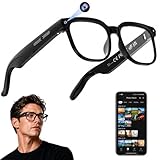
- 【AI Real-Time Translation & ChatGPT Assistant】AI glasses break language barriers instantly with AI real-time translation. The built-in ChatGPT voice assistant helps you communicate, learn, and handle travel or business conversations smoothly—ideal for conferences, overseas trips, and daily use.
- 【4K Ultra HD】 Smart glasses feature 4K resolution for clear, detailed visuals, making them suitable for travel, outdoor activities, everyday moments, and daily use.
- 【Bluetooth Music & Hands-Free Calls 】Smart glasses provide Bluetooth music and crystal-clear hands-free calls with an open-ear design. Stay aware of your surroundings while listening—comfortable for long wear and safer for commuting, cycling, and outdoor use.
- 【IP65 Waterproof & Long Battery Life】 AI glasses are designed for daily wear with IP65 waterproof protection against sweat, rain, and dust. The built-in 290mAh battery provides reliable performance for workdays and travel—no anxiety when you’re on the go.
- 【Smart App Control & Object Recognition】Smart glasses connect to the companion app for easy setup, file management, and feature control. They support AI object recognition to help identify items and improve your daily efficiency—perfect for travel exploration and a smart lifestyle.
The limits behind the headline
Accuracy has consequences
Scene AI and optical character recognition can struggle with dim light, motion, glare, small or curved text, handwriting, occlusion, and unfamiliar context. Translation can vary by language and may require a network connection; latency can make a supposedly real-time conversation awkward. An answer that is good enough for identifying a snack is not necessarily safe for reading a medication dose or judging traffic.
Battery and connectivity depend on workload
Camera recording, cloud AI, live translation, GPS, and a bright display all draw power. A company’s “up to” battery figure should not be read as a promise of a full day of continuous AI or screen use. Ask whether the particular feature works offline, whether setup still needs a phone or account, and what happens when connectivity drops.
Field of view is not the same as camera coverage
A camera may capture a wider image than a lens display can show. A narrow display makes persistent directions, multiple labels, peripheral alerts, and natural-feeling anchoring harder. Conversely, a large virtual screen can dominate attention without providing a wide overlay on the physical world.
Privacy and safety are part of the product
Camera glasses can record people who have not chosen to participate, and always-on microphones raise separate concerns. Recording indicators do not settle questions about data handling, consent, workplace rules, or venue policies. Schools, hospitals, courts, museums, and private businesses may restrict recording; laws and rules vary by location, so do not assume permission simply because a device can record.
Best Value
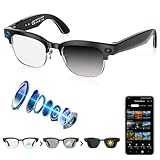
- 【4K Camera with EIS Stabilization】Smart glasses with camera feature a built-in 4K camera with EIS stabilization for clearer and steadier image performance during sports, cycling, travel, outdoor activities, and everyday use.
- 【Open-Ear Speakers & Clear Bluetooth Calling】Camera glasses feature built-in open-ear speakers for music and clear Bluetooth calls while helping you stay aware of your surroundings. Noise-reduction microphones provide clearer voice pickup and a comfortable listening experience for everyday use.
- 【AI Real-Time Translation & Voice Assistant】AI glasses support real-time translation in 139+ languages to make communication easier across different languages. The built-in AI voice assistant helps you access information and interact more efficiently—ideal for work, study, travel, and daily use.
- 【Photochromic Lenses & Lightweight Comfort】Smart sunglasses with camera feature photochromic lenses that respond to changing sunlight conditions for comfortable indoor and outdoor use while helping reduce UV exposure. The lightweight 35g frame provides a comfortable fit for extended everyday wear.
- 【IP66 Water Resistance & 290mAh Battery】AI sunglasses with camera feature IP66 water resistance for added protection against sweat, rain, and dust during active daily use. The built-in 290mAh battery provides convenient power for travel, outdoor activities, work, and everyday use.
Do not interact with a display while driving, rely on AI to detect hazards, or use a visual overlay as the sole navigation aid. Try new displays while stationary, switch to audio-only assistance if overlays are distracting, and keep a conventional phone, navigation aid, or human support available when the task is safety-critical.
What is coming, and what is not here yet
XREAL describes AURA as an optical-see-through AR product coming in fall 2026, with a 70-degree display, AI assistance, hand tracking, 6DoF tracking, and a separate compute puck. Its page mentions a $299 deposit applied toward the final purchase price. A deposit is not the product’s final price, and an announced future device should not be treated as a shipping, independently reviewed buying option.
Meta’s Orion is likewise a prototype, not an ordinary retail pair of glasses. These products show the direction developers are pursuing—larger and more spatial displays—but do not change the capabilities of glasses buyers can purchase today.
The useful way to think about “superhuman vision”
Smart glasses are beginning to make some visual tasks hands-free: asking what a camera sees, reading a sign aloud, displaying a caption, or putting a private screen in view. Those are meaningful extensions of perception, but they are selective and fallible. Choose by the specific task—AI interpretation, glanceable text, virtual screens, or low-vision support—and judge the device by its real limits as carefully as by its headline features.
Quick Recap
Product prices and availability are accurate as of the date/time indicated and are subject to change. Any price and availability information displayed on Amazon at the time of purchase will apply.

