What’s actually slowing this PC down?
Pick the symptom - the matching free tool is one click away.
Some links on this page are affiliate links: if you buy through them we may earn a commission, at no extra cost to you.
A heart-rate watch does not measure a number directly: it detects repeating features in a body signal and converts the time between them into beats per minute. Most watches use optical photoplethysmography (PPG), which tracks pulse-related blood-volume changes at the wrist. Some also offer an electrocardiogram (ECG) recording, which measures electrical activity. The signals are related, but they are not interchangeable—and a plausible-looking number can still come from a poor waveform.
What a cardiac waveform represents
A waveform is a signal plotted over time. In heart-rate monitoring, it can represent the heart’s electrical activity or the pulse wave produced as blood moves through the body. The distinction matters when choosing or interpreting a watch: ECG records electrical events in the heart, while wrist PPG detects changes in blood volume in tissue near the sensor.
Other systems can measure arterial pressure or specialized signals such as impedance and ballistocardiography. For watch users, however, ECG and PPG are the main modalities to understand. A watch’s heart-rate display may not show either raw waveform; often it presents only a processed estimate.
Do these 3 things before closing this tab:
1Repair Windows errors before they cause bigger problems2Fix the driver behind crashes, sound loss and screen glitches3Clear out junk files and repair common Windows errorsHow a waveform becomes a heart-rate reading
- Capture: An electrode records an ECG signal, or optical emitters and detectors capture changes in light reflected or transmitted through tissue for PPG.
- Clean: The device filters baseline drift and noise. Movement, weak contact, or other artifacts may remain.
- Find beat markers: An ECG algorithm commonly detects the R peak in the QRS complex. A PPG algorithm identifies a recurring pulse-wave peak or another timing feature.
- Measure intervals: The device calculates the time between successive markers. For an interval in seconds, heart rate in beats per minute is 60 divided by that interval.
- Process and display: Quality checks may reject noisy segments; the watch may also average, smooth, or delay its displayed rate. The screen is therefore not necessarily an instantaneous view of every beat.
A missed marker can make the estimated rate too low; a noise spike or extra waveform feature can make it too high. A steady display does not prove that the underlying signal was clean, particularly if the software smooths short-term changes.
#1 Best Overall
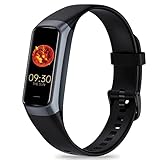
- 24/7 Heart Rate Monitor :This blood pressure watch supports real-time dynamic heart rate, blood oxygen, blood pressure ,Sleep Tracking,temperature monitoring so you can know more about your physical condition
- 1.10 inch AMOLED HD Touch screen: The Stopwatch pairs flawlessly with the Skin-friendly fitness straps, while its 1.10 inch AMOLED HD Touch Color Screen design and multitude of invigorating watch faces blow you away any moment
- 25 Sport Modes Activity Tracker: you can select any number of sports modes in the app as your exclusive sports mode to record your sports data.can record all daily health data such as steps, distance, and calorie consumption in the App "Keep Health"
- 5 ATM Waterproof activity & fitness trackers :step counter for walking Designed according to waterproof and dustproof standard, you can wear it when washing hands, taking bath, swimming, diving or getting caught in the rain will not damage your watches
- Multiple Convenient Functions :This smart band has multiple functions such as remote photography, mobile search, drinking water reminder, sedentary reminder, menstrual reminder cycle, real-time weather display, etc
How to read a basic ECG waveform
An ECG traces electrical activation and recovery of the heart. In a basic tracing, the main landmarks are:
- P wave: Atrial depolarization.
- QRS complex: Ventricular depolarization. Its sharp R peak is often used to mark each beat for rate calculations.
- T wave: Ventricular repolarization.
- PR interval: The time from the start of atrial depolarization to the start of ventricular depolarization.
- QT interval: The period covering ventricular depolarization and repolarization. Interpretation takes heart rate into account, often through a corrected QT measure.
The interval between successive R peaks is the R–R interval. ECG standards cover how leads are derived, waveforms displayed, and recordings interpreted; these details affect what a tracing can show (AHA/ACC/HRS ECG standardization statement).
A watch ECG is typically a limited-lead, user-initiated recording, not a diagnostic 12-lead ECG. Lead placement and orientation determine which electrical vectors are visible, so a single-lead recording cannot provide the same view as electrodes positioned across the chest and limbs.
Windows Errors? Fix Them Before They Spread
Repair common Windows errors and clear accumulated junk for a smoother, more stable PC - no reinstall needed.Free scan · no reinstallOutdated Drivers Are Slowing You Down
One free scan finds every outdated or missing driver and matches the right update for your exact hardware.Free scan · exact hardware matchHow to read a PPG pulse waveform
PPG uses light to track cyclical changes in blood volume in peripheral tissue. A typical pulse waveform rises as blood arrives, reaches a primary systolic peak, then falls. Some recordings show a secondary or dicrotic feature. The details depend on the person, sensor placement, and signal conditions; watch software may use a timing feature other than the most visually obvious peak.
Electrical activation occurs before the resulting pulse reaches a wrist sensor. The delay between an ECG event and a peripheral pulse means that ECG R–R timing and PPG pulse-to-pulse timing are related, but not identical measurements. Many watches show a processed heart-rate value without exposing the raw PPG trace.
Rank #2
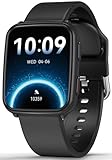
- 【Advanced Health Fitness Tracker】-This fitness tracker offers 24/7 heart rate and blood pressure monitoring to help you stay proactive about your health goals. It also supports on-demand blood oxygen checks, so you can quickly see your O₂ level whenever you need it. Detailed sleep tracking (deep sleep, light sleep and wake-ups) and all-day activity tracking give you a clearer picture of your overall health trends. (Inspire a healthy life, not for medical use
- 【All-Day Activity & Fitness Tracking】-The MorePro fitness tracker for women and men offers 120+ sport modes including running, walking and more, so you can track the workouts you actually do. With a built-in pedometer step counter, this smart watch records steps, distance, calories burned, heart rate and training time in real time, giving you clear references for exercise intensity. Whether you’re at the gym, on a run or playing ball with friends, every workout becomes safer, more efficient and easier to enjoy
- 【Women’s Health & Cycle Tracking】-Designed as a women’s health tracker, the smart watches for women offers intuitive menstrual cycle tracking right on your wrist. Use the built-in period tracker to log your menstrual period, safe days, ovulation window and ovulation day, while the app supports period mode, trying-to-conceive mode and pregnancy mode to match different life stages. Whether you’re at work, in class or relaxing at home, gentle women’s health reminders help you prepare in advance with the right clothes and pads, so every month feels more predictable and in control
- 【Everyday Smart Lifestyle Companion】-Stay connected without constantly checking your phone. This smart watch fitness tracker delivers real-time call, SMS and app message notifications on your wrist, so you can see who’s contacting you while you’re in a meeting, commuting or working out. The IP68 waterproof design easily handles sweat, rain and hand-washing. With over 200 watch faces and simple DIY custom faces using your own photos, you can quickly match your watch to business, workout or casual looks
- 【Practical Daily Smart Tools】-From sedentary reminders and drink water reminders to on-wrist weather forecasts, this smart watch helps you build healthier routines at work or while studying. Use music control and camera control while your phone stays in your bag, and rely on the stopwatch, timer, alarm clock and find my phone features to keep workouts, cooking and busy mornings on track
Pulse oximeters also use optical measurement to estimate pulse rate, often alongside oxygen saturation. The FDA describes their mechanism and limitations, including factors that can affect accuracy (FDA pulse-oximeter overview; FDA pulse-oximeter performance-testing guidance). A pulse oximeter is not an ECG monitor.
ECG and PPG: what each is suited to
| Question | ECG | PPG |
|---|---|---|
| What does it measure? | Electrical cardiac activity. | Pulse-related blood-volume changes in peripheral tissue. |
| Typical watch use | Usually a spot recording made while the wearer touches an electrode and stays still. | Passive heart-rate tracking and trends, often during everyday wear and exercise. |
| What can the waveform show? | Depending on lead configuration and recording quality, features such as P waves, QRS complexes, and T waves. | Recurring peripheral pulse features; it does not show ECG morphology. |
| Rhythm information | More direct electrical evidence, but a single lead has limited coverage and does not replace clinical interpretation. | Can identify irregular pulse patterns for screening in supported systems, but an alert is not an ECG diagnosis. |
| Common sources of error | Movement, muscle activity, electrode contact, and difficulty staying still. | Movement, changing fit, weak peripheral pulse, and optical or contact interference. |
| Practical trade-off | Useful when a recording of electrical rhythm is needed; often requires deliberate user action. | Convenient for background trends, but depends on optical signal quality and the device’s processing. |
Wearable and mobile tools can support arrhythmia management in different ways, but optical pulse analysis and ECG recording remain distinct approaches (ISHNE/HRS/EHRA/APHRS mHealth statement).
Free tools Windows power users keep installed
One-click scans. No signup required.
Why a watch reading can be unreliable
Signal quality is the foundation of a useful rate. Common problems can distort either modality, though they affect each differently.
- Motion: Arm movement can create or obscure PPG peaks. ECG can be disrupted by muscle activity or moving electrodes. A study of wearable ECG signal quality found that activity type mattered, with upper-body-intensive activity presenting challenges (ECG signal quality during different activity types).
- Fit and contact: A loose watch can shift and admit movement; a band that is uncomfortably tight can impair wearability and may affect local perfusion. Tattoos, hair, sweat, and wrist flexion can also interfere with optical contact or light measurement, depending on sensor and placement.
- Cold or weak circulation: Cold extremities, vasoconstriction, vascular disease, edema, or low pulse amplitude can weaken the peripheral optical signal. A displayed rate should inspire less confidence if the waveform or quality indicator is weak or unstable.
- Irregular beats: Premature beats, atrial fibrillation, pulse deficits, and changing stroke volume can produce mismatches between electrical events and detectable peripheral pulses. Pulse irregularity alone does not establish an ECG diagnosis.
- Extra or missing features: Noise or a secondary waveform feature can be counted as an extra beat; a weak pulse may be missed. Smoothing may hide brief discrepancies.
- Person-to-person and device differences: Optical performance can vary with device, fit, activity, perfusion, tissue properties, and algorithm. Findings on skin tone are mixed and device-specific, rather than supporting a universal pass/fail claim. Recent studies have examined these factors in particular devices and populations (2026 study in Hispanic adults; study of skin pigmentation and PPG accuracy). The FDA also discusses pulse-oximeter limitations and performance concerns (FDA pulse-oximeter overview).
Accuracy is not a single property of “PPG” or “ECG.” It depends on the model, placement, firmware, activity, participant group, reference method, and how rates are averaged and compared. For example, a treadmill comparison of four commercial PPG devices used Polar H10 ECG as its reference across low, moderate, and high exercise intensities and found device-specific differences (study abstract; full text). An earlier exercise comparison likewise reported variation among wrist devices and found the tested Polar H7 chest strap agreed most strongly with ECG in that study (exercise-monitor comparison). These results do not establish a universal winner for every wearer or activity.
Results from healthy volunteers may not transfer directly to people with cardiac disease or poor peripheral perfusion. In a small study of patients with atrial fibrillation, heart failure, and coronary artery disease, ECG-based Polar H10 measurements agreed highly with Holter monitoring, while Fitbit Inspire 2 PPG measurements showed more over- and underestimation (study of continuous heart-rate measurement in cardiac patients).
Rank #3
![Apple Watch Series 11 [GPS 42mm] Smartwatch with Rose Gold Aluminum Case with Light Blush Sport Band - S/M. Sleep Score, Fitness Tracker, Health Monitoring, Always-On Display, Water Resistant](https://m.media-amazon.com/images/I/31caPPnRysL._SL160_.jpg)
- A FULL-FEATURED HEALTH TRACKER—Apple Watch Series 11 gives you invaluable insights about your body, right from your wrist. Take an ECG anytime* and get alerts for a high and low heart rate or an irregular rhythm*—so you can stay closer to your heart. You can also view your overnight health tracking metrics with the Vitals app* and be notified of possible sleep apnea.*
- KNOW YOUR SLEEP SCORE—With advanced sleep tracking, Series 11 gives you a daily sleep score. It’s an easy way to help measure and understand the quality of your sleep, so you can make it more restorative.
- GET HYPERTENSION NOTIFICATIONS—Did you know that Series 11 can spot signs of chronic high blood pressure? By analyzing how your blood vessels respond to beats of the heart, it can notify you of possible hypertension.*
- SAFETY FEATURES—A smartwatch that puts your safety first. Series 11 can detect a hard fall or severe car crash, automatically help connect you with emergency services, and notify your emergency contacts.* Check In can automatically notify a loved one when you’ve arrived at your destination.
- A POWERFUL FITNESS TRACKER—With advanced metrics and motivating features like Pacer, Heart Rate Zones, training load, and Workout Buddy powered by Apple Intelligence from your nearby iPhone*—Series 11 is made to help everyone stay active, from runners and hikers to strength-training enthusiasts.
How to check a suspicious watch reading
- Stop and settle: Pause movement and sit still if possible. For a baseline resting measurement, sit quietly for several minutes; avoid measuring immediately after exercise, caffeine, nicotine, or emotional stress if you want a baseline.
- Reseat the sensor: Put the watch in stable contact with the skin and follow its fit guidance. If it provides a signal-quality indicator or waveform, wait for a stable signal rather than relying on a noisy segment.
- Repeat: Take another reading instead of treating one isolated number as definitive. A manual pulse can serve as a rough plausibility check, not a clinical confirmation.
- Consider the context: Compare the result with how you feel and what you were doing. If it conflicts with symptoms or perceived exertion during exercise, pause and repeat rather than assuming the watch is right.
- Escalate appropriately: Seek medical advice for recurrent, unexplained, or worsening palpitations. Seek urgent care for chest pain, fainting, severe shortness of breath, new neurological symptoms, or a sustained very fast or very slow rate accompanied by symptoms.
If a watch supports an ECG recording and you experience palpitations, make the recording while sitting still and use the manufacturer’s sharing or export process to show it to a clinician. Do not change medication based only on a watch or pulse-oximeter result.
Quick wins for a faster PC:
Fix the driver behind crashes, sound loss and screen glitchesFind Drivers →Clear out junk files and repair common Windows errorsFree Scan →Which heart-rate monitor fits the job?
Fitness and changing exercise intensity
For rapid changes, intervals, or training-zone precision, an ECG chest strap is often a reasonable starting point; it may be less comfortable than a watch. Wrist PPG can be more convenient and may be sufficient for steady aerobic activity, general fitness, and longer-term trends. Upper-arm or other placements may suit some activities better than a wrist sensor. Choose based on the actual activity and model-specific validation, not a claim that one signal type is always more accurate.
Resting, sleep, and everyday trends
A wrist or ring PPG wearable offers low-friction background tracking. It is useful for trends when readings are collected consistently, but it is not a substitute for ECG rhythm evaluation. Treat changes as prompts to consider context, not as a diagnosis.
Occasional palpitations
A supported watch ECG or handheld ECG can capture a limited recording during symptoms, provided the user can remain still and operate it. In a clinical comparison, Apple Watch Series 4 and KardiaMobile produced useful rhythm and heart-rate recordings, but artifacts, tremor, fit, and stillness affected performance; KardiaMobile was not designed for continuous background monitoring like a watch or patch (Apple Watch and KardiaMobile comparison). A brief recording can help document an episode but does not replace clinician assessment or a standard 12-lead ECG.
Features vary by model, software, and region. The American Heart Association’s study materials state that the Apple Watch ECG app is available on Series 4 and later, subject to device, regional, and software availability (AHA study FAQ; updated AHA FAQ). Check current manufacturer support information for a particular watch and location.
Windows Errors? Fix Them Before They Spread
Repair common Windows errors and clear accumulated junk for a smoother, more stable PC - no reinstall needed.Free scan · no reinstallCrashes, No Sound, or Screen Glitches?
Random freezes, missing sound and display glitches usually trace back to one bad driver. Find and replace yours safely.Free scan · under a minuteRank #4

- 【Superb Visual Experience & Effortless Operation】Diving into the latest 1.58'' ultra high resolution display technology, every interaction on the fitness watch is a visual delight with vibrant colors and crisp clarity. Its always on display clock makes the time conveniently visible. Experience convenience like never before with the intuitive full touch controls and the side button, switch between apps, and customize settings with seamless precision.
- 【Comprehensive 24/7 Health Monitoring】The fitness watches for women and men packs 24/7 heart rate, 24/7 blood pressure and blood oxygen monitors. You could check those real-time health metrics anytime, anywhere on your wrist and view the data record in the App. The heart rate monitor watch also tracks different sleep stages for light and deep sleep,and the time when you wake up, helps you to get a better understanding of your sleep quality.
- 【120+ exercise modes & All-Day Activity Tracking】There are more than 120 exercise modes available in the activity trackers and smartwatches, covering almost all daily sports activities you can imagine, gives you new ways to train and advanced metrics for more information about your workout performance. The all-day activity tracking feature monitors your steps, distance, and calories burned all the day, so you can see how much progress you've made towards your fitness goals.
- 【Messages & Incoming Calls Notification】With this smart watch fitness trackers for iPhone and android phones, you can receive notifications for incoming calls and read messages directly from your wrist without taking out your phone. Never miss a beat, stay in touch with loved ones, and stay informed of important updates wherever you are.
- 【Essential Assistant for Daily Life】The fitness watches for women and men provide you with more features including drinking water and sedentary reminder, women's menstrual period reminder, breath training, real-time weather display, remote camera shooting, music control,timer, stopwatch, finding phone, alarm clock, making it a considerate life assistant. With the GPS connectivity, you could get a map of your workout route in the app for outdoor activity by connecting to your phone GPS.
Longer-term clinical monitoring
If symptoms are intermittent, clinical review is required, or a clinician needs longer-duration ECG evidence, ask about a prescribed patch, Holter monitor, event monitor, or telemetry service. These are clinician-directed options rather than interchangeable retail gadgets; the appropriate choice depends on the indication, wear duration, whether recording is continuous or event-triggered, and the review service.
Pulse rate plus oxygen saturation
A fingertip pulse oximeter may be appropriate when oxygen saturation is also relevant, but its optical pulse-rate estimate is not a rhythm tracing and does not replace ECG monitoring. Use a device for its intended purpose and consider its signal quality and known limitations.
Choosing a watch or monitor: a practical checklist
Before relying on a device, check the details that determine whether it can answer your question:
- Signal modality: ECG, PPG, or both.
- For ECG: number of leads and whether recording is spot-check or continuous.
- For PPG: sensor placement and whether the device displays a signal-quality indicator.
- Whether the device records continuously, stores continuously, samples periodically, or only offers background notifications.
- How the rate is averaged, smoothed, and displayed, and whether raw recordings can be saved.
- Motion handling, artifact rejection, and validation for the activities and population relevant to you.
- Regulatory status and intended use of the specific feature, not just the device brand.
- Phone and operating-system compatibility, data export, clinician-sharing options, battery, and wear duration.
- Subscription or accessory requirements, privacy practices, and data-retention terms.
For clinical monitoring, the decision also needs to account for required duration, telemetry, arrhythmia detection versus rate-only monitoring, alarm limits and delays, power, connectivity, data integrity, and patient-specific factors such as tremor, edema, poor perfusion, skin sensitivity, or difficulty maintaining electrode contact. FDA cardiac-monitor guidance addresses accuracy ranges, alarms, operating modes, power, and other limitations (FDA cardiac-monitor guidance).
What a consumer watch can—and cannot—tell you
A passive PPG irregular-rhythm notification is a screening signal, not a diagnosis. Some devices can screen for or record signals suggestive of atrial fibrillation under specified conditions, but confirmation requires clinical evaluation. A watch that displays heart rate continuously is not necessarily cleared or intended to diagnose disease, provide continuous arrhythmia monitoring, or manage clinical alarms. FDA directs users to device-specific records for sensor-based digital-health features rather than assuming that every feature has the same regulatory status (FDA sensor-based digital-health device information).
Heart-rate variability also depends on the source signal and method. ECG-derived R–R intervals and PPG-derived pulse intervals are not automatically equivalent for every use; a device’s HRV label alone does not establish that its measure suits clinical interpretation.
The useful monitor is the one that supplies a trustworthy signal for the question being asked, with a practical burden the wearer can sustain. For watch users, that usually means treating PPG as a convenient tool for heart-rate trends, recognizing when a limited ECG recording may add rhythm information, and involving a clinician when symptoms or decisions require more than a consumer reading.
Quick Recap
Product prices and availability are accurate as of the date/time indicated and are subject to change. Any price and availability information displayed on Amazon at the time of purchase will apply.

