The Tool Desk
Outbyte PC Repair FREEClear out junk files and repair common Windows errorsFree Scan →Outbyte Driver Updater FREEScan for outdated or missing drivers - takes under a minuteDriver Scan →Some links on this page are affiliate links: if you buy through them we may earn a commission, at no extra cost to you.
The Garmin fēnix 2 was an unusually capable multisport GPS watch when it launched in 2014. In 2026, it is worth considering only as a very inexpensive used watch or backup, and only if its battery and charging connection work properly. Its rugged build, route recording and broad sport support remain useful; its small monochrome screen, dated interface, ANT+-only sensors and uncertain current phone compatibility make it a poor fit for most people buying a watch today.
What the Garmin fēnix 2 was built to do
Garmin positioned the fēnix 2 as a rugged outdoor and multisport training watch, not a modern smartwatch. It could record running, cycling, hiking, climbing, paddling, skiing, snowboarding and swimming, while adding outdoor tools such as a compass, altimeter, barometer, route navigation and TracBack. It could also display notifications from a paired phone. Garmin’s discontinued-product page lists the original feature set.
The appeal was breadth: one watch could track workouts, connect to external sensors and help a user retrace a route. The cost was complexity. Getting the most from it meant learning button-driven menus, configuring data screens and, for several training features, pairing additional hardware.
Garmin fēnix 2 specifications
| Specification | Garmin fēnix 2 |
|---|---|
| Dimensions | 4.9 × 4.9 × 1.7 cm |
| Weight | 90.6 g (3.19 oz) |
| Display | 1.2-inch monochrome LCD; 70 × 70 pixels |
| Lens | Curved mineral glass |
| Water rating | 5 ATM / 50 m |
| Battery | Rechargeable 500 mAh lithium-ion |
| Internal memory | 20 MB |
| Wireless | ANT+ sensors; Bluetooth connection to a phone |
| Battery life claimed by Garmin | Up to 16 hours in normal GPS mode; up to 50 hours in UltraTrac at one-minute polling; up to five weeks in watch mode |
Specifications and original battery figures are from Garmin’s product page and owner’s manual. The figures are launch-era claims, not a prediction of how long a decade-old used unit will run.
#1 Best Overall

- Advanced multisport GPS smartwatch for athletes/adventurers features a bright 1.4” AMOLED display, stainless steel bezel, enhanced graphical interface and a built-in LED flashlight for after- dark visibility
- Power up your body’s performance, endurance and resistance to injury with targeted strength training plans, real-time stamina tracking, sport-specific workouts and a full range of built-in sports apps
- Battery performance: up to 16 days in smartwatch mode; up to 47 hours in GPS mode. Fits wrists with the following circumference: Silicone band: 125-208 mm UltraFit Band: 125-215 mm Leather Band: 132-210 mm Metal Band: 132-210 mm
- Your training readiness score is based on sleep quality, recovery, training load and HRV status to determine if you’re primed to go hard and reap the rewards (data presented is intended to be a close estimation of metrics tracked)
- For your active lifestyle, a built-in speaker and mic let you make and take phone calls from your wrist when your watch is paired to your smartphone — and you can even use your smartphone’s voice assistant to respond to text messages and more
Design, screen and comfort
The fēnix 2’s substantial body and physical buttons suited outdoor use: buttons are easier to operate with gloves or wet hands than a touchscreen, and the watch was built for rough activities. Its included fabric strap could be worn over heavier clothing. But at 90.6 g, it is heavy by everyday-watch standards, and the size may be uncomfortable on smaller wrists or during sleep.
The 70 × 70-pixel monochrome display was efficient and readable for basic data, but it looks dated and has little room for information. Contemporary reviews praised the ruggedness while noting the chunky design and dated screen; TechRadar also criticized the interface as clunky. See Wareable’s review and TechRadar’s review.
GPS recording and outdoor navigation
Recording an activity and navigating a route are different jobs. In an activity, the fēnix 2 uses GPS to log where you went. For navigation, it can follow transferred course data, show basic route guidance and use TracBack to help retrace a recorded track. Its high-sensitivity GPS works alongside a three-axis compass, altimeter and barometer; it can also store custom points of interest.
Rank #2

- Advanced multisport GPS smartwatch for athletes/adventurers features a 1.4” solar charged display with scratch-resistant sapphire lens, durable titanium bezel and built-in LED flashlight for after-dark visibility
- Battery performance: up to 48 days of battery life in smartwatch mode with solar charging (assumes all-day wear with 3 hours per day outside in 50,000 lux conditions) and up to 149 hours in GPS mode with solar charging (assumes continuous use for entire period in 50,000 lux conditions) — all with an always-on display, so you’re ready to take on the toughest challenges
- Power up your body’s performance, endurance and resistance to injury with targeted strength training plans, real-time stamina tracking, sport-specific workouts and a full range of built-in sports apps
- Your training readiness score is based on sleep quality, recovery, training load and HRV status to determine if you’re primed to go hard and reap the rewards (data presented is intended to be a close estimation of metrics tracked)
- For your active lifestyle, a built-in speaker and mic let you make and take phone calls from your wrist when your watch is paired to your smartphone — and you can even use your smartphone’s voice assistant to respond to text messages and more
This is not a modern mapping watch. The fēnix 2 does not offer detailed color topographic maps, automatic route recalculation or the current generation’s navigation experience. Its outdoor tools are most useful to someone comfortable following a basic course or track rather than expecting a map on the wrist.
At launch, reviewers found GPS performance favorable after satellite lock: TechRadar reported no dropouts in its testing, while Wareable reported strong distance and speed tracking during a half-marathon. Those are historical tests of review units, not a guarantee that an individual used watch will acquire satellites or record reliably today. Sources: TechRadar and Wareable.
Running and training data
The watch can record time, distance, pace, elevation, calories and cadence, plus training information such as recovery time and VO₂ max estimates. Heart rate is not measured at the wrist: a compatible external monitor is required. The HRM-Run chest strap, when included or purchased separately, adds running dynamics such as cadence, vertical oscillation and ground-contact-time-related data. Do not assume a bare watch or every used bundle includes that strap.
Rank #3

- Advanced multisport GPS smartwatch for athletes/adventurers features a 1.3” solar charged display with scratch-resistant sapphire lens, durable titanium bezel and built-in LED flashlight for after-dark visibility
- Battery performance: up to 28 days of battery life in smartwatch mode with solar charging (assumes all-day wear with 3 hours per day outside in 50,000 lux conditions) and up to 92 hours in GPS mode with solar charging (assumes continuous use for entire period in 50,000 lux conditions) — all with an always-on display, so you’re ready to take on the toughest challenges
- Power up your body’s performance, endurance and resistance to injury targeted strength training plans, real-time stamina tracking, sport-specific workouts and a full range of built-in sports apps
- Your training readiness score is based on sleep quality, recovery, training load and HRV status to determine if you’re primed to go hard and reap the rewards (data presented is intended to be a close estimation of metrics tracked)
- For your active lifestyle, a built-in speaker and mic let you make and take phone calls from your wrist when your watch is paired to your smartphone — and you can even use your smartphone’s voice assistant to respond to text messages and more
Its extensive data and multisport profiles were a strength for athletes willing to set up screens and accessories. For someone who wants quick setup, automatic wrist heart rate and current training guidance, the old interface and dependence on external sensors are substantial drawbacks. Garmin’s product information and manual describe the features and sensor requirements.
Cycling sensors and ANT+ compatibility
The fēnix 2 can pair with ANT+ heart-rate monitors, footpods, speed and cadence sensors, power meters, Garmin’s Tempe temperature sensor and Chirp geocaching sensor. It does not support Bluetooth Smart sensors, according to DC Rainmaker’s detailed review. A strap advertised simply as “Bluetooth” may therefore be incompatible. Check for explicit ANT+ support before buying a replacement heart-rate strap or cycling sensor.
Swimming: pool tracking versus open water
Pool swimming
In pool mode, the watch estimates laps and distance using its accelerometer rather than GPS. It can track strokes, intervals and SWOLF, but results depend on entering the correct pool length and swimming in a way the watch can recognize. Consistent turns and push-offs help; stops in the middle of a length, unusual drills or weak push-offs can lead to missed or extra lengths. DC Rainmaker’s testing and feature review discusses its pool tracking.
Rank #4

- Multisport GPS watch with a large 1.4” display in a resilient 51 mm fiber-reinforced polymer case with a titanium bezel and rear cover
- Scratch-resistant Power Sapphire solar charging lens uses the sun’s energy for weeks of battery life in smartwatch mode
- Built-in LED flashlight with variable intensities and strobe modes gives you greater awareness while you train at night and provides convenient illumination when you need it
- New hill score feature measures your running strength/endurance during ascents and gauges your progress over time
- New endurance score feature combines training data from all your athletic pursuits to help you better understand how training impacts your overall endurance
Open-water swimming
Open-water GPS is inherently approximate because the watch is underwater for part of each stroke. In one historical comparison, DC Rainmaker recorded about 0.58 miles on a reference device and 0.68 miles on the fēnix 2. That single result illustrates possible disagreement; it is not a universal error rate. The HRM-Run also does not transmit heart-rate data while swimming, according to the owner’s manual.
Independent reader supportYour contribution helps us test, update, and keep practical guides available for everyone.Battery life: original claims and used-watch reality
Garmin specified up to 16 hours in normal GPS mode, up to 50 hours in UltraTrac with one-minute GPS polling, and up to five weeks in watch mode. UltraTrac saves power by recording location less frequently, so its track is less detailed than normal GPS recording; 50 hours is not the normal-GPS figure. These are Garmin’s original estimates in the manual and product listing.
Actual runtime depends on GPS mode, backlight, connected sensors, phone notifications, temperature and the condition of the battery and electronics. Because surviving units are more than a decade old, battery health matters more than the launch specification. Before buying, ask the seller for a recent GPS runtime test, how long it ran, and whether it shut down under load. Confirm that it charges consistently and that the charging contacts are clean. A watch that powers on may still have very limited usable runtime.
Best Value
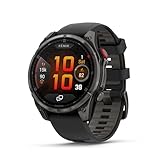
- Multisport GPS smartwatch with built-in inReach technology for two-way satellite and LTE connectivity (active subscription required; coverage limitations may apply; some jurisdictions regulate or prohibit the use of satellite communication devices)
- Rugged design with a bright 1.4" AMOLED touchscreen display, titanium bezel, scratch-resistant sapphire lens and other premium materials
- In an emergency, inReach satellite technology allows you to trigger an interactive SOS message to the Garmin ResponseSM coordination center for 24/7 assistance (active subscription required; coverage limitations may apply; some jurisdictions regulate or prohibit the use of satellite communication devices)
- LTE network connectivity lets you leave your phone behind; use your watch to exchange messages and make voice calls — plus let friends follow along with LiveTrack location sharing (30-second update rate) and location check-ins with the on-device Garmin Messenger app (active subscription required; coverage limitations may apply)
- inReach technology allows you to send messages and get location check-ins over satellite when taking on an off-grid adventure (active subscription required; coverage limitations may apply; some jurisdictions regulate or prohibit the use of satellite communication devices)
Phone connection, Garmin Connect and support
At launch, the fēnix 2 could upload activities to Garmin Connect and use paired-phone features such as notifications, live tracking and sharing. Garmin’s quick-start guide references Garmin Connect Mobile and BaseCamp Mobile. Garmin Connect offered detailed activity and progress analysis, but the phone and desktop experience belongs to an older generation.
Garmin still provides the manuals and support page, while its product listing identifies the fēnix 2 as discontinued. That is not a promise of ongoing product development, repair availability or compatibility with every current phone and app version. Before buying, verify the specific phone, Garmin Connect sync and Garmin Express workflow you intend to use.
How it compares with a current rugged Garmin
The Instinct 2 Solar illustrates how much a rugged, button-operated Garmin has changed. For the 45 mm model, Garmin lists a 53 g weight, 10 ATM water rating, multi-GNSS, Garmin Pay, Connect IQ compatibility and modern health features. It retains a monochrome MIP display rather than offering full-color mapping. The fēnix 2 is 90.6 g and has a 5 ATM rating; it has neither the modern health platform nor the newer connectivity. See Garmin’s Instinct 2 Solar product page. Features and battery specifications vary by edition, and solar figures depend on Garmin’s stated conditions.
Do these 3 things before closing this tab:
1Scan for outdated or missing drivers - takes under a minute2Repair Windows errors before they cause bigger problems3Fix the driver behind crashes, sound loss and screen glitchesThe newer watch is a more sensible direction for buyers seeking current connectivity, health tracking and multi-GNSS. It still is not the right choice for everyone: someone who wants detailed maps, an AMOLED display or advanced premium training features should compare current fēnix or Forerunner models instead. No current price comparison is included here because prices vary by market and date.
Quick Recap
Used fēnix 2 buying checklist
- Battery: Request a recent GPS test with the elapsed runtime and ask whether the watch shut down unexpectedly.
- Charging: Confirm it charges reliably; inspect the proprietary connection and contacts for dirt, corrosion or wear.
- Buttons: Test every button for consistent response, since the interface depends on them.
- GPS: Ask to see it acquire a location outdoors and record an activity.
- Outdoor sensors: Check that compass, altimeter and barometer readings respond plausibly.
- Screen and case: Inspect the display, mineral lens, case and strap pins for damage that could affect use.
- Accessories: Confirm any heart-rate strap or cycling sensor is ANT+ compatible; check exactly which accessories are included.
- Phone workflow: If syncing matters, verify Garmin Connect compatibility with your own phone and account before purchase.
Who should buy the Garmin fēnix 2?
- Retro-Garmin enthusiast or collector: It can be appealing as a piece of multisport-watch history, provided expectations match its age.
- Budget hiker or outdoor backup: Consider it only at a very low price and after proving battery runtime, charging and basic navigation.
- Serious runner or triathlete: Usually skip it; wrist heart rate is absent, modern training conveniences are missing and sensor compatibility is limited to ANT+.
- Swimmer: Pool tracking can be useful with correct settings, but open-water distance is approximate and swimming heart rate is not live from the HRM-Run.
- Everyday smartwatch buyer: Choose a current watch if you need sleep and wellness tracking, payments, music, modern apps or a bright screen.
Product prices and availability are accurate as of the date/time indicated and are subject to change. Any price and availability information displayed on Amazon at the time of purchase will apply.

