Do these 3 things before closing this tab:
1Repair Windows errors before they cause bigger problems2Scan for outdated or missing drivers - takes under a minute3Clear out junk files and repair common Windows errorsSome links on this page are affiliate links: if you buy through them we may earn a commission, at no extra cost to you.
A Google smart-glasses filing reportedly describes a built-in display, speakers, cameras, a microphone and eye tracking, with some processing handled by a connected phone. The report, published on December 11, 2024, says the filing surfaced through China’s patent office. It is evidence of a possible design—not confirmation that Google plans to sell these glasses.
The distinction matters: patent documents cover potential inventions, not finished products. The exact Chinese filing could not be independently matched to a publication number in the available material, so the reported feature list should be treated as a description from Android Headlines, not as a verified specification sheet.
What the reported Google filing describes
According to the report, the proposed glasses combine several familiar wearable components: a display, speakers, cameras and a microphone. They could accept voice, touch and gesture input, use gaze tracking to help interpret what the wearer is looking at, and provide contextual information or navigation. The report also says a connected smartphone could handle at least some processing.
The Tool Desk
Outbyte Driver Updater FREEScan for outdated or missing drivers - takes under a minuteDriver Scan →Outbyte PC Repair FREEClear out junk files and repair common Windows errorsFree Scan →Those details do not establish that every feature belongs to one finalized design, or that Google has built a working prototype. Nor do they tell us whether the display would be a small, single-eye notification screen or a more capable see-through system. “Display” alone does not prove full augmented reality, binocular visuals, environmental registration or any particular field of view.
#1 Best Overall

- 【Biggest. Boldest. Smartest. — A Viewing Experience Like Never Before】This isn't just another pair of XR glasses — it's The Beast. The BIGGEST screen in XR (174″, 58° FOV). The BOLDEST display ever (1250 nits, Powerd by Latest Sony Micro-OLED). And the SMARTEST glasses on the planet — Your Screen, You Rules. Built-in 3DoF, screen customizations, Auto Transparency, and Smart Re-Centering that just work. No software needed. One glance and you'll never go back.
- 【SMARTEST: YOUR SCREEN, YOU RULES — No Software Needed】 Your Screen. You Rules! Built-in VisionPair 3DoF lets you pin, resize, and lock a 174″ screen in mid-air — no software, no dongles, no drift. Full screen customizations built right into the glasses: Anchor, Smooth Follow, 32:9 UltraWide, Side Mode. Auto Transparency switches between immersion and the real world with one tap. Smart Re-Centering snaps your view back instantly.
- 【BIGGEST: THE ULTIMATE IMMERSIVE GIANT — 174″ Screen, 58° FOV, 1200p】The largest virtual display in consumer XR. Period. A 174″ screen powered by Sony's latest-generation Micro-OLED panel pushes 1200p per eye at a class-leading 58° field of view with a 120 Hz refresh rate. Every frame is edge-to-edge sharp, silky-smooth, and jaw-droppingly vivid. It's like strapping an IMAX to your face.
- 【SMARTEST: 9-LEVEL DIMMING + AUTO TRANSPARENCY — No Software Needed】 Another reason The Beast is the smartest XR glasses ever made. One tap shifts between crystal-clear AR and full cinematic blackout across 9+ electrochromic levels — no app, no software, just hardware intelligence. Auto Transparency adapts between immersion and awareness on its own. Bright office, dim plane, pitch-dark bedroom — The Beast reads the moment for you. No glare. No reflections. Just pure immersion.
- 【BOLDEST: NEXT-LEVEL CLARITY & AUDIO — 1250 Nits + HARMAN AudioEFX】1250 nits of peak brightness — over 2× brighter than the competition — means you can actually see your screen outdoors, in sunlight, no squinting required. Pair that with HARMAN AudioEFX: deeper bass, wider soundstage, and crystal-clear highs tuned by the world's leading audio engineers. Other XR glasses make you choose between picture and sound. The Beast gives you both — cranked to eleven.
The available coverage does not identify the underlying Chinese publication number, title, filing date or claims well enough to verify the CNIPA record directly. It is therefore more precise to call this a reported Google patent filing than to say Google has announced or developed a specific product.
What eye tracking could add
Eye tracking measures eye position or gaze direction; it is different from head tracking, which measures the orientation or movement of the wearer’s head. A system that relates gaze to the surrounding world attempts to work out which location or object the wearer is looking toward, rather than simply recording eye movement.
That could make a glasses interface faster to navigate: gaze might point to an item, while a voice command, touch input or deliberate gesture confirms the selection. It could also help prioritize information associated with a viewed object, or direct audio pickup toward the wearer’s attention. These are possibilities, not confirmed functions of the reported filing.
Rank #2

- 【8MP HD Camera & 4K Ultra HD】Experience authentic first-person perspectives with an upgraded 8MP ultra HD camera. 4K resolution delivers clear, detailed imagery, while multi-frame noise reduction and advanced anti-shake technology help enhance image clarity for travel, cycling, outdoor sports, family gatherings and everyday adventures.
- 【AI Voice Assistant & Intelligent Object Recognition】Powered by the advanced ChatGPT model, the AI assistant supports real-time Q&A, daily planning and intelligent recommendations. These smart glasses also feature AI object recognition, which can instantly identify landmarks, plants, animals and everyday items, making them an ideal smart companion for travel, shopping, learning and exploring the world.
- 【139 Languages Real-Time AI Translation】Break down language barriers effortlessly with AI translation across 139 languages. Ideal for international travel, business communication, academic exchanges and cross-border socializing, these smart glasses help make multilingual conversations more natural, convenient and efficient.
- 【Open-Ear Hi-Fi Audio & Dual-Mic ENC Noise Cancellation】Enjoy immersive premium sound while staying fully aware of your surroundings with our open-ear headphone design. These bluetooth smart glasses are built with advanced dual-microphone ENC noise reduction technology, which effectively suppresses wind and ambient noise, ensuring crystal-clear hands-free calls and stable music playback even in noisy outdoor, cycling and commuting scenarios.
- 【Photochromic Lenses, Suitable for Any Scenes】Designed for all-day comfortable wear, AI glasses feature an ultra-lightweight frame and integrated photochromic lenses. The lenses automatically darken in sunlight for UV protection and return to a clear state indoors. A built-in 290mAh battery delivers long-lasting power for full-day use, fitting perfectly with all scenes of daily life, work and outdoor adventures.
Google has separately patented related technologies. Its granted U.S. patent “Passive world-referenced eye tracking for smartglasses” describes relating gaze to the world around the wearer. Another Google patent discusses using gaze direction in connection with microphone-array sensitivity and eyewear behavior (US11967335B2). These documents show technical interest in the area; they do not establish that their features are combined in the China-reported design.
Gaze is useful as a pointing method but can be a poor standalone command: people look at things without intending to select them. A practical device would need a deliberate confirmation method, such as a voice command, touch, button press or gesture, and a way to avoid accidental activation.
Why connect the glasses to a phone?
Offloading computation to a smartphone could help keep the frame lighter, reduce heat near the face and draw on the phone’s processor, modem and storage. But that phone-assisted setup is reported by Android Headlines, not established here as a mandatory product specification.
Rank #3
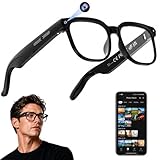
- 【AI Real-Time Translation & ChatGPT Assistant】AI glasses break language barriers instantly with AI real-time translation. The built-in ChatGPT voice assistant helps you communicate, learn, and handle travel or business conversations smoothly—ideal for conferences, overseas trips, and daily use.
- 【4K Ultra HD】 Smart glasses feature 4K resolution for clear, detailed visuals, making them suitable for travel, outdoor activities, everyday moments, and daily use.
- 【Bluetooth Music & Hands-Free Calls 】Smart glasses provide Bluetooth music and crystal-clear hands-free calls with an open-ear design. Stay aware of your surroundings while listening—comfortable for long wear and safer for commuting, cycling, and outdoor use.
- 【IP65 Waterproof & Long Battery Life】 AI glasses are designed for daily wear with IP65 waterproof protection against sweat, rain, and dust. The built-in 290mAh battery provides reliable performance for workdays and travel—no anxiety when you’re on the go.
- 【Smart App Control & Object Recognition】Smart glasses connect to the companion app for easy setup, file management, and feature control. They support AI object recognition to help identify items and improve your daily efficiency—perfect for travel exploration and a smart lifestyle.
The trade-off is dependence. A phone-linked pair could lose features when the phone is out of range, its battery is depleted or the wireless connection drops. Processing over a connection may also add latency, while cameras, a display, radios and eye-tracking components all place demands on battery life. The glasses’ functions would depend in part on how processing and data are divided between the frame, phone and any online services—a division the report does not specify.
Recommended Free Tools
Google’s other eyewear patents provide context, not a roadmap
The reported filing fits a broader pattern of Google patent activity around eyewear. Separate U.S. documents address eye tracking, display-capable eyewear and combinations of cameras, microphones, speakers and wireless circuitry. For example, see US20240275937A1, US11933977B2 and US20220057631A1.
Patent portfolios often contain alternative approaches and separate inventions. A feature appearing in one Google patent cannot automatically be assigned to the glasses described in another. Taken together, these records support the narrower conclusion that Google has explored smart-eyewear technologies—not that a unified product is nearing release.
Rank #4

- XREAL's Self-Developed X1 Spatial Computing Chip: Delivers Native 3DoF tracking with ultra-low 3ms M2P latency, ensuring stable visuals even during rapid movements. With the optional XREAL Eye, full 6DoF spatial anchoring. It delivers high processing power, seamless compatibility with devices, and distortion-free visuals through advanced stabilization.
- The New Optic Engine-X-Prism Optics: XREAL’s advanced lens and projection system—ultra-slim, precision-engineered optics that project a large, sharp virtual screen right in front of your eyes, while still letting you see your real surroundings clearly. With a best-in-class 57° FOV, Optic Engine 4.0 recreates the feeling of watching a massive 171-inch screen from four meters away—all in lightweight, compact design. Its advanced anti-glare design minimizes reflections and light interference, enhancing clarity and immersion.
- Experience True AR with 6 DoF, Spatial Anchor Anytime: Pairing with XREAL Eye, anchor your screen anywhere in your room, so it stays perfectly fixed in place—even as you walk around, lean in, or change your position. Unlike 3DoF, which keeps the screen at a constant distance relative to your head movements, 6DoF keeps your virtual screen locked to a real spot in your space for true spatial freedom and a more natural, immersive AR experience.
- REAL 3D – Turn everything you watch into an immersive 3D experience: REAL 3D Now Available on All One Series Glasses, instantly transforming all your content—from games and movies to apps and photos—into true 3D with a single switch. Experience richer depth and lifelike visuals across everything you watch or play.
- 57°FOV, 171'' Spatial Screen – More Immersive Visual Experience: Experience a virtual screen starting at 171 inches wide, filling your view with blockbuster visuals, thanks to XREAL’s advanced optics and industry-leading 57° FOV. Powered by Sony’s 0.55' Micro-OLED display technology and a smooth 120Hz refresh rate, get swept into your games or movies with immersion that rivals traditional home theaters—without the size, setup, or space concerns.
How the concept differs from glasses already on the market
| Category | Typical emphasis | What remains uncertain about the reported Google concept |
|---|---|---|
| Camera-and-audio glasses | Hands-free capture, calls, music and voice interaction | Whether Google’s reported display and gaze features would work reliably in a consumer frame |
| Display glasses | Visual notifications or information in the wearer’s view | Display type, brightness, field of view and phone requirements |
| AR headsets | More immersive visuals and tracking | Whether this filing describes anything comparable; “built-in display” is not enough to tell |
| Reported Google filing | Potential combination of display, audio, cameras and gaze input | Whether it becomes a product at all |
Existing products with overlapping functions are not confirmed substitutes or successors to the reported design. The patent material does not establish a product name, compatibility, retail availability or a direct connection to Google Glass.
Independent reader supportYour contribution helps us test, update, and keep practical guides available for everyone.Practical questions a patent cannot answer
There is no verified information here about the display’s resolution or brightness, whether it is monocular or binocular, camera specifications, battery capacity, weight, prescription-lens support, phone compatibility, standalone operation, price or launch date. Those are the details that would determine whether the concept is comfortable and useful day to day.
Eye tracking also brings practical limits: fit and calibration can affect accuracy, and sunglasses, lighting, eye shape or movement may interfere. A forward camera could misidentify a scene or object; a display could be hard to read outdoors. Whether the glasses keep working when a phone disconnects, an online service is unavailable or the battery runs low is likewise unknown.
Best Value

- Giant Virtual Screen – Immersive Theater Anywhere: Step into a breathtaking virtual screen up to 500 inches, transforming movies, games, and apps into larger‑than‑life experiences. Whether you’re commuting, flying, or unwinding at home, your personal cinema travels with you—bringing immersive entertainment wherever life goes.
- Premium Display Quality – Smooth, Sharp, and True-to-Life: XREAL 1S delivers ultra‑smooth viewing with a 120Hz refresh rate in 3DoF mode and a 90Hz global refresh that eliminates flicker and blur. Every unit is individually color‑tuned for precise, natural hues. The redesigned optical engine boosts clarity by 9%, delivering crisp detail from center to edge. Advanced optical alignment ensures each image point locks perfectly to your eye, keeping visuals sharp, vivid, and lifelike.
- Spatial Viewing Modes – Work, Watch, and Play on Your Terms: Shape your environment with XREAL 1S. Effortlessly switch between 0DoF follow mode, 3DoF anchor mode, Ultrawide Mode (32:9 or 21:9), Real 3D Mode, and Side-View Mode — ideal for both deep focus and entertainment. Pair with XREAL Eye to unlock 6DoF spatial anchoring, allowing for total freedom of movement while your screen stays pinned.
- Native 3DoF Spatial Screen – Plug & Play Freedom: XREAL 1S brings your AR experience to life with native 3DoF spatial viewing powered by the X1 chip. No apps, no setup — simply connect to any USB‑C DP‑enabled device and step straight into expansive spatial content. With rock‑solid stability and smooth head tracking, every session feels natural and comfortable, free from motion sickness and distractions, keeping you fully immersed.
- REAL 3D – Instant Spatial Depth for Everything You Watch: XREAL 1S debuts the world’s first on‑glasses REAL 3D spatial technology, instantly transforming all your content—from games and movies to apps and photos—into true 3D with a single switch. Experience richer depth and lifelike visuals across everything you watch or play, supported at up to 30fps with just 90–100ms latency for smooth, natural viewing.
Privacy and safety are central, not optional details
Glasses with outward-facing cameras and microphones raise questions for both wearers and bystanders: when recording is active, how that is signaled, and whether captured images are processed on the device, on a phone or online. Eye-gaze data can reveal where someone directs attention. The available sources do not establish how Google would store or use such information, so claims about advertising or other specific uses would be speculation.
Any real product would need clear controls for disabling cameras, microphones, gaze tracking and location, alongside understandable recording indicators and data-handling policies. Use in workplaces, schools, healthcare settings and public spaces may also be restricted. Smart glasses should not distract a wearer while driving or cycling; patent drawings do not resolve those safety questions.
What this patent story does—and does not—tell us
- It does suggest: Google has explored eyewear concepts that could combine a display, speakers, cameras, microphones and gaze-aware interaction.
- It does not establish: a confirmed product, final feature set, Google Glass successor, launch timing, price or retail availability.
- The strongest supporting context: Google has separate U.S. patents covering smart-eyewear displays and eye-tracking-related technologies, including a granted patent published in 2024.
The sensible reading is evidence of ongoing technical exploration, not a sign that Google is about to launch smart glasses. Until Google announces a product or the underlying filing is clearly identified and its claims verified, the reported feature list remains a description of a patent concept—not a buyer’s checklist.
Quick Recap
Product prices and availability are accurate as of the date/time indicated and are subject to change. Any price and availability information displayed on Amazon at the time of purchase will apply.

