Project Aria has always been Meta’s quiet proving ground, a long-running research initiative designed to answer a deceptively hard question: what does a truly wearable, always-on pair of smart glasses need in order to work in the real world. Unlike consumer products like Ray-Ban Meta Smart Glasses, Aria devices are not built to sell at retail, but to be worn by researchers, developers, and internal teams collecting massive volumes of real-world data. Aria Gen 2 represents the most mature expression of that vision to date.
This matters now because smart glasses are finally brushing up against practical usefulness rather than novelty. Battery efficiency, on-device AI, sensor miniaturization, and computer vision have all crossed thresholds that didn’t exist even three or four years ago. Aria Gen 2 lands at the moment when Meta is no longer just experimenting with what’s possible, but stress-testing what’s scalable, socially acceptable, and wearable all day.
Understanding Aria Gen 2 is essential if you want to understand where Meta’s consumer glasses, mixed reality headsets, and AI wearables are actually headed. This section breaks down what Project Aria is, what’s meaningfully different in Gen 2, and why this iteration signals a shift from exploratory research toward foundational infrastructure for future AR products.
Project Aria is Meta’s real-world data engine
Project Aria began as a way for Meta to collect egocentric data: vision, motion, audio, and spatial context captured from the perspective of a human wearing glasses. The goal wasn’t augmented reality overlays, but understanding how people move, look, listen, and interact in complex environments like cities, homes, and workplaces.
🏆 #1 Best Overall

- #1 SELLING AI GLASSES - Tap into iconic style for men and women, and advanced technology with the newest generation of Ray-Ban Meta glasses. Capture photos and videos, listen to music, make hands-free calls or ask Meta AI questions on-the-go.
- UP TO 8 HOURS OF BATTERY LIFE - On a full charge, these smart AI glasses can last 2x longer than previous generations, up to 8 hours with moderate use. Plus, each pair comes with a charging case that provides up to 48 hours of charging on-the-go.
- 3K ULTRA HD: RECORD SHARP VIDEOS WITH RICH DETAIL - Capture photos and videos hands-free with an ultra-wide 12 MP camera. With improved 3K ultra HD video resolution you can record sharp, vibrant memories while staying in the moment.
- LISTEN WITH OPEN-EAR AUDIO — Listen to music and more with discreet open-ear speakers that deliver rich, quality audio without blocking out conversations or the ambient noises around you.
- ASK YOUR GLASSES ANYTHING WITH META AI - Chat with Meta AI to get suggestions, answers and reminders straight from your smart AI glasses.
That data feeds Meta’s core research in computer vision, simultaneous localization and mapping (SLAM), hand tracking, eye tracking, spatial audio, and contextual AI. In other words, Aria isn’t about what the wearer sees today, but about training systems to understand the world well enough to eventually augment it seamlessly.
Crucially, Aria devices are worn for hours at a time in uncontrolled environments, which forces Meta to solve problems that don’t show up in lab-bound headsets. Comfort, thermal management, battery life, weight distribution, and social wearability all become non-negotiable constraints rather than nice-to-haves.
What’s fundamentally new in Aria Gen 2
Aria Gen 2 is not a cosmetic refresh. It represents a substantial leap in sensing density, processing capability, and power efficiency compared to the first-generation Aria glasses introduced in 2020.
Gen 2 integrates a more advanced sensor array, including higher-resolution RGB cameras, improved global shutter sensors for motion accuracy, upgraded eye-tracking hardware, spatial microphones, and inertial measurement units tuned for long-duration capture. These sensors are designed to run concurrently, enabling richer multimodal datasets without destroying battery life.
Equally important is what’s happening on-device. Aria Gen 2 shifts more perception and data preprocessing onto the glasses themselves, reducing reliance on external compute and enabling near-real-time inference. This mirrors a broader industry move toward edge AI, which is essential for privacy, latency, and eventual consumer viability.
Why Aria Gen 2 isn’t a consumer product, and why that’s the point
It’s tempting to ask why Meta doesn’t just sell Aria Gen 2, especially when it looks closer than ever to something you could wear daily. But Aria’s value comes from being unconstrained by consumer expectations around price, apps, or immediate utility.
Because Aria Gen 2 is a research platform, Meta can prioritize data fidelity over features like displays, haptics, or polished user interfaces. There is no waveguide, no visual AR layer, and no attempt to deliver notifications or media. That absence is deliberate, allowing Meta to focus entirely on perception, context, and understanding.
This separation also explains why Aria Gen 2 can push more aggressive sensor configurations than consumer glasses. Some of what Aria captures today would be controversial, impractical, or too power-hungry for a retail device, but invaluable for training the systems that future consumer products will rely on.
Privacy and consent are baked into the hardware itself
One of the most overlooked aspects of Aria Gen 2 is how much Meta has invested in visible, hardware-level privacy signals. The glasses include clear recording indicators, audible cues, and design choices meant to make it obvious when data is being captured.
This is not just a PR exercise. For smart glasses to succeed outside research labs, they must address bystander trust as much as wearer utility. Aria Gen 2 functions as a testbed for these social contracts, helping Meta understand what signals are effective, what feels intrusive, and what becomes acceptable over time.
The data collected through Aria is also governed by strict research protocols, consent frameworks, and anonymization pipelines. While skepticism around Meta’s data practices is understandable, Aria Gen 2 shows that future smart glasses will need privacy-aware hardware, not just privacy policies.
Why Aria Gen 2 matters for everyday smart glasses
Aria Gen 2 sits directly upstream from Meta’s consumer roadmap. The spatial understanding, hand tracking, eye gaze estimation, and contextual AI trained on Aria data are already influencing products like Quest headsets and Ray-Ban Meta Smart Glasses.
More importantly, Aria Gen 2 demonstrates that all-day wearable glasses packed with sensors are no longer a theoretical challenge. Weight, balance, and thermal comfort have reached a point where long-term wear is viable, even without compromising data quality.
This is why Aria Gen 2 matters right now. It signals that the bottleneck for smart glasses is no longer hardware feasibility, but product judgment: deciding which capabilities to surface, which to hide, and how to introduce them without overwhelming users. Aria Gen 2 is Meta solving the hardest part first, long before asking consumers to wear the result.
Aria Gen 2 vs. Aria Gen 1: What Has Actually Changed
Seen in context, Aria Gen 2 is not a cosmetic refresh of the original research glasses. It is Meta revisiting almost every trade-off made in Aria Gen 1 and correcting them now that the company understands what actually breaks when you try to wear sensor-heavy glasses all day.
Where Gen 1 proved that large-scale egocentric data capture was possible, Gen 2 is about making that data cleaner, longer-running, more socially acceptable, and closer to what a future consumer device could realistically support.
Form factor, weight, and real-world wearability
The most immediately noticeable change is physical. Aria Gen 2 is meaningfully lighter and better balanced than Gen 1, with weight reduced from the roughly 95–100 gram range to closer to everyday eyewear territory.
That reduction is not just about comfort over minutes, but stability over hours. Less forward weight means fewer micro-slips on the nose, more consistent eye tracking, and better alignment of cameras and sensors throughout a full day of movement.
Meta has also refined the frame geometry, hinge tension, and nose pad system. These are small details, but they reflect lessons learned from Gen 1 researchers reporting pressure points, fatigue, and fit drift during extended sessions.
Battery life: from short sessions to all-day capture
Aria Gen 1’s biggest practical limitation was endurance. Battery life was typically measured in a couple of hours, forcing researchers to plan short, controlled capture windows rather than continuous real-world use.
Gen 2 significantly extends battery life into the all-day range, depending on sensor configuration. This is critical, because many of the most valuable signals for contextual AI only emerge across long, uninterrupted periods of natural behavior.
Longer battery life also reduces the need for external battery packs or frequent downtime, bringing Aria closer to the daily usability expectations that consumer smart glasses will eventually face.
Sensors: higher fidelity, better synchronization, fewer compromises
Both generations are packed with sensors, but Gen 2 benefits from a more mature understanding of which signals matter most. Camera systems have been upgraded with improved resolution, wider dynamic range, and better low-light performance.
Eye tracking in Gen 2 is more robust and more consistent across different face shapes and lighting conditions. That matters not just for gaze estimation, but for training attention models that power hands-free interfaces and contextual AI responses.
IMUs, microphones, and environmental sensors have also been refined, with tighter synchronization across data streams. In Gen 1, aligning vision, motion, and audio data was possible but messy. Gen 2 treats synchronization as a first-order design requirement, not a post-processing problem.
On-device compute and data handling
Aria Gen 1 leaned heavily on off-device processing, with large volumes of raw data captured for later analysis. Gen 2 introduces more capable on-device compute, enabling preprocessing, filtering, and selective capture before data ever leaves the glasses.
This shift reduces power draw, storage overhead, and unnecessary data collection. It also mirrors where consumer products are heading, with more intelligence at the edge rather than constant cloud dependence.
For Meta, this is about stress-testing which AI tasks must run locally and which can be deferred. For future wearables, it is the difference between a responsive assistant and a laggy, privacy-sensitive liability.
Privacy signals: clearer, louder, harder to ignore
While both generations include privacy indicators, Gen 2 makes them impossible to overlook. LEDs are brighter and more visible from multiple angles, and audible cues are more clearly tied to recording states.
This is a direct response to real-world feedback from Gen 1 deployments, where bystanders often failed to notice or understand when recording was happening. Gen 2 treats privacy signaling as part of the user interface, not an afterthought.
These changes are especially important because they inform how future consumer smart glasses will negotiate social acceptance. Meta is effectively using Aria to test what kinds of signals people actually recognize and trust.
What hasn’t changed, and why that matters
Despite the upgrades, Aria Gen 2 remains a research device, not a prototype consumer product. There is still no display, no notifications, and no attempt to surface features directly to the wearer.
That continuity is intentional. By keeping Aria focused on data capture rather than user-facing utility, Meta avoids conflating research needs with product expectations. It also keeps the comparison between Gen 1 and Gen 2 clean: this is about better inputs, not new experiences.
The real change, then, is not any single spec upgrade. It is that Aria Gen 2 feels less like an experiment strapped to your face and more like a believable ancestor of something you could eventually choose to wear every day.
Inside the Hardware: Sensors, Cameras, and On-Device Compute Explained
If Aria Gen 2 feels less experimental than its predecessor, that impression starts at the hardware level. Meta has clearly rebalanced the system around richer sensing, tighter synchronization, and more capable local processing, all while keeping the glasses form factor wearable for extended sessions.
Rather than chasing headline-grabbing features, the Gen 2 hardware stack is about fidelity and reliability. The goal is not just to collect more data, but to collect better data that can survive real-world movement, lighting, and long-term wear.
A denser, more deliberate sensor array
Aria Gen 2 expands and refines the sensor suite that made the original a research workhorse. You still get a multi-camera setup anchored by forward-facing RGB cameras, but these are now paired with improved inertial sensors, more precise time alignment, and better calibration across the system.
Rank #2
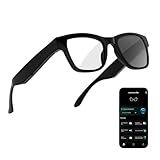
- 3-in-1 AI Glasses: Enjoy ① AI Voice Assistant (Powered by ChatGPT, Gemini & Deepseek), ② Stylish Photochromic Lenses Glasses, and ③ Bluetooth Open-Back Headphones, all in one.
- Free Talk Translation: Automatically detects and translates over 160 languages in real-time, allowing seamless work and translation without touching your phone or glasses.
- Voice, Video & Photo Translation: Supports over 98% of global languages, offering fast and accurate translations—ideal for international travel, business meetings, or cross-cultural communication.
- AI Meeting Assistant: Converts recordings from smart glasses into text and generates mind maps, making it easier to capture and organize meeting insights.
- Long Battery Life, Bluetooth 5.4 & Eye Protection: Up to 10 hours of music and 8 hours of talk time, with easy Type-C charging. Bluetooth 5.4 ensures stronger, stable connections, while photochromic lenses block UV rays and blue light, protecting your eyes in any environment.
The IMU package combines accelerometers and gyroscopes tuned for high-frequency head tracking. This is essential for understanding micro-movements, gait, and subtle posture shifts that matter in spatial computing and human behavior research.
Additional environmental sensors, including magnetometer and barometric inputs, help anchor motion data to the real world. In practice, this improves long-duration tracking stability and reduces drift, a persistent challenge in head-worn devices that rely on sensor fusion rather than external markers.
Cameras built for context, not content creation
The cameras in Aria Gen 2 are not trying to rival smartphone photography, and that distinction matters. These sensors are optimized for field of view, consistency, and temporal accuracy rather than dynamic range or aesthetic output.
Wide-angle RGB cameras capture scene context for computer vision tasks like object recognition, spatial mapping, and activity understanding. The emphasis is on capturing what the wearer is interacting with, not producing shareable media.
Crucially, Meta has improved synchronization between cameras and other sensors. This tighter alignment allows researchers to correlate what the wearer saw with how they moved and reacted at that exact moment, something Gen 1 could struggle with under fast motion or variable lighting.
Eye tracking moves from novelty to foundation
One of the most meaningful upgrades in Aria Gen 2 is eye tracking quality and reliability. Inward-facing cameras now deliver more stable gaze estimation across a wider range of users and lighting conditions.
This matters because eye tracking is not just about knowing where someone is looking. It is a proxy for attention, intention, and cognitive load, all of which are foundational inputs for future AR interfaces and AI assistants.
By improving eye tracking at the hardware level, Meta reduces the need for aggressive post-processing or cloud correction. That shift reinforces the broader Gen 2 theme: cleaner inputs upfront enable faster, more private intelligence downstream.
Audio capture that understands space
Microphone placement and processing have also been revisited. Aria Gen 2 uses a multi-mic array designed to capture spatial audio cues while minimizing wind noise and mechanical interference from the frame itself.
This is not about voice assistant performance today. It is about understanding conversations, environments, and social context in a way that can later inform audio AR, real-time translation, or situational awareness features.
As with video, audio data benefits from better on-device filtering. The glasses can isolate relevant signals before anything is stored or transmitted, reducing both power consumption and privacy exposure.
On-device compute: smaller, faster, and more selective
All of this sensing would be useless without the ability to process it locally. Aria Gen 2 integrates a more capable on-device compute platform that can handle sensor fusion, basic vision tasks, and real-time filtering without leaning on a tethered device.
Meta has not positioned this silicon as a consumer-grade AI processor, and that restraint is telling. The focus is on determinism and efficiency rather than raw throughput, ensuring the system behaves predictably during long research sessions.
By deciding what data is worth keeping in real time, the compute stack acts as a gatekeeper. This is where Meta can test which workloads truly belong on the glasses themselves and which can be deferred or discarded entirely.
Power, thermals, and the reality of wearing it all day
Improved hardware inevitably raises questions about battery life and heat, especially in a glasses-sized form factor. Aria Gen 2 addresses this through aggressive power management and workload scheduling rather than larger batteries.
Sensors do not all run at full tilt continuously. Instead, they scale based on context, allowing the system to remain comfortable on the face during extended wear.
This is one of the most underappreciated aspects of the hardware redesign. Comfort and thermal stability are not glamorous specs, but they are non-negotiable if smart glasses are ever going to move beyond short demos and into daily use.
Taken together, the hardware inside Aria Gen 2 is less about experimentation and more about discipline. Each sensor, camera, and processor exists to answer a specific question about what future smart glasses must do locally, reliably, and responsibly before they can earn a place on someone’s face.
AI and Machine Perception: How Aria Gen 2 Understands the World
If the hardware discipline of Aria Gen 2 is about sensing responsibly, its machine perception stack is about making sense of that data without overwhelming the wearer or the system. This is where Meta’s research priorities become clearest: not flashy augmented reality overlays, but a foundational understanding of people, places, and motion as they actually unfold in daily life.
Rather than treating vision, audio, and movement as separate inputs, Aria Gen 2 is designed to interpret the world as a continuous, multimodal stream. The goal is not to render graphics, but to build reliable internal representations of reality that higher-level systems can reason about later.
From raw sensors to semantic understanding
At the lowest level, Aria Gen 2 is constantly translating raw sensor data into structured signals. Camera feeds become depth estimates, object boundaries, and motion vectors, while microphones are parsed for directionality and environmental context rather than intelligible speech.
This shift from pixels and waveforms to semantic primitives is critical. It allows the system to understand that it is in a crowded indoor space, walking alongside another person, or transitioning from standing to sitting, without storing recognizable imagery or audio.
For Meta’s researchers, this is a proving ground for perception models that must work in uncontrolled environments. Lighting changes, occlusions, background noise, and unpredictable human behavior are not edge cases here; they are the default.
Egocentric vision as a first-class problem
Aria Gen 2 continues Meta’s focus on egocentric, or first-person, perception. Understanding the world from the wearer’s point of view introduces challenges that static cameras or third-person systems never face, including constant motion, partial views, and rapid context shifts.
The glasses are trained to recognize hands entering the field of view, tools being used, and objects being manipulated at close range. This is especially important for mapping human intent, not just surroundings, which is a prerequisite for meaningful assistance or interaction in future consumer devices.
What makes Gen 2 notable is the consistency of this tracking over long sessions. Improvements in sensor fusion and temporal modeling reduce drift and false positives, allowing perception to remain stable even as the wearer moves through complex spaces.
Audio intelligence without always listening
Machine perception in Aria Gen 2 extends beyond vision, but audio is treated with particular caution. Rather than continuous speech recognition, the system focuses on acoustic features like sound direction, intensity, and environmental signatures.
This enables contextual awareness, such as detecting whether the wearer is in a quiet room, a busy street, or a social setting, without capturing or interpreting spoken content. It is a subtle but important distinction that aligns with Meta’s emphasis on privacy-preserving research.
From a technical standpoint, this also keeps power consumption in check. Lightweight audio classifiers can run intermittently, waking more complex processes only when the context meaningfully changes.
Learning across time, not just moments
One of the less obvious advances in Aria Gen 2 is its ability to reason over longer time horizons. Instead of treating each frame or sensor reading independently, the system builds short-term memory of actions and environments.
This temporal awareness allows it to understand sequences, such as entering a room, interacting with an object, and leaving again. For researchers, this is essential for studying habits, workflows, and human-environment interaction at scale.
Crucially, this learning happens within tightly controlled bounds. Data retention, abstraction, and summarization are baked into the perception pipeline, ensuring that long-term understanding does not require long-term storage of sensitive raw data.
Why this matters beyond a research prototype
Taken on its own, Aria Gen 2’s machine perception may seem academic. But these systems are effectively rehearsals for consumer-grade smart glasses that must operate all day, in real time, without drawing attention or compromising trust.
The techniques being refined here, such as selective perception, egocentric understanding, and privacy-aware abstraction, are exactly what future assistants will rely on to feel helpful rather than intrusive. You cannot offer timely guidance, navigation, or contextual cues unless the device genuinely understands what the wearer is doing.
In that sense, Aria Gen 2 is less about seeing the world and more about interpreting it responsibly. It is Meta testing whether glasses can become perceptive companions, not by knowing everything, but by knowing just enough, at the right moment.
From Glasses to Data Platform: What Aria Is (and Is Not) Designed to Do
Seen in this light, Aria Gen 2 is better understood not as a product, but as infrastructure. The glasses are the visible layer, but the real ambition sits beneath them, in how Meta is building a scalable, privacy-aware data platform for understanding human behavior through wearables.
This distinction matters, because it explains both Aria’s capabilities and its deliberate limitations. Meta is not trying to ship a finished smart-glasses experience here, nor to compete directly with devices like Ray-Ban Meta or prospective consumer AR eyewear.
Rank #3

- 【AI Real-Time Translation & ChatGPT Assistant】AI glasses break language barriers instantly with AI real-time translation. The built-in ChatGPT voice assistant helps you communicate, learn, and handle travel or business conversations smoothly—ideal for conferences, overseas trips, and daily use.
- 【4K Video Recording & Photo Capture 】Smart glasses with camera let you capture your world from a first-person view with the built-in 4K camera. Take photos and record videos hands-free anytime—perfect for travel moments, vlogging, outdoor adventures, and work documentation.
- 【Bluetooth Music & Hands-Free Calls 】Camera glasses provide Bluetooth music and crystal-clear hands-free calls with an open-ear design. Stay aware of your surroundings while listening—comfortable for long wear and safer for commuting, cycling, and outdoor use.
- 【IP65 Waterproof & Long Battery Life】 Recording glasses are designed for daily wear with IP65 waterproof protection against sweat, rain, and dust. The built-in 290mAh battery provides reliable performance for workdays and travel—no anxiety when you’re on the go.
- 【Smart App Control & Object Recognition】Smart glasses connect to the companion app for easy setup, file management, and feature control. They support AI object recognition to help identify items and improve your daily efficiency—perfect for travel exploration and a smart lifestyle.
Aria as a reference platform, not a consumer device
Aria Gen 2 is explicitly designed as a reference platform for researchers, internal teams, and academic partners. Its job is to generate high-quality, multimodal datasets that help train and evaluate perception systems over months and years, not to delight a buyer on day one.
That’s why it lacks many features consumers expect. There is no display, no notifications, no voice assistant, and no always-on cloud sync. Even battery life and comfort, while improved over Gen 1, are tuned for controlled study sessions rather than carefree all-day wear.
The physical form reflects this intent. Aria Gen 2 looks closer to conventional eyewear than before, but the materials, sensor placement, and weight distribution prioritize data fidelity and repeatability over fashion or personalization. Think lab instrument first, lifestyle accessory second.
The real product is the data pipeline
What Meta is actually building is an end-to-end perception pipeline: sensors on the face, on-device processing, selective data capture, and structured outputs that can be studied without exposing raw personal footage. The glasses are simply the most practical place to anchor that system.
Each sensor stream, from eye tracking to inertial motion, is treated as a signal to be fused, filtered, and abstracted. The goal is not archival video, but semantic understanding: what objects were interacted with, how attention shifted, how environments changed over time.
This is why Aria Gen 2 emphasizes synchronization, calibration, and consistency across units. For machine learning at scale, messy or biased data is worse than no data at all. Aria exists to solve that problem before Meta attempts to productize the results.
What Aria is intentionally not trying to solve
Just as important are the problems Aria Gen 2 avoids. It is not designed to be socially expressive, emotionally responsive, or continuously helpful in the way consumer AI wearables aspire to be.
There is no attempt to provide real-time guidance, overlays, or conversational feedback. Doing so would compromise the controlled nature of data collection and introduce variables that make research outcomes harder to interpret.
Likewise, Aria is not optimized for mass-market durability, water resistance, or cost efficiency. Those trade-offs belong to consumer hardware teams, not a research platform whose value lies in accuracy and flexibility.
Why this platform-first approach matters for Meta’s roadmap
By separating research hardware from consumer products, Meta is trying to avoid the trap that plagued earlier smart glasses: shipping immature ideas directly to users. Aria Gen 2 gives Meta a way to test perception systems at human scale without eroding trust or overpromising functionality.
The insights generated here feed forward into multiple product lines. Future Ray-Ban Meta updates, true AR glasses, and even non-visual wearables benefit from better models of attention, context, and intent.
In other words, Aria is the rehearsal space. It is where Meta learns how glasses can quietly observe, reason, and forget in the right proportions, long before those capabilities appear in devices people actually buy.
A bridge between sensing hardware and everyday wearables
For wearable enthusiasts, Aria Gen 2 signals a shift in how smart glasses are being conceived. The challenge is no longer just miniaturization or battery life, but epistemology: deciding what a wearable should know, when it should know it, and what it should never retain.
Aria sits squarely in that philosophical gap. It is less about augmenting reality and more about understanding it well enough that augmentation, when it arrives, feels natural rather than invasive.
That makes Aria Gen 2 a meaningful step toward everyday adoption, even if no one outside a research lab will ever wear it casually. It is Meta acknowledging that the future of smart glasses depends as much on restraint and structure as it does on technical ambition.
Privacy, Ethics, and Data Capture: How Meta Is Addressing the Hard Questions
If Aria Gen 2 represents Meta’s most serious attempt to understand the world from a human point of view, it also forces the company to confront the most uncomfortable reality of smart glasses: sensing at this level is inseparable from privacy risk. The difference this time is that privacy is not being retrofitted after the hardware exists, but architected directly into how Aria is designed, deployed, and governed.
Meta is explicit that Aria Gen 2 is a research instrument first, not a consumer product in disguise. That framing matters, because it dictates who wears it, where it is worn, and how the resulting data is treated long before it reaches any AI model.
Designed for consent-first environments, not public ambiguity
One of the most important distinctions with Aria Gen 2 is that it is not intended for casual, everyday use in uncontrolled public settings. The glasses are worn by trained participants, researchers, or Meta employees operating under strict study protocols, typically in environments where consent, disclosure, and oversight are already established.
This sharply contrasts with consumer smart glasses, where bystanders often have no idea whether recording is taking place. With Aria, Meta is prioritizing environments where ethical review boards, institutional guidelines, and participant agreements define what can be captured and why.
That may limit scale, but it allows Meta to explore sensing technologies without normalizing always-on recording in public life.
On-device processing as a first line of defense
Aria Gen 2 places heavy emphasis on local, on-device processing rather than raw data streaming to the cloud. Many perception tasks, such as eye gaze estimation, hand tracking, and spatial mapping, are designed to be processed directly on the glasses or on paired research hardware.
This approach reduces the need to store or transmit identifiable audio and video whenever possible. Instead of saving raw footage, Aria can extract abstracted signals like vectors, poses, or attention metrics that are far less sensitive but still scientifically valuable.
For Meta, this is a critical testbed for techniques that will eventually be required in consumer wearables, where battery life, latency, and privacy expectations all demand more intelligence at the edge.
Clear separation between sensing and identity
Another notable design principle in Aria Gen 2 is the deliberate separation of sensor data from personal identity. Research datasets are anonymized, access-controlled, and purpose-limited, with internal safeguards designed to prevent cross-linking between individuals and long-term behavioral profiles.
This is not just a policy decision but a systems-level one. Data pipelines are structured to make misuse difficult by default, rather than relying solely on rules about appropriate behavior.
For wearable enthusiasts watching from the sidelines, this is an early glimpse of how future smart glasses may need to operate: capable of understanding context without building persistent dossiers on the people wearing them.
Visual indicators and transparency as social signals
While Aria Gen 2 is not a consumer device, Meta continues to experiment with outward-facing cues that communicate when sensing is active. Status LEDs and usage conventions are part of ongoing research into how wearables can signal intent to others nearby.
This may sound cosmetic, but it is foundational to social acceptance. Glasses that can see, hear, and infer meaning must also be legible to the people around them, especially in shared spaces.
The lessons learned here are likely to influence future Ray-Ban Meta designs and any eventual true AR glasses, where social friction could be a larger barrier than technical feasibility.
Purpose limitation over data hoarding
Meta has been clear that Aria Gen 2 data is collected with specific research goals in mind, not as a general-purpose training firehose. Studies are scoped, data retention is limited, and datasets are reviewed against the original research intent.
This matters because the temptation with rich multimodal data is to keep everything indefinitely, just in case it becomes useful later. Aria’s structure pushes in the opposite direction, favoring intentional collection over maximal accumulation.
If this philosophy carries forward into consumer wearables, it would represent a meaningful shift away from the surveillance-first assumptions that have historically haunted smart glasses.
Ethics as an enabling constraint, not a blocker
Perhaps the most telling aspect of Aria Gen 2 is that Meta does not present ethics as a problem to be solved later. Instead, ethical constraints are treated as enabling boundaries that make long-term adoption possible.
By forcing researchers to work within clear limits around consent, data scope, and retention, Meta is effectively stress-testing whether advanced perception systems can deliver value without eroding trust.
Aria Gen 2 does not answer every question about privacy in smart glasses, but it does demonstrate that Meta understands the stakes. For an industry still recovering from earlier missteps, that acknowledgment may be as important as any sensor upgrade or AI breakthrough.
Wearability and Industrial Design: How Close Aria Gen 2 Is to Everyday Glasses
If ethics and social signaling are the rules of engagement, industrial design is where those rules either survive contact with reality or quietly fail. Meta clearly understands that no amount of privacy scaffolding matters if the hardware still feels like a prototype strapped to your face.
Aria Gen 2 is best understood as a deliberate attempt to erase the visual and physical tells that have historically marked smart glasses as “other.” It is not invisible, but it is finally approaching the threshold where prolonged, real-world wear becomes plausible rather than aspirational.
Rank #4
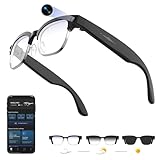
- 【8MPW Camera & 1080P Video and Audio】:These camera glasses feature an 800W camera that outputs sharp 20MP photos and smooth 1080P 30fps videos. Ultra-Clear Video + Powerful Anti-Shake tech+ Built-in dual microphones, you can capture crystal-clear video and audio together -sharply restoring details, perfect for vlogging, travel, and everyday moments
- 【Real-time AI translation Smart Glasses with Camera】:Instantly translate multiple major languages, breaking down language barriers in an instant—no phone required. Ideal for office settings, travel, academic exchanges, international conferences, watching foreign videos, and more
- 【Voice Assistant Recognition and Announcement】:Powered by industry-leading AI large models such as Doubao AI and OpenAI's GPT-4.0. AI voice wake-up lets you ask questions, recognize objects, and get answers on the go. Automatically recognizes objects, menus, landmarks, plants, and more, quickly analyzing the results and announcing them in real time. It instantly becomes your mobile encyclopedia on the go
- 【Bluetooth 5.3 Connection and Automatic Sync to Phone】:Equipped with a low-power BT5.3 chip and Wi-Fi dual transmission technology, offering ultra-low power and high-speed transmission. Captured images and videos are transferred to your phone in real time, eliminating manual export and eliminating storage worries
- 【290mAh Ultra-Long Battery Life】:Ultra-light at 42g, it's made of a durable, skin-friendly material, as light as a feather. Lenses are removable. Its simple, versatile design makes it a comfortable and comfortable wearer. 290mAh ultra-long battery life, 12 hours of music playback and 2 hours of photo or video recording, making it a perfect travel companion
A familiar silhouette with fewer compromises
At first glance, Aria Gen 2 looks far closer to conventional eyewear than its predecessor. The frame geometry is slimmer, the lenses sit more naturally in front of the eyes, and the overall mass has been redistributed to avoid the front-heavy feel common to camera-centric wearables.
Meta has reduced overall weight meaningfully compared to Aria Gen 1, landing in a range that feels closer to thick acetate glasses than a head-mounted device. That matters not just for comfort, but for posture, fatigue, and the subconscious cues that make wearers adjust or remove glasses throughout the day.
The design language is intentionally neutral. This is not a fashion statement in the Ray-Ban Meta sense, but it no longer screams “research hardware” either.
Weight distribution, balance, and all-day tolerance
What stands out most in extended wear is balance rather than absolute weight. The battery and compute components are spread along the temples, reducing pressure on the bridge of the nose and minimizing hot spots around the ears.
This is a lesson long understood in watchmaking and head-worn audio, and it is encouraging to see it applied rigorously here. Even small reductions in localized pressure dramatically improve perceived comfort over multi-hour sessions.
For researchers, this translates directly into better data. Fewer unconscious adjustments mean fewer interruptions and more natural behavior, which is essential when studying perception, movement, and social interaction.
Materials, finishing, and tactile realism
Aria Gen 2 uses materials that feel intentional rather than purely functional. The frame surfaces are matte and subdued, avoiding reflective finishes that would draw attention or trigger social discomfort in public spaces.
Hinges and joints feel closer to premium optical hardware than consumer electronics. There is controlled resistance when folding the arms, and nothing about the construction feels loose or provisional.
This matters because wearables live at the intersection of technology and personal object. Like a well-finished watch or a pair of quality headphones, perceived quality directly influences how often users choose to wear it.
Sensors without visual clutter
The real design achievement is how much sensing capability has been visually compressed. Aria Gen 2 integrates multiple cameras, eye-tracking sensors, microphones, and inertial sensors without turning the frame into a constellation of obvious apertures.
Cameras are recessed and symmetrically placed, avoiding the asymmetry that often triggers discomfort in observers. Status indicators remain present but restrained, reinforcing the idea that transparency does not require visual noise.
This approach aligns directly with the ethical framing discussed earlier. By making sensing legible but not aggressive, Meta is testing whether advanced perception can coexist with everyday social norms.
Fit, adjustability, and human variance
Meta has also expanded fit considerations beyond a single “average” face. Aria Gen 2 supports multiple nose pad options and frame sizes, acknowledging that facial geometry is not a rounding error.
This is critical for eye-tracking accuracy, camera alignment, and long-term comfort. Poor fit does not just degrade user experience; it undermines the validity of the research itself.
The glasses are designed to sit where normal glasses sit, not perched unnaturally high or forced forward to accommodate sensors. That subtle alignment choice has outsized impact on wearability.
Where it still feels like a research device
Despite the progress, Aria Gen 2 does not fully disappear on the face. The temples are still thicker than most consumer frames, and extended battery and compute demands impose limits that fashion-first designs do not face.
Battery life remains measured in hours rather than days, which is acceptable for research sessions but not yet aligned with habitual, always-on wear. Thermal management is improved, but sustained workloads still remind you that active computation is happening inches from your skin.
These are not failures so much as honest constraints of current technology.
A bridge between ethics and adoption
What makes Aria Gen 2’s industrial design compelling is how tightly it connects back to Meta’s ethical positioning. Comfort, visual restraint, and familiarity are not aesthetic luxuries here; they are prerequisites for trust.
By bringing the hardware closer to everyday glasses, Meta is effectively testing whether its privacy-first research model can survive outside controlled environments. If people are willing to wear Aria Gen 2 naturally, it suggests a path forward for future consumer designs that are socially acceptable by default.
In that sense, Aria Gen 2’s design is not just about wearability. It is about whether smart glasses can finally earn the right to be worn without explanation.
How Aria Gen 2 Fits Into Meta’s AR and Smart Glasses Roadmap
Seen in isolation, Aria Gen 2 can look like a well-executed research tool with limited relevance to everyday buyers. Placed inside Meta’s broader hardware strategy, however, it becomes much more revealing.
This is not a side project or academic dead end. Aria Gen 2 sits at the foundation layer of Meta’s long-term plan to make smart glasses socially acceptable, technically robust, and eventually indispensable.
Aria is Meta’s data engine, not its product
Meta has been unusually clear that Aria is not meant for consumers, and that distinction matters. Aria Gen 2 exists to gather high-fidelity, real-world data that consumer devices cannot ethically or practically collect at scale.
Every sensor choice, from eye tracking to egocentric video and spatial audio, is designed to train perception systems that will later run on far lighter hardware. In that sense, Aria is closer to a test bench than a prototype product.
Ray-Ban Meta smart glasses, by contrast, are already optimized for comfort, battery life, and social acceptability. What they lack today is deep contextual understanding, and that gap is exactly what Aria is meant to close.
From controlled research to everyday context
The first-generation Aria glasses were largely confined to structured studies and lab-adjacent environments. Aria Gen 2 is explicitly built to escape those constraints.
Improved comfort, better fit options, and more natural alignment on the face are not cosmetic upgrades. They allow researchers to wear the glasses for longer periods, across more varied daily activities, without altering behavior.
That shift matters because Meta’s biggest unsolved problem in AR is not display technology. It is understanding how people actually move, look, interact, and make decisions in unstructured environments.
Laying the groundwork for perceptual AI
Meta’s public AI narrative often centers on large language models, but Aria Gen 2 reveals where the company sees the next bottleneck. Intelligence without perception is limited, especially for wearable devices that need to operate hands-free and eyes-up.
Aria’s sensor stack is designed to capture synchronized streams of visual, spatial, and biometric data. This enables Meta to train models that understand not just what is in front of you, but what you are attending to, how you are moving, and what context surrounds an interaction.
Those capabilities are prerequisites for future smart glasses that can anticipate needs, deliver timely information, and avoid becoming distracting or intrusive.
Bridging Ray-Ban Meta and full AR glasses
Meta’s current consumer lineup stops short of true augmented reality. Ray-Ban Meta glasses offer audio, cameras, and basic AI features, but no visual overlays.
At the other end of the roadmap sit full AR glasses with displays, spatial anchoring, and persistent digital objects. Aria Gen 2 operates in the critical middle ground, solving perception and interaction problems before displays enter the picture.
By separating perception research from consumer hardware, Meta reduces risk. When display-ready AR glasses arrive, they can inherit years of validated behavioral and environmental understanding rather than learning on the fly.
Ethics as a strategic differentiator
Aria Gen 2 also reflects a deliberate attempt to rebuild trust after years of skepticism around always-on sensors. Visible indicators, strict data handling protocols, and limited distribution are not just compliance measures.
They allow Meta to pressure-test whether advanced sensing can coexist with social norms. If researchers struggle to wear Aria naturally in public, that feedback directly informs future consumer design decisions.
💰 Best Value

- #1 SELLING AI GLASSES - Move effortlessly through life with Ray-Ban Meta glasses. Capture photos and videos, listen to music, make hands-free calls or ask Meta AI* questions on-the-go. Ray-Ban Meta glasses deliver a slim, comfortable fit for both men and women.
- CAPTURE WHAT YOU SEE AND HEAR HANDS-FREE - Capture exactly what you see and hear with an ultra-wide 12 MP camera and a five-mic system. Livestream it on Facebook and Instagram.
- LISTEN WITH OPEN-EAR AUDIO — Listen to music and more with discreet open-ear speakers that deliver rich, quality audio without blocking conversations or the ambient noises around you.
- GET REAL-TIME ANSWERS FROM META AI — The Meta AI* built into Ray-Ban Meta’s wearable technology helps you flow through your day. When activated, it can analyze your surroundings and provide context-rich suggestions - all from your smart AI glasses.
- CALL AND MESSAGE HANDS-FREE — Take calls, text friends or join work meetings via bluetooth straight from your glasses.
This approach suggests Meta understands that technical readiness alone will not unlock adoption. Social readiness is just as critical, and arguably harder to engineer.
A signal of patience, not retreat
It is tempting to view Aria Gen 2 as evidence that consumer AR glasses are still far away. A more accurate reading is that Meta is choosing to move deliberately where mistakes would be costly.
Rather than rushing half-capable AR hardware to market, Meta is investing in the unglamorous work of perception, fit, comfort, and ethics. These are the constraints that ultimately determine whether smart glasses become a daily wearable or remain a novelty.
Aria Gen 2 does not point to a single upcoming product. It points to a future where Meta’s smart glasses feel less like gadgets and more like an extension of how people already see and move through the world.
What Aria Gen 2 Signals for Consumer Smart Glasses and AI Wearables
Seen in context, Aria Gen 2 is less about a single prototype and more about a philosophy for how smart glasses should evolve. Meta is effectively arguing that perception, comfort, and trust must mature before displays, not after.
That stance has implications well beyond Meta’s own roadmap, shaping expectations for how consumer smart glasses and AI wearables will realistically reach everyday adoption.
Perception-first is replacing display-first AR
For much of the last decade, consumer AR has been framed around optics: waveguides, field of view, brightness, and resolution. Aria Gen 2 flips that priority, treating environmental understanding as the foundation rather than the feature.
By deeply instrumenting how glasses perceive motion, depth, gaze, and context, Meta is building systems that know where you are, what you’re doing, and how you’re moving before attempting to show you anything. That dramatically reduces the risk of disorienting, low-value visual overlays when displays eventually arrive.
This mirrors how smartwatches matured, where accurate sensors and background intelligence mattered more long-term than flashy interfaces.
AI wearables are shifting from reactive to anticipatory
Aria Gen 2 points toward a class of wearables that do less explicit command-taking and more silent inference. The glasses are designed to observe patterns across head movement, eye tracking, hand interaction, and environment without constant user input.
That matters because future consumer AI glasses won’t succeed if they require frequent voice prompts or manual controls. The winning model looks more like proactive assistance that understands intent from behavior, similar to how modern fitness watches infer activity rather than asking users to log workouts.
Aria Gen 2 is training those systems in real-world conditions, where ambiguity and noise are unavoidable.
Comfort and wearability are being treated as core technologies
One of the quiet but critical signals from Aria Gen 2 is how much emphasis Meta places on physical ergonomics. Weight distribution, heat management, and long-duration comfort are treated as engineering problems on par with sensors and AI models.
This reflects a hard-earned lesson from earlier smart glasses attempts: if a device cannot be worn naturally for hours, its intelligence becomes irrelevant. Unlike wrist-based wearables, glasses sit on the face, amplifying even small design flaws over time.
By instrumenting real users over extended sessions, Meta is gathering data that directly informs future consumer designs, from frame geometry to material choices.
Privacy and social acceptability are no longer afterthoughts
Aria Gen 2 signals that privacy constraints are shaping hardware architecture from day one. Visible recording indicators, controlled data access, and limited deployment are not temporary compromises, but test cases for how always-on sensing can exist in public spaces.
For consumer smart glasses, this is arguably as important as battery life or processing power. Social friction, not technical limitation, has historically been the fastest way to kill wearable categories.
Meta is using Aria Gen 2 to map where discomfort arises, how people react in shared environments, and which design cues make sensing feel transparent rather than invasive.
Smart glasses are converging with health and motion wearables
While Aria Gen 2 is not positioned as a health device, its sensor suite overlaps heavily with domains long dominated by smartwatches and fitness trackers. Head motion, eye behavior, posture, and spatial movement offer rich signals for fatigue, attention, and even neurological research.
This hints at a future where smart glasses complement, rather than replace, wrist wearables. Watches excel at continuous physiological data, while glasses provide contextual and spatial understanding that wrists cannot.
Aria Gen 2 sits at that intersection, showing how multi-device wearable ecosystems may evolve rather than collapsing into a single form factor.
A clearer timeline for consumer readiness, without a release date
Perhaps the most important signal Aria Gen 2 sends is that Meta believes consumer smart glasses are a question of readiness, not ambition. The absence of a product launch is not hesitation, but discipline.
By decoupling perception research from commercial pressure, Meta avoids forcing immature technology into consumer frames. When consumer-facing AR or AI glasses do arrive, they are more likely to feel coherent, reliable, and socially acceptable from day one.
Aria Gen 2 suggests that the next breakthrough in smart glasses will feel subtle, not spectacular, and that may be exactly what finally makes them stick.
The Big Picture: Is Aria Gen 2 a Meaningful Step Toward Mass Adoption?
Taken in context, Aria Gen 2 feels less like a prototype chasing a product and more like infrastructure being quietly laid beneath the category. Meta is not testing whether smart glasses are possible, but whether they can be acceptable, reliable, and useful in everyday environments without triggering the social backlash that doomed earlier attempts.
That framing matters, because mass adoption of smart glasses has never been blocked by raw compute or sensor quality alone. It has stalled at the intersection of comfort, trust, and unclear value, and Aria Gen 2 is clearly designed to probe all three at once.
From experimental hardware to wearable systems thinking
Compared to Gen 1, Aria Gen 2 shows a shift from isolated sensing experiments toward a more holistic wearable platform. Improvements in weight distribution, thermal behavior, and sensor integration suggest Meta is learning how glasses need to feel over hours, not minutes.
This mirrors lessons long learned in smartwatches, where thinness, balance, and skin contact often matter more than headline specs. Aria Gen 2 may not display content, but it behaves like a product that expects to be worn continuously, which is a prerequisite for any mass-market future.
Why the lack of a display is actually a strength
For consumer adoption, displays have been both the promise and the problem of smart glasses. They introduce power drain, optical complexity, visual intrusion, and immediate social signaling that something unusual is happening.
By removing that variable entirely, Aria Gen 2 allows Meta to refine sensing, AI interpretation, and privacy frameworks without the distractions of visual AR. The result is a clearer understanding of how glasses can add value passively, much like early fitness trackers did before smartwatches became mainstream.
Privacy-first design as a gating factor for scale
Aria Gen 2’s most consequential contribution may be its explicit treatment of privacy as a core system requirement rather than a policy afterthought. Visible recording indicators, limited data access, and constrained deployment environments are shaping how always-on devices coexist with non-wearers.
This is not altruism; it is survival strategy. Any consumer smart glasses that fail this test will struggle to scale regardless of how advanced the technology becomes, and Aria Gen 2 is effectively stress-testing social tolerance before a commercial product ever ships.
Positioning within Meta’s broader wearable roadmap
Seen alongside Meta’s work on Ray-Ban smart glasses, Quest headsets, and wrist-based input research, Aria Gen 2 fills an important middle layer. It explores how AI-driven perception can live on the face without demanding attention, while still feeding richer spatial context into Meta’s broader ecosystem.
Rather than replacing watches, phones, or headsets, Aria Gen 2 reinforces a future where wearables specialize. Glasses understand the world around you, watches understand your body, and larger devices handle immersive interaction when you choose it.
So, does this actually move the needle?
Aria Gen 2 will not drive adoption directly, because it is not meant to. Its value lies in reducing the unknowns that have repeatedly derailed smart glasses just as they approached consumer readiness.
In that sense, it is a meaningful step toward mass adoption precisely because it resists the temptation to rush there. By prioritizing wearability, trust, and system coherence over spectacle, Meta is quietly increasing the odds that when consumer smart glasses finally arrive, they will feel less like a tech demo and more like something people are willing to live with every day.
If mass adoption of smart glasses is going to happen, it will likely look far closer to Aria Gen 2’s restraint than to the bold but brittle visions of the past.