Outdated Drivers Are Slowing You Down
One free scan finds every outdated or missing driver and matches the right update for your exact hardware.Free scan · exact hardware matchPC Slower Than It Used to Be?
A free scan shows the junk files, broken settings and background clutter dragging Windows down - then fixes them in one click.Free scan · Windows 10 & 11Some links on this page are affiliate links: if you buy through them we may earn a commission, at no extra cost to you.
Qualcomm’s June 10, 2025, demonstration showed a generative-AI assistant answering a recipe question directly on RayNeo X3 Pro smart glasses, without a phone, internet connection or cloud inference for that task. The announcement also introduced the Snapdragon AR1+ Gen 1, a platform designed to make selected AI workloads more practical on compact eyewear. It points toward glasses that can do more on their own—not a phone replacement, and not proof that every feature will work offline.
What Qualcomm demonstrated
At Augmented World Expo USA, Qualcomm executive Ziad Asghar asked an AI assistant for help with fettuccine Alfredo. Qualcomm said the assistant ran a Llama 1B small language model on RayNeo X3 Pro glasses powered by Snapdragon technology. It returned the answer as audio and text in the lens. Qualcomm described the inference as running without a smartphone, internet connection or cloud server. Qualcomm called it a “world’s first” demonstration; that wording is the company’s claim, not an independently established industry-wide finding.
The distinction matters: this was a demonstration of a particular on-device task, not evidence that the glasses—or all future AI glasses—can do everything offline. A local recipe response does not provide live web search, current information, remote messaging or continuously updated knowledge. Those services may still require a phone, network connection or cloud service.
What “on-glass GenAI” means
In this context, “on-glass” means the model’s inference—the computation used to generate an answer—runs on processing hardware in the glasses. Qualcomm said the demo used a 1-billion-parameter model, a relatively compact model intended to fit the power, thermal, memory and size limits of wearable hardware.
#1 Best Overall

- 【8MP HD Camera & 4K Ultra HD】Experience authentic first-person perspectives with an upgraded 8MP ultra HD camera. 4K resolution delivers clear, detailed imagery, while multi-frame noise reduction and advanced anti-shake technology help enhance image clarity for travel, cycling, outdoor sports, family gatherings and everyday adventures.
- 【AI Voice Assistant & Intelligent Object Recognition】Powered by the advanced ChatGPT model, the AI assistant supports real-time Q&A, daily planning and intelligent recommendations. These smart glasses also feature AI object recognition, which can instantly identify landmarks, plants, animals and everyday items, making them an ideal smart companion for travel, shopping, learning and exploring the world.
- 【139 Languages Real-Time AI Translation】Break down language barriers effortlessly with AI translation across 139 languages. Ideal for international travel, business communication, academic exchanges and cross-border socializing, these smart glasses help make multilingual conversations more natural, convenient and efficient.
- 【Open-Ear Hi-Fi Audio & Dual-Mic ENC Noise Cancellation】Enjoy immersive premium sound while staying fully aware of your surroundings with our open-ear headphone design. These bluetooth smart glasses are built with advanced dual-microphone ENC noise reduction technology, which effectively suppresses wind and ambient noise, ensuring crystal-clear hands-free calls and stable music playback even in noisy outdoor, cycling and commuting scenarios.
- 【Photochromic Lenses, Suitable for Any Scenes】Designed for all-day comfortable wear, AI glasses feature an ultra-lightweight frame and integrated photochromic lenses. The lenses automatically darken in sunlight for UV protection and return to a clear state indoors. A built-in 290mAh battery delivers long-lasting power for full-day use, fitting perfectly with all scenes of daily life, work and outdoor adventures.
- Phone-free for the demonstrated task: the glasses did not need a paired phone to run that inference.
- Cloud-free for the demonstrated task: the answer was generated locally rather than by a remote model.
- Not universally offline: any feature needing live data, a remote account or a larger service can still depend on connectivity.
“Standalone” can describe local inference without describing an entirely self-sufficient product. Qualcomm’s broader vision includes glasses paired with phones or connected to PCs, cars and other nearby devices. Local and remote computing can share the work.
What the Snapdragon AR1+ Gen 1 adds
The Snapdragon AR1+ Gen 1 is a platform for device makers, not an app or a Qualcomm-branded pair of consumer glasses. Qualcomm positions it for AI glasses and says it includes a third-generation Hexagon NPU for on-device AI, including small language models. Its stated capabilities also cover imaging, displays, audio and wireless connectivity. Qualcomm’s platform specifications include:
- Up to 12MP photo capture and 6MP video, with dual image signal processors, plus Qualcomm-described low-light and stabilization improvements.
- Support for single- or binocular-display designs, 3DoF, and output up to 1280 × 1280 per eye at 60 Hz.
- Wi-Fi 7 and Bluetooth 5.3/5.2 support.
- Up to eight microphones and targeted audio capture.
- Power-management and thermal improvements, alongside a package Qualcomm says is 26% smaller than the previous generation.
That 26% figure describes the platform comparison Qualcomm reports; it does not mean finished glasses will be 26% smaller. Frames also have to accommodate optics, batteries, cameras, speakers, antennas and heat management. The final size and comfort depend on the product maker’s design.
Likewise, platform specifications are not a promise that every AR1+ product will have binocular displays, the maximum stated resolution, every camera feature or the same software. The chipset makes capabilities available to manufacturers; product choices determine what users actually get.
Why local AI could help—and what it costs
Running selected AI tasks on glasses can reduce the delay of sending a request to a server and waiting for a reply. It can also let supported functions continue when a network is unavailable, reduce reliance on a phone for those tasks, and keep some camera or microphone processing on-device. Device makers may also send fewer inference requests to cloud services.
Rank #2

- #1 SELLING AI GLASSES - Tap into iconic style for men and women, and advanced technology with the newest generation of Ray-Ban Meta smart AI glasses. Capture photos and video recordings, listen to music, make hands-free calls or ask Meta AI questions on-the-go.
- UP TO 8 HOURS OF BATTERY LIFE - On a full charge, these smart AI glasses can last 2x longer than previous generations, up to 8 hours with moderate use. Plus, each pair comes with a charging case that provides up to 48 hours of charging on-the-go.
- 3K ULTRA HD: RECORD SHARP VIDEOS WITH RICH DETAIL — Hands-free video recording with an ultra-wide 12 MP camera in up to 3K resolution. Record clips up to 3 minutes per session. Capture sharp, vibrant memories while staying in the moment.
- LISTEN WITH OPEN-EAR AUDIO — Listen to music and more with discreet open-ear speakers that deliver rich, quality audio without blocking out conversations or the ambient noises around you.
- ASK YOUR GLASSES ANYTHING WITH META AI — Get real-time suggestions, answers, object identification, and reminders hands-free. Requires Bluetooth connection to your smartphone and the Meta AI app. Ensure your phone has internet connectivity.
These are potential advantages, not automatic guarantees. Local processing does not prove that a product never uploads or stores recordings, telemetry or account data; that depends on its software and privacy policies. Nor is local always better: a compact model has less compute and often less capability than a larger cloud model. A hybrid system can use local inference for quick or connectivity-sensitive tasks and call on a phone or cloud service when more capability or current information is needed.
There are physical trade-offs, too. Sustained camera, microphone, display and NPU use draws power in a small device worn against the face. Battery life and heat depend on the complete product and workload; Qualcomm’s demo does not establish either for everyday use.
What a Llama 1B model can—and cannot—suggest
A 1B model can be useful for brief, constrained assistant interactions, but the parameter count alone does not specify the exact model build, runtime, quantization or performance. Qualcomm identified the demo model as Llama 1B; that does not establish which implementation or software stack a commercial product would use.
Compared with a large cloud model, a small local model generally has tighter memory and context limits and can be less capable at difficult reasoning. It may provide less reliable factual answers, and without network access it cannot reliably answer questions about current events or other changing information. A convincing short exchange is not evidence of long conversations with persistent memory or dependable, complex multimodal reasoning.
That makes task design important. Short prompts, simple assistant responses and some recognition or translation workflows are more plausible early uses than unrestricted research or high-stakes advice. AI-generated output should not be relied on for medical, driving, industrial or other safety-critical decisions.
Rank #3

- 【AI Smart Translation Glasses】 - These smart glasses(No Camera) with built-in ChatGPT voice assistant, support real-time translation over 160 languages, simultaneous interpretation, meeting audio recording transcription. Helps you to suit any scenario and effortlessly break language barriers. Note: This model has no camera, all functions run via audio.
- 【Bluetooth Audio & Hands-Free Calling 】 - With Bluetooth 5.4 stable connection and open-ear design, our AI smart glasses features 3D surround sound music, delivering immersive audio directly to your ears. Built-in HD microphone ensures crystal-clear hands-free calls.
- 【Ultra-Lightweight Design with Gradient Lenses】 - Our smart glasses using medical-grade skin-friendly material, featured ergonomic design, 3D facial fitting, C-shaped wrap-around temples, and apple-arc nose pads that reduce pressure by 50% for all-day comfort up to 8 hours. The lenses will turn gray when exposed to sunlight, instantly transforming into stylish sunglasses, shielding eyes from harsh light and keeping us comfortable at all times.
- 【Extra-long Battery Life】 - AI bluetooth audio glasses equipped with 220mAh high-quality battery that takes only 1 hour to fully charge and can play continuously for up to 11 hours, solving battery anxiety. IP65 waterproof protection against sweat, rain, and dust, ideal for daily use and travel.
- 【Practical Flashlight & All-in-one Button】 - The integrated flashlight in AI glasses provides hands-free illumination, supports long-time walking and reading in dark. While the all-in-one button enables seamless control of power/flashlight/answering/hanging up/playing/pausing and wake-up the voice assistant —all with intuitive presses.
Smart glasses, display glasses and augmented reality are not synonyms
The RayNeo X3 Pro demonstration combined audio with text in a lens. Qualcomm’s AR1+ platform can support display-equipped glasses, including binocular displays, but the processor’s display capability does not define the optics in a finished product. Resolution alone says nothing about field of view, brightness or comfort.
Free tools Windows power users keep installed
One-click scans. No signup required.
“AI glasses” can refer to glasses with cameras, microphones and voice features; “display glasses” add visual output; and “augmented reality” often implies digital content aligned with the wearer’s view or surroundings. These categories overlap, but they are not interchangeable. A camera-equipped audio-only pair is not automatically an AR display product, and an AR1+ design is not necessarily a full spatial-computing headset.
AR1+ versus AR1: an important distinction
Qualcomm introduced the Snapdragon AR1 Gen 1 as a platform purpose-built for smart glasses, covering features such as imaging, livestreaming, notifications and on-device AI. Qualcomm identifies the Ray-Ban Meta collection as powered by AR1 Gen 1. The AR1 Gen 1 platform and Qualcomm’s Ray-Ban Meta device listing should not be confused with the newer AR1+.
The AR1+ is an evolution aimed at next-generation AI glasses, with Qualcomm explicitly describing support for on-glass small language models and claiming a smaller package and improved power management. Qualcomm’s 2025 demonstration used RayNeo X3 Pro; it does not establish that Ray-Ban Meta glasses use AR1+ or that every AR1+ platform feature is available in a retail pair.
| Area | Snapdragon AR1 Gen 1 | Snapdragon AR1+ Gen 1 |
|---|---|---|
| Positioning | Platform for smart glasses | Platform for next-generation AI glasses |
| On-device AI | AI and functions such as visual search and translation | Explicit support for on-glass small language models |
| Imaging | Up to 12MP photos and 6MP video | Up to 12MP photos and 6MP video, with Qualcomm-described enhancements |
| Size and power | Designed for lightweight glasses | Qualcomm claims a 26% smaller platform package and improved power management |
| Identified example | Ray-Ban Meta collection | RayNeo X3 Pro used in Qualcomm’s 2025 demonstration |
Qualcomm’s vision is a network of devices, not glasses alone
Qualcomm’s longer-term picture is modular. Some glasses could run selected AI locally; lighter models could lean more on a smartphone; more demanding work could move to a nearby PC, car or computing device. A watch, ring or other wearable sensor might provide additional context. This division of work reflects a basic constraint: glasses have limited room for batteries, cooling and powerful processors.
What’s actually slowing this PC down?
Pick the symptom - the matching free tool is one click away.
Rank #4
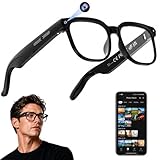
- 【AI Real-Time Translation & ChatGPT Assistant】AI glasses break language barriers instantly with AI real-time translation. The built-in ChatGPT voice assistant helps you communicate, learn, and handle travel or business conversations smoothly—ideal for conferences, overseas trips, and daily use.
- 【4K Ultra HD】 Smart glasses feature 4K resolution for clear, detailed visuals, making them suitable for travel, outdoor activities, everyday moments, and daily use.
- 【Bluetooth Music & Hands-Free Calls 】Smart glasses provide Bluetooth music and crystal-clear hands-free calls with an open-ear design. Stay aware of your surroundings while listening—comfortable for long wear and safer for commuting, cycling, and outdoor use.
- 【IP65 Waterproof & Long Battery Life】 AI glasses are designed for daily wear with IP65 waterproof protection against sweat, rain, and dust. The built-in 290mAh battery provides reliable performance for workdays and travel—no anxiety when you’re on the go.
- 【Smart App Control & Object Recognition】Smart glasses connect to the companion app for easy setup, file management, and feature control. They support AI object recognition to help identify items and improve your daily efficiency—perfect for travel exploration and a smart lifestyle.
That hybrid approach is not a retreat from on-glass AI. It is a way to put time-sensitive or locally useful tasks on the glasses while reserving heavier, current or connected tasks for other devices. Qualcomm’s platform direction is about making glasses one part of a broader computing system, rather than asking every pair to replace a phone.
Independent reader supportYour contribution helps us test, update, and keep practical guides available for everyone.What might be useful first
Qualcomm cites personalized assistants and real-time translation as potential on-glass small-model applications. Other plausible short-range uses include simple voice interactions, visual search, recognizing objects or scenes, translating a sign or menu, audio prompts, notifications and hands-free capture. Whether a feature works offline—and how well—depends on the particular glasses, software and model.
More demanding jobs are a different proposition: autonomous navigation, continuous video understanding, long conversations with persistent memory, current web research and enterprise workflows tied to live databases need capabilities or information a small offline model may not have. They are more likely to involve a phone, edge device, cloud service or some combination.
Real-world results also depend on input quality. Dim light, motion blur and blocked text can undermine visual recognition; wind and overlapping voices can impair speech recognition. Always-on camera use raises battery, thermal, privacy and consent questions, particularly when other people or private spaces are in view.
What changed after the 2025 demo
By August 2026, Qualcomm’s product portfolio continued to list AR1+ Gen 1 for AI glasses, while later announcements pointed to separate, more powerful platforms and partnerships. In June 2026, Qualcomm announced Snapdragon Reality Elite, a spatial-computing platform it says provides 48 TOPS of AI processing and supports large vision and language models on-device. It targets more powerful XR devices; it is distinct from the compact AR1+ smart-glasses platform. Qualcomm’s announcement is context for the wider move toward local AI, not an upgrade to the 2025 glasses demonstration.
Best Value
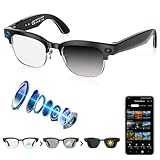
- 【4K Camera with EIS Stabilization】Smart glasses with camera feature a built-in 4K camera with EIS stabilization for clearer and steadier image performance during sports, cycling, travel, outdoor activities, and everyday use.
- 【Open-Ear Speakers & Clear Bluetooth Calling】Camera glasses feature built-in open-ear speakers for music and clear Bluetooth calls while helping you stay aware of your surroundings. Noise-reduction microphones provide clearer voice pickup and a comfortable listening experience for everyday use.
- 【AI Real-Time Translation & Voice Assistant】AI glasses support real-time translation in 139+ languages to make communication easier across different languages. The built-in AI voice assistant helps you access information and interact more efficiently—ideal for work, study, travel, and daily use.
- 【Photochromic Lenses & Lightweight Comfort】Smart sunglasses with camera feature photochromic lenses that respond to changing sunlight conditions for comfortable indoor and outdoor use while helping reduce UV exposure. The lightweight 35g frame provides a comfortable fit for extended everyday wear.
- 【IP66 Water Resistance & 290mAh Battery】AI sunglasses with camera feature IP66 water resistance for added protection against sweat, rain, and dust during active daily use. The built-in 290mAh battery provides convenient power for travel, outdoor activities, work, and everyday use.
In April 2026, Qualcomm also announced that future generations of Snap’s Specs would use Snapdragon XR solutions. Qualcomm said consumer availability was planned for later in 2026, but the announcement does not establish a final retail price, release date or complete product specifications. The collaboration announcement is a future-product signal, not confirmation that the glasses are available to buy.
Neither development shows that the particular RayNeo X3 Pro demonstration became a mass-market product. Qualcomm supplies platforms; partner manufacturers decide what to build and sell. The 2025 announcement alone does not establish current retail availability or pricing for an AR1+ consumer product.
What buyers should check in a finished pair
Snapdragon branding cannot answer the practical questions that matter most. For any specific glasses, check whether they have a display and what it shows; which tasks work offline; when the phone or cloud is required; how the maker describes battery behavior under camera and AI use; and what privacy controls govern capture, storage and uploads. Also check availability and support for the exact model in your market. The platform’s maximum specifications are not a substitute for those product details.
Do these 3 things before closing this tab:
1Repair Windows errors before they cause bigger problems2Scan for outdated or missing drivers - takes under a minute3Clear out junk files and repair common Windows errorsThe useful advance in Qualcomm’s announcement is narrower—and more credible—than a promise that glasses will replace phones: compact eyewear is becoming capable of running selected generative-AI workloads locally. The recipe demonstration showed the idea in action; the AR1+ platform is intended to help manufacturers build on it. How independent, comfortable and useful the resulting glasses are will depend on their models, software, power and product design.
Quick Recap
Product prices and availability are accurate as of the date/time indicated and are subject to change. Any price and availability information displayed on Amazon at the time of purchase will apply.

