Crashes, No Sound, or Screen Glitches?
Random freezes, missing sound and display glitches usually trace back to one bad driver. Find and replace yours safely.Free scan · under a minutePC Slower Than It Used to Be?
A free scan shows the junk files, broken settings and background clutter dragging Windows down - then fixes them in one click.Free scan · Windows 10 & 11Virtual reality works by showing each eye a slightly different computer-rendered view, then updating those views as you move. Headset cameras and motion sensors estimate your position; software uses that information to redraw the scene, while controllers or hand tracking let you interact with it. When the images, movement, sound, and input stay in sync, the experience can feel like being inside a virtual space.
In fully immersive VR, opaque headset displays replace your view of the room with computer-generated content. Mixed-reality headsets can instead show camera footage of the room alongside virtual objects. VR does not project a world into the room or reproduce every physical sensation: it coordinates visual, audio, and interaction cues to create a sense of presence.
How VR works, step by step
- The headset shows two views. Software renders a separate image for each eye from a slightly different viewpoint. Your brain combines them into a sense of depth.
- Lenses shape the images. Headset optics magnify and correct the display images so they appear farther away and fill more of your field of view. Lens design and how the headset fits your eyes affect clarity.
- Sensors estimate your movement. Gyroscopes and accelerometers measure rapid motion, while cameras observe the room and help estimate the headset’s position. Many standalone headsets use inside-out tracking, with cameras mounted on the headset.
- The scene updates to match your viewpoint. The software renders the virtual world from your current or predicted position. This lets nearby objects shift relative to distant ones as you move, a depth cue called motion parallax.
- Input changes what happens. Controllers, hand tracking, and, on some headsets, eye tracking or voice input let you select, point, grab, or otherwise interact with virtual content.
- Sound and vibration support the experience. Spatial audio changes with your position and orientation; controller or headset vibration can add tactile cues.
VR, AR, and mixed reality compared
| Term | What you see | How digital content relates to the real world |
|---|---|---|
| Virtual reality (VR) | Primarily a computer-generated environment on headset displays. | The virtual scene replaces your direct view of the room. |
| Augmented reality (AR) | The physical world with digital information overlaid or viewed through it. | Digital content supplements the real environment. |
| Mixed reality (MR) | The real environment and virtual content together, often shown using headset cameras. | Virtual content can be positioned in relation to the room; the exact meaning of “mixed reality” varies across products. |
These labels are not perfectly standardized. For example, a headset with passthrough cameras can show the room on its displays and place virtual content in that view. The experience may shift between a mostly virtual environment and one that includes more of the physical room.
How tracking creates a stable virtual space
Headsets combine inertial sensors with camera observations to estimate a user’s pose: position and orientation. Camera-based inside-out tracking can identify visual features in the room and use them as references. This allows the virtual viewpoint to respond not only when you turn your head, but also when you lean or move.
Quick wins for a faster PC:
Fix the driver behind crashes, sound loss and screen glitchesFind Drivers →Repair Windows errors before they cause bigger problemsFix Now →#1 Best Overall

- CARDBOARD MONKENAUT — Get our best Gorilla Tag bundle yet with this Amazon exclusive deal. Purchase Meta Quest 3S to get exclusive items, including the Gorilla Space Program Suit and Helmet, plus 2,000 SHINY ROCKS.
- NO WIRES, MORE FUN — Break free from cords. Game, play and explore immersive worlds — untethered and without limits.
- 2X GRAPHICAL PROCESSING POWER — Enjoy lightning-fast load times and next-gen graphics for smooth gaming powered by the Snapdragon XR2 Gen 2 processor.
- EXPERIENCE VIRTUAL REALITY — Take gaming to a new level and blend virtual objects with your physical space to experience two worlds at once in your VR headset.
- 2+ HOURS OF BATTERY LIFE — Charge less, play longer and stay in the action with an improved battery that keeps up. *Based on the graphic performance of the Qualcomm Snapdragon XR2 Gen 2 platform vs the Meta Quest 2 platform.
Tracking is an estimate, not a perfect measurement. Poor lighting, blank or reflective surfaces, blocked cameras, and fast movement can make it harder to maintain a stable estimate. Systems use sensor fusion, filtering, and prediction to help keep the scene steady.
Controllers can combine inertial sensors with optical markers or other tracking features that headset cameras can see. Hand tracking uses cameras and computer-vision models to estimate hand and finger positions. It can be convenient, but hands may be harder to track when they overlap, move quickly, leave the cameras’ view, or are in poor lighting. Controllers remain useful when an application needs physical buttons or reliable input outside the hand-tracking area.
What the display and lenses do
The separate left- and right-eye images provide binocular disparity, one of the depth cues used in ordinary vision. Positional tracking adds motion parallax: as you move, objects at different distances shift relative to one another. Together, these cues make a scene feel more spatial than a fixed panoramic image.
Rank #2
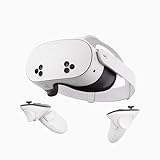
- NO WIRES, MORE FUN — Break free from cords. Game, play, exercise and explore immersive worlds — untethered and without limits.
- 2X GRAPHICAL PROCESSING POWER — Enjoy lightning-fast load times and next-gen graphics for smooth gaming powered by the SnapdragonTM XR2 Gen 2 processor.
- EXPERIENCE VIRTUAL REALITY — Take gaming to a new level and blend virtual objects with your physical space to experience two worlds at once.
- 2+ HOURS OF BATTERY LIFE — Charge less, play longer and stay in the action with an improved battery that keeps up.
- 33% MORE MEMORY — Elevate your play with 8GB of RAM. Upgraded memory delivers a next-level experience fueled by sharper graphics and more responsive performance.
Lenses magnify the displays and correct their geometry. Clarity depends on more than a headline resolution: lens design, eye position, interpupillary distance (IPD), image processing, and field of view all matter. A headset also cannot reproduce every natural depth cue. In most consumer headsets, the eyes may converge on an object that appears at a virtual depth while focusing at a fixed display distance. This mismatch can contribute to visual fatigue for some people.
Free tools Windows power users keep installed
One-click scans. No signup required.
How software keeps the image responsive
A VR application maintains a virtual scene and repeatedly renders views for both eyes. The headset runtime supplies tracking and display information, and the application updates the scene as the user moves. Consistent, low-latency presentation matters: if the displayed image reflects an older head position, the world can seem to lag or swim.
Systems may predict where the head will be when a frame reaches the display or adjust a recently rendered frame to improve perceived smoothness. These techniques can help, but they do not remove the need for adequate performance and well-designed content. OpenXR is a standard interface that can help applications work with compatible XR runtimes and devices.
Rank #3

- CARDBOARD MONKENAUT — Get our best Gorilla Tag bundle yet with this Amazon exclusive deal. Purchase Meta Quest 3 to get exclusive items, including the Gorilla Space Program Suit and Helmet, plus 2,000 SHINY ROCKS.
- NEARLY 30% LEAP IN RESOLUTION — Experience every thrill in breathtaking detail with sharp graphics and stunning 4K+ Infinite Display.
- NO WIRES, MORE FUN — Break free from cords. Game, play and explore in immersive worlds — untethered and without limits.
- 2X GRAPHICAL PROCESSING POWER — Enjoy lightning-fast load times and next-gen graphics for smooth gaming powered by the Snapdragon XR2 Gen 2 processor.
- EXPERIENCE VIRTUAL REALITY — Blend virtual objects with your physical space and experience two worlds at once in your VR headset.
How audio, haptics, and interaction add presence
Spatial-audio processing adjusts sound according to the virtual source’s location and the user’s orientation. As you turn, a sound can remain anchored to a place in the virtual room rather than moving with the headset. Controller or headset vibration adds simple tactile feedback when an action has a corresponding event, such as an impact or button press.
Presence is the subjective feeling of being located in or inhabiting a virtual environment. It can be strengthened when movement, depth, interaction, and audio cues agree. It does not mean you mistake the simulation for physical reality, and no single specification guarantees a convincing experience.
Why VR can cause motion sickness
VR can cause nausea, dizziness, disorientation, eyestrain, headache, or fatigue. A commonly discussed explanation is sensory conflict: the eyes may signal movement while the inner ear and body indicate that you are stationary. Cybersickness is multifactorial, however, and individual sensitivity varies.
Rank #4

- Your purchase of this item includes a new Meta Quest Pro 256 GB VR headset and a 12-month subscription to Optima Academy Online (OAO) field trips.
- Optima Academy Online (OAO) harnesses the power of virtual reality to make previously impossible learning opportunities just a few clicks away. Our VR Field Trips provide powerful ways of engaging users on a whole new level while providing learning experiences. With our VR Field Trips, we deliver users directly into an immersive educational experience that engages them like never before. We offer a one-month subscription to our VR Field Trips. During your subscription, you can spend as much time in our uniquely created Metaverse environments as you like. Each environment has its own theme, learning experiences, and adventures.
- High resolution mixed reality passthrough uses full-color sensors to let you see and engage with the physical world around you, even as you connect, work and play in virtual spaces.
- Share your true emotions and reactions with real time natural avatar expressions. Meta Avatars translate your natural facial expressions into VR so you can bring your true personality to meetings and gatherings with friends.
- Meta Quest Touch Pro Controllers translate instinctive hand gestures and detailed finger actions directly into VR with self-tracking cameras and precision controls. Multi-point, advanced haptics make virtual interactions feel entirely real
Smooth virtual movement while your body remains still can be challenging for some users. Latency, unstable frame presentation, visual motion, session length, and fit can also affect comfort. Research reviews identify visual-vestibular mismatch as an important mechanism, while noting that it does not explain every case.
If you are new to VR, try these comfort measures:
- Start with a short session and stop if symptoms begin; do not try to push through discomfort.
- Adjust the headset fit and lens spacing so the image is clear and comfortable.
- Choose comfort options such as teleport movement or snap turning if an app offers them.
- Prefer experiences that run smoothly, and take breaks between sessions.
What varies between VR headsets?
“VR headset” describes different designs, not one fixed set of features. Standalone headsets contain their own computing hardware; PC- or console-connected systems rely on another device for some or most processing. Products also differ in their displays, optics, tracking, input, comfort, software, and support for passthrough mixed reality.
| Example | What the research dossier says it illustrates | Important distinction |
|---|---|---|
| Meta Quest 3 | Standalone VR and mixed reality, with color passthrough, pancake optics, and hand tracking. | Combines immersive VR with room-aware passthrough features. |
| PlayStation VR2 | PS5-connected VR, with inside-out tracking, eye tracking, and foveated rendering. | Depends on a PlayStation 5 rather than operating as a standalone headset. |
| Apple Vision Pro | A spatial-computing device supporting windows, volumes, shared and fully immersive spaces, and eye-and-hand interaction. | It is better described as a spatial-computing or mixed-reality device than as a conventional game-focused headset. |
These examples are not a ranking. Which design suits someone depends on what they want to do, the devices they already own, comfort, software availability, and other preferences.
The Tool Desk
Outbyte PC Repair FREERepair Windows errors before they cause bigger problemsFix Now →Outbyte Driver Updater FREEScan for outdated or missing drivers - takes under a minuteDriver Scan →Best Value

- NEARLY 30% LEAP IN RESOLUTION — Experience every thrill in breathtaking detail with sharp graphics and stunning 4K Infinite Display.
- NO WIRES, MORE FUN — Break free from cords. Play, explore and exercise in immersive worlds — untethered and without limits.
- 2X GRAPHICAL PROCESSING POWER — Enjoy lightning-fast load times and next-gen graphics for smooth gaming powered by the Snapdragon XR2 Gen 2 processor.
- EXPERIENCE VIRTUAL REALITY — Blend virtual objects with your physical space and experience two worlds at once.
- 2+ HOURS OF BATTERY LIFE — Charge less, play longer and stay in the action with an improved battery that keeps up.
FAQ
Does a VR headset project images into the room?
No. In fully immersive VR, displays inside the headset show computer-generated images to your eyes. In passthrough mixed reality, cameras capture the room and the headset displays that view together with virtual content.
Why does VR show a different image to each eye?
The two viewpoints reproduce binocular disparity, the difference between the images normally received by your left and right eyes. Your brain uses that difference as one cue for depth.
What is inside-out tracking?
Inside-out tracking uses cameras mounted on the headset to observe the surroundings, usually combining those observations with inertial sensor data to estimate the headset’s position and orientation.
Does every VR headset track your eyes?
No. Eye tracking is available on some headsets, not all. Where supported, it can enable gaze-based interaction or help render more detail where the wearer is looking.
Recommended Free Tools
Why can VR make some people feel sick?
One important explanation is that visual movement can conflict with signals from the inner ear and body. The causes and severity vary, so stop and take off the headset if you start to feel unwell.
Quick Recap
Product prices and availability are accurate as of the date/time indicated and are subject to change. Any price and availability information displayed on Amazon at the time of purchase will apply.