The Tool Desk
Outbyte Driver Updater FREEFix the driver behind crashes, sound loss and screen glitchesFind Drivers →Outbyte PC Repair FREERepair Windows errors before they cause bigger problemsFix Now →Short answer: A smartwatch estimates sleep from movement and body signals; it does not measure brain waves. It is generally useful for bedtime, wake time and broad sleep-versus-wake trends, but its REM, light and deep-sleep readings are approximations—not a substitute for a sleep study.
What a smartwatch actually measures
The watch records raw signals, then software converts them into labels such as awake, light, deep and REM. Those labels are inferences, not direct observations of sleep stages.
Movement
An accelerometer detects wrist motion such as turning over, getting out of bed and repeated restlessness. Long still periods can look like sleep even when you are reading, watching television or lying awake. Conversely, movement during restless sleep can be classified as wakefulness.
Heart rate and PPG
Photoplethysmography (PPG) uses LEDs and photodiodes to detect blood-volume changes under the skin. From the pulse waveform, a device estimates heart rate, and sometimes beat-to-beat timing and heart-rate variability (HRV). Nighttime cardiovascular patterns can help separate sleep from wake, but they do not uniquely identify a stage. Alcohol, illness, stress, exercise recovery, medication, temperature and poor sensor contact can all change those patterns.
Recommended Free Tools
#1 Best Overall

- 👍【Your Ultimate Fitness Partner】With 120+ sport modes, this smart watch for android phones covers running, cycling, hiking, yoga, skiing, and more. It accurately tracks heart rate, steps, calories, distance, and activity time. Acting as your wrist-based coach, it helps optimize training intensity. IP68 waterproof design lets you train through sweat and rain. Unleash your fitness potential anywhere.
- 📞【Bluetooth Calling & Smart Alerts】Stay connected hands-free. Our smart watche for women features advanced Bluetooth 5.3 for stable calls directly from your wrist. The built-in HD speaker and mic deliver crystal-clear audio, while smart vibration alerts notify you of messages from apps like Facebook and WhatsApp. Perfect for driving, workouts, or busy days—never miss a call or important update again.
- ⌚【1.83" HD Touchscreen & 200+ Faces】Experience the vibrant full-color display, perfect for checking info on-the-go. Choose from 200+ faces or use your photo to match any style, from workouts to daily life. More than a watch—it's the android smartwatch that matches your life.
- 🚀 【Your 24/7 Wellness Companion for Smarter Choices】From busy workdays to restful nights, this smart watche for men is with you. It tracks your heart rate and stress during meetings, analyzes your deep and light sleep, and provides a morning readiness report. It also features female health tracking. All your data is clearly displayed, helping you make smarter daily choices for a healthier, more balanced life.
- 💖 【7-Day Battery & Universal Compatibility】Say goodbye to daily charging. This smart watch lasts up to 7 days on a single 2-hour charge and stays ready for 30 days in standby mode. It seamlessly pairs with both iOS and Android devices, including Apple iPhone, Samsung, and Google Pixel. Enjoy total freedom from battery anxiety and stay connected effortlessly.
Temperature, oxygen and respiration
Some devices add skin-temperature trends, blood-oxygen readings or respiratory-rate estimates. These can provide context for recovery, illness or possible breathing disturbances, but fit, movement, circulation and sensor limitations affect the readings. A consumer oxygen or breathing graph is not automatically a diagnostic sleep-apnea test.
The algorithm
Machine-learning or rules-based software combines the sensor streams into a time series. It was typically trained on recordings matched with laboratory polysomnography (PSG), then assigns the most probable state to each period. The watch is classifying a pattern; it is not observing EEG-defined sleep directly.
What a sleep laboratory measures instead
PSG is the reference method used in most wearable-validation studies. A typical study records:
Rank #2

- Designed with a bright, colorful AMOLED display, get a more complete picture of your health, thanks to battery life of up to 11 days in smartwatch mode
- Body Battery energy monitoring helps you understand when you’re charged up or need to rest, with even more personalized insights based on sleep, naps, stress levels, workouts and more (data presented is intended to be a close estimation of metrics tracked)
- Get a sleep score and personalized sleep coaching for how much sleep you need — and get tips on how to improve plus key metrics such as HRV status to better understand your health (data presented is intended to be a close estimation of metrics tracked)
- Find new ways to keep your body moving with more than 30 built-in indoor and GPS sports apps, including walking, running, cycling, HIIT, swimming, golf and more
- Wheelchair mode tracks pushes — rather than steps — and includes push and handcycle activities with preloaded workouts for strength, cardio, HIIT, Pilates and yoga, challenges specific to wheelchair users and more (data presented is intended to be a close estimation of metrics tracked)
- EEG: electrical brain activity.
- EOG: eye movements.
- EMG: muscle activity and tone.
- ECG or heart rate.
- Airflow and breathing effort.
- Blood-oxygen saturation, body position and sometimes leg movements.
A technologist scores the recording in commonly used 30-second epochs as awake, non-REM stage 1, stage 2, stage 3 or REM. A watch usually compresses those clinical categories into its own labels—often awake, light or core, deep and REM. The labels and boundaries differ between brands.
Why stages are harder than sleep duration
Sleep stages differ by combinations of brain activity, eye movements, muscle tone, heart rate, breathing and movement. A wrist device sees only some peripheral signals.
- Deep sleep may be inferred from sustained stillness and stable cardiovascular signals.
- REM may be inferred from movement and pulse patterns, but peripheral signals can resemble wake or lighter sleep.
- Light sleep often becomes the broad category used when the algorithm is uncertain.
- Brief arousals can be missed when they do not produce movement.
That combination can produce useful broad trends while misplacing individual stage transitions. A plausible-looking percentage of deep or REM sleep does not prove that each epoch was scored correctly.
Rank #3

- 【Crystal-Clear Bluetooth Calls & Message Notification】 AEAC smart watch with Bluetooth 5.3 and a built-in DSP chip, enjoy ultra-clear call quality and zero lag. Stay connected on the go with real-time SMS and app notifications (Not supporting reply messages)—all from your wrist.
- 【1.85" HD Display with 60Hz Refresh Rate】Experience crisp visuals and smooth scrolling on the vibrant 1.85" HD touchscreen. Plus, you can also upload photos of your family, pets, and scenery to customize a watch face with your own style.
- 【24/7 Health Monitoring】Track your health around the clock with advanced sensors. Monitor heart rate, sleep stages, stress levels, and more, helping you make informed choices for a healthier lifestyle.
- 【Fitness Tracking with 100+ Modes】Elevate your workouts with over 100 sport modes, including running, swimming, yoga, and more. The IP68 waterproof design ensures it’s ready for your toughest adventures, from the gym to the pool.
- 【Seamless Compatibility & Long Battery Life】AEAC smart watch works effortlessly with iOS and Android smartphones. Enjoy up to 7 days of battery life on a single charge, so you never have to worry about recharging.
Accuracy by metric: what each number can support
| Metric | Practical confidence | Safe interpretation |
|---|---|---|
| Bedtime and wake time | Moderate to high with a regular routine | Useful for habit and schedule tracking |
| Broad sleep versus wake | Moderate to high, although quiet wake may be missed | Use repeated patterns, not a single night |
| Total sleep time | Moderate | An estimate that can include quiet wakefulness |
| Number and duration of awakenings | Low to moderate | Especially uncertain when awakenings are quiet |
| Sleep-onset latency | Moderate at best | Lying still awake can be counted as sleep |
| REM sleep | Low to moderate | Directional trend only |
| Deep sleep | Low to moderate | Not a medical measurement or target |
| Sleep score | Device-specific | A proprietary coaching composite, not a clinical result |
| Breathing-disturbance alerts | Potentially useful when a feature is medically authorized | Follow up clinically; an alert or a normal result is not a diagnosis |
“Accuracy” is not one universal number. Sensitivity is the share of a target state the device detects; specificity is how well it rejects that state when absent; precision is how often a positive label is correct. Researchers also report agreement statistics such as Cohen’s kappa, correlation and mean absolute error. Correlation can be high even when nightly values differ substantially. A device may have good sleep sensitivity but poor wake specificity, the classic reason total sleep is overestimated.
What independent studies show
A 2025 meta-analysis of 24 studies involving 798 participants compared consumer wrist devices with PSG and found variable performance for total sleep time, sleep efficiency, latency, wake after sleep onset and stage classification. Results depend on device generation, algorithm, population and test conditions. Read the meta-analysis or its full text.
Windows Errors? Fix Them Before They Spread
Repair common Windows errors and clear accumulated junk for a smoother, more stable PC - no reinstall needed.Free scan · no reinstallOutdated Drivers Are Slowing You Down
One free scan finds every outdated or missing driver and matches the right update for your exact hardware.Free scan · exact hardware matchIn a 2024 laboratory comparison of Oura Ring Gen3, Fitbit Sense 2 and Apple Watch Series 8, stage sensitivity ranged from 50.5% to 86.1%, depending on device and stage. Those are study-specific results, not a guarantee for every owner or software version. Study details and full text.
Rank #4
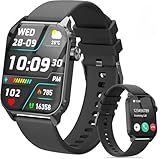
- 1.83" HD Display and Custom Watch Faces: Enjoy a bright 1.83 inch screen with 240x284 resolution. Change watch faces freely to match your style, whether casual, sporty, or professional. Clear visuals and elegant design for any occasion.
- 120 Workout Modes and Health Tracking: Track over 120 activities including walking, running, and cycling. Monitor your heart rate and sleep quality continuously. Step counting starts after 20 steps to avoid false records. A complete wellness companion for daily fitness.
- IP67 Waterproof and Long Battery Life: Rated IP67 to resist sweat, rain, and splashes. The 350mAh battery lasts 5 to 7 days of normal use and up to 30 days on standby. Reliable for workouts, travel, and daily wear.
- Bluetooth Calling and Wide Compatibility: Make and answer calls from your watch. Control music and your phone's camera remotely. Works with iPhone iOS 9.0 and above and Android 5.0 and above. A smart, all in one watch for easier living.
- Alexa Built-in and Smart Notifications: Talk to Alexa directly from your wrist. Get real time alerts for calls, messages, and apps like Facebook and WhatsApp. Supports 15 languages. Stay connected without picking up your phone.
A systematic review of Fitbit Charge 4, Garmin Vivosmart 4 and WHOOP highlighted limitations of actigraphy-heavy approaches, particularly variable wake detection. Review and full text. A later validation study assessed Fitbit Charge 5, Fitbit Sense, Withings ScanWatch, Garmin Vivosmart 4, WHOOP 4.0 and Apple Watch Series 8 against PSG. Validation study.
Oura states that its algorithm combines movement, skin temperature, resting heart rate, HRV and respiratory rate, and reports 79% agreement with PSG. This is a company-reported figure, not an independent industry-wide benchmark. Oura describes four categories—awake, REM, light and deep—in its sleep-stage documentation.
Why your watch may disagree with how you feel
- Quiet wakefulness, reading, pain or anxiety can be counted as sleep.
- Restless sleep can be counted as wakefulness.
- Loose fit, sleeping on the sensor, sweat, tattoos, hair, cold skin or poor contact can disrupt PPG.
- Charging, a dead battery or removing the watch creates missing epochs.
- Alcohol, illness, a late meal, unusual training, stress and medication changes alter physiology.
- Shift work and irregular schedules may fall outside the patterns used to train the algorithm.
- Naps, unusual sleeping positions, a partner or pet can produce inconsistent detection.
- Firmware or model updates can change results from the same device.
- “Deep,” “light,” “core” and “sleep time” are not standardized across brands.
How health conditions change the picture
Many validation studies use healthy adults, so results may not generalize to people with sleep apnea, insomnia, periodic limb movements, circadian-rhythm disorders, chronic pain, depression or anxiety, older adults, children, or people taking sedatives, stimulants or antidepressants. A wearable can document a pattern to discuss with a clinician, but it cannot diagnose or rule out these conditions.
Best Value

- 【120 Sports Modes & Advanced Health Tracking】Our TG08 smart watches for women men come equipped with 120 sports modes, allowing you to effortlessly track a variety of activities such as walking, running, cycling. With integrated heart rate and sleep monitors, you can maintain a comprehensive overview of your health, achieve your fitness goals, and maintain a balanced, active lifestyle with ease. Your ideal wellness companion (Note: Step recording starts after exceeding 20 steps)
- 【1.83" HD Display & Customizable Watch Faces】Immerse yourself in a vibrant 1.83-inch IPS display, boasting a sharp resolution of 240*284 for crystal-clear visuals. Effortlessly personalize your smart watch with a wide array of customizable watch faces to suit your personal style for every occasion—whether trendy, artistic, or minimalist—ideal for casual, sporty, or professional. Its sleek, modern design complements any outfit, blending technology and fashion seamlessly for everyday wear
- 【Stay Connected Anytime, Anywhere】Stay informed and in control with Bluetooth call and music control features. Receive real-time notifications for calls, messages, and social media apps like Facebook, WhatsApp, Twitter, and Instagram directly on your smartwatch. Easily manage calls, control your music playlist, and stay updated without needing to reach for your phone. Perfect for work, workouts, or on-the-go, this watch keeps you connected and never miss important updates wherever you are
- 【IP67 Waterproof & Long-Lasting Battery】Designed to keep up with your active lifestyle, this smartwatch features an IP67 waterproof rating, ensuring it can withstand splashes, sweat, and even brief submersion, making it perfect for workouts, outdoor adventures, or rainy days. Its reliable 350mAh battery offering 5-7 days of active use and up to 30 days in standby mode, significantly reducing frequent charging. Ideal for all-day wear, whether you’re at the gym, outdoors, or simply on the go
- 【Multifunction & Wide Compatibility】Seamlessly handle heart rate monitoring, sleep tracking, and enjoy conveniences like camera/music control, Seamlessly handle heart rate monitoring, sleep tracking, and more-all directly from your wrist. This 1.83 inches HD smartwatch is compatible with iPhone (iOS 9.0+) & Android (5.0+), ensuring smooth daily connectivity and convenience throughout your day. More than just a timepiece, it’s a stylish, all-in-one wearable for smarter, healthier living
Can a smartwatch detect sleep apnea?
Some devices can flag breathing disturbances, oxygen patterns or irregular overnight signals, and a specifically authorized feature may be useful for screening. A normal-looking report does not reliably exclude apnea, while a concerning result does not establish it. Diagnosis requires medical evaluation and, when indicated, a home sleep-apnea test or PSG. Ordinary sleep-stage charts should not be treated as apnea tests.
Use sleep data without being misled
- Wear the device consistently for two to four weeks.
- Keep the sensor snug enough for contact but comfortable overnight.
- Note alcohol, illness, travel, unusual exercise, late meals, stress and medication changes.
- Review bedtime, wake time, estimated total sleep, regularity and repeated awakenings before looking at stages.
- Compare the graphs with a simple sleep diary and daytime symptoms.
- Ignore isolated outliers unless they recur under similar conditions.
- Do not chase a perfect score if checking the app makes sleep more anxious; excessive metric-focusing can become counterproductive.
- Seek medical advice for persistent loud snoring, witnessed pauses, gasping, severe daytime sleepiness, unexplained insomnia or dangerous drowsiness.
Choosing a smartwatch, ring, band or medical test
There is no universal “most accurate” consumer device. Choose the form factor and ecosystem that you will wear reliably, then assess battery life, platform compatibility, data export, privacy, interpretation and recurring fees.
| Device type | Best fit | Main trade-off |
|---|---|---|
| Apple Watch | iPhone owners who also want notifications, exercise, safety and apps | Regular charging and limited appeal for Android users |
| Fitbit | A lighter tracker with sleep and activity features | Some advanced insights depend on model or Fitbit Premium |
| Garmin | Athletes combining training, GPS, recovery and sleep estimates | Sleep features vary by model; sports ecosystem is the main strength |
| Oura Ring | Screen-free overnight comfort and passive trends | Full features require membership; Oura’s US support page lists $5.99 monthly or $69.99 yearly, with one included month for new members (pricing details) |
| WHOOP | Performance-focused recovery, strain and coaching | Subscription economics and strap-first design |
| Medical device or sleep study | When the goal is diagnosis | Requires clinical evaluation rather than lifestyle interpretation |
Before buying, check overnight comfort, battery life, phone compatibility, historical-data access, export or health-platform integration, subscription terms, privacy controls and whether a feature has medical authorization.
The Bottom Line
A smartwatch is a useful behavioral instrument, not a portable sleep laboratory. Trust repeated patterns in sleep timing and broad sleep-versus-wake data; treat REM, light and deep readings as directional estimates, and take persistent symptoms to a clinician instead of self-diagnosing from a score.
Quick Recap
Product prices and availability are accurate as of the date/time indicated and are subject to change. Any price and availability information displayed on Amazon at the time of purchase will apply.