Short answer: the invention was real, but the headline is exaggerated. A University of California, San Diego-led team demonstrated a scleral contact lens with a fixed approximately 2.8× telescopic optical path and a separate 1× viewing path. It was designed mainly as a potential aid for people with low vision, including central-vision loss from age-related macular degeneration (AMD), not as a consumer product that gives healthy eyes superhuman sight. No verified evidence establishes that this specific prototype is FDA-cleared or available to buy as of August 18, 2026.
The original announcement appeared on July 9, 2013, followed by a 2013 Optics Express paper and a 2015 Applied Optics paper describing a thicker wearable prototype.
What the researchers actually built
This was a scleral contact lens, not an ordinary soft lens. A scleral lens vaults the cornea and rests partly on the white of the eye. Inside the prototype were two optical routes:
- Central aperture: approximately 1×, or ordinary unmagnified vision.
- Annular telescope: a ring around the center that provided approximately 2.8× angular magnification.
The later prototype was about 1.6 mm thick. Its telescope used an 8.2-mm annular entrance pupil and four internal reflections in a precision polymethyl methacrylate (PMMA) optic. A rigid gas-permeable outer casing helped the optic conform to the eye’s curved surface and correct aberrations. The design was optical, not electronic: it contained no camera, image-recognition system, night vision, or continuously variable zoom.
#1 Best Overall
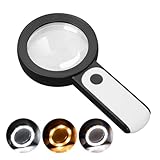
- HIGH POWER MAGNIFICATION: This magnifying glass provide Optical high magnification, allowing users with low vision to read text, no matter the size.
- ULTRA BRIGHT 18 LED WITH 3 MODES: The built-in energy-saving 18 LED lights provides extra luminance to ensure an overall better reading experience even at night or dark places. The stepless dimmable 3 lighting modes (cold, warm and mixed) can be switched based on different light condition, which can reduces visual fatigue, which is very useful for people with macular degeneration or far-sightedness/feyopia.
- EASY TO USE: Comes completely assembled, just requires 3x AAA batteries (not included). Easy to operate with a simple ON / OFF button switch, making it perfect for the elderly or those requiring an intuitive magnification system.
- LARGE LENS(Diameter 3.15"): Magnifies without optical distortion. Optimal to enhance reading and viewing very fine details in books, newspapers, magazines, photographs, maps, electronics, miniatures, jewelry, pill bottles, medications, hobbies, models, and crafts of all kinds.
- PERFECT GIFT FOR THE ELDERLY: Great magnifier for seniors, Most elderly have difficulty reading the small print on coupons, prescription,medical bottle.clear magnifier with light also a great choice for those who have low or impaired vision of most types.
The 2013 Optics Express paper described the switchable concept, while the 2015 Applied Optics paper reported fabrication and testing of the wearable version.
How switching between 1× and 2.8× worked
The contact lens did not independently “zoom.” Switching relied on specially modified active-shutter 3D glasses:
- The lens presented a central normal-vision path and a peripheral telescopic path.
- Liquid-crystal shutters in the glasses changed the polarization of incoming light.
- Polarizing elements in the lens transmitted either the central 1× image or the annular magnified image.
- The wearer therefore selected ordinary or magnified viewing by changing the glasses’ state.
The team discussed a future hands-free control using a blink or wink, but that was a proposed direction, not a demonstrated self-contained control system. Without the glasses, the two images could be superimposed.
UC San Diego’s explanation describes the polarization system and the proposed blink-controlled approach.
Rank #2

- 8X Magnification: Enjoy enhanced clarity with 8X magnification, allowing you to see details with precision. Whether it's fine print or intricate details, these adjustable eyeglasses bring clarity to your vision.
- For All Fishing Enthusiasts: Whether you have good eyesight or are visually impaired, including those with myopia (below 500 degrees), this eyewear is designed for you. Ideal for activities like rock fishing and fishing with a long pole, it proves especially effective in windy conditions, areas with reflections, low light situations, and when the drift tail is too fine to see clearly.
- Wearable Convenience: Experience hands-free magnification with these wearable magnifying glasses with large nose pad. Effortlessly wear them like regular eyeglasses, leaving your hands free for reading, fishing, or any other activity that requires a closer look.
- Clear Vision Design: The frosted objective lens housing eliminates distracting reflections, delivering a clear and uninterrupted view. Experience enhanced vision in dimly lit environments, especially during nighttime fishing. The advanced lens technology ensures clear visibility even in challenging lighting conditions.
- Versatile Use: This pair of Fishing Glasses is ideal for various activities such as reading, fishing, crafting, and other tasks that require a closer look. Enhance your vision and make daily activities more enjoyable and accessible.
What “2.8× magnification” means—and what it does not
Approximately 2.8× means that an object’s angular image is about 2.8 times larger through the telescope than through the 1× path. It does not mean visual acuity improves 2.8-fold or that the lens creates detail missing from the retina or scene.
- Magnification cannot repair destroyed retinal tissue or automatically improve contrast.
- A larger image can reduce the effective field of view and make scanning or locating objects harder.
- Focus, alignment, lighting, pupil size, tear-film quality, and remaining retinal function still determine useful detail.
- Switching views may require practice so that magnification does not disrupt orientation.
For a selected low-vision patient, enlarging an image may help place information onto a more useful area of functioning retina. For a person with normal vision, it would not provide unlimited long-distance sight or “Superman” perception.
What the testing actually demonstrated
2013 optical proof of concept
The first study demonstrated the independent 1× and telescopic paths with computer modeling and a life-sized optomechanical model eye. It showed the optical concept and approximately 2.8× magnification; it was not a broad human efficacy study. See the peer-reviewed paper.
2015 wearable prototype
The later study characterized a 1.6-mm-thick lens with a scale-model eye and reported that telescope functionality was confirmed in a small, nondispensed clinical demonstration. “Wearable” in this context means a prototype could be placed on an eye for testing; it does not mean approved for routine or extended daily wear. See the Applied Optics report.
The Tool Desk
Outbyte PC Repair FREEClear out junk files and repair common Windows errorsFree Scan →Outbyte Driver Updater FREEFix the driver behind crashes, sound loss and screen glitchesFind Drivers →Rank #3

- HANDS FREE LIGHTED MAGNIFIER WITH A STORAGE CASE - VisionAid headset comes with 5 magnification lenses 1x, 1.5x, 2x, 2.5x, 3.5x, rechargeable LED Light, regular temples and an interchangeable elastic head strap. ✔️The Protective Storage Case keeps your VisionAid Safe and Clean so you can enjoy its benefits longer, is great for travelling and makes a beautiful gift!
- CLEAR & SHARP VISION WITHOUT EYE STRAIN - Distortion-free optical grade lenses allow you to see small details clearly. The built-in LED Light has 2 brightness modes and boosts visibility relieving pressure from your eyes. ✔️The LED light lasts for 4-5 hours if you use it non-stop. Recharges fully within 40 minutes with the USB cord included in the set. Read a book in bed without disturbing the person next to you!
- MAKES DETAIL WORK & FIDDLY TASKS EASY - Vision Aid head magnifier provides ideal magnification for close work : Hand Embroidery, Jewelry making, Miniature painting, Scale model, Eyelash extensions, Nail painting, Fly tying, Electronic repair, Sewing, Cross stitch, Crochet, Painting by Numbers, Diamond Painting, Reading. ✔️People with macular degeneration also find VisionAid useful for reading books and looking at small print on pill bottles.
- LIGHTWEIGHT & COMFORTABLE - VisionAid headset weighs only 3 oz and can be worn comfortably for extended periods of time . Allows you to keep your hands free to work on your projects more productively. No more bulky or hand-held magnifiers that take up space and are difficult to use. ✔️Order your VisionAid now and start enjoying your hobby without eye fatigue!
- WEAR OVER PRESCRIPTION GLASSES FOR EXTRA MAGNIFICATION - because VisionAid is lightweight you can comfortably wear it on top of your prescription eyeglasses (see pictures). ✔️For example, you can use the 1x magnification lens of VisionAid in combination with your regular eyeglasses to zoom in extra and see the smallest prints on medicine bottles clearly and without eye strain while keeping your favorite prescription glasses.
What these studies did not establish
- Long-term daily-wear safety or comfort.
- Broad clinical effectiveness across patients.
- Improved reading speed, mobility, face recognition, or independence.
- FDA clearance, a prescription-fitting network, or consumer sales.
- Suitability for healthy eyes or every form of retinal disease.
Who it was meant to help
The principal target was low-vision rehabilitation, especially conditions that damage central vision, such as AMD. A patient may retain useful peripheral retina even when central detail is impaired; magnification can sometimes make remaining information easier to use. Results depend on the location and severity of retinal damage, contrast sensitivity, corneal health, tear film, peripheral vision, and rehabilitation training.
A review of low-vision rehabilitation discusses telescopic approaches and the importance of matching aids to a patient’s remaining function: PMC review.
Independent reader supportYour contribution helps us test, update, and keep practical guides available for everyone.Why it did not immediately become a product
Oxygen delivery
PMMA is robust but effectively oxygen-impermeable. The cornea receives oxygen from the atmosphere, so a thick PMMA optic cannot simply be worn continuously. The researchers identified gas-permeable materials and oxygenation as essential for an extended-wear design. The UC San Diego announcement and 2015 paper both discuss this barrier.
Thickness, fit, and comfort
At approximately 1.6 mm, the prototype was far thicker and more complex than a conventional contact lens. Scleral lenses require specialist fitting; mass, edge geometry, tear exchange, stability, and pressure all affect comfort and safety.
Crashes, No Sound, or Screen Glitches?
Random freezes, missing sound and display glitches usually trace back to one bad driver. Find and replace yours safely.Free scan · under a minuteWindows Errors? Fix Them Before They Spread
Repair common Windows errors and clear accumulated junk for a smoother, more stable PC - no reinstall needed.Free scan · no reinstallRank #4

- HANDS-FREE MAGNIFICATION: Make small details appear larger without holding a magnifying glass. Ideal for close-up projects like needlework, beading, model kits, fly tying, and jewelry work – both hands stay free for the task.
- BUILT FOR DETAIL WORK: The +4.00 strength is designed for very close working distances, giving a larger view of fine stitches, small parts, tiny components, and small print on labels and packaging.
- REPLACES BULKY HANDHELD MAGNIFIERS: A lightweight, face-worn alternative to desk lamps and handheld lenses. Easy to carry in a bag or keep at your craft table or workbench.
- FLEXIBLE, COMFORTABLE FIT: Spring-hinged arms flex to fit most faces without pinching or sliding, staying secure during long craft sessions and hobby projects.
- SCRATCH-RESISTANT LENSES: Durable lenses resist scratches from everyday handling. Non-prescription magnifiers for hobby, craft, and general close-up tasks – not intended to correct vision.
Optical and mechanical complexity
The curved eye surface introduced chromatic and other aberrations that required specialized correction, precision grooves, and a surrounding soft skirt. The external switching glasses added electronics, power, alignment, and bulk.
Clinical and regulatory work
A laboratory prototype still needs reproducible manufacturing, human safety data, clinical evidence, fitting protocols, replacement logistics, and regulatory review. The FDA’s contact-lens information explains that lenses must undergo review before being marketed in the United States; its listings do not establish approval of this research prototype.
Is the telescopic contact lens available today?
No verified manufacturer, ordering pathway, or current consumer price for this specific lens is established by the cited sources. Do not confuse a journal publication or a small clinical demonstration with FDA clearance or a commercial prescription product. Anyone with vision loss should consult a low-vision optometrist or ophthalmologist rather than attempt to obtain an experimental lens online.
Practical alternatives for people with low vision
| Option | What it does | Trade-offs |
|---|---|---|
| Low-vision specialist evaluation | Measures residual vision and matches aids and rehabilitation to the diagnosis. | Requires a clinical appointment; it is not an impulse purchase. |
| Electronic glasses | Head-worn cameras and displays can provide adjustable magnification and digital contrast; one example is eSight. | Battery dependence, weight, training, cost, and condition-specific results. |
| Portable video magnifiers | Screen-based magnification for reading, faces, signs, and documents; HumanWare is an example vendor. | Adjustable and removable, but less natural for walking or continuous distance viewing. |
| Mounted or handheld telescopes | Established external optics for selected distance tasks; Eschenbach is an example vendor. | No corneal-wear issue, but devices can be bulky, conspicuous, and narrow-field. |
| Implantable miniature telescope | A surgical option for a narrowly selected group with advanced retinal disease. | Invasive, irreversible, eligibility-limited, and unrelated to the contact-lens prototype. See the FDA record. |
Why “world’s first” needs qualification
The defensible claim is that researchers demonstrated an early switchable telescopic contact-lens concept, not that they created the first magnifying contact lens or first wearable low-vision telescope in history. Earlier telescopic systems and experimental contact-lens approaches existed. Attribute any “first” wording to the specific switchable optical demonstration described in the 2013 and 2015 papers.
Verdict
The project was a notable optical-engineering achievement: a scleral lens combined a normal viewing aperture with a fixed approximately 2.8× telescope and switched between them through polarized glasses. But the viral “Superman vision” framing hides the important reality. It was an experimental low-vision aid with major oxygenation, comfort, fitting, switching, and clinical-validation challenges—not a consumer zoom lens and not a way to restore healthy or damaged eyes to superhuman vision.
Quick Recap
Product prices and availability are accurate as of the date/time indicated and are subject to change. Any price and availability information displayed on Amazon at the time of purchase will apply.