The Omega Seamaster Planet Ocean debuted in 2005 as a 600-metre dive watch, pairing design cues from earlier Seamaster divers with Omega’s Co-Axial escapement and calibre 2500. Since then, the collection has added new movements, GMT models, ceramic and titanium construction, and Master Chronometer certification. Its fourth generation arrived in 2025, retaining the original’s 42 mm diameter while revising the case and bracelet.
When did the Omega Planet Ocean come out?
Omega introduced the Seamaster Planet Ocean in 2005. The collection’s design draws on the Seamaster 300 and the brand’s 1960s dive-watch heritage, but the Planet Ocean was a modern release rather than a revival of a specific vintage reference. Omega identifies it as an emblem of its dive-watch category since 2005. Omega’s history of the Seamaster describes the past as an influence on the first Planet Ocean, released that year.

From the outset, the model was positioned as a professional dive watch with 600-metre water resistance. Its notable movement feature was Omega’s Co-Axial escapement, introduced in the collection with calibre 2500. The combination of deep-water rating and a distinctive movement technology helped set the Planet Ocean apart within the broader Seamaster family.
How the Planet Ocean developed
The Planet Ocean’s history is best understood through changes in its movements, case materials, functions, and proportions. The core 600M identity remained, while successive models broadened what the line could offer.
#1 Best Overall
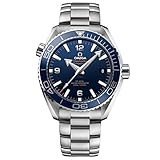
- Blue Dial with Arabic Numeral and Index Hour Markers, Minute Track, Date Window, Luminescent Hands and Hour Markers
- Stainless Steel Case and Bracelet, Case Diameter: 43.5mm
- Anti-Magnetic, Resistant to Magnetic Fields Reaching 15,000 Gauss
- Self-winding Automatic Chronometer Movement, COSC Chronometer Certified and Co-Axial Escapement
- Scratch Resistant Sapphire Crystal with Anti-reflective Treatment, Exhibition Case Back
2005: Co-Axial beginnings
The original generation established the 600M rating and used Co-Axial calibre 2500. It set the design direction that later models would reinterpret rather than abandon.
Later generations: more movements and functions
Subsequent Planet Ocean models expanded the movement range and added options such as GMT functionality. One documented 42 mm reference uses Co-Axial calibre 8507 and is rated to 600 metres, with a helium-escape valve. The specific reference’s published rating is 60 bar, equivalent to 600 metres or 2,000 feet. Omega’s product documentation for that 42 mm model gives its specifications.
Later technical developments also brought Master Chronometer certification and ceramic construction into the range. Those changes are model-specific: a Planet Ocean’s size, movement, materials, and functions depend on its reference and generation.
2023: ceramic and titanium specialization
The 2023 Dark Grey Planet Ocean illustrates the collection’s more technically specialized materials. Its 45.5 mm casebody and bezel ring use silicon-nitride ceramic, with Grade 5 titanium components. It houses Co-Axial Master Chronometer calibre 8906 with GMT functionality and is water resistant to 600 metres. Omega’s Dark Grey product sheet lists the model’s construction and specifications.
Free tools Windows power users keep installed
One-click scans. No signup required.
Rank #3

- Brand New Omega Seamaster Planet Ocean Men's Watch
- Self Winding Automatic Master Chronometer Movement
- Omega Caliber 8800
2025: fourth generation
In November 2025, Omega announced the fourth Planet Ocean generation, marking 20 years since the collection began. The launch comprised seven watches and brought revised case and bracelet architecture alongside updated technical specifications. Omega’s current collection page describes the new generation as flatter and slimmer, in 42 mm—the same diameter as the 2005 original—with Co-Axial Master Chronometer calibre 8912 and new orange-ceramic bezel technology. Omega’s current Planet Ocean collection page presents the new-generation line-up. The announcement and product details are specific to the 2025 launch; they do not establish that every earlier Planet Ocean shares these specifications.
What does 600 metres of water resistance mean?
For documented 600M models, Omega specifies 60 bar, 600 metres, or 2,000 feet. These are equivalent expressions of the rating, not three separate performance claims. A cited 42 mm calibre 8507 reference also has a helium-escape valve; that feature should not be assumed on every Planet Ocean without checking the individual model’s specifications. The reference’s product documentation identifies its rating and valve.
Rank #4

- Omega Seamaster Planet Ocean Automatic Men's Watch 215.30.44.21.01.002
Water resistance is a specification attached to a particular watch, not a guarantee that every model or used example is suitable for every underwater use. For a specific watch, check its reference, condition, and Omega’s documentation rather than relying on the Planet Ocean name alone.
Independent reader supportYour contribution helps us test, update, and keep practical guides available for everyone.How to compare Planet Ocean sizes and generations
A 42 mm case and a 45.5 mm case are meaningfully different wearing-size choices. Diameter alone does not determine fit: thickness, lug-to-lug dimensions, case shape, bracelet or strap, and your wrist all affect how a watch wears. The available specifications in the cited material do not establish thickness or lug-to-lug measurements for every model, so compare the exact reference rather than extrapolating from diameter.
Best Value

- Omega Seamaster Planet Ocean Automatic Men's Watch 215.33.44.22.01.001
| Model or generation | Case diameter | Movement and function | Materials and bezel | Water resistance |
|---|---|---|---|---|
| 2005 original | 42 mm on the current collection page’s comparison to the original | Co-Axial calibre 2500 | Not stated in the cited history source | 600 metres; original-generation rating described in Omega’s collection history |
| Documented 42 mm reference | 42 mm | Co-Axial calibre 8507 | Not stated in cited product details here | 60 bar / 600 metres / 2,000 feet; helium-escape valve |
| 2023 Dark Grey | 45.5 mm | Co-Axial Master Chronometer calibre 8906; GMT | Silicon-nitride ceramic casebody and bezel ring; Grade 5 titanium components | 600 metres |
| Fourth generation, announced 2025 | 42 mm | Co-Axial Master Chronometer calibre 8912 | New orange-ceramic bezel technology; revised case and bracelet architecture | Not stated on the cited current collection page |
Specifications above refer to the identified models or Omega’s stated generation details; they should not be treated as universal specifications for the collection. For a buying comparison, check the reference-specific sheet for thickness, bracelet or strap, bezel, exact materials, function, certification, and whether the model is current or discontinued. Ceramic and titanium versions signal a materials choice as well as a visual one, but the particular construction varies by reference.
Which Planet Ocean size should you choose?
Use diameter as a first filter, then compare the full case and band dimensions on the reference you are considering. The 2025 generation’s 42 mm size matches the original’s diameter; the 2023 Dark Grey example is 45.5 mm. Neither measurement alone establishes which watch will fit better on a given wrist. If you are comparing current and discontinued watches, weigh wearability alongside movement generation, certification, materials, bezel construction, and any GMT or chronograph function present on the specific reference.
Quick Recap
Product prices and availability are accurate as of the date/time indicated and are subject to change. Any price and availability information displayed on Amazon at the time of purchase will apply.