Recommended Free Tools
Both Neil Armstrong’s and Buzz Aldrin’s Apollo 11 Speedmasters were reference ST105.012, according to Omega Museum archival research reported by Monochrome Watches in 2014. That finding corrects the frequently repeated claim that Aldrin wore an ST145.012. Armstrong carried his watch as a backup inside the Lunar Module; Aldrin wore his on the lunar surface, making it the first watch worn on the Moon. The Speedmaster’s NASA qualification in 1965 and its Apollo 11 use established the “Moonwatch” identity.
What Speedmaster did Neil Armstrong wear?
Omega Museum research, as reported by Brice Goulard in Monochrome Watches on 25 September 2014, identifies Armstrong’s Apollo 11 watch as an Omega Speedmaster ST105.012. The same report gives Armstrong’s serial number as 24002981.
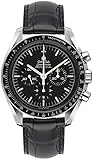
![[Omega] OMEGA Watch [2021 Omega 310.30.42.50.01.002 Speedmaster Moon Watch Professional Hand Winding See Through Back Chronograph Black 5 ATM Waterproof [Parallel Import], Black, Bracelet Type](https://m.media-amazon.com/images/I/41w4a0vIS+S._SL160_.jpg)
Monochrome says the museum reached its conclusion by working with former NASA engineer James H. Ragan and consulting original NASA documents. The reference attribution should therefore be cited as the Omega Museum’s archival conclusion reproduced by Monochrome, rather than as a number established by the NASA landing transcript itself.
What reference did Buzz Aldrin wear on the Moon?
The same Omega Museum conclusion identifies Aldrin’s Apollo 11 Speedmaster as ST105.012. The museum statement, quoted by Monochrome, says that both Armstrong’s and Aldrin’s watches were ST105.012 models and that the documents proving Aldrin’s reference had been reviewed.
What’s actually slowing this PC down?
Pick the symptom - the matching free tool is one click away.
#1 Best Overall

- First Man On The Moon Watch Model 31130423001005
- Famous Manual-winding Chronograph Movement that was Worn on the Moon
- Omega Mechanical Caliber 1861
- Black Dial, 42mm Stainless Steel Case and Stainless Steel Bracelet
- Presentation Box Includes NATO Strap, Velcro Strap and Strap Changing Tools
This is the key correction to the common story that assigns an ST145.012 to Aldrin. Swatch Group’s Apollo 11 history confirms that the crew’s Speedmasters came from the ST105.012 and ST145.012 reference families, but that account does not assign one reference to Armstrong and the other to Aldrin. On the evidence cited here, assigning ST145.012 specifically to Aldrin is not supported.
Why Aldrin’s watch was the first watch on the Moon
Armstrong was the first person to step onto the lunar surface, but his Speedmaster stayed in the Lunar Module. The electronic timing system was not functioning correctly, so he left the watch inside as a backup. Aldrin wore his Speedmaster during the moonwalk. Consequently, “the first watch worn on the Moon” refers to Aldrin’s watch, while Armstrong’s watch remained the first astronaut’s backup watch inside the spacecraft.
Rank #2

- Model 310.32.42.50.01.001
Swatch Group describes the Speedmaster as the first watch worn on the Moon in its Apollo 11 history. That wording concerns lunar-surface wear, not which astronaut took the first step.
How NASA made the Speedmaster flight-qualified
In 1964, NASA’s program office searched for a wrist-worn chronograph and tested submitted watches. Swatch Group states that NASA declared the Speedmaster “Flight Qualified for all Manned Space Missions” on March 1, 1965. Omega’s official space-exploration timeline also gives 1965 as the qualification year.
The Tool Desk
Outbyte Driver Updater FREEFix the driver behind crashes, sound loss and screen glitchesFind Drivers →Outbyte PC Repair FREERepair Windows errors before they cause bigger problemsFix Now →The qualification explains why the watch was available to the Apollo crew, but it does not by itself prove the individual reference numbers. Those specific Armstrong and Aldrin attributions come from the Omega Museum archival work reported by Monochrome.
ST105.012 and ST145.012: what the evidence actually establishes
| Question | Established answer | Evidence and limitation |
|---|---|---|
| Armstrong’s Apollo 11 reference | ST105.012 | Omega Museum archival research reported by Monochrome; Armstrong’s serial is reported as 24002981. |
| Aldrin’s Apollo 11 reference | ST105.012 | Omega Museum conclusion quoted by Monochrome after review of original NASA documentation. |
| Were both reference families present in the Apollo 11 story? | ST105.012 and ST145.012 | Swatch Group identifies both families among Apollo-era astronaut equipment, without assigning each to an individual astronaut in that account. |
| Does the NASA landing transcript list the watch references? | Not stated | The Apollo Lunar Surface Journal transcript documents landing dialogue and events, not the individual Speedmaster reference numbers. |
Why the Speedmaster is called the Moonwatch
The nickname is a historical description, not merely a modern marketing label. The Speedmaster was selected for NASA’s manned-mission requirements, received its all-manned-missions flight qualification in 1965, and was then used by Apollo astronauts. Aldrin’s ST105.012 crossed onto the lunar surface during Apollo 11, giving the model an unmatched association with the Moon landing.
Rank #4
Swatch Group’s Apollo 11 history says the live 1969 broadcast reached 600 million viewers; that figure is Swatch Group’s published historical estimate. The global visibility of the mission helped turn the NASA-qualified chronograph into the watchmaking world’s enduring “Moonwatch.”
Independent reader supportYour contribution helps us test, update, and keep practical guides available for everyone.The Apollo 11 watches versus modern Moonwatch editions
A vintage ST105.012 with documented astronaut provenance is not the same thing as a current-production Moonwatch. The Apollo watches are specific 1960s instruments whose identity depends on reference, serial, condition, originality and chain of custody. “Moonwatch” is also used for later Speedmaster models that commemorate or continue the design lineage; the name alone does not make a modern watch one of the astronauts’ actual watches.
Best Value

- Model 310.30.42.50.01.002
Swatch Group documented two 2009 Apollo 11 40th-anniversary releases: a steel edition limited to 7,969 pieces and a platinum-and-gold edition limited to 69 pieces. Those quantities describe the 2009 anniversary models and should not be confused with the number of original Apollo 11 astronaut watches.
A concise timeline
- 1964: NASA searches for and tests wrist-worn chronographs for manned missions, according to Swatch Group.
- March 1, 1965: NASA declares the Speedmaster “Flight Qualified for all Manned Space Missions,” according to Swatch Group.
- July 1969: Apollo 11 flies with Speedmasters; Armstrong keeps his as a Lunar Module backup and Aldrin wears his on the lunar surface.
- 2009: Swatch Group documents steel and platinum-and-gold Apollo 11 40th-anniversary Moonwatch editions.
- September 25, 2014: Monochrome publishes the Omega Museum archival conclusion identifying both Apollo 11 watches as ST105.012.
What collectors should verify
- Reference: An Apollo 11 claim should distinguish ST105.012 from ST145.012 and explain which source makes the attribution.
- Provenance: A normal vintage ST105.012 is not automatically Armstrong’s or Aldrin’s watch; an astronaut connection requires documentary provenance.
- Serial and condition: Armstrong’s reported serial, 24002981, is a historical identifier, while originality and service history determine how much of a vintage watch remains period-correct.
- Source wording: Swatch Group’s general Apollo account supports the presence of both reference families but does not allocate ST145.012 to Aldrin.
The accurate answer in one sentence
According to Omega Museum archival research reported by Monochrome, Armstrong and Aldrin both had ST105.012 Speedmasters; Armstrong left his inside the Lunar Module as a backup, Aldrin wore his on the Moon, and NASA’s 1965 flight qualification made the Speedmaster the chronograph that earned the Moonwatch name.
Quick Recap
Product prices and availability are accurate as of the date/time indicated and are subject to change. Any price and availability information displayed on Amazon at the time of purchase will apply.