Do these 3 things before closing this tab:
1Fix the driver behind crashes, sound loss and screen glitches2Clear out junk files and repair common Windows errors3Scan for outdated or missing drivers - takes under a minutePowermatic 80 and Powermatic 80 COSC share the same headline capability: up to 80 hours of power reserve. The COSC version earns its premium through a tighter published accuracy range and independent chronometer certification, not through extra running time. Tissot specifies Standard at -4/+10 seconds per day, Elaborated at -2/+8, and COSC at -4/+6.
What is the Powermatic 80?
Powermatic 80 is Tissot’s automatic movement family, introduced in 2013. Tissot says it evolved from the ETA 2824 architecture, runs its balance at a slower 3 Hz frequency, and uses a longer mainspring to achieve a maximum reserve of 80 hours.
The “80” is a maximum under the maker’s specification. It does not promise that every watch will run exactly 80 hours in every position, winding state, temperature, or service condition. A watch may stop sooner if it was not fully wound or if friction, magnetism, or servicing issues affect performance.
Powermatic 80 vs Powermatic 80 COSC
| Attribute | Powermatic 80 Standard or Elaborated | Powermatic 80 COSC |
|---|---|---|
| Maximum power reserve | Up to 80 hours | Up to 80 hours |
| Tissot-published daily range | Standard: -4/+10 seconds; Elaborated: -2/+8 seconds | -4/+6 seconds |
| Regulation figure | Standard: +3 seconds per day; Elaborated figure not stated in the comparison | +1 second per day |
| Certification | No COSC certification claim for the Standard grade in Tissot’s comparison | Chronometer-certified after testing by the Official Swiss Chronometer Testing Institute |
| Balance-spring example | PRX Powermatic 80 is described by Tissot with an anti-magnetic Nivachron spring | The Ballade reference T108.408.16.037.00 lists a patented silicon balance spring |
| Best reason to choose | More model, design, fit, and price choices | Documented chronometer performance and the value of independent certification |
Tissot describes reliability, reserve, and anti-magnetic performance as uncompromised across its grades; the principal published differences are precision and finishing. Exact specifications still depend on the reference.
Windows Errors? Fix Them Before They Spread
Repair common Windows errors and clear accumulated junk for a smoother, more stable PC - no reinstall needed.Free scan · no reinstallCrashes, No Sound, or Screen Glitches?
Random freezes, missing sound and display glitches usually trace back to one bad driver. Find and replace yours safely.Free scan · under a minute#1 Best Overall

- Case Size: 40.00 mm, Band Width: 12, Case Thickness: 10.93 mm
- Automatic movement, 316L stainless steel case, Index dial type, Date
- Stainless steel strap/bracelet, interchangeable quick release bracelet,butterfly clasp with push-buttons closure
- Water-resistant up to a pressure of 10 bar (100 m / 330 ft)
- 2 Year International Warranty
How does a Powermatic 80 reach 80 hours?
A slower balance
The movement oscillates at 3 Hz rather than the faster rate used by many traditional automatic calibres. A lower frequency can reduce energy consumption while preserving practical timekeeping.
A longer mainspring
Tissot says the barrel-arbor core was reduced, creating room for a longer mainspring. More stored energy, combined with the lower operating frequency, produces the stated maximum reserve.
Rank #2

- COSC Certified Chronometer
- Case Size: 39.00 mm, Band Width: 20 mm, Case Thickness: 10.98 mm
- Automatic movement, 316L solid stainless steel bracelet, Roman dial type, Date
- Water-resistant up to a pressure of 10 bar (100 m / 330 ft): suitable for short periods of recreational swimming and showering, but no diving or snorkeling.
ETA 2824 development
Powermatic 80 is not an unrelated design: Tissot presents it as an evolution of the ETA 2824 architecture. The family has been adapted into different grades and model-specific configurations, so the movement name alone does not identify every component.
What does COSC add?
COSC is the French acronym commonly used for the Official Swiss Chronometer Testing Institute. Tissot says the institute tests movements for 15 days, checking accuracy, anti-magnetism, and resistance to impact.
Rank #3

- These timepieces are perfect for those in search of a sporty yet assertive accessory, offering water resistance up to 1000 feet (300 meters) and improved visibility in dim conditions thanks to the Super-LumiNova coated hands and hour markers.
In Tissot’s comparison, a COSC movement is regulated at +1 second per day and specified at -4/+6 seconds per day. That is a narrower documented range than Standard’s -4/+10 and Elaborated’s -2/+8. COSC therefore adds traceable testing and a chronometer designation; it does not add power reserve.
The range applies to the tested movement specification, not a guarantee that every owner will see identical results on the wrist. Position, how fully the watch is wound, exposure to magnetic fields, temperature, impact, and service condition can all influence a particular watch’s rate.
Rank #4
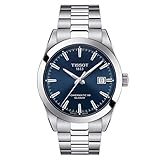
- Case size: 40 millimeters; Bandwidth: 21 millimeters; Case thickness: 11.5 millimeters. The diameter is 25.6 millimeters; Lugs 21; Dial: HMSD
- Swiss automatic movement, 316L stainless steel case, scratch-resistant sapphire crystal, Indexes dial type, date
- Stainless steel bracelet, butterfly clasp with push-button
- Water-resistant up to a pressure of 10 bar (100 meter/330 feet): Suitable for short periods of recreational swimming and showering, but not diving or snorkeling
Is Powermatic 80 COSC more accurate in real life?
It has the stronger documented accuracy target, but certification is not the same as a promise of one fixed daily result. A COSC watch can gain or lose time within its certified range, and a well-regulated non-COSC watch may perform very well. The meaningful difference is that the COSC grade has passed an independent, defined testing process and carries the tighter published tolerance.
Tissot’s technical description summarizes the grades this way: the Standard version is regulated at +3 seconds and specified at -4 to +10 seconds per day, while the COSC version is regulated at +1 second and specified at -4 to +6 seconds per day.
Best Value

- Case Size: 40.00 mm, Band Width: 12, Case Thickness: 10.93 mm
- Automatic movement, 316L stainless steel case, Index dial type, Date
- Stainless steel strap/bracelet, interchangeable quick release bracelet,butterfly clasp with push-buttons closure
- Water-resistant up to a pressure of 10 bar (100 m / 330 ft): suitable for short periods of recreational swimming and showering, but no diving or snorkeling.
- 2 Year International Warranty
Spring materials vary by reference
Do not assume that every Powermatic 80 uses the same balance-spring material. Tissot describes the PRX Powermatic 80 family with an anti-magnetic Nivachron balance spring. By contrast, the Ballade Powermatic 80 COSC reference T108.408.16.037.00 lists a patented silicon balance spring.
Those are reference-specific examples, not a universal Standard-versus-COSC rule. Check the technical sheet for the exact watch you are considering.
Named examples
Tissot Ballade Powermatic 80 COSC (T108.408.16.037.00)
- 41 mm 316L stainless-steel case
- Sapphire crystal
- See-through caseback
- Up to 80 hours of power reserve
- Patented silicon balance spring
- COSC certification
Tissot PRX Powermatic 80
Tissot’s press material describes the PRX Powermatic 80 family as having an 80-hour reserve and an anti-magnetic Nivachron balance spring. Dimensions, water resistance, bracelet, dial, and other details vary by reference, so verify the individual model number before buying.
Which one should you choose?
Choose Standard or Elaborated when priorities are practical
- You care most about case shape, wrist fit, dial, bracelet, or overall design.
- You want the widest choice of models and price points.
- A published -4/+10 or -2/+8 range is sufficient for your use.
- You value the 80-hour reserve but do not need a chronometer certificate.
Choose COSC when the certification matters
- You specifically want the tighter published -4/+6-second daily range.
- Independent 15-day chronometer testing is important to you.
- You prefer a model whose finishing or specified spring material justifies the additional cost.
- You enjoy owning a watch with a documented chronometer designation rather than relying only on ordinary regulation.
Compare the complete reference, not just the movement label
The Powermatic 80 name does not determine case diameter, water resistance, crystal, bracelet, dial, finishing, or spring material. Compare the exact reference numbers and technical sheets before treating two watches as equivalent.
Free tools Windows power users keep installed
One-click scans. No signup required.
How accurate is a Tissot Powermatic 80?
Use Tissot’s grade figures as the appropriate benchmark: Standard is -4/+10 seconds per day, Elaborated is -2/+8, and COSC is -4/+6. These are specification ranges, not promises that a watch will remain at the same rate throughout its service life. If a watch suddenly runs far outside its expected behavior, check for magnetism, impact, insufficient winding, or a service need before judging the movement grade.
Quick Recap
Product prices and availability are accurate as of the date/time indicated and are subject to change. Any price and availability information displayed on Amazon at the time of purchase will apply.