Grand Seiko’s modern mechanical watches belong to the 9S family, a line revived in 1998 and developed from conventional automatic and hand-wound calibers into high-beat GMTs, chronographs and the current 9SA architecture. The key differences between movements are winding method, beat rate, reserve, complications, construction and the accuracy standard used to test them—not simply the number engraved on the bridge.
The 9S family is Grand Seiko’s modern mechanical lineage
Grand Seiko returned to modern mechanical production in 1998 with the 9S5. Seiko Museum history describes a new hairspring and mainspring, a MEMS-based escapement, 10-beat technology and a three-day self-winding concept. That launch established the technical direction for the mechanical Grand Seiko watches that followed.


The official 9S overview lists automatic, manual-winding, GMT, small-seconds, chronograph and high-beat variants, including calibers 9SA4, 9SC5, 9SA5, 9S86, 9S85, 9S68, 9S66, 9S65, 9S64, 9S63 and 9S27. A caliber number therefore identifies a design family and function; it does not, by itself, tell you the winding system, reserve or complications.
How the mechanical generations developed
1998: the 9S5 revival
The first modern 9S caliber combined a newly developed regulating system with MEMS-manufactured escapement components. Grand Seiko states that this original 9S had a power reserve of around 50 hours. Its importance was not just the reserve figure: it re-established a contemporary mechanical platform for Grand Seiko after the brand’s earlier mechanical production had ended.
The Tool Desk
Outbyte Driver Updater FREEScan for outdated or missing drivers - takes under a minuteDriver Scan →Outbyte PC Repair FREERepair Windows errors before they cause bigger problemsFix Now →2009: 9S85 brings back Hi-Beat 36000
The 9S85 restored a modern high-beat platform at 36,000 vibrations per hour (vph), or 5 Hz. Grand Seiko says a new SPRON alloy helped the movement deliver approximately 55 hours of running time despite the higher torque required by the faster balance. The 9S85 is an automatic high-beat caliber; the closely related 9S86 adds a GMT function.
2014: the 9S86 Hi-Beat GMT
Seiko Museum history identifies the 9S86 as the Hi-Beat 36000 GMT caliber. It keeps the 5 Hz regulating frequency while adding an independently useful second time zone, making it mechanically more complex than a time-and-date 9S85.
The 9SA generation
The 9SA5 extends the high-beat idea with a new architecture rather than simply increasing the frequency of an older design. Its Dual Impulse Escapement, slimmer construction and redesigned energy transmission allow approximately 80 hours of reserve. Grand Seiko describes that reserve as “exceptional for a high beat movement.”
What is inside a Grand Seiko mechanical watch?
The answer depends on the reference printed on the watch or movement. The following comparison shows the principal choices represented in the modern family.
Do these 3 things before closing this tab:
1Repair Windows errors before they cause bigger problems2Scan for outdated or missing drivers - takes under a minute3Clear out junk files and repair common Windows errors| Caliber or group | Winding and frequency | Functions | Power reserve or jewel count | What distinguishes it |
|---|---|---|---|---|
| 9S65/9S68-style standard automatic | Automatic; lower-frequency 9S operation than the Hi-Beat calibers | Time and date configurations, depending on the reference | Exact current specification varies by caliber | Everyday automatic architecture within the broad 9S family |
| 9S85 | Automatic; 36,000 vph (5 Hz) | Time and date | Approximately 55 hours | Modern Hi-Beat 36000 platform introduced in 2009 |
| 9S86 | Automatic; 36,000 vph (5 Hz) | GMT and date functions | Approximately 55 hours class | High-beat GMT identified by Seiko Museum history |
| 9SA5 | Automatic and manual winding; 36,000 vph (5 Hz) | Time and date; hacking seconds | Approximately 80 hours; 47 jewels | Dual Impulse Escapement and slimmer, redesigned architecture |
| 9SA4 | Manual winding; Hi-Beat 36000 architecture | Time with a power-reserve indicator | Exact current specification depends on the reference | Hand-wound member of the 9SA generation |
| 9SC5 Tentagraph | Automatic; high-beat chronograph | Chronograph | Approximately 72 hours; 60 jewels in Grand Seiko’s official comparison table | Combines the high-beat concept with a column of chronograph functions |
| 9S64 | Manual winding | Time-focused configuration | Exact current specification depends on the reference | Hand-wound 9S option for a thinner, more direct interaction |
| 9S63, 9S66 and 9S27 | Different 9S winding and size configurations | Small-seconds, GMT or compact-watch functions, depending on caliber | Check the individual official caliber specification | Shows how broadly the 9S family is used beyond a standard three-hand automatic |
Grand Seiko’s lineup changes over time and the same caliber can appear in more than one case reference. For a purchase or service decision, use the exact caliber designation rather than assuming that every 9S movement has the same reserve or accuracy range.
Rank #2
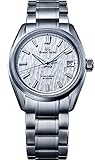
- See-through case back
- Date display
- Screw-down crown
- 40mm Diameter
- Weight 178.0 g
What does Hi-Beat 36000 mean?
“Hi-Beat 36000” means that the balance completes 36,000 vibrations per hour: 10 vibrations per second, or 5 Hz. A faster oscillator gives the movement more timing events over a given period and can improve rate stability, but it also raises energy consumption and makes the escapement, lubrication and balance design more demanding.
That trade-off explains the progression from roughly 50 hours in the original 1998 9S to about 55 hours in the 2009 9S85, and then to approximately 80 hours in the 9SA5. The 9SA5’s longer reserve comes from its redesigned energy path and escapement, not from high beat rate alone.
9S85 versus 9SA5: the practical difference
| Axis | 9S85 | 9SA5 |
|---|---|---|
| Frequency | 36,000 vph (5 Hz) | 36,000 vph (5 Hz) |
| Winding | Automatic | Automatic with manual winding |
| Reserve | Approximately 55 hours | Approximately 80 hours |
| Escapement and architecture | Earlier modern Hi-Beat design using the 9S85 platform | Dual Impulse Escapement and slimmer, newly organized architecture |
| Functions | Time and date | Time and date with hacking seconds |
| Stated accuracy figures | Covered by the 9S85 Grand Seiko Standard target of -1 to +8 seconds per day | Mean daily rate of -3 to +5 seconds per day; normal-usage specification of -1 to +8 seconds per day |
Both are 5 Hz movements, so the meaningful upgrade is not beat rate. The 9SA5 is a new high-beat architecture that transfers energy more efficiently, runs for roughly a day longer when fully wound and fits a slimmer construction.
How Grand Seiko measures mechanical accuracy
Grand Seiko does not reduce mechanical accuracy to a single guaranteed number for every owner. 9S movements are tested in six positions and at three temperatures under the company’s Grand Seiko Standard before they are approved. Position and temperature testing matters because gravity, friction and thermal changes affect a mechanical oscillator differently from one orientation or environment to another.
Mean daily rate
For the 9SA5, Grand Seiko states a mean daily rate of -3 to +5 seconds per day. This is a controlled, pre-casing measurement taken under the manufacturer’s test conditions; it is not a promise that a cased watch will gain or lose exactly that amount on a wrist.
Rank #3

- Stainless steel case 47mm diameter x 14.44mm thick; Exhibition case back; Blue dial; Luminous hands and hour markers
- NH35A Japanese Automatic movement, 24 jewel; Assembled in Malaysia; Watch weight: 310 grams
- Stainless steel band, 215mm L x 22mm W; Band is adjustable by adding/removing links; Fold over safety clasp
- Mineral crystal; Screw-down crown; Unidirectional stainless steel bezel with blue top bezel ring; 300 meter water resistant: Suitable for professional marine activity and surface water sports. Suitable for diving.
Normal-usage accuracy
The same 9SA5 documentation gives a normal-usage range of -1 to +8 seconds per day. This broader figure is intended to describe use outside the tightly controlled mean-rate test.
Grand Seiko Standard targets by caliber
| Caliber group | Published target | How to read it |
|---|---|---|
| Most listed 9S calibers | -1 to +10 seconds per day | Manufacturer target under the Grand Seiko Standard’s defined test conditions |
| 9S85 and 9S86 | -1 to +8 seconds per day | Tighter published target for these Hi-Beat calibers |
| 9S25 | -5 to +10 seconds per day | Caliber-specific target; it should not be generalized to the rest of the family |
These are specifications, not a guarantee of every owner’s daily result. Wearing position, winding state, temperature, shocks and elapsed service time can all change observed performance. A watch that is outside its stated range should be assessed against the exact caliber’s documentation and condition rather than judged by a generic “Grand Seiko accuracy” figure.
What’s actually slowing this PC down?
Pick the symptom - the matching free tool is one click away.
What the 9S construction contributes
MEMS-manufactured precision parts
Grand Seiko says MEMS technology fabricates critical 9S precision parts to tolerances of one millionth of a millimeter. The process is used for components such as escapement parts, where consistent geometry and low mass support stable energy transfer.
Hand-finished friction surfaces
Grand Seiko also says craftspeople polish pinions individually. Smooth pinion surfaces reduce friction and are intended to help component longevity. This is a functional finishing step, not merely decoration visible through a display back.
Newer balance and escapement details
Newer 9S-generation designs use features such as a free-sprung balance and carefully optimized escapement components. In the 9SA5, the Dual Impulse Escapement is the central change: Grand Seiko credits it with improving the efficiency of transferring mainspring energy to the balance while retaining the 5 Hz rate.
Rank #4
A practical framework for comparing any Grand Seiko mechanical caliber
When two references look similar, compare them in this order:
The Tool Desk
Outbyte Driver Updater FREEFix the driver behind crashes, sound loss and screen glitchesFind Drivers →Outbyte PC Repair FREEClear out junk files and repair common Windows errorsFree Scan →- Winding: determine whether a rotor, hand winding or both wind the mainspring. The 9SA5 permits both; the 9S64 and 9SA4 are hand-wound examples.
- Frequency: note the vph figure. 36,000 vph means 5 Hz and identifies a Hi-Beat movement; a lower-frequency 9S caliber is not automatically inferior, but it makes a different reserve and energy trade-off.
- Power reserve: compare the fully wound running time under the stated specification. The historical reference points are about 50 hours for the first 9S, about 55 hours for 9S85 and approximately 80 hours for 9SA5.
- Complications: identify whether the movement adds a date, GMT hand, small seconds, chronograph or power-reserve display. Each adds useful information but also mechanical complexity.
- Regulation and accuracy: read the caliber-specific Grand Seiko Standard range and distinguish it from mean daily rate or normal-usage figures.
- Construction and finishing: look for the escapement architecture, balance design, MEMS components and hand finishing. These details explain how the movement delivers its stated performance and what you can see through the case back.
Which mechanical 9S type suits which use?
For a straightforward daily automatic
A 9S65- or 9S68-style automatic is the sensible starting point when the priority is conventional time-and-date use within the 9S family. Confirm the exact reference’s current reserve, dimensions and accuracy specification before choosing between models.
For high-beat timing and a GMT
Choose the 9S85 when the appeal is the 5 Hz Hi-Beat behavior without an additional time zone. Choose the 9S86 when a second time zone is part of the job; its GMT mechanism is the defining functional difference.
For maximum reserve in the current high-beat design
The 9SA5 is the flagship automatic/manual-winding example: 5 Hz operation, approximately 80 hours, date, hacking seconds, 47 jewels and the Dual Impulse Escapement. It is the appropriate comparison point when reserve and the newest architecture matter more than a simpler movement layout.
For hand-winding interaction
The 9SA4 provides a manual-winding 9SA option with a power-reserve indicator, while the 9S64 represents a more traditional hand-wound route in the broader family.
For a mechanical chronograph
The 9SC5 Tentagraph adds chronograph operation to a high-beat automatic platform. Grand Seiko’s official comparison table gives it approximately 72 hours of reserve and 60 jewels.
Bottom line
Grand Seiko mechanical watches are best understood as an evolving 9S system. The 1998 9S5 established the modern platform, the 9S85 and 9S86 made 36,000 vph practical in automatic and GMT forms, and the 9SA5 redesigned the high-beat movement around efficiency, a slimmer profile and approximately 80 hours of reserve. To compare calibers intelligently, start with winding and frequency, then check reserve, complications, the exact Grand Seiko accuracy specification and the construction choices that make the figures possible.
Quick Recap
Product prices and availability are accurate as of the date/time indicated and are subject to change. Any price and availability information displayed on Amazon at the time of purchase will apply.