Recommended Free Tools
Read a timegrapher as a set of related measurements, not a single pass/fail score. Rate tells you how many seconds per day the watch gains or loses, beat error shows tick–tock asymmetry, and amplitude estimates the balance’s swing. Beat rate and lift angle must be set for the movement before amplitude can be trusted. Check a stable trace in several positions and compare the pattern with specifications for that caliber.
What a timegrapher actually measures
A timegrapher listens to the escapement’s ticking signal and converts it into timing data. Professional instruments can display rate deviation, beat error, amplitude, beat rate, lift angle and a trace or diagram. Witschi lists rate variation, beat error, amplitude and actual lift angle as numerical outputs for its WisioScope, while its Chronoscope CT lists rate accuracy, amplitude and beat error.
The display is a measurement of timing behavior under the test conditions. It is not, by itself, proof of water resistance, lubricant condition, magnetization, amplitude under every load state or the need for a complete overhaul.
How to read every field
| Field | Unit | What it means | How to interpret it |
|---|---|---|---|
| Rate | s/d | Running error in seconds per day | Positive values mean the watch gains time; negative values mean it loses time. Judge repeated readings and positions, not one snapshot. |
| Beat error | ms | Difference between the tick and tock intervals | It represents asymmetry in the balance’s oscillation. A high value can indicate the balance is not centered in beat, but read it with the trace, position and movement design. |
| Amplitude | ° | Angle from the balance’s equilibrium position to its turning point | It is calculated from the escapement signal and depends on the correct lift-angle setting. A wrong lift angle produces a wrong amplitude result. |
| Beat rate | vib/h or V/H (bph) | Oscillation frequency of the movement | Enter or confirm the caliber’s value. The correct rate is movement-specific. |
| Lift angle | ° | A movement parameter used in the amplitude calculation | Use the caliber’s documented value or the instrument’s database entry. 50° or 52° is not universally correct. |
| Trace | diagram | Visual representation of the detected tick and tock pattern | A clean, repeating trace supports confidence in the signal. Scatter or drift can indicate coupling, noise, an unstable beat or a mechanical problem. |
Rate: seconds per day
Rate deviation is the oscillator’s frequency deviation expressed in seconds per day. A reading of +6 s/d means the watch is gaining about six seconds per day under that test condition; −6 s/d means it is losing about six seconds per day. The value is a snapshot, so record it in multiple positions and after stabilization.
Outdated Drivers Are Slowing You Down
One free scan finds every outdated or missing driver and matches the right update for your exact hardware.Free scan · exact hardware matchPC Slower Than It Used to Be?
A free scan shows the junk files, broken settings and background clutter dragging Windows down - then fixes them in one click.Free scan · Windows 10 & 11#1 Best Overall

- Ultra-Precision: The No.1000 timegrapher delivers industry-leading ±0.1s/d accuracy (50-sample avg.) for advanced movements and ±999s/d range for antique/faulty watches. Instantly diagnose timing issues with this professional watch timegrapher. NOTE: Our mechanical watch timegrapher No. 1000 is only suitable for mechanical movement watches and does not support quartz movement watches!
- Smart Frequency Analysis & Multi-Parameter Display: Auto-detects standard beats (manual mode for special frequencies) with 2-60s sampling cycles. Test 6 positions (pocket watches to tourbillons). Color LCD shows real-time rate, amplitude, beat error, lift angle, and timing curves – essential timegrapher intelligence.
- Comprehensive Performance Metrics: The timegrapher features either a microphone or sensor that detects the ticking sounds or vibrations produced by the escapement. Measures critical parameters: amplitude (100°-360°), beat error (0.0-9.9ms), and adjustable lift angle (30°-70°). Live graphs enable swift diagnostics for watch timegrapher professionals.
- Professional Calibration Essential: The definitive tool for watchmakers, manufacturers, and technicians. Perfectly complements watch demagnetizer professional setups for complete movement servicing. Indispensable bench equipment for precision calibration.
- 12-Month Satisfaction Guarantee: All SWANSOFT 1000 timegrapher units include 12-month support. Contact us 24/7 – your satisfaction drives our professional commitment.
Beat error: milliseconds
Beat error measures the asymmetry between the intervals from tick to tock and tock to tick. It is shown in milliseconds. Because the figure can vary with position and movement design, do not diagnose a fault from the number alone: inspect whether the trace is stable and repeat the test.
Amplitude: degrees
Amplitude is the balance’s angular swing, estimated from the escapement signal. The calculation requires lift angle. Witschi’s WisioScope documentation illustrates the instrument-dependent nature of this value: it specifies a 70°–360° amplitude measuring range and ±1.0° stated instrument accuracy. That range and accuracy describe the instrument, not a universal health grade for every movement.
Beat rate: vibrations per hour
Beat rate is commonly entered as vibrations per hour. Timegrapher X lists common supported rates of 18,000, 19,800, 21,600, 25,200, 28,800 and 36,000 V/H. Select the value for the actual caliber. If automatic detection is unreliable because the signal is noisy or unusual, enter it manually.
Rank #2
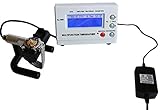
- Timegrapher NO.1000
- coaxial test
- for almost all mechanical watch
- Multi-purpose timegrapher, popular with the professional watchmakers as well as the watch collection
Lift angle: the setting that controls amplitude
Lift angle is a movement parameter, not a universal default. Witschi instruments allow manual input or database selection, with a 10°–90° range documented for WisioScope. Timegrapher.io describes 52° as only a default. If your movement’s specified lift angle is 50°, 52° or another value, use that exact value; otherwise the displayed amplitude is not dependable.
A repeatable way to take a reading
- Identify the movement. Find the caliber or manufacturer specification for beat rate and lift angle.
- Set the parameters. Enter or confirm beat rate and lift angle before judging amplitude. Manually select an unusual beat rate when automatic detection is uncertain.
- Couple the watch consistently. Seat the case firmly against the sensor and reduce background noise. Phone or microphone apps are especially vulnerable to weak or noisy signals.
- Allow stabilization. Wait until the trace and numbers settle instead of recording the first display value.
- Test several positions. Record rate, beat error, amplitude and trace in each position. One documented WAIO program uses CH, CB, 6H and 12H positions, with 20 seconds of stabilization and 40 seconds of measurement per position. That is an example program, not a universal timing rule.
- Compare the pattern. Look for consistent behavior across positions and over time, then compare it with the movement maker’s specification or a watchmaker’s documented tolerance.
How to interpret the trace
A clean, repeating line means the instrument is hearing a consistent escapement signal. A scattered, doubled or continually changing line can result from poor microphone coupling, background noise, an unstable beat or a mechanical issue. Automatic estimates can fail when the beat noise is unusual; software such as Timegrapher X provides a manual cursor measurement for such cases.
Escapement type matters. Witschi lists support for Swiss lever, coaxial and AP escapements on WisioScope. A phone guide’s experimental amplitude mode does not support coaxial or other special escapements, so an apparently missing or implausible value may be a compatibility limitation rather than a sudden movement failure.
Rank #3

- Model of this Watch timing machine:NO.1000;110V-220V US plug;
- Easy to use for mechanical watch collection. This watch tester automatically calculates rate, amplitude, and beat error using readings from the microphone stand.
- LCD screen displayed.According to different watches, the instrument will automatically adjust optimal signal level during testing. - The LCD screen shows the readings in real time with 2 dotted lines moving across the screen to provide a visual representation of the “tic tock” from your watch
- 6 kinds of testing position can be adjusted. Amplitude level is between 275 and 315; Rate Deviation Range: ±999 s/d with precision ± 1 s/d'
- The sampling period can selected by 2 , 4 , 6 , 8 , 10, 20, 30 , 60 seconds, and the average of corresponding period will be regard as the precise value of the watch.
What is a good timegrapher reading?
There is no single pass/fail number for every mechanical watch. Movement design, position, winding state, temperature, service history and instrument settings all affect the display. Use the caliber’s specification and repeated measurements rather than applying a generic internet threshold.
For context, a documented WAIO standard program lists rate tolerance of −10 to +15 s/d, beat-error tolerance of 0.8 ms and amplitude of 200°–330°. Those are tolerances for that program, not a blanket rule for every caliber or every test position.
What’s actually slowing this PC down?
Pick the symptom - the matching free tool is one click away.
Why amplitude can be blank or wrong
- Incorrect lift angle: amplitude is calculated with this setting, so a wrong value makes the result wrong.
- Weak or noisy signal: poor coupling, background sound or a phone microphone can prevent a reliable estimate.
- Wrong beat rate: the instrument may misread the escapement if the rate is unusual or incorrectly selected.
- Unsupported escapement: coaxial, AP and other special designs require compatible detection and calculation.
- Unstable movement behavior: an irregular trace can reflect a mechanical problem rather than a display error.
Correct the movement-specific settings, reseat the watch, reduce noise and repeat the measurement. If the trace remains abnormal in several positions, have a qualified watchmaker assess it.
Choosing equipment for timegrapher readings
| Consideration | Professional bench instrument | Phone or microphone tool |
|---|---|---|
| Signal quality | Dedicated sensor and controlled coupling generally provide a more consistent signal. | Depends heavily on microphone, case contact and background noise. |
| Escapement support | Witschi documents Swiss lever, coaxial and AP support for WisioScope. | Compatibility can be limited; one phone guide excludes coaxial and other special escapements from its experimental amplitude mode. |
| Parameter entry | May offer automatic detection plus manual beat-rate and lift-angle entry. | Manual correction may be needed when detection is uncertain. |
| Positions | WisioScope documentation lists 12 recognized test positions. | Position testing depends on the app, fixture and operator. |
| Trace and repeatability | Designed for repeatable readings and trace display. | Useful for basic checks but more vulnerable to noise and coupling changes. |
| Best use | Regular diagnosis, servicing and documented multi-position testing. | Convenient screening when its signal and escapement limitations are understood. |
Limits of a timegrapher diagnosis
A timegrapher diagnoses timing behavior under a defined test setup. It cannot by itself establish water resistance, lubricant condition, magnetization, performance at every mainspring state or whether a complete overhaul is required. Use repeated, correctly configured measurements and escalate persistent abnormal patterns to a qualified watchmaker.
Quick Recap
Product prices and availability are accurate as of the date/time indicated and are subject to change. Any price and availability information displayed on Amazon at the time of purchase will apply.