Japanese fan jackets turn ordinary workwear into a wearable ventilation system. Two battery-powered fans near the waist draw ambient air inside a loose shell, inflate it slightly, and push air across the torso before it escapes at the collar and sleeves. That airflow helps sweat evaporate, but most models do not refrigerate the incoming air. They are best understood as powered ventilation—not miniature air conditioners.
What Japanese fan jackets are
The Japanese term kūchō-fuku (空調服) literally means “air-conditioning clothes.” Retailers also use fan wear or fan-equipped clothing. In practice, the category includes a washable garment shell, two compatible fans, a proprietary battery, a cable and charger. Fans are often removable rather than permanently built into the jacket, so a low shell price may not be a usable outfit price.
The technology began in construction and other outdoor work, then spread to logistics, security, agriculture, gardening, commuting and leisure. Japan’s contribution is less the invention of moving air through clothing than the large-scale commercialization of a practical, battery-powered ventilation system through its workwear ecosystem. Japanese government guidance describes waist-mounted fans drawing air into clothing to promote evaporative cooling (Japanese government explanation).
How the cooling airflow works
- Fans mounted low on the back or sides pull outside air through ports.
- The loose shell balloons away from the body, creating an air channel.
- Air travels upward over the torso and base layer.
- Moving air helps moisture evaporate from the skin.
- Warm, humid air leaves through the collar, sleeves and other openings.
The sensation has two parts: moving air feels cooler, and evaporation removes heat from the skin. Wear a thin, close-fitting, moisture-managing base layer beneath a loose shell. Workman advises keeping fan inlets clear of bags or outer clothing and says opening the front zipper slightly can improve circulation (Workman product guidance).
The Tool Desk
Outbyte PC Repair FREEClear out junk files and repair common Windows errorsFree Scan →Outbyte Driver Updater FREEScan for outdated or missing drivers - takes under a minuteDriver Scan →#1 Best Overall
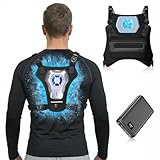
- [TARGETED CORE COOLING] Unlike traditional bulky fans, this wearable thermoelectric cooler focuses on your core temperature. The cooling plate delivers precision temperature drops to your back, providing efficient heat relief without the false promise of whole-body air conditioning.
- [HANDS-FREE OUTDOOR MOBILITY] Designed for active outdoor workers and hikers. The integrated chest pack securely holds your phone, keys, and wallet, allowing you to move freely and stay focused on your tasks while enjoying continuous thermal regulation under the sun.
- [ADVANCED SEMICONDUCTOR MODULE] Powered by professional-grade semiconductor technology, this vest actively pulls heat away from your body. It operates quietly and efficiently, ensuring you stay comfortable during prolonged outdoor shifts or intense gardening sessions.
- [ADJUSTABLE ERGONOMIC FIT] Engineered for both men and women, the fully adjustable strap system fits chest sizes from S to XXL. For optimal thermal transfer, we highly recommend wearing this cooling gear directly over a thin, moisture-wicking base layer.
- [INTUITIVE CONTROLS AND SUPPORT] Features reinforced, durable control buttons for seamless mode switching. Our professional support team is ready to help you with any operational issues.
A fan garment is not equivalent to a refrigerated garment. Peltier clothing adds thermoelectric plates that create a cold contact surface; ice or phase-change vests store cooling in removable packs. Hybrid designs combine direct cooling with fans.
Why the technology became common
Japan combines long, humid summers with extensive outdoor construction, infrastructure and delivery work. Heat-stress concerns, a mature workwear and tool-retail market, increasingly affordable batteries and neutral-looking vests made the equipment easier to adopt beyond industrial crews. Retail campaigns now target women, children and general summer users as well as traditional workwear customers; that is retailer positioning, not proof that every resident wears one (Japanese government summer-clothing overview).
Who benefits most
- Construction, road, utility and civil-engineering crews.
- Warehouse, delivery, security and event staff.
- Agricultural, landscaping, gardening and DIY workers.
- People working for long periods in unconditioned buildings.
- Cyclists, commuters and travelers who will remain outdoors rather than make a brief trip between air-conditioned spaces.
The strongest use case is sustained activity that produces sweat. A short walk may not justify the battery, noise and extra clothing.
Do fan jackets actually work?
Yes, conditionally. They can improve thermal comfort and reduce some measures of heat strain, but they are not a universal heat shield and should not be advertised as preventing heatstroke.
Free tools Windows power users keep installed
One-click scans. No signup required.
A 2025 controlled study comparing a fan-cooling jacket with a thermoelectric neck cooler in hot, humid conditions reported better thermal perception with the fan jacket and reductions in skin temperature, sweat volume and the rise in axillary temperature (2025 controlled study). A 2026 study found that a personal cooling garment produced larger reductions in tympanic-temperature rise, heart-rate rise and sweat loss than a ventilation-only garment using the same fan layout (2026 comparative study). Those results apply to the tested garments, workloads, layers, humidity and exposure periods—not automatically to every retail jacket.
Manufacturer demonstrations and surveys are weaker evidence. A Showa Shokai–Toda Construction field evaluation of a hybrid Peltier-and-fan garment reported about 65% of surveyed workers describing it as “cool” or “somewhat cool”; it was a manufacturer-reported evaluation rather than an independent clinical trial (company announcement).
Rank #2

- 【COOLING PLATE SYSTEM】 Upgrade your heat management. Unlike standard vests, our wearable fan jacket with an advanced cooling plate. This technology draws out body heat and delivers a rapid temperature drop up to 30°C, keeping your core refreshed during intense outdoor tasks.
- 【30000mAh LARGE BATTERY PACK】 Banish battery anxiety for good. This cooling vest comes comes with 30000mAh large-capacity power banks. Enjoy continuous, uninterrupted airflow from dawn to dusk, eliminating the need for frequent recharges during long shifts on the construction site or in the warehouse.below the maximum ambient temperature.
- 【CUSTOMIZABLE AIRFLOW & FIT】 Tailor your comfort with adjustable strength and weakness modes. The vest features a flexible, unisex design with adjustable shoulder straps to ensure a snug fit for various body types. Made with safe, breathable materials, it maintains excellent ventilation without compromising durability.
- 【BUILT FOR EXTREME ENVIRONMENTS】 Engineered for professionals facing severe heat. Whether you are working in hot kitchens, managing gardening work, performing in mascots/cosplay, or enjoying summer golfing and cycling, this portable air conditioner vest provides targeted relief.
- 【EASY MAINTENANCE & COMPLETE KIT】 Designed for daily heavy-duty use. Simply remove the cooling units before washing. Your package includes 1x Vest, 1x 30000mAh Power Banks, Adjustment Cords, and 1x User Manual.
Where ventilation works—and where it falters
Favorable conditions
- Dry or moderately humid air, where sweat can evaporate.
- Outdoor or well-ventilated surroundings.
- Active work that generates sweat.
- Unblocked fan ports and a breathable base layer.
- A collar or other opening that lets humid air escape.
Important limitations
- High humidity: Airflow remains noticeable, but evaporation becomes weaker as the air approaches saturation.
- Extreme heat: Fans may move air hotter than the skin; the result depends on humidity, radiation, clothing and workload.
- Radiant heat: Sun, furnaces, hot machinery and asphalt can overwhelm ventilation. Direct or reflective cooling may be more suitable.
- Rain: Water precautions are required, while a rain shell can block the air channel unless designed for fan wear.
- Backpacks, harnesses and seats: They can cover inlets or crush the inflated channel. Workman’s high-back model is marketed for harness and seating clearance, but compatibility is specific to that design (model details).
- Enclosed or contaminated spaces: The garment draws ambient air; it is not respiratory protection and can pull in dust or chemicals.
- Dehydration or impaired sweating: Feeling cooler does not remove medical risk.
Fan, Peltier, ice and conventional options
| System | How it cools | Best fit | Main trade-off |
|---|---|---|---|
| Fan jacket | Ambient airflow plus sweat evaporation | Sweaty, sustained outdoor or semi-outdoor work | Humidity-dependent; ports can be obstructed; audible at high speed |
| Peltier vest | Thermoelectric cold plates at the neck, back or torso | Localized cooling, including relatively sedentary work or humid conditions | Higher cost and battery demand; localized rather than whole-body cooling |
| Ice or phase-change vest | Frozen or phase-change packs absorb heat | Short shifts where packs can be refrozen or swapped | Finite duration, bulk and possible condensation |
| Reflective clothing, breaks and shade | Reduces solar load or heat exposure | Any setting, especially where powered garments conflict with PPE | Does not provide continuous torso airflow |
Workman’s 2026 campaign demonstrated five-plate Peltier clothing in a simulated environment above 45°C. That is a product demonstration, not evidence that strenuous work at 45°C is safe (Workman demonstration). Workman lists a WindCore Ice × Heater Peltier vest at ¥29,800 and a Pro 3 vest at ¥19,800; the former listing is store-pickup-only and non-returnable (Peltier listings).
What a complete system costs
Japanese Workman prices observed in 2026 illustrate the modular model. They are Japanese retail prices, not export prices; shipping, tax, exchange rates, warranty and availability vary.
Recommended Free Tools
| Item | Observed price | Notes |
|---|---|---|
| Air Sensor-1 long-sleeve shell | ¥4,500 | Garment only |
| Burtle high-back short-sleeve shell | ¥6,500 | Fans and battery separate; harness-oriented design |
| WindCore entry-set vest | ¥9,800 | Check included components |
| Air Sensor 20V fan-and-battery set | ¥16,800 | About 319 g battery; listed runtimes vary by voltage |
| WindCore 30V fan-and-battery set | ¥20,800 | About 378 g; approximately 11.9 hours at 16V to 2.4 hours at 30V |
| Air Craft 30V battery set | ¥16,800 | Battery ecosystem component |
| Air Craft 30V fan set | ¥7,500 | Fan component |
Component catalogs also list fan sets around ¥3,973–¥7,500, batteries around ¥10,800–¥16,800, cables near ¥980 and chargers near ¥2,300 (Workman component catalog). A ¥4,500 shell can therefore become a ¥20,000-plus purchase.
Runtime, compatibility and fit checks
- Confirm whether the listing includes two fans, battery, cable and charger.
- Match the connector, voltage range, battery generation and fan-hole diameter.
- Treat runtime as setting-specific: the WindCore figures range from 11.9 hours at 16V to 2.4 hours at 30V, while Air Sensor output uses automatic behavior at its highest setting (WindCore specifications; Air Sensor specifications).
- Do not substitute a generic USB power bank without verified voltage, current and control compatibility.
- Check replacement-battery availability, aircraft-carriage rules, sizing and import support.
- Choose a shell loose enough to inflate but not so loose that it snags tools, ladders or vehicle controls.
- Plan for noise at high fan speeds in offices, transit, museums and quiet worksites.
- Remove electronics and follow the garment’s washing instructions.
Workman warns that its 2026 batteries and fans must be used with compatible devices; other-brand equipment may not work (compatibility warning).
Should you buy one?
Choose a fan jacket when you will sweat during prolonged outdoor work, can keep the inlets clear and value lower cost, weight and broad airflow. Choose Peltier when localized direct cooling matters more than whole-garment ventilation, particularly for sedentary work or very humid conditions. Choose ice or phase-change packs when quiet simplicity and short sessions outweigh charging convenience. Choose conventional protective clothing, shade, scheduling and rest when certified PPE, contaminated air, flames, machinery or electrical hazards make consumer cooling wear unsuitable.
Safe use
Cooling clothing is an aid, not a heat-safety control by itself. Continue water and electrolyte planning appropriate to the task, shade and rest breaks, acclimatization, symptom monitoring, buddy checks and employer procedures. Stop work and seek medical help for confusion, fainting, loss of coordination or other heat-illness signs, even if the garment still feels comfortable.
What’s actually slowing this PC down?
Pick the symptom - the matching free tool is one click away.
Quick Recap
Common failure symptoms
- No inflation: Check blocked ports, tight layers, the cable, battery compatibility and a collapsed back panel.
- Hot airflow: High ambient or radiant heat and weak evaporation may exceed the system’s benefit.
- Rapid battery fade: Maximum-voltage operation, battery age or automatic step-down can shorten runtime.
- Wet but not cooler: Humidity is too high for effective evaporation.
- Back discomfort while seated: Fan housings or batteries may press against the seat; a high-back design may help.
- Conflict with a harness or pack: Reposition equipment or use a model designed for that interface.
Product prices and availability are accurate as of the date/time indicated and are subject to change. Any price and availability information displayed on Amazon at the time of purchase will apply.