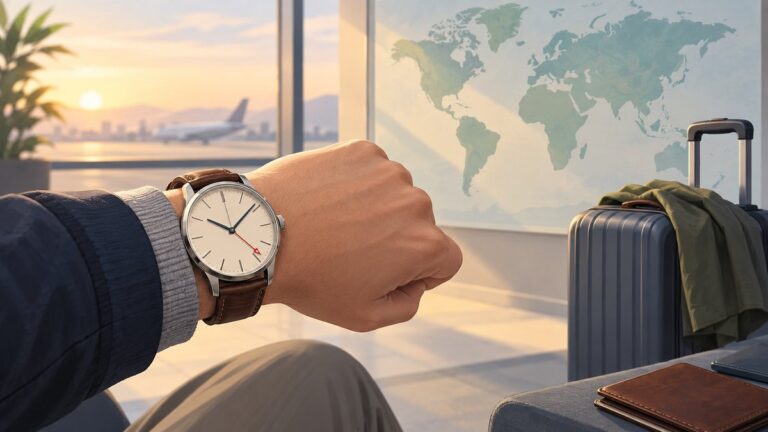
Smartwatch history did not begin with an electronic watch: the 1927 Plus Four Wristlet Route Indicator was a mechanical, manually operated route aid. Later devices explored digital timekeeping, calculation, television, information storage, computing, and sports measurement in different ways. Together, these experiments set the context for Apple Watch, but they do not form one straight engineering lineage.
The key to understanding the history is to ask what each device was designed to do, what information it could handle, how the wearer operated it, and whether it depended on another device or service. On that basis, the 1927 route aid, a calculator watch, and a modern connected smartwatch belong to an overlapping history—not the same technical category.
What counts as a smartwatch?
There is no single definition that fits every device in this history. A narrow definition might require an electronic, programmable wrist computer. A broader account can include wrist-worn tools that made information, calculation, communication, or sensing available beyond telling time. The broader approach is useful here, as long as mechanical route aids and multifunction digital watches are not mistaken for modern connected computers.
Compare these devices by their intended job, the information they showed or stored, their input method, their reliance on another device or service, and their display and power constraints. Those differences matter more than treating every milestone as a version of the same product.
What’s actually slowing this PC down?
Pick the symptom - the matching free tool is one click away.
#1 Best Overall

- 📞 【Bluetooth 5.3 Calls & Smart Notifications】 Make and answer calls directly from your smartwatch with stable Bluetooth 5.3 connectivity. Receive vibration alerts for calls and messages from Facebook, WhatsApp, Instagram, Twitter and more.
- ⌚ 【1.96 HD Touch Screen & 200+ Watch Faces】 Enjoy a large 1.96 HD full-touch display with smooth operation and clear visuals. Choose from 200+ watch faces in the GloryFit app or customize the screen with your favorite photo.
- 💖 【24/7 Health Monitoring】 Track heart rate, blood oxygen, stress, sleep and daily activity with built-in sensors. View your health and activity data in the GloryFit app to better understand your daily wellness.
- 🏊 【110+ Sports Modes & IP68 Waterproof】 Supports 110+ sports modes including running, walking, hiking, cycling, basketball and fitness. Tracks steps, calories, distance and heart rate during workouts. IP68 waterproof for daily exercise, sweat and hand washing.
- 🚀 【7-Day Battery & Multiple Smart Features】 Enjoy up to 7 days of use and about 30 days of standby after a 2-hour charge. Includes alarm, timer, stopwatch, music control, weather, camera control, calculator, sedentary reminder and more. Compatible with Android and iPhone.
Milestones at a glance
| Period | Device or development | Primary function | Why it matters |
|---|---|---|---|
| 1927 | Plus Four Wristlet Route Indicator | Route guidance using a scroll-map cartridge and manual controls | An early wrist-worn information aid, but not an electronic smartwatch |
| 1970–1972 | Hamilton Pulsar lineage | Electronic digital timekeeping | Illustrates the miniaturization work behind practical digital watches |
| 1974 | Microma LCD digital watch | Digital time display | A system-integration milestone identified by the Computer History Museum |
| 1977 | Seiko Calculator | Timekeeping and calculation | Put a calculator interface on a watch, using case buttons and a supplied stylus |
| 1982 | Seiko TV Watch | Television viewing and FM radio reception | Explored a watch as a miniature media device |
| 1980s onward | Data-entry and wrist-computer experiments | Memo storage, calendar entries, calculation, and computing | Tested how to enter and use information on a very small device |
| 1990s–2000s | Computing, network-information, and GPS sports devices | Different tasks, including computing, messaging, or sports measurement | Showed that wrist-worn technology developed along several branches |
| 2010s–2023 | Connected wrist wearables, including Apple Watch | Connected information and a wider range of wrist functions | Part of the later convergence of ideas explored by earlier devices |
1927: a mechanical route aid, not an electronic smartwatch
The Plus Four Wristlet Route Indicator used a replaceable scroll-map cartridge for a planned route. The wearer advanced it manually using controls on the device. Wareable describes it as a route-specific map aid; it had no GPS.
Its place in smartwatch history is conceptual: it put useful information on the wrist for a task beyond checking the time. It should not be described as an electronic computer or as the first smartwatch under a modern technical definition.
1970s: digital electronics and multifunction watches
Pulsar and the miniaturization challenge
The Computer History Museum traces an early system-on-chip watch lineage to the Hamilton Pulsar wrist computer. Its account says an early design used 44 chips and 4,000 bonding wires before engineers reduced the timekeeping circuitry. The figures describe that early design, not a specification shared by later watches.
The Pulsar story illustrates a central constraint of wrist technology: electronics had to become compact and practical enough to fit in a wearable object. The museum also credits LCD technology and further reductions with helping improve practicality and battery life. Digital timekeeping was an important foundation, but it did not by itself make a watch a programmable, connected smartwatch.
The Tool Desk
Outbyte Driver Updater FREEScan for outdated or missing drivers - takes under a minuteDriver Scan →Outbyte PC Repair FREERepair Windows errors before they cause bigger problemsFix Now →Microma and integrated electronics
The Computer History Museum identifies Microma’s 1974 LCD digital watch as the first product to integrate a complete electronic system onto one silicon chip. This was a miniaturization milestone. It helped establish the compact electronics that could support increasingly capable watches, rather than introducing a smartwatch feature such as apps or wireless connectivity.
Rank #2

- No APP & Phone Required Fitness Tracker Watch: This Fitness Tracker watch doesn't require any App or smartphone connections! It's as simple to use as a regular watch but smarter. Perfect for anyone looking for an easy fitness tracker without the hassle of smartphone setups.
- Heart Rate and Sleep Monitoring: The Fitness Tracker monitors your heart rate automatically all day, and you can select manual mode through the App. The fitness Watch also monitors your sleep at night, providing a detailed analysis of your sleep quality (deep sleep, light sleep, awake time). It is a health advisor for women men in daily life.
- Multi Sport Modes with Activity Tracking: The fitness tracker features 9 sport modes like running, walking and more. Additionally, the activity tracker records daily steps, calories burned, walking distance and active time throughout the day. You can also set a daily steps goals through the App to track your progress.
- Smart Notification Reminder: You can get SMS messages, and SNS notifications directly on your wrist including Facebook, Twitter, Gmail ect. You won't miss any important calls and message and stay updated. Please note: the smart watch can not make calls or text.
- Long Battery Life and IP68 Waterproof: This smart watch only requires 2 hours of charging and can be used for 5-7 days continuously, IP68 waterproof rating can withstand daily sweat, washing hands and rainy day, allowing you to fully enjoy your workouts.
Seiko Calculator adds an input task
Seiko’s official heritage chronology dates its Calculator watch to 1977. The watch displayed the time and provided calculator functions operated using buttons on the case; Seiko says a stylus was supplied for the small keypad. This made calculation a specific wrist-worn task, while also exposing the difficulty of entering information on a tiny interface.
These early products show why it helps to separate digital timekeeping from multifunction use. A digital display made a watch electronic; a calculator added another job, but neither alone amounted to a general-purpose connected computer.
1980s: television, data storage, and wrist-computer experiments
Seiko’s history groups calculator, television, and wrist-computer products within the broader wave of multifunction digital watches. Its corporate timeline describes the 1982 Seiko TV Watch as showing television on a 1.2-inch LCD and receiving FM radio. Seiko also reports that it was listed in the Guinness Book of Records in 1984 as the smallest television; that record claim is attributed here to Seiko.
Free tools Windows power users keep installed
One-click scans. No signup required.
Other experiments focused on storing or entering information. Wareable describes the Seiko Data-2000 as storing memos and calendar entries and working as a calculator with a clip-on keyboard. The separate keyboard addressed an enduring interface problem: a watch could display or store information, while a larger accessory handled difficult data entry.
These devices had different intended jobs. A TV watch was a media experiment; a data watch handled stored information; a wrist computer explored computing. Their small displays, input methods, and practical constraints varied, so they are better understood as parallel experiments than as steps in a single product sequence.
Rank #3

- 【Crystal-Clear Communication】AEAC smartwatch delivers clear call quality with high-definition speakers and microphones. Built with an AI assistant, it enables smooth voice commands and hands-free calls.
- 【Comprehensive Health Monitoring】The AEAC smartwatch tracks vital health metrics—blood oxygen, heart rate, stress, and sleep analysis—providing you with valuable insights for enhanced well-being.
- 【Long-Lasting Battery】Enjoy up to 10 days of use on a quick 2-hour charge. Will monitor your heart rate, steps, activity routes, and calorie burn around the clock, offering a complete view of your health and fitness.
- 【110+ Sports Modes & Waterproof】With 110+ sports modes, this fitness watch supports a wide range of activities, from yoga to swimming. Its 3ATM water-resistant design ensures reliable performance in wet conditions.
- 【1.32" AMOLED Touchscreen】 Features a 1.32-inch AMOLED display for sharp visuals and smooth responsiveness. The watch face measures 43 mm, offering a clear and comfortable viewing area. Choose from 200+ watch faces or personalize with your own photos, making the watch uniquely yours
1990s–2000s: computing, network information, and sports measurement
Wearable devices continued to explore distinct uses. Wareable’s timeline includes a Linux wristwatch and a Fossil Palm Pilot watch as computing-oriented examples, Microsoft SPOT as a network-information approach, and Garmin Forerunner as a sports-measurement branch. These examples are useful for showing the range of experiments, but a secondary timeline is not enough to treat every date or “first” claim as uncontested.
The branches addressed different needs: putting computing functions on the wrist, delivering information over a network, or measuring activity for sport. A dedicated sports device, for example, need not offer the same functions as a general-purpose wrist computer to be important to the broader history of wrist-worn technology.
Quick wins for a faster PC:
Clear out junk files and repair common Windows errorsFree Scan →Fix the driver behind crashes, sound loss and screen glitchesFind Drivers →2010s–2023: connected wearables and Apple Watch in context
In the 2010s and through the title’s 2023 endpoint, connected wrist wearables became part of the broader smartwatch story. This article’s research supports the earlier product and electronics history more deeply than a detailed account of later Apple Watch specifications. The sound historical conclusion is therefore about convergence: modern connected wearables draw on ideas explored by earlier digital watches, calculators, wrist computers, network-information devices, and sports products.
Apple Watch belongs in that retrospective as a prominent modern example, not as the invention of wrist-worn information technology. The dossier does not establish a complete inventory of devices through 2023 or substantiate detailed claims about Apple Watch launch specifications, sales, or market share, so those claims are not included here.
Independent reader supportYour contribution helps us test, update, and keep practical guides available for everyone.How to compare wrist-worn devices
When comparing devices from different eras, use the same practical questions rather than assuming they all served the same purpose:
Rank #4

- 【Superb Visual Experience & Effortless Operation】Diving into the latest 1.58'' ultra high resolution display technology, every interaction on the fitness watch is a visual delight with vibrant colors and crisp clarity. Its always on display clock makes the time conveniently visible. Experience convenience like never before with the intuitive full touch controls and the side button, switch between apps, and customize settings with seamless precision.
- 【Comprehensive 24/7 Health Monitoring】The fitness watches for women and men packs 24/7 heart rate, 24/7 blood pressure and blood oxygen monitors. You could check those real-time health metrics anytime, anywhere on your wrist and view the data record in the App. The heart rate monitor watch also tracks different sleep stages for light and deep sleep,and the time when you wake up, helps you to get a better understanding of your sleep quality.
- 【120+ exercise modes & All-Day Activity Tracking】There are more than 120 exercise modes available in the activity trackers and smartwatches, covering almost all daily sports activities you can imagine, gives you new ways to train and advanced metrics for more information about your workout performance. The all-day activity tracking feature monitors your steps, distance, and calories burned all the day, so you can see how much progress you've made towards your fitness goals.
- 【Messages & Incoming Calls Notification】With this smart watch fitness trackers for iPhone and android phones, you can receive notifications for incoming calls and read messages directly from your wrist without taking out your phone. Never miss a beat, stay in touch with loved ones, and stay informed of important updates wherever you are.
- 【Essential Assistant for Daily Life】The fitness watches for women and men provide you with more features including drinking water and sedentary reminder, women's menstrual period reminder, breath training, real-time weather display, remote camera shooting, music control,timer, stopwatch, finding phone, alarm clock, making it a considerate life assistant. With the GPS connectivity, you could get a map of your workout route in the app for outdoor activity by connecting to your phone GPS.
- What job was it designed for? Timekeeping, route guidance, calculation, media, data storage, computing, network information, and sports measurement are different aims.
- What could it show or store? A time display, map, calculator result, memo, calendar entry, or network-delivered information each implies different capabilities.
- How did the wearer interact with it? Consider manual controls, buttons, a stylus, a separate keyboard, or other documented input methods.
- Did it work alone? Identify any dependence on an accessory, another device, a network, or a service, where the evidence supports that distinction.
- What constrained its use? Small displays, limited input space, and the practical demands of a wearable form shaped what each device could do.
Frequently Asked Questions
Was the 1927 Plus Four Wristlet Route Indicator the first smartwatch?
It was an early wrist-worn route aid, not an electronic smartwatch. It used a scroll-map cartridge and manual controls, and had no GPS, according to Wareable.
Quick wins for a faster PC:
Clear out junk files and repair common Windows errorsFree Scan →Scan for outdated or missing drivers - takes under a minuteDriver Scan →Repair Windows errors before they cause bigger problemsFix Now →What did the Seiko Calculator watch do?
Seiko’s official heritage chronology says its 1977 watch displayed the time and performed calculations using buttons on the case. A stylus was supplied for its small keypad.
What was unusual about the Seiko TV Watch?
Seiko says its 1982 TV Watch displayed television on a 1.2-inch LCD and could receive FM radio. Seiko also reports that it was listed in the Guinness Book of Records in 1984 as the smallest television.
Did all early smartwatch precursors have the same purpose?
No. The devices explored different tasks, including route guidance, digital timekeeping, calculation, television, data storage, computing, network information, and sports measurement. They are related by being wrist-worn experiments, not by sharing one function or a single direct lineage.
Did Apple invent the smartwatch?
This history shows that wrist-worn information tools and electronic multifunction watches preceded Apple Watch by decades. Apple Watch is part of the later connected-wearable era, but the research used here does not support treating any one earlier device—or Apple Watch—as the sole beginning of the broader category.
What’s actually slowing this PC down?
Pick the symptom - the matching free tool is one click away.
Quick Recap
Product prices and availability are accurate as of the date/time indicated and are subject to change. Any price and availability information displayed on Amazon at the time of purchase will apply.