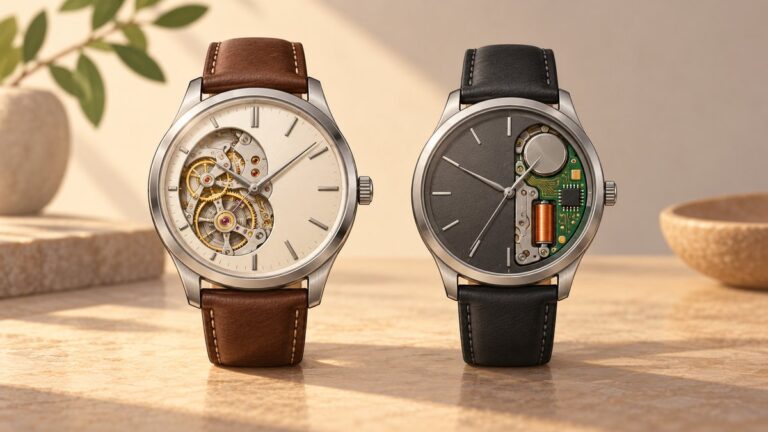
For most owners, a Seiko solar watch is the best all-round choice. It keeps quartz-level time with light-powered charging, so you avoid routine battery changes and frequent resetting. Choose standard quartz when maximum simplicity, predictable accuracy and a usually thinner case matter most. Choose automatic when the appeal is mechanical construction, a moving seconds hand and the hands-on ritual of wearing or winding a watch—not laboratory-level precision.
The right answer depends on what you value every day: accuracy, freedom from intervention, thickness and weight, mechanical character, or the way you wear and maintain the watch. The comparison below uses Seiko’s published guidance and clearly separates typical figures from model-specific specifications.
| # | Preview | Product | Price | |
|---|---|---|---|---|
| 1 |

|
[Seiko] Seiko Solar Watch Spirit Spirit Watch 10 ATM Waterproof Business Men's Women's | $209.99 | Buy on Amazon |
As an Amazon Associate I earn from qualifying purchases.
The short answer: solar for most people, quartz for simplicity, automatic for enthusiasts
| Movement | How it gets energy | Published accuracy example | Runs when left unworn | Best match |
|---|---|---|---|---|
| Automatic | A mainspring wound by wrist motion or by turning the crown | −15/+25 seconds per day (Seiko Boutique Europe FAQ example) | About 45 hours in the cited Seiko FAQ example; some 4R35 models specify approximately 41 hours | Enthusiasts who enjoy mechanical operation, a sweeping seconds hand and regular wear |
| Quartz | A conventional battery powers a 32,768 Hz quartz crystal | ±15–20 seconds per month (Seiko Boutique Europe FAQ typical variation) | Until the disposable battery is depleted; a universal interval is not stated because it varies by calibre and use | Accuracy-first buyers who want the simplest, usually thin and light option |
| Solar | Light is converted to electricity and stored in a rechargeable cell | Quartz regulation; exact tolerance depends on the model | Typically 5–6 months (Seiko FAQ); 6–10 months for listed Prospex models on Seiko UK’s 2025 collection page | Commuters, office wear, travel and anyone who dislikes routine battery replacement |
These are movement-family examples, not a promise that every reference performs identically. Case design, calibre, temperature, magnetism, position and the condition of the watch all affect real-world results.
Free tools Windows power users keep installed
One-click scans. No signup required.
How the three Seiko movements work
Automatic: a mechanical watch powered by motion
An automatic movement stores energy in a wound mainspring. A rotor turns as your wrist moves, winding that spring through the automatic winding system; turning the crown can add energy when the watch has stopped or has not been worn enough. The regulating assembly releases the stored energy in measured increments to move the hands.
#1 Best Overall
- Includes individual box, instruction manual (English language not guaranteed)
- Solar
- Approximately 10 months when fully charged
- Average monthly difference ±15 seconds
- Calendar (date) function
There is no battery and no electronic time base. The visible result is usually a smooth-looking sweep of the seconds hand rather than the distinct one-second steps common to quartz. “Smooth” does not mean perfectly continuous: the hand advances in several small beats per second, with the exact beat rate determined by the calibre.
Mechanical parts are affected by position, temperature, shock and magnetism. A watch may gain while resting in one position and lose in another, so the daily rate can change even when nothing is wrong. Seiko’s European FAQ describes automatic movements as less precise than quartz, Kinetic or Spring Drive movements and gives −15/+25 seconds per day as an example variation. Treat that figure as an illustrative published range for the FAQ, not a guarantee for every automatic Seiko.
Quartz: an electronic oscillator for predictable time
A conventional quartz movement uses a battery to power an electronic circuit and a quartz crystal. Seiko explains that its crystal vibrates at 32,768 hertz, or 32,768 vibrations per second. The circuit divides that high-frequency signal into a one-second pulse that drives the hands.
That stable frequency is why ordinary quartz is the accuracy benchmark for non-radio-controlled watches. Seiko’s European FAQ gives a typical variation of ±15–20 seconds per month. Real performance still depends on the specific calibre, temperature, battery condition and exposure to strong magnetic fields, but position-related effects are far smaller than in a mechanical movement.
A standard quartz watch does require eventual disposable-battery replacement. The material supplied for this comparison does not establish one replacement interval for all Seiko quartz models, so do not treat any single number as universal. A service centre can test the battery, seals and water resistance when replacement is due.
Solar: quartz regulation with a rechargeable power system
Solar Seiko watches are quartz watches. A dial or an integrated light-receiving surface converts light into electrical energy, and the watch stores that energy in a rechargeable cell. Seiko describes the system as a quartz watch that takes energy from light and stores it in a self-recharging battery that does not need routine changing.
“Does not need to be changed” refers to normal battery replacement during ordinary use, not to an immortal component. Rechargeable capacity can decline with age, and Seiko support recommends periodic overhaul approximately every three years in the cited guidance. A service can evaluate the rechargeable cell, movement, seals and charging performance.
Do these 3 things before closing this tab:
1Scan for outdated or missing drivers - takes under a minute2Clear out junk files and repair common Windows errors3Fix the driver behind crashes, sound loss and screen glitchesAccuracy: which movement keeps the closest time?
If accuracy is your first filter, choose quartz or solar. Both use quartz regulation, so their expected rate is measured in seconds per month rather than the larger daily variation typical of a mechanical watch. Solar does not become less accurate because it charges from light; its timekeeping system is still quartz. The main practical difference is how the watch is powered.
Automatic is the deliberate compromise. A published example of −15/+25 seconds per day can amount to several minutes over a month if the watch consistently runs at one end of that range. Many owners accept that trade because a mechanical calibre provides a visible, tactile mechanism. If you need a watch to stay close to an appointment time without periodic correction, quartz or solar is the safer choice.
How to interpret the figures
- Per day versus per month: an automatic tolerance stated per day cannot be compared by simply reading it as a monthly promise. Its rate can vary with position and activity.
- Typical is not guaranteed: Seiko’s FAQ figures are examples of expected movement-family performance. A particular reference may have a different stated tolerance.
- Accuracy can change: a sudden large gain or loss may indicate magnetism, shock, low power or a service need rather than normal variation.
Power and reserve: what happens when you stop wearing the watch?
Automatic reserve
An automatic runs only while its mainspring has stored energy. Seiko’s European FAQ gives about 45 hours as an example of autonomy. A cited group of 4R35-powered Essentials models specifies approximately 41 hours. Once that reserve is exhausted, the seconds hand stops; the watch does not “break,” but it must be wound or reset before use.
To restart a stopped automatic, follow the model’s instructions. In general, a few careful crown turns can provide initial energy, after which wearing it allows the rotor to continue winding. Do not force the crown at the end of its winding travel. If the watch repeatedly stops despite sufficient wear and winding, have the movement checked.
Outdated Drivers Are Slowing You Down
One free scan finds every outdated or missing driver and matches the right update for your exact hardware.Free scan · exact hardware matchPC Slower Than It Used to Be?
A free scan shows the junk files, broken settings and background clutter dragging Windows down - then fixes them in one click.Free scan · Windows 10 & 11Quartz battery operation
A standard quartz movement runs from its disposable battery until the stored charge is depleted. The exact life depends on the calibre, hands, complications, alarm functions and battery type; no single replacement period is established for every Seiko quartz watch in the supplied specifications. When the battery is due, prompt replacement helps avoid leakage damage and gives the technician an opportunity to inspect gaskets and water resistance.
Solar reserve and charging
Solar watches continue running in darkness by drawing on their rechargeable cell. Seiko’s FAQ describes typical running time of 5–6 months when fully charged. Seiko UK’s 2025 Prospex collection page cites 6–10 months for the listed models. The difference reflects model-specific specifications, so use the figure for your exact reference rather than assuming every solar Seiko reaches the longer range.
Light exposure is part of ownership. A solar watch left for months in a drawer can eventually stop even though its cell is rechargeable. Keep it where it receives ordinary indoor or daylight exposure when practical, and consult the model manual for charging and temperature limits. Do not place it against an intense heat source simply to charge it faster.
Daily convenience, thickness and wearing style
Set-and-forget convenience
Solar requires the least routine intervention for many owners: wear it or leave it in a normally lit place, and it can keep running for months in darkness after a full charge. It is especially practical for commuting, office wear and travel, where stopping to set the time or find a replacement battery is inconvenient.
What’s actually slowing this PC down?
Pick the symptom - the matching free tool is one click away.
Quartz is equally straightforward at the point of use. Set the time, wear the watch and expect the best ordinary accuracy of the three. Its only recurring interruption is battery replacement, whose timing depends on the reference.
Automatic demands the most interaction. A watch worn regularly can stay wound, but a rotation of several watches means one may stop between wears. Resetting the time and date becomes part of the routine. Some owners find that ritual rewarding; others experience it as unnecessary friction.
Case size, thickness and weight
Quartz movements can be compact, which often permits a thinner and lighter case, although the finished dimensions depend on the dial, crystal, water-resistance construction and complications. Solar watches add a light-receiving dial or layer and a rechargeable cell, so thickness varies by model rather than following a universal rule.
Automatic movements contain a rotor, mainspring barrel and mechanical gear train. Those parts can require more vertical space and may make a comparable automatic feel thicker or heavier. Compare the published case dimensions and lug-to-lug length of the exact references you are considering; movement type alone cannot predict wrist fit.
Quick wins for a faster PC:
Scan for outdated or missing drivers - takes under a minuteDriver Scan →Clear out junk files and repair common Windows errorsFree Scan →Fix the driver behind crashes, sound loss and screen glitchesFind Drivers →Durability and sensitivity in ordinary use
All three types can be durable when used within their specifications, but they fail in different ways. Quartz and solar have fewer moving mechanical parts and are generally less affected by the positional changes that alter a mechanical rate. Automatic watches are more sensitive to shock and positional conditions, so avoid treating a mechanical watch as a tool for impacts that the manufacturer does not permit.
Water resistance belongs to the case, not the movement category. A solar diver and an automatic dress watch can have very different ratings, and a quartz field watch may be more suitable for your use than either. Check the reference’s water-resistance marking, crown instructions and service guidance. Water resistance is not permanent because gaskets age.
Magnetism can affect mechanical regulation and can also disturb electronic watches, although the symptoms and recovery differ. If your watch suddenly gains or loses a large amount of time after contact with a strong magnetic source, stop guessing from the calendar and ask an authorised service professional for diagnosis.
Maintenance and long-term ownership
Automatic service planning
Mechanical oils age, seals harden and wear accumulates in pivots and gear teeth. Seiko UK guidance gives roughly three to four years for mechanical and automatic Prospex models when service is due. That is a planning interval, not a diagnosis: water exposure, shock, magnetism and a noticeable change in rate can justify attention sooner.
Free tools Windows power users keep installed
One-click scans. No signup required.
Service normally includes cleaning, lubrication, regulation and inspection of the case and seals. A watch that has stopped after its reserve or is running within its expected rate does not automatically need an overhaul; a watch with declining amplitude, erratic rate or damaged seals should be assessed.
Quartz battery and seal service
When a conventional quartz battery is depleted, use a competent service centre rather than leaving the watch open or fitting an unknown cell. Battery replacement is also a sensible point to inspect the gasket, crown and case-back seal, particularly if the watch is used around water. The replacement interval is model-specific and is not stated as one standard number for the entire Seiko quartz range.
Solar cell and overhaul service
Seiko support says rechargeable capacity can decline with age and recommends a periodic overhaul approximately once every three years in the cited guidance. Seiko UK gives roughly three years for solar and quartz models when service is due. If a fully charged watch runs for far less than the model’s published reserve, or stops soon after exposure to normal light, have the rechargeable cell and charging circuit tested rather than repeatedly forcing a charge cycle.
Independent reader supportYour contribution helps us test, update, and keep practical guides available for everyone.Which movement fits your situation?
Choose solar when you want the best balance
- You want quartz-level timekeeping without routine disposable-battery changes.
- You wear the watch for commuting, office work, travel or everyday errands and do not want it to stop in a drawer after a weekend.
- You are willing to provide normal light exposure and accept eventual rechargeable-cell service.
- You prefer a practical watch over the ritual of resetting a mechanical one.
Solar is the default recommendation for a buyer who has no strong mechanical preference. Confirm the exact model’s reserve, case dimensions and charging instructions, because the published 5–6-month FAQ figure and the 6–10-month Prospex figures are not interchangeable promises.
Choose quartz when accuracy and simplicity lead
- You want the most predictable ordinary timekeeping from the three categories.
- You prefer a usually thin, light and uncomplicated case.
- You are comfortable treating battery replacement as normal long-term maintenance.
- You do not need the visual and tactile character of a mechanical movement.
Quartz is often the rational choice for a first watch, a work watch or any situation where being on time matters more than the mechanism’s personality.
Choose automatic when the mechanism is the point
- You enjoy seeing a mechanical seconds hand and knowing that wrist motion winds the watch.
- You accept a daily-rate variation such as the −15/+25-second-per-day example published in Seiko’s European FAQ.
- You will wear it often enough to keep it running, or you do not mind winding and resetting it.
- You budget for periodic mechanical servicing and take greater care around shocks and magnetism.
An automatic is not the “better” version of quartz or solar. It is a different ownership experience in which engineering tradition and interaction outweigh maximum precision.
A practical buying checklist for a specific Seiko reference
- Identify the movement code. Confirm whether the listing says automatic, quartz or solar; do not infer it from the collection name or dial design.
- Read the exact accuracy specification. Look for the model or calibre’s stated tolerance. Use movement-family figures only as context.
- Check the power information. For automatic, note the stated reserve. For solar, note the reserve after full charge and charging instructions. For quartz, confirm the battery type and replacement procedure in the manual.
- Measure the case. Compare diameter, thickness and lug-to-lug length with a watch you already find comfortable. Movement category cannot substitute for these dimensions.
- Match water resistance to use. Swimming, desk wear and occasional rain have different requirements. Follow the crown and pressure-test guidance for the exact reference.
- Price the ownership, not only the purchase. Include battery replacement for conventional quartz, eventual rechargeable-cell work for solar and periodic overhaul for automatic.
- Decide how much interaction you want. If resetting a stopped watch sounds annoying, avoid choosing automatic solely because it looks more premium. If a mechanical ritual is the reason you are buying, do not choose solar and expect the same experience.
Common mistakes and how to avoid them
Assuming “solar” means maintenance-free
Solar removes routine disposable-battery changes, but it still relies on light and a rechargeable cell whose capacity can decline. Keep it exposed to ordinary light and plan for service when charging performance falls.
Comparing daily automatic tolerance with monthly quartz tolerance as if they were identical
The units describe different behaviours. Automatic rate changes with position and conditions; quartz variation is normally much smaller and expressed per month. Use the figures to choose a movement family, then consult the exact reference for its specification.
Recommended Free Tools
Leaving a stopped automatic unwound indefinitely
A stopped automatic is not necessarily damaged, but leaving any watch unused does not eliminate the need for seal and movement maintenance. Restart it according to the manual, and investigate persistent stopping or a sudden rate change.
Choosing by collection name instead of calibre and case
One collection can contain different movements, reserves and dimensions. Verify the movement code, reserve, accuracy, thickness, water resistance and service guidance on the exact model before ordering.
Final decision
Pick solar if you want the strongest combination of accuracy, low intervention and no routine disposable-battery changes. Pick quartz if predictable timekeeping, a simple mechanism and a potentially thinner case matter more than charging convenience. Pick automatic if the movement’s mechanical construction, sweeping seconds hand and winding ritual are central to why you want the watch, and you accept its lower precision, finite reserve and service needs.
Quick Recap
Product prices and availability are accurate as of the date/time indicated and are subject to change. Any price and availability information displayed on Amazon at the time of purchase will apply.
The Tool Desk
Outbyte PC Repair FREERepair Windows errors before they cause bigger problemsFix Now →Outbyte Driver Updater FREEFix the driver behind crashes, sound loss and screen glitchesFind Drivers →