The Tool Desk
Outbyte PC Repair FREEClear out junk files and repair common Windows errorsFree Scan →Outbyte Driver Updater FREEScan for outdated or missing drivers - takes under a minuteDriver Scan →A B-Uhr (Beobachtungsuhr, or “observation watch”) was a standardized navigation instrument for Luftwaffe observers and navigators. It was issued for flights, remained Luftwaffe property, and was built around legibility and synchronization rather than civilian dress-watch conventions. The designation Fl.23883 identifies the governing requirement; it does not mean that every surviving watch has the same movement, case construction, or untouched history.
What is a B-Uhr?
“B-Uhr” abbreviates Beobachtungsuhr, German for observation watch. In the historical account, the watch served as flight-navigation equipment for Luftwaffe observers and navigators. Watches were issued for missions and remained government property rather than becoming personal service souvenirs.
The Deutscheluftwaffe specialist catalog records the requirement designation Fl.23883. Its account says the Reichsluftfahrtministerium (RLM) requirements led manufacturers to begin production under strict specifications in 1940. A catalogued IWC example is dated circa 1940; another Laco-Durowe example is dated tentatively to 1944, so the surviving record does not support a single production date for all B-Uhren.
Why the design looks so distinctive
The B-Uhr’s appearance follows operational needs. The design history describes a very large case—about 55 mm for the original watches in that source’s general description—so the dial could be read quickly. That figure should not be treated as a universal measurement for every surviving example.
#1 Best Overall
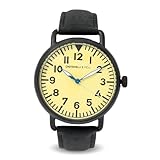
- Case & Design : The case has a satin sand blasted finish and the design harkens back to 1940s pocket watches which were issued to U-boat crews and Navy Pilots during the war. The surgical grade 316L stainless steel case is 43mm in diameter x 12mm in height , so a substantial watch without going over the top.
- The Tipo 3 is using a straightforward beige-and-black dial design. Each has an outer minute track with enlarged marks and accompanying Arabic numerals for each hour, with the exception of the 12 o’clock position, which features the B-Uhr signature triangle icon in upside down position which give the watch more minimal feel.
- The Crystal : High Quality scratch resistance Domed mineral. The crown is mid size and easy to use for setting the time . The lug width is 20mm, common for a case of this size, and the watch is water-resistant to 50 metres.
- The Movement : Powering the watch is Japan made Auto-Sweep movement , based centre second hand moves in 1/4 second increments, resembles mechanical timepieces. High Torque hands , 2 jewels and Accuracy ± 15 seconds per month at normal temperature range.
- High-contrast Arabic numerals: intended to remain legible at a glance.
- Luminous hands and orientation marker: supported reading in low light and helped establish dial orientation.
- Hacking central seconds: stopping the seconds hand allowed synchronization with a reference time before a flight.
- Oversized crown: made winding and setting easier when wearing gloves.
- Long strap: the catalog notes that wristwatches were typically worn over a flight uniform; the extra length could pass around a flight jacket.
These are design-account claims describing the intended use. They are not proof that every maker implemented every detail identically, or that every watch now described as a B-Uhr retains its original components.
What is the difference between Type A and Type B?
| Feature | Type A | Type B |
|---|---|---|
| Dial organization | A single, large outer minute scale with the hour numerals arranged on the main dial. | An outer minute/seconds scale plus a separate inner hour scale. |
| How hours are read | Read the prominent hour numerals directly, while the outer track gives the minutes. | Read hours on the inner ring and minutes on the outer ring. |
| 12 o’clock marker | A large orientation marker at 12 helps the wearer establish the dial’s top immediately. | The marker remains an orientation aid, while the concentric scales separate hour and minute readings. |
This Type A/Type B explanation follows the B-UHR history account. The catalog index lists examples, but it should not be read as a complete rulebook defining every dial detail.
Rank #2

- Case & Design :The case has a satin sand blasted finish and the design harkens back to 1940s pocket watches which were issued to U-boat crews and Navy Pilots during the war. The surgical grade 316L stainless steel case is 43mm in diameter x 12mm in height , so a substantial watch without going over the top.
- The Tipo 3 is using a straightforward black and white dial design. Each has an outer minute track with enlarged marks and accompanying Arabic numerals for each hour, with the exception of the 12 o’clock position, which features the B-Uhr signature triangle icon in upside down position which give the watch more minimal feel.
- The Crystal : High Quality scratch resistance Domed mineral. The crown is mid size and easy to use for setting the time.The lug width is 20mm, common for a case of this size, and the watch is water-resistant to 50 metres.
- The Movement : Powering the watch is Japan made Auto-Sweep movement , based centre second hand moves in 1/4 second increments, resembles mechanical timepieces. High Torque hands , 2 jewels and Accuracy ± 15 seconds per month at normal temperature range.
How standardization worked—and where variation remained
Fl.23883 specified the instrument’s intended function and appearance, while multiple firms supplied watches. A commonly cited five-maker roster is:
| Supplier named in historical summaries | What the record shows |
|---|---|
| A. Lange & Söhne | Listed among the commonly cited suppliers; the catalog index includes Lange-related material through the Wempe/Lange & Söhne grouping. |
| Wempe | Named as a supplier and, in at least one catalogued example, an assembler. |
| Lacher & Co. / Durowe (Laco) | Associated with a catalogued Laco-Durowe Type B watch. |
| Walter Storz (Stowa) | Included in the commonly cited supplier roster and catalog index. |
| IWC | Represented by a catalogued Fl.23883 Type B example. |
“Maker” and “assembler” are not always the same attribution. The catalogued Laco-Durowe Type B watch is associated with Lacher & Co. in Pforzheim, while its page notes assembly by Wempe in Hamburg. That relationship is why a name on a dial should not automatically be treated as the complete manufacturing history.
Crashes, No Sound, or Screen Glitches?
Random freezes, missing sound and display glitches usually trace back to one bad driver. Find and replace yours safely.Free scan · under a minuteWindows Errors? Fix Them Before They Spread
Repair common Windows errors and clear accumulated junk for a smoother, more stable PC - no reinstall needed.Free scan · no reinstallRank #3

- Case & Design : The case has a satin sand blasted finish and the design harkens back to 1940s pocket watches which were issued to U-boat crews and Navy Pilots during the war. The surgical grade 316L stainless steel case is 43mm in diameter x 12mm in height , so a substantial watch without going over the top.
- The Tipo 11 is using a straightforward black-and-white design. Each has an outer minute track with enlarged marks and accompanying Arabic numerals for each hour, with the exception of the 12 o’clock position, which features the B-Uhr signature triangle icon in upside down position which give the watch more minimal feel
- The Crystal : High Quality scratch resistance Domed mineral. The crown is mid size and easy to use for setting the time . The lug width is 20mm, common for a case of this size, and the watch is water-resistant to 50 metres.
- The Movement : Powering the watch is Japan made Auto-Sweep Chronograph second hand 1/4 sec. Timing up to 59 minutes 59 seconds.
Two catalogued examples show why object-level evidence matters
IWC Fl.23883 Type B, circa 1940
The specialist catalog describes an IWC Type B from circa 1940 with a steel case and a gold-plated Cal. 25T movement. It records 19 jewels and swan-neck regulation. Those specifications belong to that catalogued object; they do not establish a universal B-Uhr caliber or construction.
Laco-Durowe Fl.23883 Type B, “1944?”
A separate catalog entry identifies a Laco-Durowe Type B example, associates it with Lacher & Co., and notes Wempe assembly in Hamburg. The date is explicitly tentative—“1944?”—and the movement is recorded as having 22 jewels. The uncertainty is part of the evidence, not a defect to be silently converted into a firm year.
Rank #4

- Case & Design :The case has a satin sand blasted finish and the design harkens back to 1940s pocket watches which were issued to U-boat crews and Navy Pilots during the war. The surgical grade 316L stainless steel case is 43mm in diameter x 12mm in height , so a substantial watch without going over the top.
- The Tipo 5 is using a straightforward beige-and-black dial design. Each has an outer minute track with enlarged marks and accompanying Arabic numerals for each hour, with the exception of the 12 o’clock position, which features the B-Uhr signature triangle icon in upside down position which give the watch more minimal feel.
- The Crystal : High Quality scratch resistance Domed mineral. The crown is mid size and easy to use for setting the time. The lug width is 20mm, common for a case of this size, and the watch is water-resistant to 50 metres.
- The Movement : Powering the watch is Japan made Auto-Sweep movement , based centre second hand moves in 1/4 second increments, resembles mechanical timepieces. High Torque hands , 2 jewels and Accuracy ± 15 seconds per month at normal temperature range.
How to assess a surviving B-Uhr
A familiar dial layout or one of the five often-repeated names is a starting point, not authentication. Evaluate an individual watch against its own documentation:
- Record the case, dial, hands, crown, movement, and markings separately.
- Check whether the movement and case details fit the claimed maker and period.
- Distinguish an original component from a later replacement, restoration, or assembled watch.
- Look for object-level records such as catalog photographs, service history, ownership documentation, or archived military paperwork.
- Keep uncertain dates and maker-versus-assembler relationships explicit.
No broad production total or market-size statistic is established here, so rarity claims based on an invented number should be treated skeptically.
Best Value

- Mechanical Movement: This Pilot Watch Use is Japan MIYOTA 8215 Automatic, quite accurate.Fits wrists from approximately 152mm to approximately 228mm.
- Luminous:Luminous hands and markers.It can see the time in dark place or at night.
- Fashion watch: This men's Pilot Watch features a stainless steel case and automatic mechanical movement, which not only ensures comfort on the wrist but also can be easily matched with your clothes.
- Waterproof: The watch is water resistant to 50 methers It can not only support daily hand washing, car washing, rain and other water contact sports, but also support long-term water sports such as snorkeling and swimming, diving.
- As a gift: watches are suitable for outdoor sports such as running, sports, fishing, dating, new year, christmas, thanksgiving, hollywood, wedding, anniversary, birthday, graduation, father's day, birthday party, corporate events.
Modern echoes of the B-Uhr
Contemporary watches may borrow the Fl.23883-era visual language: an oversized pilot case, Type A or Type B dial, luminous numerals, a prominent crown, and a long leather strap. Such a watch is a modern interpretation or B-Uhr-style design, not a wartime-issued instrument. Compare it by dial layout, case diameter, movement, and strap length rather than by military appearance alone.
A long strap can recreate the historical over-the-jacket wearing method, but compatibility depends on the modern watch’s lug width and the strap’s actual length. Not every modern pilot watch needs an extra-long strap.
Why the B-Uhr still matters in pilot-watch history
The B-Uhr is best understood as a system: a requirement, a legible dial, a synchronizable seconds hand, and a supply network in which production and assembly could involve different firms. Its importance lies less in a single “hero” manufacturer than in how standardized navigation needs produced a recognizable instrument while leaving room for movement and constructional variation.
Quick Recap
Product prices and availability are accurate as of the date/time indicated and are subject to change. Any price and availability information displayed on Amazon at the time of purchase will apply.