Recommended Free Tools
Some links on this page are affiliate links: if you buy through them we may earn a commission, at no extra cost to you.
If your priority is the smallest, thinnest titanium watch powered by light, the Citizen Eco-Drive One AR5030-59L is the strongest alternative in this group: Citizen lists a 36.5 mm case and only 3.53 mm overall thickness. Choose the Seiko Astron SSH153J1 instead when GPS time adjustment and 38-city world time matter more than size. For simpler daily wear, Citizen’s AW1900-50A offers a 40 mm Super Titanium case, a 240-day reserve and 5 bar water resistance; the CA4750-51E adds a chronograph, sapphire crystal and 10 bar resistance. Casio’s Oceanus Manta OCW-S6000 is a benchmark for Bluetooth, Multi-Band 6 and Tough Solar features, but it is not a like-for-like substitute for an ultra-thin case.
Which compact solar titanium watch alternative fits your priority?
There is no single winner because these watches preserve different parts of the compact solar-titanium idea. The AR5030-59L is the clear choice for minimum thickness and dress-watch proportions. The SSH153J1 is designed around GPS travel functions, while the AW1900-50A is the straightforward everyday option. The CA4750-51E is for buyers who need a chronograph and stronger water resistance. Keep the Oceanus Manta OCW-S6000 in consideration when connected or radio-controlled timekeeping is the feature you are trying to retain.
As an Amazon Associate I earn from qualifying purchases.
| Model | Best for | Power and time adjustment | Published dimensions and materials | Main trade-off |
|---|---|---|---|---|
| Citizen Eco-Drive One AR5030-59L | Minimum thickness and dress-watch wear | Eco-Drive light-powered movement | 36.5 mm case; 3.53 mm overall thickness; titanium; sapphire crystal | The cited specification does not establish Bluetooth, radio reception or world time. |
| Seiko Astron SSH153J1 | GPS travel and city-time changes | GPS Solar; world time for 38 cities | 43.3 mm diameter; 13.4 mm thick; 117 g; titanium with ceramic/titanium bezel; dual-curved sapphire | It is substantially larger and heavier than the compact Citizen. |
| Citizen AW1900-50A | Everyday titanium solar wear | Eco-Drive calibre J810 | 40 mm diameter; 9.49 mm high; Super Titanium; 240-day reserve; 5 bar water resistance | The cited page lists crystal glass rather than sapphire. |
| Citizen CA4750-51E | Solar chronograph use | Eco-Drive calibre B620 | 40 mm diameter; 11.63 mm high; Super Titanium; anti-reflective sapphire; 270-day reserve; 10 bar water resistance | The chronograph case is thicker than the compact dress option. |
| Casio Oceanus Manta OCW-S6000 | Connected and radio-controlled timekeeping | Tough Solar; Bluetooth; Multi-Band 6 | 8.7 mm case thickness; titanium band; sapphire crystal; 10 bar water resistance | Diameter and weight are not stated in the cited specification summary, and the feature set prioritizes connectivity over minimum thickness. |
What does “compact” mean for a solar titanium watch?
For a watch, compactness is a combination of diameter, thickness and weight rather than one number. Diameter affects how much of the wrist a watch covers; thickness determines whether it slips under a cuff; weight influences how noticeable it feels during a full day. The published figures in this comparison use different combinations of those measurements, so compare like with like instead of treating a single dimension as a complete comfort score.
The Citizen Eco-Drive One establishes the strongest thinness benchmark here at 3.53 mm overall, with a 1.00 mm movement according to Citizen’s 2026 product verification. The AW1900-50A and CA4750-51E are both 40 mm watches, but their 9.49 mm and 11.63 mm heights reflect more conventional cases and, in the CA4750-51E, the extra chronograph hardware. The Seiko Astron’s 13.4 mm thickness and 43.3 mm diameter put it in a different wearing category even though its titanium construction helps control weight.
Popular on Amazon
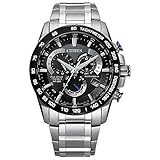
- With bold design and superior accuracy, Citizen Atomic Timekeeping watches synchronize to an atomic clock with a margin of error of just one second in 100,000 years.
- An Eco-Friendly Evolution: Citizen launches first Titanium Watch in 1970. More than 50-year-old evolution of innovative timepieces crafted from proprietary space-age material.
- Benefits of Super Titanium: Lightweight for Better Comfort, Scratch Resistant, Gentle on Skin, and Rust Resistant. Five times harder and 40% lighter than stainless steel.
- 1/5 Second Chronograph Measures up to 60 Minutes, 12/24 Hour Time, Date, Anti-Reflective Sapphire Crystal
- Sustainably powered by any light, with our Eco-Drive technology this watch never needs a battery. 200 Meter Water Resistant and 5 Year Limited Warranty
Why is the Citizen Eco-Drive One AR5030-59L the best thin alternative?
The AR5030-59L is the most convincing choice when “compact” means as little metal on the wrist as possible. Citizen lists a 36.5 mm case, 3.53 mm total thickness, titanium construction and a sapphire crystal. That combination gives it both the smallest stated diameter in this group and by far the lowest stated profile.
What the Eco-Drive One preserves
- Dress-watch proportions: A 36.5 mm case is substantially narrower than the 40 mm everyday models and the 43.3 mm Astron.
- Low-profile wear: The 3.53 mm overall measurement is the key figure for cuffs and discreet daily wear.
- Light-powered operation: Citizen lists 12 months of running time for the model.
- Scratch resistance: The cited specification names sapphire crystal.
What it does not establish
The cited AR5030-59L specification does not establish Bluetooth, radio reception, GPS adjustment or world-time functions. It should therefore be selected for thinness and simple light-powered operation, not as a substitute for a travel watch with automatic time-zone correction. Citizen’s product archive records the model as launching in 2018; the current product information was verified in 2026.
Do these 3 things before closing this tab:
1Scan for outdated or missing drivers - takes under a minute2Clear out junk files and repair common Windows errors3Fix the driver behind crashes, sound loss and screen glitchesWhen is the Seiko Astron SSH153J1 a better choice than a smaller watch?
Choose the SSH153J1 when changing time zones quickly is more important than keeping the case small. Seiko’s product-page verification lists GPS Solar operation and world time for 38 cities, giving it a travel-oriented function set that the thin Citizen specification does not claim.
Travel functions
GPS time adjustment is designed for travelers who want the watch to obtain time information from satellites rather than set each new zone manually. The 38-city world-time coverage provides named city selections for common time zones; the exact city list should be checked against Seiko’s current regional product page before purchase.
Size and materials
Seiko lists a 43.3 mm diameter, 13.4 mm thickness and 117 g weight. The case uses titanium with a ceramic/titanium bezel, and the crystal is dual-curved sapphire. Those specifications describe a full-size sports-travel watch, not a compact dress watch. Buyers with smaller wrists should account for both the diameter and the thickness, since either can dominate fit even when titanium reduces the material burden.
Also popular on Amazon

- Timeless styling that effortlessly takes you from work to play.
- 3 Hand, Date
- Silver-Tone Stainless Steel
- Luminous Hands and Mineral Crystal
- 100 Meters Water Resistant and 5 Year Limited Warranty
The trade-off
The Astron gives up the AR5030-59L’s 3.53 mm profile in exchange for GPS functionality, a larger display area and a more substantial case. It is the right alternative only if those travel capabilities solve a problem you actually have.
Quick wins for a faster PC:
Repair Windows errors before they cause bigger problemsFix Now →Scan for outdated or missing drivers - takes under a minuteDriver Scan →Is the Citizen AW1900-50A the best everyday option?
The AW1900-50A is the practical middle ground: a 40 mm Super Titanium Eco-Drive watch with a 9.49 mm height, a 240-day power reserve and 5 bar water resistance. It is larger than the Eco-Drive One but still considerably slimmer than the Astron and simpler than either a GPS or connected model.
Why it suits daily wear
- Balanced dimensions: The 40 mm diameter is familiar for modern everyday watches, while 9.49 mm remains moderate under most sleeves.
- Long reserve: Citizen Watch Europe lists a 240-day power reserve for calibre J810.
- Simple operation: Eco-Drive avoids routine battery replacement without adding GPS, Bluetooth or radio hardware to the stated feature set.
- Super Titanium case: Citizen describes its exclusive material as light, scratch resistant and gentle on the skin.
What to check before buying
The cited product page identifies the crystal as crystal glass rather than sapphire. If scratch resistance is a deciding factor, that distinction matters more than the small difference in case height. The 5 bar rating is also lower than the 10 bar ratings on the chronograph and Oceanus benchmark, so buyers should match the rating to their intended water exposure rather than assume all solar titanium watches are equally suitable.
Should you choose the Citizen CA4750-51E for a chronograph?
Choose the CA4750-51E when stopwatch functions and stronger water resistance outweigh the desire for an ultra-thin case. It uses Citizen’s Eco-Drive calibre B620 in a 40 mm Super Titanium case measuring 11.63 mm high.
Features that justify the extra thickness
- Chronograph layout: The additional timing functions require more movement and dial architecture than a simple three-hand watch.
- Sapphire protection: Citizen lists anti-reflective sapphire crystal.
- Longer stated reserve: Citizen Watch Europe lists 270 days for the B620, longer than the AW1900-50A’s 240 days.
- 10 bar water resistance: This is the strongest stated rating among the Citizen alternatives in the comparison.
At 11.63 mm, the CA4750-51E is not a replacement for the 3.53 mm Eco-Drive One. Its appeal is functional breadth: a chronograph, sapphire and a higher water-resistance rating in a still-manageable 40 mm titanium format.
Also popular on Amazon

- Iconic Promaster watches with advanced functions designed to venture to the deepest depths.
- 3 Hand, Date
- Silver-Tone Stainless Steel
- Luminous Hands and Markers and Mineral Crystal
- Sustainably powered by any light, with our Eco-Drive technology this watch never needs a battery. ISO Certified, 200M Water Resistant and 5 Year Limited Warranty
Is the Casio Oceanus Manta OCW-S6000 a true alternative?
The OCW-S6000 is best treated as a benchmark for features rather than a direct substitute for thinness. The reviewed specification summary describes Tough Solar, Bluetooth smartphone linking, Multi-Band 6 radio reception, a titanium band, sapphire crystal, an 8.7 mm case thickness, 10 bar water resistance and a slide-adjust clasp.
Why buyers compare it with compact solar watches
Bluetooth linking can provide phone-assisted settings, while Multi-Band 6 is designed to receive radio time signals where supported. Tough Solar keeps the watch light powered. Together, those systems address the same broad desire for low-maintenance ownership as Eco-Drive, but with more explicit connected and radio-controlled functions.
Why it is not the thinness winner
At 8.7 mm, the Oceanus is considerably thicker than the Eco-Drive One’s 3.53 mm. The cited summary does not state its case diameter or weight, so it cannot be ranked fairly against the other models on those dimensions. Choose it when Bluetooth and Multi-Band 6 are the features you want to preserve, not when the smallest possible profile is the main goal.
How do the solar and time-setting systems differ?
| System | Models in this comparison | What is established | What is not established by the cited specifications |
|---|---|---|---|
| Eco-Drive | AR5030-59L, AW1900-50A, CA4750-51E | Light-powered operation; AR5030-59L lists 12 months running time; AW1900-50A lists 240 days; CA4750-51E lists 270 days | Automatic GPS, Bluetooth or radio time adjustment is not stated for these references. |
| GPS Solar | Seiko Astron SSH153J1 | GPS time adjustment and world time for 38 cities | A power-reserve figure is not stated in the supplied product verification. |
| Tough Solar with connectivity | Casio Oceanus Manta OCW-S6000 | Tough Solar, Bluetooth linking and Multi-Band 6 radio reception | A power-reserve figure and case diameter are not stated in the supplied summary. |
“Solar” describes how the movement is powered, not how it sets the time. The Eco-Drive models focus on light-powered autonomy; the Astron adds satellite-based adjustment; the Oceanus combines light power with phone and radio links. Decide first whether your inconvenience is battery replacement, manual time-zone changes or both.
How should you choose by wrist, use and feature priority?
Choose the AR5030-59L if thinness comes first
Select it for a small wrist, formal clothing or a watch that disappears under a cuff. Its 36.5 mm case and 3.53 mm profile are the defining reasons to buy it.
Also popular on Amazon

- Men's luxury timepieces with technical advancements and a sporty style
- 1/5 Second Chronograph Measures up to 60 Minutes, 12/24 Hour Time, Date
- Silver-Tone Stainless Steel
- Mineral Crystal
- 100M Water Resistant and 5 Year Limited Warranty
Choose the SSH153J1 if you cross time zones often
Select it when GPS adjustment and 38-city world time are worth accepting a 43.3 mm, 13.4 mm and 117 g package. Measure your wrist and compare lug reach before ordering because the published diameter alone does not describe how the watch will overhang.
Choose the AW1900-50A for uncomplicated daily use
Select it when you want a conventional 40 mm titanium Eco-Drive watch, a 240-day reserve and 5 bar resistance without chronograph or travel electronics.
Choose the CA4750-51E for timing functions
Select it when the chronograph, anti-reflective sapphire and 10 bar rating justify an 11.63 mm case. The model is a functional everyday sports option rather than a minimalist dress watch.
Choose the OCW-S6000 for connected accuracy features
Select it when Bluetooth and Multi-Band 6 are non-negotiable. Confirm the exact regional specification because the cited summary does not provide a diameter or weight for direct size comparison.
What should you verify before ordering?
- Confirm the exact reference: Use the complete code—AR5030-59L, SSH153J1, AW1900-50A, CA4750-51E or OCW-S6000—because similar collections can have different movements and dimensions.
- Check regional availability: Inventory, warranty coverage and included documentation can vary by country. Verify those details with an authorised retailer before payment.
- Match crystal expectations: The AR5030-59L and CA4750-51E are listed with sapphire; the AW1900-50A is listed with crystal glass; the Oceanus summary lists sapphire.
- Compare the complete size set: Look at diameter, thickness and weight together. The Astron is the only model here with all three figures published in the cited specification.
- Read the water-resistance rating correctly: The listed ratings range from 5 bar on the AW1900-50A to 10 bar on the CA4750-51E and Oceanus benchmark. Treat the rating as a specification to match to your use, not as proof that every model has the same water capability.
- Check the time-setting method: Decide whether manual setting, GPS, Bluetooth or radio reception fits your travel routine and local signal availability.
What are the common buying mistakes?
- Calling every titanium solar watch compact: Titanium can reduce material weight, but a 43.3 mm, 13.4 mm watch is still physically large.
- Comparing thickness without function: A chronograph or GPS module generally needs more case volume than a simple three-hand movement; the thinner watch may not provide the functions you need.
- Assuming solar means automatic time-zone changes: Light power and time synchronization are separate capabilities. Only the Astron’s GPS and the Oceanus summary’s Bluetooth/Multi-Band 6 functions establish those features here.
- Treating brand material claims as laboratory rankings: Citizen and Casio describe their titanium as light and skin friendly, but no independent comparative durability or controlled weight-versus-steel study establishes a universal ranking.
- Ignoring the crystal: The AW1900-50A’s cited crystal-glass specification is materially different from the sapphire listings on the AR5030-59L, CA4750-51E and Oceanus benchmark.
What do the titanium and durability claims actually prove?
Citizen calls Super Titanium a proprietary material that is beautiful, scratch resistant, light and gentle on the skin. Casio says the Oceanus surface is hardened with a special treatment applied to lightweight, skin-friendly pure titanium. These are manufacturers’ descriptions of their materials and finishing; they should not be read as independently measured rankings against steel or against one another.
Also popular on Amazon

- Featuring our Eco-Drive technology – powered by light, any light. Never needs a battery
- Eco-Drive Movement (Caliber E660) - Synchronized to Atomic Time Clock for Superior Accuracy, Atomic Timekeeping Technology with Synchronized Time Adjustment Available in 24 Time Zones, 1 Second Chronograph Measures up to 60 Minutes, Perpetual Calendar, 12/24 Hour Time, Alarm, Power Reserve Indicator, Day / Date
- Two-Tone Stainless Steel 43mm Case with a Sapphire Crystal, One of the Hardest Materials in the World
- Two-Tone Stainless Steel Bracelet Featuring Fold Over Clasp with Push Buttons
- 200M Water Resistant & 5 Year Warranty
The crystal specifications are more directly comparable: sapphire is listed for the AR5030-59L, CA4750-51E and Oceanus summary, while the AW1900-50A page lists crystal glass and the Astron lists dual-curved sapphire. Case size, crystal type, water resistance and time-setting hardware together explain why the watches occupy different roles even though all are associated with solar power and titanium.
How can you narrow the shortlist in one minute?
- If your first sentence is “I need the thinnest possible watch,” choose the AR5030-59L.
- If it is “I need automatic time-zone adjustment,” choose the SSH153J1 and accept its larger dimensions.
- If it is “I want a simple daily watch,” choose the AW1900-50A after confirming that crystal glass and 5 bar resistance meet your expectations.
- If it is “I need a chronograph,” choose the CA4750-51E for its B620 movement, sapphire and 10 bar rating.
- If it is “I want phone and radio synchronization,” use the OCW-S6000 as the feature benchmark and verify its regional details before buying.
Frequently Asked Questions
Does a titanium case guarantee that a watch will feel lighter than a steel model?
No. Titanium is generally associated with low density, and the manufacturers describe these materials as lightweight, but the supplied specifications do not provide a controlled comparison with steel. Bracelet construction, movement, crystal and case size can change the final weight substantially.
Do these 3 things before closing this tab:
1Clear out junk files and repair common Windows errors2Scan for outdated or missing drivers - takes under a minute3Repair Windows errors before they cause bigger problemsCan an Eco-Drive model change time zones automatically when I travel?
The cited specifications establish light-powered operation for the three Citizen models, but they do not establish GPS, Bluetooth or radio time adjustment for them. Automatic time-zone functions are specifically identified for the Seiko’s GPS system and the Casio benchmark’s Bluetooth and Multi-Band 6 systems.
Why can’t I compare the Casio Oceanus Manta directly by size?
The cited Oceanus summary gives an 8.7 mm case thickness but does not state its diameter or weight. Without those two measurements, it can be compared on thickness and features, but not ranked fairly for wrist coverage or total mass.
Is sapphire always the best choice for these watches?
Sapphire is the crystal material listed for the AR5030-59L, CA4750-51E, Astron and Oceanus summary, while the AW1900-50A is listed with crystal glass. Buyers should balance scratch-resistance priorities against the specific case, reserve and water-resistance requirements of the model.

