Recommended Free Tools
Some links on this page are affiliate links: if you buy through them we may earn a commission, at no extra cost to you.
For most people buying one watch, a compact dive or sport-leaning watch is the more versatile choice. It offers a larger safety margin around rain, travel, swimming and rough daily use, while a restrained 38–40 mm case can still work with business clothing. Choose a dress watch first when suits, ceremonies, a thin case and disappearing under a shirt cuff describe most of your life.
The trade-off is straightforward: dress watches optimize slimness and visual restraint; dive watches optimize water resistance, legibility and durability. The right answer depends less on the label than on your most demanding regular use. As one 2026 buying guide puts it, “Choose by how you will wear it, not by the logo.”
As an Amazon Associate I earn from qualifying purchases.
What is the practical difference between a dress watch and a dive watch?
A dress watch is designed to stay visually quiet under formal clothing. A dive watch is designed to remain readable and protected in water and demanding everyday conditions. Those different jobs affect almost every component: case height, crown protection, bezel, dial contrast, lume, crystal, bracelet and water-resistance testing.
| Axis | Dress watch | Dive watch | Why it matters |
|---|---|---|---|
| Primary job | Suits, offices and ceremonies | Water, sailing and hard daily use | Match the most demanding environment you regularly face. |
| Typical diameter | 36–40 mm | 39–44 mm | Diameter changes visual formality and wrist presence. Figures are from Pedro Luis Olivares Joyero’s 2026 guide. |
| Case profile | Thin and cuff-friendly | Taller for seals, a bezel and crown protection | Thickness is often the decisive formal-wear constraint. |
| Typical water resistance | 30–100 m, depending on model | Commonly 200 m or more | Use the maker’s activity table; metres are pressure-test ratings, not guaranteed swimming depth. |
| Dial and bezel | Clean dial, little or no timing bezel | High contrast, luminous markers and a unidirectional elapsed-time bezel | Dive layouts are easier to read quickly and in low light. |
| Strap | Leather or a slim bracelet | Steel bracelet with extension or rubber | Interchangeability determines how easily one watch moves between settings. |
| Formal clothing | Natural match; usually slides under a cuff | Possible when compact; commonly sits over the cuff | Aesthetic tolerance depends on diameter, lug-to-lug length and height. |
A dress watch is not automatically fragile, and a dive watch is not automatically suitable for every aquatic activity. Construction, seals, crown design and the manufacturer’s instructions matter more than the category name alone.
Popular on Amazon
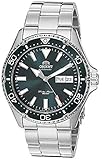
- Powered by the Orient F6922 Automatic / Hand-Winding / Hacking Movement
- Case Diameter: 41.8 mm | Lug to Lug Length: 46.8 mm | 22 mm Lug Width | 12.8mm Thick
- Features: Day | Date |120-Click Unidirectional Bezel | Screwdown Crown
- Stainless Steel Case | Sapphire Crystal
- Water resistant 200m (660ft): in general, suitable for professional marine activity and serious surface water sports, but not diving
Why is a dress watch better for formal clothing?
A dress watch solves a problem a diver cannot completely solve: it disappears beneath a cuff. Its thin case avoids catching on fabric, its restrained dial does not compete with a jacket or shirt, and a polished leather strap or narrow bracelet reinforces the formal appearance.
Case thickness and cuff clearance
For formal wear, thickness often matters more than diameter. A watch that is 9–10 mm thick can slide under a close-fitting cuff where a 13 mm sports case cannot. Lug shape also matters: downward-curving lugs keep the watch closer to the wrist, while long, straight lugs can make even a modest diameter look large.
Dial restraint
Dress dials generally use simple hour markers, slim hands and little visual text. They are legible in normal indoor light but do not usually have the heavy lume plots and high-contrast printing used by divers. That restraint is an advantage at a wedding or formal business meeting, where the watch should support the outfit rather than become its focal point.
Water-resistance limits
Many dress watches are rated at 30 m or 50 m, although some reach 100 m. A low rating is not a promise that the watch can be submerged to that number of metres. It indicates pressure used in a controlled test. Tissot’s 2026 guidance, for example, distinguishes 30 m/3 bar, 50 m/5 bar, 100 m/10 bar and 200–300 m/20–30 bar categories and directs owners to the activity guidance for the specific rating.
Why is a dive watch better for mixed daily use?
A dive watch is usually the stronger only-watch candidate because it is built around the activities that most quickly expose a watch’s limitations: water, impact, poor light and changing environments.
Legibility in changing light
Large markers, luminous hands and strong dial contrast let a diver be read at a glance. A unidirectional bezel provides a simple elapsed-time reference. You may never use it for a dive, but the same design remains useful for timing parking, cooking or a commute.
Also popular on Amazon

- Gents stainless steel analogue
- Automatic movement
- Sports
- Green dial and metallic strap or bracelet
- Wr 200mt
Water and environmental margin
Typical dive watches are rated at 200 m or more, while PADI says a good sports dive watch should have at least 100 metres (330 feet) of water resistance. That does not make every 200 m watch interchangeable with professional dive equipment, but it provides substantially more margin than a 30 m dress watch when you swim, boat, travel or work outdoors.
Why divers are taller
A diver’s height accommodates a thicker case, seals, a rotating bezel and often crown guards. The extra structure is useful in demanding conditions but can be the exact reason it catches on a cuff or feels visually heavy with a tuxedo. A 39–40 mm diver with short lugs can be comfortable and discreet; a 43–44 mm model with broad crown guards will read as sports equipment even with a leather strap.
Is a 30 m dress watch safe for swimming?
Do not treat a 30 m rating as swimming permission. Water-resistance metres describe tested pressure, not a universal real-world depth. For a 30 m/3 bar watch, follow the manufacturer’s activity table; unless the maker explicitly allows swimming, keep it away from pools, showers and immersion.
Seiko customer-service guidance states that “A watch’s water resistance is not permanently guaranteed.” Gaskets age, crowns can be left improperly positioned, and shocks or case opening can compromise sealing. Even a highly rated diver requires correct crown use and periodic inspection according to its maker.
How to read common ratings
| Marking | Pressure rating | How to use the information |
|---|---|---|
| 30 m | 3 bar | Use the manufacturer’s lowest-activity guidance; do not infer swimming capability. |
| 50 m | 5 bar | Check the maker’s table before exposure to water; the number is not literal operating depth. |
| 100 m | 10 bar | Often the practical threshold for a more water-flexible everyday watch, subject to the maker’s instructions. |
| 200–300 m | 20–30 bar | Typical of dive-oriented models, but crown, gasket condition and the watch’s stated purpose still govern use. |
Water-resistance habits that prevent avoidable damage
- Never operate a crown or push-button while the watch is wet or submerged.
- Make sure a screw-down crown is fully secured before contact with water.
- Rinse salt or chlorine residue with fresh water when the manufacturer permits it, then dry the case and bracelet.
- Have seals checked after a battery change, case opening or significant shock.
- Use the brand’s written activity table rather than converting the metre figure into a personal depth limit.
Can you wear a dive watch with a suit?
Yes, but it will normally sit on top of the cuff and read as a deliberate casual contrast rather than a traditional dress choice. The combination works best when the diver is compact, the dial is restrained and the rest of the outfit is not extremely formal.
What makes a diver suit-compatible?
- Diameter: Around 38–40 mm is easier to balance with tailoring than a large case.
- Lug-to-lug length: Shorter lugs keep the watch from extending beyond the wrist and reduce visual bulk.
- Thickness: A low-profile case is less likely to fight the cuff, even if it still sits outside it.
- Bezel and dial: A narrow bezel, muted color and limited branding look less overtly technical.
- Strap: A clean steel bracelet or well-finished leather strap can reduce the impression of a tool watch, but leather should not be used for swimming.
For black-tie clothing or a very conservative ceremony, a thin dress watch remains the safer aesthetic choice. For a business suit, blazer or smart-casual outfit, a restrained diver is usually acceptable if its proportions are controlled.
Also popular on Amazon

- Orient 21 Jewels Self-Winding Automatic Movement, Oscillation Frequency:
- Stainless Steel Case, Black Silicone Strap, Regular Connect Type Buckle Clasp
- Sapphire Crystal, Day/Date Function w/ Spanish Option, Uni-Directional Rotating Bezel, Luminous Hands and Markers
- Case Size: 41.8 mm Diameter, 12.8 mm Thickness
- Water Resistant - 200 M, Screw Down Crown and Case Back
Which is better as an only watch?
For a mixed life, choose the watch that covers your most demanding regular use. That usually means a compact diver or sport-leaning model rated at 100 m or more, because it can handle rain, travel and recreational water while remaining credible with business-casual clothing.
Choose the dress watch first when
- You wear suits or formal clothing most days.
- Your main frustration is a watch catching on or protruding past a shirt cuff.
- Swimming, boating and outdoor work are rare or can be handled by removing the watch.
- You prefer a quiet dial and a thin profile over maximum environmental margin.
Choose the dive watch first when
- You swim, boat, travel frequently or work outdoors.
- You need strong legibility in low or changing light.
- You want one watch that tolerates more accidental exposure and activity.
- Your normal clothing is casual, business-casual or moderately tailored rather than strictly formal.
If you already own a rugged everyday watch
Add the dress watch as a specialist second watch. Its value is not greater toughness; it is the ability to complete formal clothing without competing with it. This two-watch approach avoids forcing one case to solve opposite design problems.
What do real specifications look like?
The following figures illustrate the compromise rather than ranking products. They are specifications reported by Dial & Lug in 2026 from the manufacturers’ documents; availability and prices can change by region and date.
| Example | Diameter | Thickness | Crystal | Water resistance | Movement reserve | What it illustrates |
|---|---|---|---|---|---|---|
| Seiko Prospex SPB453J1 | 40 mm | 13 mm | Sapphire | 300 m | 72 hours | Compact diameter with a tall, highly water-resistant diver profile. |
| Orient Kamasu RA-AA0004E39B | 41.8 mm | 12.8 mm | Sapphire | 200 m | 40 hours | A conventional sport-diver footprint with substantial water margin. |
| Tissot PRX Powermatic 80 40 mm T137.407.11.041.00 | 40 mm | 10.93 mm | Sapphire | 100 m | 80 hours | A dress-leaning compromise; its integrated bracelet limits strap changes. |
| Tissot Le Locle Powermatic 80 39.3 mm | 39.3 mm | 9.75 mm | Sapphire | 30 m | 80 hours | A genuinely thin, formal profile with much less water flexibility. |
The comparison shows why diameter alone is a poor buying filter. The 40 mm diver is the same nominal width as the 40 mm sport-dress model, yet it is roughly 2 mm thicker. That difference can determine whether a cuff clears the watch. Conversely, the 39.3 mm dress watch is only slightly smaller than the divers but is over 3 mm thinner than the 13 mm model, making it much easier to hide under formal clothing.
How should you compare two watches before buying?
Use the following sequence rather than beginning with the logo or dial color.
- List your actual environments. Write down how often you swim, boat, travel, work outdoors, wear a suit and attend formal events. Weight recurring activities more heavily than hypothetical ones.
- Set a water-resistance floor. If swimming or regular water exposure is part of your routine, start with models whose manufacturer explicitly supports that activity. Do not select a 30 m watch and assume the number is a depth guarantee.
- Measure wrist fit beyond diameter. Check lug-to-lug length and thickness as well as case width. A compact 40 mm watch can wear smaller than a 38 mm design with long, straight lugs.
- Check crown and bezel design. Crown guards, a screw-down crown and a rotating bezel increase a diver’s capability but also add height and visual complexity.
- Assess quick legibility. If you often read the time while moving, outdoors or in dim light, prioritize contrast and lume over a highly decorated dial.
- Examine strap flexibility. Standard lugs make it easier to move between bracelet, rubber, fabric and leather. An integrated bracelet can look cohesive but restricts alternatives.
- Try the cuff test with measurements. Compare the listed thickness with the inside clearance of your shirts. Do not rely on diameter alone to predict formal comfort.
- Plan maintenance. Ask who can inspect seals, how the crown should be operated and what the maker says after shocks or case opening. Water resistance is a maintained property, not a permanent guarantee.
What are the common mistakes when choosing between them?
Buying a diver solely for the water number
A high rating does not compensate for poor fit, an uncomfortable bracelet or a case that never works with your clothes. If you rarely encounter water but wear close-fitting cuffs daily, the extra sealing may be irrelevant to your real life.
Also popular on Amazon

- Powered by the Orient F6722 Automatic, Hand-Winding and Hacking Movement
- 39.9mm Case Diameter (46.5mm lug to lug)
- 20mm Lug Width
- Sapphire Crystal
- Water resistant 200m (660ft): in general, suitable for professional marine activity and serious surface water sports, but not diving
Assuming a dress watch is unusable outside an office
Some dress-leaning watches reach 100 m and can be reasonable all-rounders when the manufacturer permits the intended activity. They still will not offer the same margin, bezel utility or impact-oriented construction as a true diver.
Ignoring lug-to-lug length
Long lugs can make a watch overhang the wrist, snag clothing and look larger than its diameter suggests. Compare this measurement whenever two cases have similar widths.
Confusing a sport-dress watch with a traditional dress watch
A 100 m sport-dress model may be an excellent compromise, but an integrated bracelet, thicker bezel or stronger dial texture can keep it from achieving the quiet, under-cuff appearance of a classic dress watch.
Treating resistance as permanent
Ageing seals, impacts and crown mistakes can reduce protection. Follow the manufacturer’s inspection and operating guidance even when the watch carries a high rating.
What’s actually slowing this PC down?
Pick the symptom - the matching free tool is one click away.
What is the final choice for different lifestyles?
| Your priority | Better starting point | Reason |
|---|---|---|
| One watch for commuting, travel, casual clothes and occasional swimming | Compact diver or sport-leaning watch rated at 100 m or more | More environmental margin without requiring a large case. |
| Daily suits, ceremonies and close-fitting cuffs | Thin dress watch | Case height and restrained styling solve the formal-wear problem. |
| Frequent swimming, boating or outdoor work | Dive watch | Higher stated resistance, stronger legibility and purpose-built sealing, subject to maintenance. |
| Existing rugged everyday watch and occasional formal events | Dress watch as a second watch | It adds a specialist formal option rather than duplicating the first watch. |
| Compromise between elegance and capability | About 100 m resistance, roughly 11 mm thickness and a restrained sport case | Closer to an all-rounder than a 30 m dress watch, though strap options may be limited. |
Frequently Asked Questions
Does a screw-down crown alone make a watch suitable for diving?
No. Water resistance depends on the complete case, crystal, crown, gaskets and testing standard, not one crown feature. Use the manufacturer’s stated activity guidance and service instructions rather than treating the crown as a certification.
Can I put a leather strap on a dive watch for the office?
Usually, if the case has conventional lugs and the strap fits correctly. Leather can make the watch look less technical, but it is a poor choice for swimming or repeated wet exposure; change back to a suitable bracelet or rubber strap first.
Is 100 m water resistance enough for recreational swimming?
It may be, but the answer belongs to the manufacturer’s activity table for that exact model. The 100 m figure is a pressure rating, and crown position, gasket condition and prior case work can change real-world safety.
Why can two watches with the same diameter wear so differently?
Thickness, lug-to-lug length, lug angle, case-back shape and bracelet articulation all alter how a watch sits. A 40 mm case with short curved lugs may feel smaller and more cuff-friendly than a thinner-looking watch with long, straight lugs.
Free tools Windows power users keep installed
One-click scans. No signup required.