Introduced in 2015, Jaeger-LeCoultre’s Geophysic True Second and Geophysic Universal Time share a mechanical seconds hand that advances in one-second jumps. The True Second adds a date to a relatively restrained dial; the Universal Time pairs the same deadbeat-seconds idea with a 24-time-zone display. That ticking hand makes seconds easier to read, but it does not make either watch inherently more accurate. The dimensions and prices below are from launch-era reports, not current availability or valuations.
What “True Second” means
“True Second” is Jaeger-LeCoultre’s name for a deadbeat-seconds display: instead of sweeping continuously, the seconds hand moves forward in discrete one-second steps. The effect resembles a quartz watch, but here it is produced by a mechanical movement. The stepwise motion can make individual seconds easier to read or synchronize. It is a display complication, not evidence that the movement keeps time more accurately.
| # | Preview | Product | Price | |
|---|---|---|---|---|
| 1 |
|
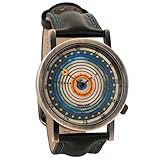
Ptolemaic Universe Model Astronomy Unisex Analog Watch | $47.13 | Buy on Amazon |
Hodinkee’s 2015 launch report describes an additional spring in the jumping-seconds mechanism. It also identifies a non-round Gyrolab balance in the caliber. Those are descriptions of the launch-era movements, not proof of a measured performance advantage.
Geophysic True Second: the simpler, smaller option
The True Second combines the deadbeat-seconds hand with a date display in a conventional-looking dial. Monochrome’s hands-on report says the crown’s first pulled position adjusts the hour hand independently, with the date changing correspondingly. That lets a wearer shift local hour and date without resetting the minute and seconds hands.
#1 Best Overall
- On the Ptolameic Watch, the sun is on the minute hand and the moon is on the hour hand and we are the center of the solar system once again.
- Features a 33mm diameter face, genuine leather band, and Japanese quartz movement.
- Battery included, and comes boxed in a beautiful tin display case.
- Click the store link near the product title for more great gifts. UPG has presents of mind.
Hodinkee identifies the movement as caliber 770, with a Gyrolab balance, gold oscillating weight and a 40-hour power reserve. The two contemporary reports give slightly different case measurements: Hodinkee lists 39.6 mm in diameter and 11.5 mm thick; Monochrome gives 39.7 mm and 11.7 mm. Those small discrepancies are best treated as reporting differences, not as evidence of distinct sizes.
Geophysic Universal Time: deadbeat seconds plus world time
The Universal Time adds a world-time display to the True Second concept. Hodinkee says its display covers 24 time zones, while Monochrome describes a city ring and world-time arrangement operated via the crown. The local hour hand can be adjusted independently, allowing local time to change without disturbing the minutes and seconds.
Monochrome reports a 41.6 mm case diameter and 11.84 mm thickness. Its 2015 account describes steel and 18k pink-gold versions, with differing treatments of the dial map. Those material and dial details come from that launch-era report and should not be assumed to describe every example or reference without checking its documentation.
How the two launch models compare
| Feature | Geophysic True Second | Geophysic Universal Time |
|---|---|---|
| Display | Deadbeat seconds and date | Deadbeat seconds and world-time display covering 24 time zones, according to Hodinkee |
| Movement | Caliber 770, according to Hodinkee | Caliber 772, according to Hodinkee |
| Case dimensions | Hodinkee: 39.6 mm diameter, 11.5 mm thick; Monochrome: 39.7 mm diameter, 11.7 mm thick | Monochrome: 41.6 mm diameter, 11.84 mm thick |
| Dial character | More restrained dial with date | Map and city/world-time display add information and visual complexity |
| Original US launch prices | Hodinkee (2015): steel $9,050; pink/red gold $17,500 | Hodinkee (2015): steel $15,000; pink gold $25,000 |
The comparison reflects contemporary launch coverage. The dimension reports do not provide matching measurements for every model from the same source, so the figures should not be read as a controlled measurement comparison.
What the launch prices and release date tell you—and what they don’t
Hodinkee reported the watches as available from 1 October 2015 and listed the US launch prices shown above. Monochrome’s launch coverage listed €8,500 for the steel True Second and €14,600 for the steel Universal Time, alongside euro prices for gold versions. Those are market-specific, period prices; they are not directly interchangeable with the US figures, current retail prices, or estimates of present-day resale value. Time and Watches also published launch-era US pricing, with a small difference in the listed steel True Second price.
Jaeger-LeCoultre’s Geophysic press archive provides broader collection context and later announcements, but does not establish that the original 2015 watches are currently available. The launch articles likewise do not establish current stock, current prices, or the condition and value of any pre-owned example.
Who each model suits
- Choose the True Second if you want the one-step-per-second display, a date, and fewer dial indications than the world-time model.
- Consider the Universal Time if a 24-time-zone display is useful to you and you prefer having local-hour adjustment alongside a world-time indication. Its larger reported diameter and busier dial are part of that trade-off.
For a closer look at the launch models, see Monochrome’s hands-on report and Hodinkee’s 2015 launch introduction. Time and Watches’ coverage provides another contemporary account of the launch context and prices.
Quick Recap
Product prices and availability are accurate as of the date/time indicated and are subject to change. Any price and availability information displayed on Amazon at the time of purchase will apply.
Free tools Windows power users keep installed
One-click scans. No signup required.