Free tools Windows power users keep installed
One-click scans. No signup required.
Some links on this page are affiliate links: if you buy through them we may earn a commission, at no extra cost to you.
The best stainless-steel luxury watch is not automatically the one with the most expensive alloy. Choose across four separate criteria: corrosion resistance, resistance to wear, the way the case and bracelet are finished, and the manufacturer’s ability to service and refinish them. 316L remains a strong everyday choice; 904L can offer greater corrosion resistance and a brighter polish; Grand Seiko’s Ever-Brilliant Steel is aimed at chloride resistance but is not materially harder. Brushed and satin surfaces usually make small marks less conspicuous than large polished planes. Compare the actual watch’s surfaces, edge transitions, coatings, and service policy rather than treating “904L” as a guarantee of scratch-proofing.
What should you prioritize when choosing a stainless-steel luxury watch?
Start by separating the properties that are often bundled together in marketing. A steel alloy can resist corrosion without resisting scratches, and a beautiful polish can make ordinary contact marks easier to see.
As an Amazon Associate I earn from qualifying purchases.
The Tool Desk
Outbyte PC Repair FREEClear out junk files and repair common Windows errorsFree Scan →Outbyte Driver Updater FREEFix the driver behind crashes, sound loss and screen glitchesFind Drivers →- Corrosion resistance: important for sweat, salt water, humid climates and chloride exposure.
- Scratch and wear resistance: influenced by hardness, coatings, geometry and how often surfaces contact desks, buckles or other objects.
- Finish: polished, brushed and satin planes reflect damage differently and require different refinishing skills.
- Serviceability: the brand or a qualified specialist must be able to recreate the original alternation of finishes without rounding edges or softening details.
These criteria can point to different watches. A highly corrosion-resistant alloy may still show the same type of desk marks as conventional steel, while a carefully brushed 316L case may look cleaner after years of office wear than a broadly mirror-polished case.
Is 904L steel better than 316L for a luxury watch?
904L is not universally “better.” It is a different alloy whose advantages are most relevant to corrosion resistance and the appearance of a high polish; 316L is already a capable, corrosion-resistant steel for daily-use and sports watches.
Popular on Amazon

- Cleans, Polishes and Protects: The perfect fine metal polish for any restoration or maintenance project. Restores all fine metals from antique silverware to brass andirons. Works great on silver, pewter, brass, copper, chrome, stainless steel, platinum, and nickel. Fantastic for fine jewelry and watches as well.
- Tarnish Remover: Our moist polishing cloth removes old tarnish, restores the original brilliance in metals, prevents new tarnish, and gives your valuables a layer of protection with our revolutionary anti-tarnish finish.
- Fine jewelry and silver polishing: Whether you are an avid coin collector or just looking to clean and protect decades old valuables to a brilliant shine, Cape Cod Polishing Cloths is the perfect polishing cloth for jewelry, watches, and other fine valuables.
- Easy to use and a pleasant smell: Simply wipe on and buff off with a soft cloth. Our polishing cloths have a pleasant vanilla fragrance and leave no excess liquid or residue in crevices as cleaning pastes or liquids often do.
- Made in the USA: Each re-sealable foil packet contains (Two) 4x6 inch moist polishing cloths ready to clean, polish and protect any type of metal. All products are manufactured on Cape Cod, Massachusetts.
| Material or treatment | What is established | How to interpret it when buying |
|---|---|---|
| 316L stainless steel | Omega describes 316L as corrosion-resistant, highly polishable and suitable for daily-use and high-stress watches. Tudor describes machined, heat-treated, strengthened and hand-finished 316L cases on its Black Bay models. | A dependable baseline for everyday luxury and sports watches. Judge case execution, finishing and the local service network rather than assuming 316L is an inferior grade. |
| 904L stainless steel (Oystersteel) | Rolex says it adopted 904L for steel cases in 1985, calls the alloy Oystersteel and notes that its physical characteristics require special tooling and methods. Bremont markets enhanced corrosion resistance, scratch resistance and retained lustre after moving from hardened 316L to 904L; those are the brand’s claims. | Worth considering when corrosion exposure and a bright polish are priorities. The alloy still needs sensible care, and its name does not establish scratch immunity. |
| Ever-Brilliant Steel | Grand Seiko reports a pitting-resistance equivalent number (PREN) of around 25 for conventional stainless steel, approximately 35 for 904L and above 40 for Ever-Brilliant Steel. It also says Ever-Brilliant Steel has almost the same hardness as conventional steel and practically the same scratch resistance. | A corrosion-focused choice, particularly where sweat or chlorides are a concern. Do not pay a premium solely on the assumption that it will stay free of scuffs. |
| Surface treatments | TAG Heuer describes fine brushing, satin finishing and titanium-carbide PVD applied to steel. These alter the surface, not the composition of the case beneath them. | Check coverage, edge wear and whether the treatment can be restored by the brand. A coating is not a substitute for a different bulk-steel grade. |
What does 904L add in real ownership?
Rolex’s own manufacturing description says 904L’s physical characteristics required special tooling when the company introduced it for steel cases in 1985. That helps explain why the material is associated with particular manufacturing processes, but it does not provide a consumer scratch score. The practical benefit is most defensible as a corrosion and polish consideration, not as proof that every 904L watch will outlast every 316L watch cosmetically.
Grade also interacts with design. A 904L watch with broad polished center links can reveal more hairlines than a 316L watch whose bracelet is predominantly brushed. Compare the specific reference, not only the alloy printed in a specification sheet.
The Tool Desk
Outbyte Driver Updater FREEFix the driver behind crashes, sound loss and screen glitchesFind Drivers →Outbyte PC Repair FREERepair Windows errors before they cause bigger problemsFix Now →Which stainless-steel luxury watch scratches least?
No ordinary stainless-steel luxury watch is scratch-proof. Scratch visibility depends on hardness, contact, surface finish, coatings and geometry; the alloy designation alone cannot rank every model.
Hardness is different from corrosion resistance
Grand Seiko states that Ever-Brilliant Steel is far more corrosion-resistant than conventional stainless steel while its hardness is almost identical. The company therefore describes practical scratch resistance as essentially the same. This is a useful warning against using PREN or the word “premium” as a shorthand for resistance to desk-diving marks.
Bremont presents its move from hardened 316L to 904L as providing enhanced scratch resistance as well as corrosion resistance and lustre. Treat that as Bremont’s product claim, not as a universal laboratory conclusion about all 904L cases.
What does ISO 18684:2020 actually tell you?
ISO 18684:2020 covers hard external watch parts with a minimum hardness of 1,200 Vickers and specifies tests involving shock, corrosion, scratches, sunlight exposure and wear. The standard is not a single consumer-facing scratch score for ordinary stainless-steel cases. A watchmaker or brand citing the standard is describing a test framework for qualifying hard exterior parts, not promising that a polished 316L or 904L case will remain mark-free.
PC Slower Than It Used to Be?
A free scan shows the junk files, broken settings and background clutter dragging Windows down - then fixes them in one click.Free scan · Windows 10 & 11Outdated Drivers Are Slowing You Down
One free scan finds every outdated or missing driver and matches the right update for your exact hardware.Free scan · exact hardware matchAlso popular on Amazon

- Cleans, Polishes and Protects: Perfect for any restoration or maintenance project. Restores all fine metals from antique silverware to brass. Works great on silver, pewter, brass, copper, chrome, stainless steel, platinum, and nickel.
- Tarnish Remover: Our moist polishing cloth removes old tarnish, restores the original brilliance in metals, prevents new tarnish, and gives your valuables a layer of protection with our revolutionary anti-tarnish finish.
- Fine jewelry and silver polishing: Whether you are an avid coin collector or just looking to clean and protect decades old valuables to a brilliant shine, Cape Cod Polishing Cloths is the perfect polishing cloth for jewelry, watches, and other fine valuables. The cloths are NOT recommended for brushed or satin finishes. The best product to use to clean brushed or satin finishes is Cape Cod Clean Link.
- How to Use: Gently rub silver jewelry or fine metal keepsakes with a Cape Cod Polishing Cloth briskly, but not hard, using even straight strokes. Then wipe dry with the Cape Cod buffing cloth and be amazed by the resurgence back to that new look again.
- Made in the USA: Each bundle tin contains (12) 4x6 polishing cloths, (1) 12x12 Buffing Cloth, and (1) pair of nitrile gloves. All products are manufactured in Cape Cod, Massachusetts.
Questions to ask before treating a specification as evidence
- Does the manufacturer publish a hardness or wear test for the exact reference, rather than for a different case or coating?
- Is the claimed protection a bulk alloy, a hardened surface or a coating?
- Will the treatment cover the case, bezel, bracelet, clasp and edges, or only selected panels?
- Can the service centre reproduce the original brushed direction and polished-to-brushed boundaries?
How does polished, brushed or satin finishing change visible wear?
Finishing changes how light reveals a mark. Polished steel gives the strongest mirror-like shine but makes fine hairlines and fingerprints obvious; brushed and satin surfaces scatter light and generally disguise small contact marks better.
| Finish | Appearance | Wear pattern and service implications |
|---|---|---|
| Polished | High-gloss, reflective and intended to create a luxury shine. | Micro-scratches catch reflected light. Restoring the look requires controlled material removal and careful preservation of edges. |
| Fine brushed | Directional matte texture; TAG Heuer describes it as scratch-resistant. | Small marks can blend into the grain, but an incorrect brushing direction or coarse abrasive is conspicuous. The grain must be recreated consistently at service. |
| Satin | Soft, low-reflection surface. | TAG Heuer says satin finishing is less sensitive to micro-scratches. It is often a practical choice for wearers who dislike visible desk marks. |
| Mixed finish | Polished bevels or center links contrasted with brushed flats. | Creates visual depth but increases the number of transitions a refinisher must preserve. Rounding a bevel can permanently change the case’s proportions. |
| Titanium-carbide PVD | Colored or hardened-looking surface over steel. | Wear at edges can expose the underlying metal. Confirm whether the brand can recoat the part or only replace it. |
Why case geometry matters as much as the steel
Grand Seiko’s Zaratsu process holds a case against a rotating metal plate while combining mirror-polished and brushed areas. Grand Seiko says polishing conditions must be adapted for Ever-Brilliant Steel and that the alloy is more difficult to forge and cut than conventional stainless steel. The example shows why crisp lug lines, bevel width and the accuracy of finish boundaries can matter as much as the alloy’s chemistry.
Inspect the bezel, lug tops, lug sides, bracelet center links, clasp and case back separately. A watch described as “brushed and polished” may put the most scratch-sensitive polished area exactly where it contacts a desk or sleeve.
Which steel and finish suit your daily environment?
Choose according to the exposure and the type of wear you are willing to see, then verify sealing and after-sales support for the exact model.
For office and mixed everyday use
316L with a well-executed brushed or satin finish is a sensible default. It provides the corrosion resistance expected of a daily watch, while directional or low-reflection surfaces make incidental contact less prominent. Look for solid clasp construction and a service centre that can reproduce the bracelet’s grain.
For salt water, humid climates or heavy perspiration
Give corrosion resistance, case-back design, water-resistance maintenance and service access priority. Grand Seiko notes that sweat and chlorides can contribute to corrosion even in stainless steel. A higher PREN figure can be relevant, but it does not replace proper cleaning, intact gaskets and periodic inspection appropriate to the watch’s water-resistance rating.
Also popular on Amazon

- QTY: 1 Foil Pack that Contains (2) 4 inch x 6 in pre-mosistened polosihing cloths.
- Cleans, Polishes and Protects: The perfect fine metal polish for any restoration or maintenance project. Restores all fine metals from antique silverware to brass andirons. Works great on silver, pewter, brass, copper, chrome, stainless steel, platinum, and nickel. Fantastic for fine jewelry and watches as well.
- Tarnish Remover: Our moist polishing cloth removes old tarnish, restores the original brilliance in metals, prevents new tarnish, and gives your valuables a layer of protection with our revolutionary anti-tarnish finish.
- Easy to use and a pleasant smell: Simply wipe on and buff off with a soft cloth. Our polishing cloths have a pleasant vanilla fragrance and leave no excess liquid or residue in crevices as cleaning pastes or liquids often do.
- Made in the USA: All products are manufactured on Cape Cod, Massachusetts.
For a strong dislike of visible scuffs
Favor brushed or satin areas and minimize broad polished surfaces on the bezel, clasp and bracelet centre links. Ask to see how the manufacturer restores edges and transitions; a refinishing job that removes too much metal can make a watch look softer and alter its original geometry.
For a mirror-like luxury appearance
904L and high-quality polishing may appeal, but polishing quality and maintenance access matter at least as much as the grade. Examine the evenness of reflections across lugs and bezel, and ask whether the official service can restore the original polish without changing the profile.
Recommended Free Tools
For long ownership or heirloom use
Investigate official refinishing, corrosion repair and parts support before buying. Rolex documents wear and resistance testing in its manufacturing information. Grand Seiko documents exterior polishing and laser filling for deep scratches. Those service capabilities can matter more over decades than a small difference in the alloy label.
How can you inspect a watch’s steel before buying?
Use the following inspection sequence in a boutique or with detailed, well-lit photographs. It is designed to uncover differences that a generic “stainless steel” specification hides.
- Map every surface: list the polished, brushed, satin and coated areas on the case, bezel, bracelet, clasp and case back.
- Check transitions: look for straight brushing, consistent grain and sharp but clean boundaries between finishes. Uneven transitions are difficult to correct later.
- Ask for material evidence: request the stated grade, any hardening or coating information and whether the claim applies to the complete bracelet as well as the case.
- Separate corrosion claims from scratch claims: ask which test or specification supports each statement. PREN indicates resistance to pitting corrosion, not a universal resistance to abrasion.
- Confirm refinishing policy: find out whether the manufacturer accepts the reference for polishing, laser filling, recoating or replacement of damaged links and bezels.
- Check regional support: verify where authorized service is available, expected intake requirements and whether pressure testing is performed after case-back work.
If a salesperson can identify the alloy but cannot explain the service treatment for a scratched bevel or coated clasp, the material choice is incomplete. Service policy is part of the watch’s practical specification.
How do you keep stainless steel from scratching or rusting?
Routine care reduces contamination and lets you catch corrosion before it becomes pitting. It cannot prevent every contact mark or repair a deep gouge.
Quick wins for a faster PC:
Scan for outdated or missing drivers - takes under a minuteDriver Scan →Repair Windows errors before they cause bigger problemsFix Now →Also popular on Amazon

- VALUE: Use the metal care kit to clean 4 metals at home: stainless steel, copper, brass, and chrome.
- COMPLETE CARE: Two cloths that complete the cleaning process. The yellow cloth is infused with a non-toxic cleaning oil that lifts dirt, removes tarnish, and restores a brilliant polish. The gray cloth is untreated and is used to remove any oil left on the piece, adding a final shine. Each cloth measures a generous 11 x 14 inches, large enough for bigger items and easy to handle for smaller, delicate pieces.
- MADE IN THE USA: This is a product made in the USA with high-quality standards. The cloths are made of ultra-soft cotton, and infused with non-toxic ingredients, that are safe for your health and the planet.
- FOR STAINLESS STEEL WATCH: The softness of the cotton cloth infused with harsh-free cleaning ingredients, provides a smooth and safe way to clean your valuable watch and bring back its shine.
- SPARKLING KITCHEN: The ingredients in the yellow cloth remove fingerprints, grease, and dirt from stainless steel surfaces, including the refrigerator, range, grill, dishwasher, microwave, sink, and kitchen gadgets. For appliances with sticky grease, begin by using a damp, soapy sponge to loosen and remove buildup. Dry with a clean cloth, and start using the yellow cloth.
- Wipe the watch after removal. Grand Seiko’s exterior-design manager Yasunori Hara stresses that stainless steel is “rust-resistant,” not “rustproof,” and links case-back corrosion to sweat and other factors. Use a soft, suitable cloth rather than an abrasive polishing compound.
- Follow the model’s water-resistance instructions. Do not assume a steel case is safe for swimming, showering or salt water simply because the alloy resists corrosion. Use the manufacturer’s stated limits and have seals checked as required by its service guidance.
- Keep abrasive contact away. Separate the watch from keys, loose metal jewellery and rough surfaces when storing or transporting it. A cloth pouch prevents incidental contact but does not make polished steel scratch-proof.
- Clean residue before storage. Sweat and chloride deposits should not be left on the case back, bracelet underside or clasp. Pay attention to crevices where residue can remain unseen.
- Stop home polishing at light cleaning. A watch-polishing cloth can remove surface residue and improve cleanliness; it cannot restore a deep scratch, a distorted edge or corrosion pits.
Never use an aggressive abrasive on a mixed-finish case. It can erase brushing, widen a polished bevel or create a surface that an authorized service centre must remove and rebuild.
Independent reader supportYour contribution helps us test, update, and keep practical guides available for everyone.Can deep scratches and corrosion be repaired?
Deep scratches can often be addressed by a qualified watch service, but corrosion pitting is a different problem and may not be safely repairable by simply polishing the surface.
What a professional exterior service may do
Grand Seiko says its exterior repair service can polish scratches and use laser welding to fill deep scratches before refinishing. This approach can preserve more of the original geometry than repeatedly polishing away metal, provided the work is performed by a service equipped for the specific case.
Why corrosion pits are harder
Grand Seiko states that corrosion pitting cannot be laser-welded because the full depth of corrosion around a pit cannot be seen. The practical implication is to have dark spots, staining or roughness assessed promptly rather than aggressively polishing them at home. A specialist can determine whether cleaning, part replacement or a more extensive case repair is appropriate.
What to request after case work
- Confirmation that polished and brushed planes were restored separately.
- Inspection of lug and bezel edges for unintended rounding.
- Replacement or inspection of gaskets disturbed during case-back or crown work.
- A water-resistance test appropriate to the watch’s specification before it returns to regular wear.
Is a premium steel grade worth paying for?
It can be worthwhile when the grade addresses your main exposure or aesthetic priority, but it is poor value if the purchase assumes automatic scratch immunity. Pay for 904L or Ever-Brilliant Steel when documented corrosion performance, the desired polish or a particular manufacturer’s engineering and service ecosystem matter to you. Choose 316L confidently when the model has excellent finishing, sensible surface proportions and dependable support.
Think of the premium as a package of material, manufacturing, finishing and service decisions. A watch with less polished area, a maintainable bracelet and accessible refinishing may remain more satisfying than a shinier watch whose marks are highly visible and whose coating or geometry is difficult to restore.
Also popular on Amazon
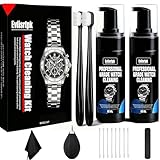
- Deep Cleaning Technology of the Watch Cleaning Kit: Exclusive Micro-Foam Technology: Ultra-fine foam penetrates deep into the gaps of bracelets, cases, and bezels, powerfully dissolving sweat stains, oil, and dust without damaging the items, leaving them looking brand new
- Scratch-Free Assurance: Gentle formula suitable for all materials: stainless steel, gold-plated, ceramic, titanium, sapphire/mineral glass, rubber/silicone straps (excluding leather straps). Soft brush bristles and non-abrasive foam ensure thorough cleaning without damage
- Professional Watch Cleaning & Polishing Tools: Cleaning Foam x 2 bottles, Premium Cleaning Cloth x 1, Soft Brushes x 2, Precision Cotton Swabs x 10, Polishing Tool x 1, Dusting Air Blower x 1
- Wide Application: Easily care for luxury watches, smartwatches, and jewelry at home. Quickly removes daily grime, the perfect choice between professional maintenance sessions
- High Quality & Durable: Designed for watch and jewelry enthusiasts, featuring professional-grade quality. User-friendly design, easy to operate, and long-lasting. Protect your precious items, keeping them radiant at all times
What is the best buying checklist for stainless-steel luxury watches?
Before committing to a reference, record the answers to these questions rather than relying on the grade name alone.
- Which alloy is used in the case, bracelet, clasp and bezel?
- What evidence supports the corrosion-resistance claim, and is it specific to this alloy?
- Is any scratch resistance provided by hardness, a coating or simply a brand description?
- How much of the watch is polished, and where will those surfaces contact desks or sleeves?
- Are brushed grains straight, even and aligned across adjoining links?
- Can the official service centre restore the exact finish and case geometry?
- What happens if the case develops corrosion pits rather than a superficial scratch?
- What water-resistance maintenance and testing does the manufacturer require?
The strongest choice is the one whose alloy, finish and service plan match the way you will actually wear it. Steel grade is one input; visible wear and long-term repairability are the outcome.
Frequently Asked Questions
Can a stainless-steel watch cause a nickel allergy?
The grade name alone does not establish skin compatibility. Nickel content, release from the finished surface, coatings and an individual’s sensitivity all matter, so anyone with a known allergy should request the manufacturer’s material and coating information for the exact reference and discuss alternatives with a clinician.
How often should a luxury watch be professionally polished?
There is no universal calendar interval. Delay cosmetic polishing until marks materially affect your enjoyment, because each conventional polish removes some metal; combine any refinishing with the watch’s normal overhaul or a needed case repair when practical.
Can I identify 316L or 904L with a home magnet test?
A simple magnet test cannot reliably identify these grades. Both are commonly used in austenitic watch construction and may show weak or variable magnetic responses depending on cold working and other components, so rely on the manufacturer’s specification and service documentation.
What should I do when I see dark spots on the case back?
Remove the watch from regular wear, wipe it gently and arrange an inspection rather than scrubbing the marks with abrasive metal polish. Darkening can be residue or early corrosion, and a specialist must determine whether the surface is cleanable, pitted or in need of part replacement.
What’s actually slowing this PC down?
Pick the symptom - the matching free tool is one click away.