Quick wins for a faster PC:
Fix the driver behind crashes, sound loss and screen glitchesFind Drivers →Clear out junk files and repair common Windows errorsFree Scan →Some links on this page are affiliate links: if you buy through them we may earn a commission, at no extra cost to you.
Choose quartz if your priority is the most stable timekeeping with almost no daily attention. Choose mechanical if you value traditional engineering, hand-finishing, tactile winding and a movement that is part of the ownership experience. Ordinary quartz watches are typically accurate to about ±20 seconds per month, while mechanical watches commonly vary by several seconds to several tens of seconds per day. Certification can tighten a mechanical watch’s measured tolerance, but it does not eliminate the inherent accuracy advantage of quartz.
The right luxury watch therefore depends less on prestige than on how you want to live with it: set-and-forget convenience, or an object you periodically wind, regulate, service and admire.
As an Amazon Associate I earn from qualifying purchases.
Recommended Free Tools
What is the mechanical-versus-quartz difference?
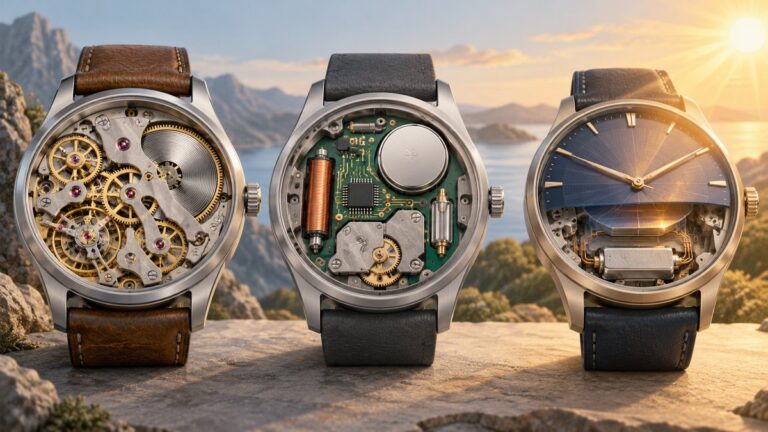
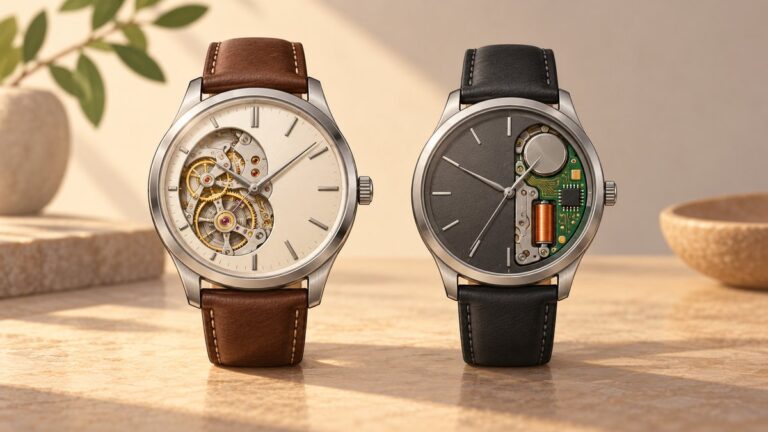
A quartz watch uses a battery, an electronic circuit and a quartz crystal oscillator. The crystal vibrates at a precise frequency—commonly 32 kHz—and the circuit converts those vibrations into regular pulses that drive the hands or a digital display. The Federation of the Swiss Watch Industry says that high vibration frequency is why quartz watches are extremely accurate.
A mechanical watch stores energy in a wound mainspring. Its gear train transfers that energy through an escapement and balance wheel, which regulate the release of power and move the hands. An automatic mechanical watch adds a rotor that winds the mainspring as your wrist moves; it can also be wound manually through the crown.
Popular on Amazon

- SILVER DIAL: this beautiful men’s watch features a deeply-patterned, glossed silver watch dial with blue dial indicator hands and a date calendar to keep you organized
- AUTOMATIC: these self-winding automatic watches for men are powered by your natural movements, with 41 hours of reserve power
- STAINLESS STEEL: Features a durable 40.5mm stainless steel watch case with see-through caseback and a beautiful silver bracelet.
- WATER-RESISTANT: these men’s wrist watches are water-resistant to 50 meters
- 4R35 CALIBER: equipped with the reliable 4R35 caliber, this precise men’s watch ensures the most accurate automatic timekeeping
Neither system is inherently more luxurious. Quartz concentrates precision and convenience in electronics, while mechanical watchmaking concentrates complexity, finishing and visible traditional craft in the movement.
Which is more accurate, quartz or automatic?
Quartz is substantially more accurate in ordinary use. The Japan Clock & Watch Association gives general quartz accuracy as about ±20 seconds per month. The same association describes mechanical watches as commonly varying from several seconds to several tens of seconds per day. Those are different scales: quartz drift is normally discussed over a month, while mechanical drift can be noticeable within a day.
| Movement type | Published accuracy information | What the figure means in practice |
|---|---|---|
| General quartz | About ±20 seconds per month (Japan Clock & Watch Association) | You may need to correct the time only occasionally, depending on your tolerance and the watch’s condition. |
| Quartz with a 32 kHz oscillator | Less than one second per day variation is cited by the Federation of the Swiss Watch Industry | A high-frequency crystal provides a very stable reference, although the exact result depends on the movement and conditions. |
| General mechanical | Several seconds to several tens of seconds per day (Japan Clock & Watch Association) | The watch can gain or lose minutes over a month and may require periodic correction. |
| METAS Master Chronometer | 0 to +5 seconds per day for qualifying larger movements (Federal Institute of Metrology, 2026) | A certified mechanical movement has a controlled measured tolerance, but it remains less accurate than ordinary quartz. |
| Seiko Presage SPB524J1 | +25/-15 seconds per day, approximately 72 hours of power reserve (Seiko Watch Corporation, product information accessed 2026) | This is the manufacturer’s stated specification for that model, not a universal mechanical-watch standard. |
Mechanical rate is not a fixed number. Winding state, temperature, gravity, shock, magnetism and the position in which the watch rests can all alter the balance’s behavior. A watch may run faster dial-up than crown-down, for example. A quartz movement is less affected by position and everyday shock, but electronic watches can still have model-specific magnetic or temperature limits.
How much daily interaction does each movement require?
Quartz: set it and wear it
A quartz watch normally continues running while it sits in a drawer. You set the time, wear it when convenient and replace the battery when it is depleted. This is the easiest choice for a rotation of watches, travel, irregular wear or anyone who dislikes resetting a stopped watch.
Quartz is not maintenance-free. Battery replacement, gasket inspection and water-resistance checks are still needed, and a leaking battery can damage the movement if ignored. Victorinox states that its quartz batteries last approximately 24 months from assembly or the last service, although life varies with the model and its functions.
Automatic mechanical: keep it wound or reset it
An automatic watch winds while you wear it, subject to the movement’s power reserve and your activity. If it is left unworn long enough to exhaust that reserve, it stops. You then wind it through the crown, set the time and, where applicable, the date. Manufacturer guidance commonly recommends keeping the mainspring sufficiently wound so the movement operates within its intended torque range.
Free tools Windows power users keep installed
One-click scans. No signup required.
A manual-wind mechanical watch requires deliberate winding at regular intervals. Some owners enjoy that ritual; others find it inconvenient when switching between several watches. An automatic watch winder is optional, not mandatory. It can keep an unworn automatic running, but it also adds cost, noise and continuous operating time. Store the watch safely instead if you do not need it to display the current time.
Is a mechanical luxury watch worth the maintenance?
It can be, if the movement’s construction and interaction are central to what you are buying. Mechanical servicing involves regulation, cleaning, lubrication and examination of wear, seals and components. Seiko advises taking a watch to its service center about once every three years for examination, cleaning and oiling where needed. Victorinox describes maintenance every 18–24 months and a complete overhaul around six years, depending on model and use. These intervals are not interchangeable rules: follow the schedule for the specific caliber and brand.
Quartz ownership usually involves fewer movement interventions, but it still needs battery replacement and periodic water-resistance service. A quartz watch used for swimming, exposed to humidity or equipped with multiple power-hungry functions may need attention sooner than a simple three-hand model.
What a mechanical service normally addresses
- Rate checks and regulation so the movement runs within the manufacturer’s stated tolerance.
- Disassembly, cleaning and inspection for worn or damaged parts.
- Fresh lubrication at the points specified for the caliber.
- Inspection or replacement of gaskets, followed by a water-resistance test when the watch is designed for it.
- Timing checks in multiple positions and a final inspection before return.
Service cost and turnaround depend on the caliber, complications, replacement parts and whether the work is performed by the manufacturer or an independent specialist. A neglected mechanical watch can require more extensive work than one serviced at the recommended interval.
Also popular on Amazon
- GOLD FINISH for an elegant classic dress timepiece featuring diamond markers and a Seiko Presage Cocktail Time Eggnog Automatic Watch
- DIAMOND MARKERS that enhances the elegance of this Seiko Presage Cocktail Time Eggnog Automatic Watch
- 41-HOUR POWER RESERVE ensures your Seiko Presage Cocktail Time Eggnog Automatic Watch keeps running smoothly through day and night
- SLIM CASE with a white gold dial that exudes sophistication and style
- 50M WATER RESISTANT for versatile wear, whether you're attending a formal event or simply going about your day with the Seiko Presage Cocktail Time Eggnog Automatic Watch
Why do mechanical luxury watches usually cost more?
Mechanical pricing reflects the movement and the rest of the watch together. A traditional caliber contains many precisely made parts, requires assembly and adjustment, and may receive hand-applied decoration such as anglage, polishing or Geneva-style striping. Higher-priced movements can also include complex calendars, chronographs, tourbillons or precious-metal components.
Case material, bracelet construction, crystal, dial work, water-resistance engineering and production volume also influence price. Quartz does not automatically mean inexpensive: a finely finished case, precious metal, a high-end dial or a specialized quartz caliber can raise the price substantially. Conversely, an entry-level mechanical watch can cost less than a luxurious quartz model. The movement is one price factor, not a complete explanation.
Do quartz watches feel less premium?
They can feel different, but “less premium” is a value judgment rather than a technical fact. A mechanical watch offers a winding sensation, a sweeping seconds hand on many calibers, visible gears through a display back and the knowledge that energy is being regulated by a miniature mechanical system. Those experiences are meaningful to collectors.
Quartz offers a different kind of refinement: long periods of accurate, quiet operation, a thin profile in some designs and freedom from daily winding. The quality of the case, bracelet, dial, finishing and fit can make a quartz watch feel as luxurious as a mechanical one. If the appeal of luxury is craftsmanship that you can see and interact with, mechanical is more likely to satisfy. If it is precision and effortless use, quartz may feel more sophisticated.
Recommended Free Tools
How do COSC and METAS certifications change the decision?
Certification is a measured performance signal for qualifying mechanical watches, not a conversion of mechanical technology into quartz technology. COSC testing evaluates chronometer movements against specified tolerances. METAS Master Chronometer certification requires a series of tests defined by the Federal Institute of Metrology. For qualifying larger movements, the 2026 METAS certification information specifies a tolerance of 0 to +5 seconds per day.
A certified movement can therefore be more consistent than an uncertified one, and certification provides documented quality control. It does not guarantee that your individual watch will never vary outside that range after magnetism, shock, wear or a need for regulation. Nor does +5 seconds per day approach the typical monthly stability of quartz. Pay for certification when its testing and assurance matter to you, not because it closes the technology gap.
What happens when a mechanical watch meets shock, magnetism or temperature?
The balance spring and escapement are sensitive regulating components. A hard impact can disturb the balance or bend a component; magnetism can cause coils in a hairspring to cling together and make the watch run rapidly; temperature changes alter the dimensions and elasticity of parts; and gravity affects the balance differently in different positions. These influences explain why a mechanical watch can keep different time on the wrist and on a nightstand.
Quartz is generally less sensitive to position and routine shock because it uses an electronic timing reference rather than a balance wheel. It is not invulnerable: severe impact can damage the circuit or motor, and individual electronic designs can have magnetic or temperature limitations. Treat either movement according to its water-resistance rating and avoid exposing it to hazards the manufacturer excludes.
Which model illustrates the mechanical trade-off?
Seiko lists the Presage SPB524J1 as an automatic mechanical watch with manual-winding capability, approximately 72 hours of power reserve, a sapphire crystal and 10-bar water resistance. Its stated precision is +25/-15 seconds per day, and Seiko’s product page lists a price of approximately US$1,000 when accessed in 2026. That price is volatile and can differ by market.
The model shows why a mechanical specification must be read as a package. You receive a long reserve, robust crystal and substantial water resistance, but the published daily rate is far wider than ordinary quartz accuracy. If the watch stops after its reserve is exhausted, it must be wound and reset; if its rate drifts, regulation or service may be appropriate.
Also popular on Amazon
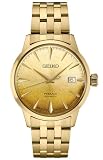
- Seiko Presage Cocktail Time U.S. Special Creation
- Special creation celebrating craft beer cocktails
- Fine mechanical watchmaking from Japan
- Automatic with manual winding capability
- Inspired by the Beer Julep cocktail, the gloss-finish gold dial is vertically gradated to suggest the sparkling hues of a fresh pour, while the pressed pattern evokes its bubbling effervescence
How should you choose between mechanical and quartz?
Start with the inconvenience you are willing to accept and the experience you want to buy. Use this decision path:
- Put accuracy first? Choose quartz. It is the clear option when being within seconds of reference time matters more than mechanical interaction.
- Wear one watch most days? An automatic mechanical watch can stay wound naturally. If your routine is irregular, quartz avoids the reset that follows a depleted power reserve.
- Enjoy winding and visible engineering? Choose mechanical, especially a model with a display back or a movement whose finishing you appreciate.
- Want the lowest recurring attention? Quartz usually wins, while still requiring battery and water-resistance service.
- Expect harsh shocks, strong magnets or frequent travel? Quartz is generally more forgiving of position and everyday disturbance. Mechanical can still work well, but requires more care and may need regulation after an incident.
- Are you buying for finishing or complications? Mechanical movements offer the broadest traditional platform for hand-finishing and complex complications. Compare the actual caliber and finishing, not just the word “automatic” on the dial.
- Is resale your deciding factor? Do not assume one movement type always retains more value. Resale depends on brand, reference, condition, provenance, supply and market timing, and no authoritative general dataset establishes a universal mechanical-versus-quartz winner.
| Priority | Usually the better fit | Reason |
|---|---|---|
| Maximum everyday accuracy | Quartz | Monthly variation is far smaller than the daily variation commonly seen in mechanical watches. |
| Traditional craft and movement appreciation | Mechanical | The mainspring, gears, escapement and finishing are part of the ownership experience. |
| Irregular wear or a large rotation | Quartz | It keeps running in storage until the battery needs replacement. |
| Daily ritual and interaction | Mechanical | Winding, setting and observing the movement are intentional parts of use. |
| Predictable maintenance burden | Quartz | Battery and seal work is generally simpler than a mechanical overhaul. |
| Complications and hand-finishing | Mechanical | Mechanical architecture supports extensive traditional decoration and complex functions. |
How do you care for each type of luxury watch?
Mechanical care checklist
- Keep the mainspring sufficiently wound according to the movement instructions.
- After non-use, wind and set the watch before wearing it rather than relying on an exhausted reserve.
- Keep it away from strong magnetic fields such as powerful speakers, magnetic clasps and industrial equipment.
- Avoid impacts and have the rate checked after a significant shock.
- Use the brand’s service interval; Seiko’s general guidance is about three years, while other brands may specify shorter or longer periods.
- Store it dry in its supplied box or a soft pouch. Do not place it loose with objects that can scratch the crystal or case.
Quartz care checklist
- Replace the battery promptly when the watch stops or shows a low-battery indication.
- Have seals and water resistance checked whenever the case is opened.
- Ask for the correct battery and handling procedure for chronographs, alarms or other high-drain functions.
- Store the watch dry and protected from scratches, even though it does not need winding.
- Follow the manufacturer’s guidance for magnetic, temperature and water exposure.
What are the most common buying mistakes?
Assuming “automatic” means highly accurate
Automatic describes how the mainspring is wound, not the rate. Read the stated tolerance and understand that it can change with position, magnetism, temperature, winding state and wear.
Windows Errors? Fix Them Before They Spread
Repair common Windows errors and clear accumulated junk for a smoother, more stable PC - no reinstall needed.Free scan · no reinstallOutdated Drivers Are Slowing You Down
One free scan finds every outdated or missing driver and matches the right update for your exact hardware.Free scan · exact hardware matchComparing a certification number with a quartz specification
A mechanical certification such as 0 to +5 seconds per day is impressive within mechanical watchmaking, but it is not equivalent to quartz’s typical ±20 seconds per month. Compare units and time periods before drawing a conclusion.
Ignoring the whole-watch construction
Crystal, case, bracelet, dial, water resistance and service support affect value and durability. A movement comparison alone cannot tell you whether a particular watch suits your use.
Buying accessories before understanding your routine
A winder is optional for an automatic watch. A storage box or soft pouch is a directly useful protection accessory, while a winder only makes sense if keeping the watch continuously running is worth its added cost and operating time.
What is the final choice?
Buy a quartz luxury watch when you want the most accurate, least demanding timekeeper and are comfortable treating the movement as a discreet tool. Buy a mechanical luxury watch when the movement itself—its winding, engineering, finishing and serviceable longevity—is the reason you want the watch. Mechanical certification can improve consistency, but no certification removes quartz’s practical accuracy advantage. The better choice is the one whose maintenance and daily interaction you will genuinely enjoy.
Frequently Asked Questions
Can a quartz movement be considered haute horlogerie?
Yes. Luxury is also expressed through case materials, dial work, finishing, thinness, design and exclusivity. A quartz movement can be appropriate when precision and slimness are central to the watch’s purpose, even though it does not offer the same traditional mechanical display.
Does stopping an automatic watch damage it?
Simply running out of power reserve does not normally damage the watch. The practical consequence is that you must wind and reset it before wearing it; follow the maker’s instructions for winding and avoid forcing the crown when resistance is abnormal.
Can I regulate a mechanical watch myself?
Adjustment requires specialized tools, timing equipment and knowledge of the caliber. A qualified service center or watchmaker can diagnose whether regulation is appropriate and check for magnetism, shock damage or the need for cleaning instead of changing the rate blindly.
Should a luxury watch be stored on a winder?
No. A winder is an optional convenience for owners who want an automatic watch to remain running between wears. Safe, dry storage in the supplied box or a soft pouch is sufficient when you are comfortable setting the watch again.