Some links on this page are affiliate links: if you buy through them we may earn a commission, at no extra cost to you.
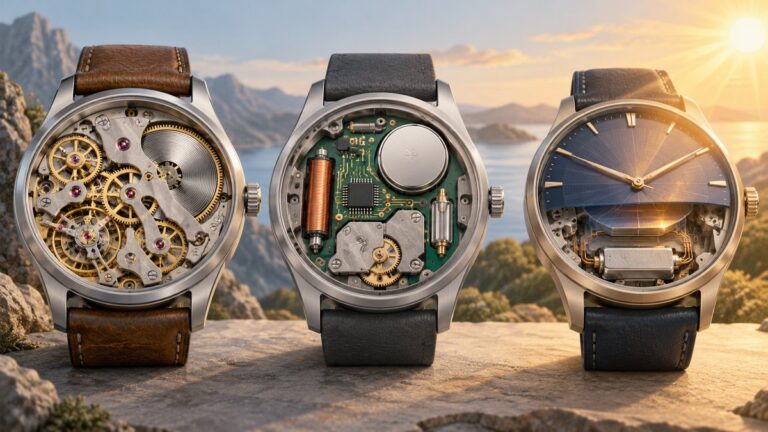
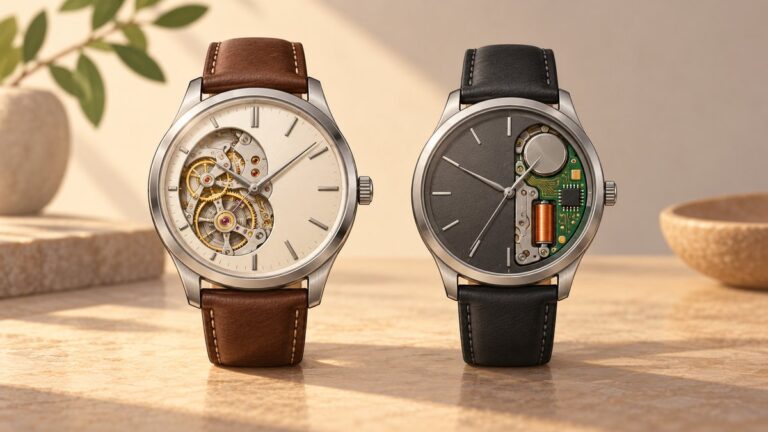
The best moon-phase watch depends on what you value most: quartz for the most stable timekeeping and low interaction, or mechanical for the winding ritual and visible horological character. Case size is a separate decision; a 40 mm watch wears more discreetly than a 43 mm model, but lug shape and thickness still determine comfort. A conventional moon-phase display follows a 29.53-day synodic month and usually needs correction about every three years. Service intervals vary widely by brand, from checks every 18–24 months to recommendations of eight to ten years, so the maker’s guidance matters more than a universal rule.
At a glance
| Name | Best for | Key spec | Checked |
|---|---|---|---|
| Quartz moon-phase movement | Stable timekeeping and infrequent wear | Luminox example: -0.5 to +0.7 seconds per day; battery-powered | Oct 2026 |
| Automatic moon-phase movement | Mechanical interaction and wrist-worn use | Typical power reserve 38–48 hours; rate varies by calibre | Oct 2026 |
| 40 mm class: Baume & Mercier Clifton 10872 | Moderate wrist presence and easier cuff clearance | 40 mm case diameter; automatic | Oct 2026 |
| 43 mm class: Baume & Mercier Riviera 10682/10681 | Larger visual presence | 43 mm case diameter; automatic | Oct 2026 |
What does a moon-phase watch actually show?
A moon-phase indicator represents the lunar cycle, specifically the interval between two successive new moons. Patek Philippe defines the complication in those terms. It is primarily an astronomical and aesthetic display rather than a function required for ordinary timekeeping.
As an Amazon Associate I earn from qualifying purchases.
What’s actually slowing this PC down?
Pick the symptom - the matching free tool is one click away.
The display normally uses a rotating disc printed with two moon images. As the disc advances, one image appears to wax, become full, and wane before the next image takes its place. The indication is meaningful only when it is set correctly to the current lunar age; it is not a substitute for a full astronomical almanac or a local prediction of when the Moon rises.
How does the moon-phase mechanism work, and why does it need resetting?
Most traditional designs use a 59-tooth wheel carrying two moon images. A finger advances the wheel once every 24 hours, so one complete rotation represents two nominal 29.5-day lunar cycles.
Popular on Amazon

- 40mmmm stainless steel case
- 8 inch brown two- piece quick release
- blue dial
- mineral glass lens
- water resistant up to 50 meters
Where the small error comes from
Baume & Mercier states that a synodic month lasts exactly 29.53 days. Two 29.5-day cycles on a conventional 59-tooth display therefore fall slightly short of the astronomical cycle. The accumulated difference is small, but Baume & Mercier says this type of display should be corrected approximately every three years.
That interval describes the conventional mechanism, not every moon-phase calibre. More elaborate designs can use different gearing and correction periods, so the owner’s manual is the authority for a particular reference.
How to correct the display safely
The procedure is model-specific. Patek Philippe’s guidance illustrates the correct approach: consult the user guide, use a reliable full-moon calendar, count the elapsed days from the last full moon including the setting day, and press the designated corrector that many times.
- Confirm the watch reference and calibre in the user guide.
- Find the date of the most recent full moon in a full-moon calendar.
- Count every day from that date through the day on which you are setting the watch, including the full-moon date.
- Use only the correct pusher or crown position specified for that calibre.
- Advance the moon disc one day at a time until the display matches the calculated lunar age.
- Return the crown and pushers to their secured positions after adjustment.
Never force a pusher, use a tool that is not specified, or improvise a sequence based on another watch. Crown and pusher layouts differ by movement, and incorrect manipulation can damage the setting works or compromise water resistance.
What size moon-phase watch should I buy?
Start with case diameter, then judge how the complete case sits on your wrist. Diameter is a useful first filter, but it does not reveal lug-to-lug length, thickness, curvature or crown position; the published entries for the examples below do not provide those measurements.
Also popular on Amazon

- 14K GOLD PLATED VINTAGE DRESS WATCH – Features an elegant gold tone case with a clean dial and bold Arabic numerals, designed for men who appreciate classic vintage style. Suitable as an everyday wear watch or for formal occasions, this analog watch effortlessly elevates any outfit.
- SUN MOON PHASE DISPLAY – The decorative sun-moon phase dial adds a sophisticated vintage complication that sets this timepiece apart from ordinary mens dress watches. A stunning conversation piece and a standout feature among gold tone analog watches for men.
- ACCURATE JAPANESE QUARTZ MOVEMENT – Powered by a precise Japanese quartz movement for reliable everyday timekeeping with minimal maintenance. Built to last and backed by the Peugeot reputation for quality affordable luxury watches for men.
- GENUINE LEATHER STRAP – Soft, durable, and fully adjustable genuine leather band fits a range of wrist sizes comfortably. Perfect as a mens leather watch for the office, date nights, weddings, or any special occasion.
- PEUGEOT LIFETIME WARRANTY & GIFT READY – Every Peugeot watch is backed by a Lifetime Warranty including free battery replacement for the life of the watch. Arrives beautifully gift boxed — ideal as a birthday gift, anniversary gift, graduation gift, or holiday gift for men.
40 mm class: restrained and versatile
Baume & Mercier lists the Clifton 10872 at 40 mm. This size is a sensible starting point if you want the moon display to remain part of an understated dress or daily-wear watch, need easier clearance under a shirt cuff, or prefer less visual mass.
Free tools Windows power users keep installed
One-click scans. No signup required.
43 mm class: more presence on the wrist
The same maker lists the Riviera 10682 and 10681 at 43 mm. The additional three millimetres create a larger dial and stronger wrist presence, which can help the moon disc and date display read more easily. The trade-off is that a larger case may overhang a narrow wrist or feel restrictive under close-fitting sleeves.
Use fit, not a universal wrist rule
- Measure your wrist circumference and compare it with photographs of the watch on a wrist of similar size.
- Check whether the lugs extend beyond the sides of your wrist when viewed from above.
- Consider thickness and cuff clearance, even when the diameter looks suitable.
- Assess crown placement and case edges if you wear the watch on your dominant hand.
- Choose the size that remains comfortable for several hours, not merely the one that looks largest in a product photograph.
A 40 mm case is not automatically correct for a small wrist, nor is 43 mm automatically unsuitable for a large one. The dial layout, lug shape and thickness can change the way either diameter wears.
Are quartz moon-phase watches more accurate than automatic ones?
Generally, yes. Maurice Lacroix says quartz watches are usually more precise. Quartz uses a battery-powered oscillator and is commonly evaluated over a month, while Citizen explains that mechanical accuracy is assessed day by day and changes with winding state, temperature, position and use.
| Movement type | Published example | What the figure means |
|---|---|---|
| Quartz | Luminox: -0.5 to +0.7 seconds per day (publication year not stated) | Typical daily deviation cited by Luminox; it is a manufacturer-specific example, not a promise for every quartz moon-phase calibre. |
| Mechanical | Luminox: -10 to +40 seconds per day (publication year not stated) | Typical daily deviation cited by Luminox; position, winding state, temperature, shocks and magnetism can alter the rate. |
| Mechanical | Victorinox: -2 to +20 seconds per day (publication year not stated) | Victorinox’s published mechanical guidance, tied to its maintenance recommendation. |
These ranges come from the named manufacturers and should not be treated as a universal specification for every moon-phase movement. A watch that gains or loses a few seconds each day can still be functioning within its maker’s stated tolerance, while a sudden change in rate may indicate magnetism, shock, low amplitude or a service need.
Also popular on Amazon

- For a touch of modern elegance and functionality, the women’s Calendrier not only tracks the phases of the moon, but also displays the time, month, day, and date.
- The mother-of-pearl dial in a beautiful blue hue is inset with diamond accents and has reflective qualities.
- Due to the iridescent properties of mother-of-pearl, no two dials are alike in color and tone, creating a unique look.
- Along with a versatile 37mm silver-tone stainless steel case and bracelet, it runs on Eco-Drive technology, meaning it’s sustainably powered by any light and never needs a battery
- Blending elevated style and advanced features into one elegant timepiece.
When quartz is the better choice
- You want the display to show the correct time when the watch is picked up after days or weeks in a drawer.
- You prefer minimal winding, resetting and rate monitoring.
- You value the most stable day-to-day timekeeping available in this comparison.
- You are comfortable replacing the battery through an appropriate service channel when it is depleted.
When automatic or manual mechanical is the better choice
- You enjoy the tactile relationship with a spring, balance and winding system.
- You accept that the watch can gain or lose seconds each day and may need occasional time correction.
- You want the visual and mechanical character of a traditional complication rather than maximum convenience.
- You will wear the watch often enough to keep an automatic movement wound, or you do not mind winding it after it stops.
Manual-winding and automatic watches share the mechanical trade-off of rate variation. An automatic winds from wrist motion; a manual watch requires deliberate winding, but both can stop when their stored energy is exhausted.
Is an automatic moon-phase watch practical if I do not wear it every day?
It is practical if you accept that it may stop and require winding and resetting. Victorinox describes typical automatic power reserves of 38–48 hours depending on model, and Patek Philippe gives the same range for many self-winding watches, with model-specific exceptions.
What happens when the power reserve runs down?
The hands stop, and the moon-phase indication no longer advances. After winding, you must set the time and check the moon display; depending on how long the watch was stopped, the lunar correction can require more button presses than a simple one-day adjustment.
Is a watch winder necessary?
No. Maurice Lacroix presents an automatic watch winder as an option for an automatic watch that is not worn regularly, not as a requirement. A winder can keep the movement running, but it also keeps the watch operating continuously when you may prefer to let it rest; follow the movement maker’s winding instructions rather than choosing a rotation program at random.
Windows Errors? Fix Them Before They Spread
Repair common Windows errors and clear accumulated junk for a smoother, more stable PC - no reinstall needed.Free scan · no reinstallOutdated Drivers Are Slowing You Down
One free scan finds every outdated or missing driver and matches the right update for your exact hardware.Free scan · exact hardware matchA low-interaction storage routine
- Store the watch in a dry, stable location away from strong magnetic fields and impact.
- When you put it back on, wind it only as the manual specifies.
- Set the time first, then correct the moon phase using the model’s designated procedure.
- Check that the crown is fully secured before exposing the watch to moisture.
How often does a moon-phase watch need servicing?
There is no single industry-wide interval. Published guidance ranges from frequent maintenance checks to an eight-to-ten-year service recommendation, and the right schedule depends on calibre, climate, use, water exposure and the brand’s warranty policy.
Also popular on Amazon

- Timeless styling that effortlessly takes you from work to play.
- Analog Month/Day/Date, Moonphase Indicator
- Black Stainless Steel
- Spherical Mineral Crystal
- 100 Meters Water Resistant and 5 Year Limited Warranty
| Manufacturer | Published guidance | What it covers |
|---|---|---|
| Patek Philippe | Service quartz and mechanical watches every eight to ten years | Use an official service centre or authorised retailer; the interval is broad and should be adjusted if the watch shows a problem. |
| Victorinox | Maintenance every 18–24 months; complete overhaul about every six years | Maintenance can include regulation, water-resistance control, cleaning and replacement of worn parts. |
| Maurice Lacroix | Maintenance every two to three years; complete overhaul every four to five years | Interval stated in the maker’s maintenance guidance. |
| Panerai | Check every two to three years, or every year for watches used in water activities | Shorter checks reflect ageing gaskets and the risk that shocks or wear have compromised water resistance. |
The differences are not contradictory: manufacturers set schedules for their own movements, seals, lubricants and service standards. A moon-phase mechanism can add labour and parts complexity, and Panerai notes that service cost varies with movement complexity, labour time and spare parts. No general price can be stated responsibly without the exact reference and region.
Signs that justify service before the calendar interval
- The watch gains or loses substantially more time than its stated guidance.
- The moon disc, date or hands hesitate, jump or fail to advance.
- The crown feels gritty, loose or difficult to screw down.
- Condensation appears under the crystal.
- The watch has suffered a significant shock or has been exposed to water after a seal may have aged.
Use an official service centre or authorised retailer when the manufacturer directs you there. Keep service records with the watch; they help the technician identify the calibre, previous work and any recurring issue.
How important is water resistance?
Water resistance is a condition that must be maintained, not a permanent feature guaranteed by the number printed on the dial or case. Gaskets age, crowns can be disturbed by impact, and a pressure rating does not show whether the seals are still in serviceable condition.
Quick wins for a faster PC:
Fix the driver behind crashes, sound loss and screen glitchesFind Drivers →Repair Windows errors before they cause bigger problemsFix Now →Scan for outdated or missing drivers - takes under a minuteDriver Scan →Panerai recommends checks every two to three years and annually for watches used in water activities. Victorinox includes water-resistance control in its maintenance description. If you regularly swim, sail or work around water, use the shorter, water-use schedule and have the seals checked by an authorised service channel.
Independent reader supportYour contribution helps us test, update, and keep practical guides available for everyone.What should I check before buying a moon-phase watch?
- Confirm the movement type. Decide whether quartz precision or mechanical interaction better fits your wearing routine.
- Read the exact accuracy guidance. Treat a manufacturer’s seconds-per-day figure as a calibre-specific example, not a guarantee for every model.
- Compare case diameter and fit. Use 40 mm and 43 mm as concrete reference classes, then verify lug-to-lug length, thickness and wrist comfort.
- Learn the correction method. Make sure the user guide explains the corrector location and any restrictions on when to adjust the display.
- Check the power reserve. For an automatic watch, a stated 38–48-hour reserve indicates whether it will still be running after a weekend off the wrist.
- Map the service policy. Record the maker’s recommended maintenance and overhaul intervals before purchase, especially if the watch will see water or heavy daily use.
- Budget for specialist work. Moon-phase parts add complexity, so ask an authorised centre for a reference-specific estimate rather than assuming a standard three-hand service price.
Common buying and ownership mistakes
- Choosing by diameter alone: a 43 mm case can wear compactly with short lugs, while a 40 mm case can feel large if it is thick or has long lugs.
- Assuming every moon phase is equally accurate: a conventional 59-tooth display normally needs correction about every three years, while other calibres may differ.
- Comparing seconds-per-day figures as universal ratings: Luminox and Victorinox publish different mechanical ranges for their own guidance.
- Leaving an automatic unwound without a plan: stopping is normal, but the next use requires winding and resetting.
- Using another model’s setting instructions: pusher positions and safe adjustment procedures are calibre-specific.
- Waiting for a leak before checking seals: water-resistance inspections are preventive maintenance, particularly for watches used in water.
FAQ
What does a mechanical watch’s “daily rate” mean?
Daily rate is the number of seconds a movement gains or loses over a 24-hour period compared with a reference time. It is a rate, not a single permanent error: the value can change when the watch is placed dial-up, crown-down, fully wound or nearly unwound.
Also popular on Amazon
- To the moon and back - track the lunar phases with striking analog timepieces featuring multiple inset dials
- These timepieces bring together stylish fashion and classic lunar design
- Case size (L? W? H): 44.5 ? 34 ? 9.4 mmCase and bezel material: Stainless steel Band: Genuine Leather BandWater resistance: 50-meter water resistancePower supply and battery life: Approx
How can I identify the correct moon-phase setting instructions?
Use the watch’s reference and calibre number, usually found in the warranty or service paperwork, and match them to the maker’s user guide. If those records are missing, an authorised service centre can identify the movement before you operate any corrector.
Why might a moon-phase display be wrong even when the hands keep good time?
The time train and the moon-phase train are separate parts of the movement. A conventional moon display accumulates a small calendar error independently of the watch’s daily timekeeping, which is why it can need a periodic lunar correction even when the hands remain accurate.
Do these 3 things before closing this tab:
1Repair Windows errors before they cause bigger problems2Scan for outdated or missing drivers - takes under a minute3Clear out junk files and repair common Windows errorsShould water-use service be scheduled differently from ordinary wear?
Yes. Panerai recommends an annual check for watches used in water, compared with every two to three years for ordinary use. The shorter interval is intended to detect ageing gaskets or impact-related loss of water resistance before exposure causes damage.
Frequently Asked Questions
What does a mechanical watch’s “daily rate” mean?
Daily rate is the number of seconds a movement gains or loses over a 24-hour period compared with a reference time. It is a rate, not a single permanent error: the value can change when the watch is placed dial-up, crown-down, fully wound or nearly unwound.
How can I identify the correct moon-phase setting instructions?
Use the watch’s reference and calibre number, usually found in the warranty or service paperwork, and match them to the maker’s user guide. If those records are missing, an authorised service centre can identify the movement before you operate any corrector.
Why might a moon-phase display be wrong even when the hands keep good time?
The time train and the moon-phase train are separate parts of the movement. A conventional moon display accumulates a small calendar error independently of the watch’s daily timekeeping, which is why it can need a periodic lunar correction even when the hands remain accurate.
Should water-use service be scheduled differently from ordinary wear?
Yes. Panerai recommends an annual check for watches used in water, compared with every two to three years for ordinary use. The shorter interval is intended to detect ageing gaskets or impact-related loss of water resistance before exposure causes damage.
Quick Recap
Product prices and availability are accurate as of the date/time indicated and are subject to change. Any price and availability information displayed on Amazon at the time of purchase will apply.