Some links on this page are affiliate links: if you buy through them we may earn a commission, at no extra cost to you.
For a chronograph you can set, wear and trust with minimal attention, choose quartz. A quartz chronograph is generally more accurate, keeps running for years while unworn and restarts immediately after storage. An automatic chronograph is less precise and can stop after a day or two off the wrist, but it delivers the tactile experience of a self-winding mechanical movement: a rotor winding a mainspring, a visible mechanical display and a traditional chronograph mechanism. The stopwatch function itself exists in both types. Your choice therefore comes down to precision and convenience versus mechanical interaction, finishing and watchmaking interest.
What is the difference between a quartz and an automatic chronograph?
A chronograph is a watch with a stopwatch function: pushers start, stop and reset elapsed-time indications. “Chronograph” describes that complication, not the way the watch keeps time. Quartz and automatic refer to the movement that regulates the watch.
As an Amazon Associate I earn from qualifying purchases.
What’s actually slowing this PC down?
Pick the symptom - the matching free tool is one click away.
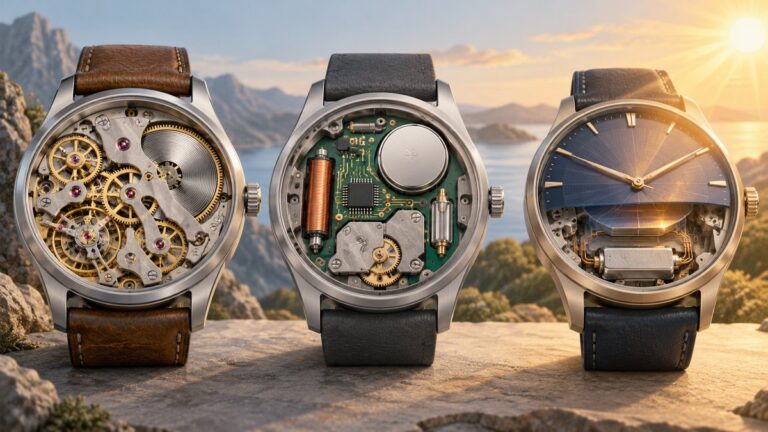
In a quartz chronograph, a battery powers an integrated circuit and a quartz oscillator. The Federation of the Swiss Watch Industry describes the oscillator as vibrating at about 32 kHz, providing a stable electronic timing reference. In an automatic chronograph, wrist motion turns a rotor, which winds a mainspring. The spring releases energy through a mechanical gear train and escapement until its stored reserve runs out.
Neither type is automatically a chronometer. A chronometer is a movement that has passed an official precision-certification process; it is a separate designation from the chronograph stopwatch complication.
Popular on Amazon

- STAINLESS STEEL BRACELET for a durable and timeless accessory paired with a multi-row design that enhances the style of this analog watch
- BOX-SHAPED CRYSTAL adding a sophisticated touch and enhancing the smooth curves of the profile, creating a pleasing shape on the wrist
- MULTI-FUNCTION CHRONOGRAPH with precise timekeeping and a nod to automotive elegance
- WATER RESISTANT DESIGN ensures your wrist watch is ready for any adventure, rain or shine
- HIGH-CONTRAST SUBDIALS for superior visibility and a vintage appeal in this stylish analog watch
Quartz movement
Quartz regulation uses electrical energy and a high-frequency oscillator. The circuit divides the oscillator’s vibration into regular pulses that drive the hands and chronograph timing system. Because the reference is electronic and the mechanism has fewer continuously moving regulating parts, daily accuracy is normally much less affected by position, wear or a partially wound spring.
Automatic movement
An automatic movement is mechanical but self-winding. Moving your wrist spins the rotor, adding energy to the mainspring. If the watch is left off the wrist, it runs only until that reserve is exhausted. Position, temperature, magnetism, shocks and the winding state can all influence its rate, so two examples of the same calibre may not keep identical time in every situation.
Meca-quartz movement
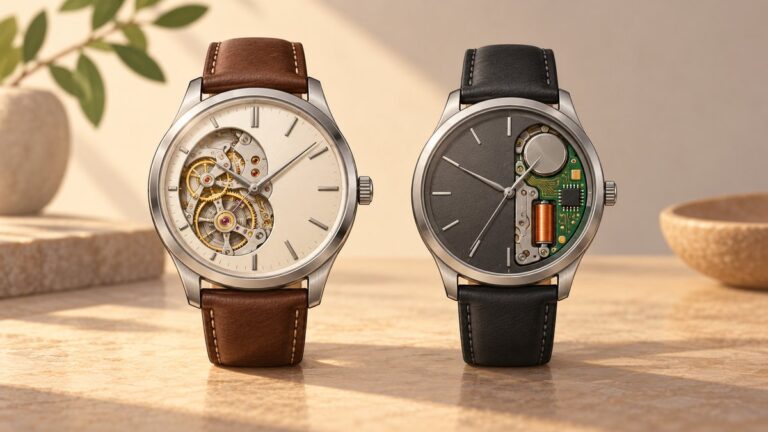
Meca-quartz is a hybrid option. Quartz regulates the timekeeping, while a mechanical module actuates the chronograph. Timex describes the arrangement as quartz-powered timekeeping combined with a mechanical chronograph module that can produce a smooth, sweeping chronograph-seconds hand. It is not an automatic movement: it does not use wrist motion to wind a mainspring.
Which is more accurate, quartz or automatic?
Quartz is the clear choice when measured timekeeping is the priority. Manufacturer guidance commonly expresses quartz performance in seconds per week or month, while mechanical performance is normally stated in seconds per day. Mechanical rates also vary with position, temperature, magnetism, shocks and how fully the mainspring is wound.
| Published guidance | Quartz | Mechanical or automatic |
|---|---|---|
| Baume & Mercier FAQ (publication year not stated on page) | Approximately 1–2 seconds per week | Approximately 1–2 minutes per week |
| Victorinox guidance (publication year not stated on page) | Battery life is approximately 24 months; a rate figure is not stated in the cited guidance | -2 to +20 seconds per day for mechanical movements |
| Chopard guidance (publication year not stated on page) | Approximately 0.10 seconds per day | Around -4 to +6 seconds per day for a luxury mechanical movement |
These are manufacturer specifications and guidance, not a single laboratory comparison or a promise that every model will achieve the same result. The figures also describe broad movement categories; an individual calibre may have a tighter or wider stated tolerance. If you need a chronograph for repeated timing, travel, work shifts or simply dislike resetting a watch, quartz removes most of the daily rate-management burden.
What happens when each watch is left unworn?
A quartz chronograph normally keeps running until its battery is depleted. The cited care guidance places quartz battery life at about two to three years in one manufacturer reference, while Victorinox cites approximately 24 months. A chronograph can consume more energy than a simple three-hand quartz watch because the stopwatch circuitry and motors may add load.
An automatic chronograph stops when its mainspring’s reserve is exhausted. Patek Philippe’s care guidance gives 38–48 hours for self-winding movements, a range also represented by the cited automatic examples. A watch removed on Friday can therefore be stopped by Sunday or Monday, depending on its calibre and how fully it was wound. Once stopped, it must be set again before use.
| Situation | Quartz chronograph | Automatic chronograph |
|---|---|---|
| Stored for a few days | Usually still running | May stop when the reserve runs out |
| Stored for months | Usually runs until the battery reaches end of life | Will be stopped and require resetting |
| Restart after storage | Set the time if needed and use the pushers normally | Restore energy and reset the time and any calendar indications according to the maker’s instructions |
| Long-term energy task | Periodic battery replacement | Regular wearing or winding, plus mechanical servicing |
This difference matters most to owners who rotate several watches. Quartz is effectively ready whenever you pick it up. An automatic rewards regular wear but makes a stopped-and-reset cycle part of ownership.
How do the stopwatch functions compare?
Both movements can provide the same basic user sequence: press a pusher to start the elapsed-time hand, press again to stop, then press reset. The movement type does not by itself determine the scale, sub-dial layout or legibility of the display; those are model and dial-design decisions.
Quartz chronograph operation
Quartz regulation gives the stopwatch a stable electronic time base. It is well suited to frequent starts and stops, and the watch can remain accurate while the chronograph is used repeatedly. Because chronograph functions draw additional battery power, heavy use may shorten the interval before a battery change compared with a non-chronograph quartz watch.
Automatic chronograph operation
An automatic chronograph uses a mechanical switching and recording system powered by the mainspring. The pusher feel, reset action and motion of the chronograph hand are part of the mechanical appeal, but the elapsed-time indication inherits the movement’s position and environmental sensitivities. A fully wound movement may not show the same rate as one near the end of its reserve.
What a smooth sweep does—and does not—mean
A smooth-looking chronograph-seconds hand is not proof that a watch is automatic. Meca-quartz hybrids can create that mechanical-style action while quartz continues to regulate the timekeeping. Check the movement description rather than inferring the mechanism from hand motion alone.
Also popular on Amazon

- WATER RESISTANT MEN'S WATCHES: Up to 100m (330ft) this Fossil watch men is suitable for bathing, swimming or snorkeling, but is not resistant enough to withstand scuba diving; 10 ATM
- CASE & MOVEMENT: Fossil mens watch includes a 44mm case, 22mm band width, hardened mineral crystal lens that resists scratches, Quartz movement with chronograph analog watch display & date window, 3 subdials to track minutes, seconds & 24-hour time
- TIMELESS: Building off a classic design, a leather cuff adds rugged appeal to this steel chronograph watch; built to outlast trends, this Fossil watch for men offers ageless style & effortless wearability, and is an investment fit for any occasion
- WRIST WATCH BAND: Brown, genuine leather cuff band with a secure adjustable buckle closure for a customized fit of this men's wristwatch; interchangeable with all Fossil 22mm straps
- DIAL: One of many Fossil watches for men, this quartz watch is a style accessory that features a round silver stainless steel case with a tan brown dial, and wood accents
Which movement is easier to maintain?
Quartz maintenance is predictable: plan for a battery replacement roughly every two to three years, with the exact interval depending on the calibre and how the chronograph is used. A battery change is also an opportunity to inspect seals, especially if the watch is regularly exposed to water. Use the battery number specified for the exact model and have the work performed according to the maker’s service guidance.
The documented Timex Marlin Quartz Chronograph 40mm (TW2Y72100) lists an SR936SW battery. That number applies to that model listing; do not assume it fits another chronograph without checking its case-back markings or instructions. A replacement part with the wrong specification can cause poor contact, leakage risk or failure to run.
Automatic chronographs need mechanical regulation and periodic servicing rather than routine battery changes. Service intervals vary by movement and manufacturer, so follow the brand’s schedule. Care guidance emphasizes that mechanical rate is affected by shocks, magnetism, temperature, position and winding state. Avoid treating a stated seconds-per-day tolerance as a permanent guarantee when the watch has been exposed to those conditions.
Is a watch winder necessary?
A watch winder is an optional convenience for someone rotating automatic watches who wants one to remain running. It is not required to keep an automatic movement healthy. A stopped watch can simply be reset and restarted using the manufacturer’s instructions, so a winder should solve a convenience problem rather than be treated as mandatory equipment.
Which is better for everyday use?
Choose the movement according to the task you actually perform, not only the movement label.
| Your priority | Better fit | Why |
|---|---|---|
| Highest practical accuracy | Quartz chronograph | Quartz is normally specified in much smaller time errors and is less condition-sensitive. |
| Immediate readiness after days in a drawer | Quartz chronograph | It generally keeps running until its battery is depleted. |
| Frequent stopwatch use | Quartz chronograph | Stable regulation and low daily interaction suit repeated timing. |
| Mechanical craftsmanship and interaction | Automatic chronograph | The rotor, mainspring, escapement and switching mechanism are part of the ownership experience. |
| Enjoying a watch as a small machine | Automatic chronograph | Winding behavior, movement finishing and the changing rate are inherent to the design. |
| Mechanical feel without an automatic reserve | Meca-quartz chronograph | It combines quartz timekeeping with a mechanical chronograph module. |
“Better” therefore has two valid meanings. Quartz is better as an instrument you want to set once and trust. Automatic is better if the act of wearing, winding and observing a mechanical movement is itself the reason you want a chronograph.
Free tools Windows power users keep installed
One-click scans. No signup required.
What should you compare before buying a chronograph?
Once you have chosen a movement family, compare the watch as a complete instrument. A reliable movement cannot compensate for a dial that is difficult to read or a case that does not suit your wrist.
Accuracy specification and real use
Read the maker’s stated tolerance and its unit. “Seconds per day” and “seconds per month” are not interchangeable, and a range may describe a test condition rather than every position on the wrist. If your use involves timing appointments or travel, prioritize the tighter and more clearly qualified specification.
Power management
For quartz, confirm the expected battery interval and whether the chronograph has a documented battery-saving behavior. For automatic, check the stated power reserve and decide whether a 38–48-hour reserve suits your wearing pattern. A longer reserve can reduce reset frequency, but it does not remove the need for servicing.
Chronograph readability
Check the scale, hand contrast, sub-dial spacing and pusher layout in the conditions where you will use it. A crowded dial can make a technically precise stopwatch difficult to read. Confirm whether the chronograph records seconds, minutes or hours and whether the reset hand returns cleanly to zero.
Case, strap and water resistance
Compare diameter, thickness, lug shape, crystal and strap material against your wrist and clothing. Water resistance is a model specification, not a movement characteristic. The Timex Marlin Quartz Chronograph 40mm, for example, is listed with a 40 mm stainless-steel case and 50-meter water resistance; those figures belong to that reference and should not be generalized to every quartz chronograph.
Service access and parts
Check where battery replacement or mechanical service can be performed and whether the manufacturer specifies a particular cell, seal or procedure. Retain the exact reference number: the Marlin listing’s SR936SW battery is useful only when it matches the watch’s documented requirement.
Also popular on Amazon

- WATER RESISTANT MEN'S WATCHES: Up to 100m (330ft) this Fossil watch men is suitable for bathing, swimming or snorkeling, but is not resistant enough to withstand scuba diving; 10 ATM
- CASE & MOVEMENT: Fossil mens watch includes a 44 mm case, 22mm band width, hardened mineral crystal lens that resists scratches, Quartz movement with chronograph analog watch display & date window, 3 subdials to track minutes, seconds & 24-hour time
- TIMELESS: Building off a classic design, a leather cuff adds rugged appeal to this steel chronograph watch; built to outlast trends, this Fossil watch for men offers ageless style & effortless wearability, and is an investment fit for any occasion
- WRIST WATCH BAND: Brown, genuine leather cuff band with a secure adjustable buckle closure for a customized fit of this men's wristwatch; interchangeable with all Fossil 22mm straps
- DIAL: One of many Fossil watches for men, this quartz watch is a style accessory that features a round silver stainless steel case with a black dial, and orange accents
What are concrete examples of quartz and hybrid layouts?
Product specifications illustrate how movement labels translate into a watch you can wear, while not replacing a comparison of every model’s tolerance and service terms.
| Model example | Movement and function | Published specifications |
|---|---|---|
| Timex Marlin Quartz Chronograph 40mm (TW2Y72100) | Quartz analog movement with chronograph stopwatch | SR936SW battery; 40 mm stainless-steel case; 50-meter water resistance |
| Timex Q Timex Continental Chronograph 40mm (TW2Y55800) | Meca-quartz hybrid | Quartz timekeeping with a mechanical chronograph module |
The first example shows the conventional battery-powered route: a specified cell, analog display and stopwatch function. The second shows why “chronograph hand sweep” is not enough to identify an automatic movement; the hybrid architecture can provide a mechanical-style chronograph action while retaining quartz regulation.
Do these 3 things before closing this tab:
1Clear out junk files and repair common Windows errors2Scan for outdated or missing drivers - takes under a minute3Repair Windows errors before they cause bigger problemsWhat are the main trade-offs in ownership?
Accuracy versus mechanical character
Quartz minimizes adjustment. Automatic ownership makes the movement’s behavior visible: the rotor winds as you move, the reserve changes as the watch rests and the rate can shift with orientation or environment. Neither experience is inherently superior; they answer different reasons for wearing a watch.
Convenience versus participation
A quartz chronograph asks you to replace a battery periodically. An automatic asks you to manage reserve and service, and possibly to reset it after a weekend off the wrist. Decide which occasional task you would rather perform.
Dependence on conditions
Quartz is generally less affected by the conditions listed in mechanical care guidance. Automatic owners should be more deliberate about shocks, strong magnetic fields, temperature changes and storage position, especially when a small change in rate matters.
Longevity and service reality
Both types require care. Quartz needs a timely battery change and seal attention; automatic needs cleaning, lubrication, regulation and eventual replacement of worn components. The movement that best fits you is the one whose maintenance pattern you will actually follow.
Quick wins for a faster PC:
Fix the driver behind crashes, sound loss and screen glitchesFind Drivers →Clear out junk files and repair common Windows errorsFree Scan →How should you decide between quartz, automatic and meca-quartz?
- Define the timing job. If you will use the stopwatch often or need the least drift, start with quartz. If timing is occasional and the watch is primarily an object of mechanical interest, consider automatic.
- Measure your wearing pattern. Someone who wears one watch most days may keep an automatic supplied with energy. Someone who alternates watches or stores them for weeks will find quartz easier to retrieve ready to wear.
- Set your tolerance for resetting. Accept that an automatic can stop after its reserve is exhausted. If that is irritating, choose quartz or a hybrid.
- Choose the interaction you want. Select automatic for rotor movement, mainspring behavior and traditional mechanical construction. Select meca-quartz for a mechanical-feeling chronograph action without giving up quartz-regulated timekeeping.
- Verify the complete specification. Check accuracy units, reserve or battery interval, case dimensions, water resistance, legibility, service instructions and the exact reference number before purchase.
- Plan ownership costs and care. Budget for battery and seal work on quartz or mechanical servicing on automatic. Treat a winder as optional convenience, not a requirement.
The practical verdict is straightforward: a quartz chronograph is the stronger all-purpose timing tool, an automatic chronograph is the richer mechanical hobby, and a meca-quartz chronograph sits between them for buyers who want quartz precision with a more mechanical stopwatch feel.
Frequently Asked Questions
Does “chronometer” mean the chronograph is automatic?
No. Chronograph identifies the stopwatch function, while chronometer identifies an officially tested precision certification. A quartz chronograph can be certified if it meets the relevant standard; the terms describe different properties.
Will using the stopwatch drain a quartz chronograph faster?
It can. The chronograph circuitry and motors add energy demand compared with a simple three-hand quartz watch, so intensive stopwatch use may shorten the interval before the next battery replacement.
Is a mechanical-looking sweep proof that a watch is automatic?
No. Meca-quartz hybrids can use quartz regulation and a mechanical chronograph module to create a smooth-looking chronograph-seconds hand. Confirm the movement description and winding system instead of judging by hand motion.
The Tool Desk
Outbyte Driver Updater FREEScan for outdated or missing drivers - takes under a minuteDriver Scan →Outbyte PC Repair FREEClear out junk files and repair common Windows errorsFree Scan →Should I buy a watch winder for an automatic chronograph?
Only if keeping a rotating watch collection running is worth the added convenience to you. A winder is not required for movement health; a stopped watch can be restarted and reset according to its manufacturer’s instructions.