Some links on this page are affiliate links: if you buy through them we may earn a commission, at no extra cost to you.
A good fitness wearable should match the way you exercise, not merely count steps. The right choice depends on whether you need independent GPS, reliable sleep data, a small band, a full smartwatch, long battery life, or a device that works without a monthly bill.
We tested these trackers and watches for comfort, battery life, workout recording, heart-rate performance, software, and value. The list below includes our established recommendations plus the buying caveats that matter in 2026: phone compatibility, subscription costs, connected versus built-in GPS, and the difference between manufacturer battery claims and real use.
As an Amazon Associate I earn from qualifying purchases.
Crashes, No Sound, or Screen Glitches?
Random freezes, missing sound and display glitches usually trace back to one bad driver. Find and replace yours safely.Free scan · under a minuteWindows Errors? Fix Them Before They Spread
Repair common Windows errors and clear accumulated junk for a smoother, more stable PC - no reinstall needed.Free scan · no reinstallUpdate note: the original recommendation set was last formally updated on January 23, 2026, with availability and currency checked on January 25. Newer models—including the Fitbit Air, Oura Ring 5, Garmin Vivoactive 6, Pixel Watch 4, and Garmin Cirqa—now deserve consideration where available, but the tested devices below remain the clearest choices for their specific jobs.
Our top fitness trackers and watches for 2026
| Category | Our pick | GPS | Battery | Best for |
|---|---|---|---|---|
| Best tracker for most people | Fitbit Charge 6 | Built-in | Up to 7 days claimed | Everyday activity, sleep, and workouts |
| Best for iPhone | Apple Watch Series 11 | Built-in | Up to 24 hours claimed | iPhone owners who want a smartwatch |
| Best Android smartwatch | Samsung Galaxy Watch 8 | Built-in | Up to 30 hours with always-on display | Android users wanting apps and health tools |
| Best inexpensive Fitbit | Fitbit Inspire 3 | Connected only | Up to 8 days | Low-cost activity and sleep tracking |
| Best small, stylish tracker | Garmin Lily 2 | Connected only | Up to 5 days tested | Small wrists and discreet styling |
| Best practical Garmin watch | Garmin Venu Sq 2 | Built-in | About 8 days tested | Long battery life and everyday training |
| Best smart ring | Oura Ring 4 | None | Several days, depending on size and use | Sleep, recovery, and screen-free wear |
| Best budget Android band | Samsung Galaxy Fit3 | None | About 7.5 days tested | Basic tracking on an Android phone |
| Best budget Apple Watch | Apple Watch SE 3 | Built-in | Daily charging is likely | Affordable iPhone smartwatch features |
| Best Garmin for music and wellness | Garmin Vivoactive 5 | Built-in | Up to 11 days claimed | Music, wellness, and general fitness |
| Best running tracker | Polar Pacer Pro | Built-in | About one week | Structured running and recovery data |
| Best tracker for children | Fitbit Ace 3 | None | Several days | Simple activity tracking for ages 6–12 |
Battery figures marked “claimed” come from the manufacturer or product specification. “Tested” figures reflect our use and should not be compared directly with a laboratory maximum.
Popular on Amazon

- Google Fitbit Air is the unbelievably comfortable, exceptionally smart way to transform your health[1]; and Google Health brings together effortless tracking and adaptive coaching to help make the most of your everyday[2]
- Unlock more with Google Health Premium: With a premium membership, get personalized coaching that’s built with Gemini and adapts to your life[2]; get a 3-month trial at no cost to you[5] (Google Health Premium subscription sold separately)
- Comfortable fit - One Size Tracker (130-210 mm): The lightweight, micro-adjustable fit sits comfortably and quietly, so you can wear Google Fitbit Air through work, play, and sleep; advanced sensors and new algorithms power more accurate, precise health tracking, 24/7[1]
- Designed for every occasion: With no screen to distract you or disrupt your style, your tracker moves seamlessly from bracelet to workout band to sleep band, and you can change looks in seconds – just press the pebble in, click, and go
- Long battery life: Google Fitbit Air’s battery lasts up to a week, and fast charging gets you one day of battery life in just five minutes[6,7]
Best fitness tracker for most people: Fitbit Charge 6
The Fitbit Charge 6 remains the easiest recommendation if you want a slim tracker rather than a full smartwatch. It has a color AMOLED display, built-in GPS, 5ATM water resistance, ECG capability, EDA stress readings, Google Maps, Google Wallet, YouTube Music controls, and more than 40 exercise modes.
Its built-in GPS is important. You can leave your phone behind for a run and still record the route, pace, and distance. Cheaper Fitbit bands such as the Inspire 3 do not offer that independence.
The Charge 6 is compatible with Android 9 or later and iOS 15 or later, but Fitbit now requires a Google Account. Some deeper analysis and coaching tools require Fitbit Premium, so the purchase price is not necessarily the total cost of ownership.
- US price: Check the current retailer price; discounts are common.
- Best feature: The balance of small size, GPS, health sensors, and smart features.
- Main limitation: Advanced Fitbit insights are subscription-dependent, and its training tools are less extensive than those on a Garmin or Polar watch.
Best fitness tracker for iPhone users: Apple Watch Series 11
The Apple Watch Series 11 is the strongest choice for an iPhone owner who wants fitness features and a proper smartwatch in one device. It records workouts with built-in GPS, supports Apple’s health ecosystem, handles notifications and apps well, and is available with cellular connectivity. Cellular models support 5G.
Compatibility is non-negotiable: Apple Watch works with an iPhone, not Android. Apple currently specifies an iPhone 11 or later running iOS 26 or later. Apple rates Series 11 for up to 24 hours of normal use. In our testing, it lasted longer under particular usage conditions, but that result should not be treated as Apple’s official battery rating.
- US price: Check Apple’s current configuration price; cellular and case choices change the total.
- Best feature: The most complete combination of fitness tracking, safety features, apps, and iPhone integration.
- Main limitation: It needs frequent charging and cannot be used with an Android phone.
Best Android-compatible smartwatch: Samsung Galaxy Watch 8
The Samsung Galaxy Watch 8 is the Android counterpart to the Apple Watch: a full smartwatch with built-in GPS, health sensors, apps, notifications, and 5ATM/IP68 durability. Samsung specifies compatibility with Galaxy smartphones running Android 12 or later, and some health functions work best—or only work—with a Samsung phone.
What’s actually slowing this PC down?
Pick the symptom - the matching free tool is one click away.
Samsung quotes up to 30 hours with the always-on display enabled, although screen brightness, cellular use, GPS, and workout frequency can reduce that considerably. It is a better fit for Android users who value a bright watch interface and smartwatch functions than for athletes seeking a week-long training watch.
- US price: Check Samsung’s current price for the selected size and Bluetooth or LTE version.
- Best feature: A polished Android smartwatch experience with independent GPS.
- Main limitation: Compatibility and feature support are not equally broad across all Android phones.
Best inexpensive Fitbit: Fitbit Inspire 3
The Fitbit Inspire 3 is a straightforward band for steps, basic exercise, sleep, and overnight blood-oxygen trends. Its AMOLED screen is clear, the band is comfortable, and its claimed battery life reaches eight days.
It does not have built-in GPS. For an outdoor walk or run, it relies on the phone’s GPS to record route and pace. That is acceptable if you always carry your phone, but it is a meaningful limitation for runners.
- US price: Check current retailer pricing; it is frequently discounted.
- Best feature: A small, inexpensive way to get Fitbit’s basic activity and sleep tracking.
- Main limitation: Connected GPS only, plus subscription-gated metrics.
Best stylish tracker for small wrists: Garmin Lily 2
The Garmin Lily 2 looks more like jewelry than sports equipment. Its narrow body and subtle display make it particularly appealing for smaller wrists or anyone who dislikes the appearance of a large smartwatch.
It works with Android and iPhone and provides useful wellness and activity features, but the compromises are substantial. It has no onboard GPS, no barometric altimeter, and cannot broadcast heart rate to exercise equipment. Outdoor route tracking therefore requires a phone.
- US price: Check the current price, especially for versions with additional accessories.
- Best feature: A discreet design that remains comfortable throughout the day and night.
- Main limitation: Its fitness hardware is less capable than the watch-like design alternatives from Garmin.
Best practical Garmin smartwatch: Garmin Venu Sq 2
The Garmin Venu Sq 2 is a sensible middle ground between a simple tracker and an expensive sports watch. It has an AMOLED display, built-in GPS, Garmin Pay, broad activity tracking, and roughly eight days of battery life in testing.
It is particularly good for people who want to charge once a week rather than every night. Garmin Connect’s core platform remains usable without a required membership, although Garmin Connect+ adds optional paid features.
- US price: Check current availability; older Garmin models can vary sharply by retailer.
- Best feature: Long endurance without giving up an onboard GPS or a bright display.
- Main limitation: It does not count floors climbed and lacks animated workout graphics.
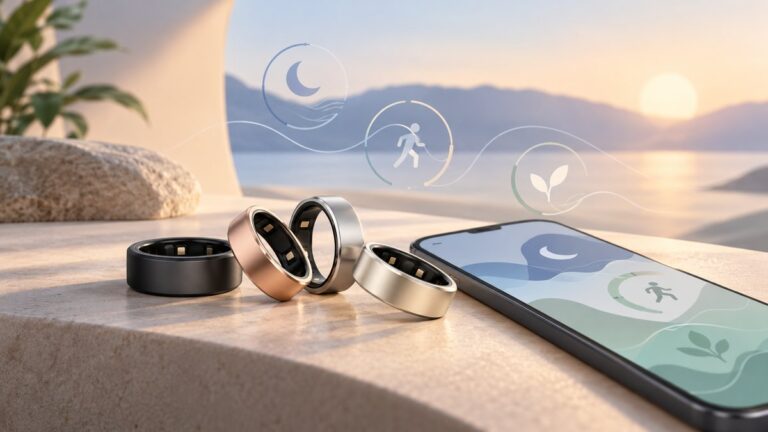
Best finger-based tracker: Oura Ring 4
The Oura Ring 4 is the pick for people who care more about sleep and recovery than live workout information. It tracks activity, sleep, stress, blood oxygen, heart rate, heart-rate variability, respiratory rate, skin temperature, cycle insights, and pregnancy-related insights.
A ring is unobtrusive at night and avoids the screen and notifications of a watch. It is less useful during a detailed training session, however. Workout information is not as comprehensive as what you get from a dedicated running watch, and most of Oura’s valuable analysis requires an ongoing membership.
- US price: Check the current ring price by finish and size, then add the membership cost.
- Best feature: Comfortable, low-distraction sleep and recovery tracking.
- Main limitation: The subscription is central to the experience, and workout features are comparatively limited.
Best entry-level Android band: Samsung Galaxy Fit3
The Samsung Galaxy Fit3 is a lightweight Android band with a large-for-its-class display and support for up to 100 workout types. In testing it lasted about 7.5 days, but it has no built-in GPS.
It is best for someone who wants inexpensive step, sleep, and workout tracking and already carries a Samsung or compatible Android phone. Some functions work best or only work when paired with a Samsung handset.
- US price: Check current regional availability; pricing and official availability can differ by market.
- Best feature: A simple, inexpensive band with a useful screen and good endurance.
- Main limitation: No independent GPS and limited iPhone support.
Best budget Apple Watch: Apple Watch SE 3
The Apple Watch SE 3 brings the core Apple Watch experience to a lower price. It uses the same processor as Series 11 in our testing and offers built-in GPS, workout recording, notifications, safety features, and access to Apple’s watchOS apps.
Free tools Windows power users keep installed
One-click scans. No signup required.
The savings come from omitted health hardware. It lacks blood-oxygen measurement, ECG, water-depth, and water-temperature sensors. Apple lists a US starting price of $249, before optional cellular service and configuration changes.
- US price: Starts at $249 in the US; confirm the current price and cellular options.
- Best feature: The least expensive route into the current Apple Watch platform.
- Main limitation: iPhone-only, with fewer health sensors than Series 11.
Best Garmin for music and wellness: Garmin Vivoactive 5
The Garmin Vivoactive 5 combines built-in GPS with onboard music storage, nap detection, Body Battery, wellness tracking, and Android/iOS compatibility. Its claimed battery life reaches 11 days, making it a strong option for people who want both smartwatch convenience and infrequent charging.
Also popular on Amazon

- Lighter gets mightier with the Google Fitbit Air Special Edition Stephen Curry[1]; including a water resistant coating, it's sweatproof and moisture-wicking for your toughest workouts[2,3]
- Unlock more with Google Health Premium: With a premium membership, get personalized coaching that’s built with Gemini and adapts to your life[2]; get a 3-month trial at no cost to you[5] (Google Health Premium subscription sold separately)
- Comfortable fit - One Size Tracker (130-210 mm): The lightweight, micro-adjustable fit sits comfortably and quietly, so you can wear Google Fitbit Air through work, play, and sleep; advanced sensors and new algorithms power more accurate, precise health tracking, 24/7[1]
- Designed for every occasion: With no screen to distract you or disrupt your style, your tracker moves seamlessly from bracelet to workout band to sleep band, and you can change looks in seconds – just press the pebble in, click, and go
- Long battery life: Google Fitbit Air’s battery lasts up to a week, and fast charging gets you one day of battery life in just five minutes[6,7]
It is not Garmin’s most advanced sports watch. There is no barometric altimeter and no animated workout graphics, which may matter to hikers or users who prefer guided exercises on the watch itself.
- US price: Check current pricing and bundle offers.
- Best feature: Music and broad wellness tracking without daily charging.
- Main limitation: Missing elevation hardware and some advanced training presentation.
Best running tracker: Polar Pacer Pro
The Polar Pacer Pro is more focused than most lifestyle trackers. It offers built-in GPS, wrist-based running power, ascent and descent data, sleep and recovery metrics, Hill Splitter, and Komoot route guidance.
Do these 3 things before closing this tab:
1Scan for outdated or missing drivers - takes under a minute2Repair Windows errors before they cause bigger problems3Fix the driver behind crashes, sound loss and screen glitchesIt works with Android, iPhone, and Polar’s web platform. Battery life is roughly a week, depending on GPS and sensor use. It is the better choice than a general-purpose band if your priority is structured running rather than notifications or contactless payments.
- US price: Check the current price and available colorways.
- Best feature: Training-specific running metrics in a relatively light watch.
- Main limitation: Its smartwatch ecosystem is less extensive than Apple’s or Samsung’s.
Best tracker for children: Fitbit Ace 3
The Fitbit Ace 3 is designed for children aged 6–12 and keeps the feature set deliberately simple. It tracks activity and sleep but has no heart-rate monitoring, GPS, or location tracking.
That last point is important: Ace 3 is an activity tracker, not a child-location device. Setup requires a Google family group and a child account. Parents should check Fitbit’s current family-account requirements before buying.
- US price: Check current availability; stock can be inconsistent because it is an older model.
- Best feature: Simple movement goals without exposing a child to a full smartwatch.
- Main limitation: No GPS, location services, or heart-rate data.
What to check before buying
1. Built-in GPS or connected GPS?
Built-in GPS records a route from the watch itself. Connected GPS borrows the phone’s location signal, so the phone must come along. The Charge 6, Apple Watch Series 11, Galaxy Watch 8, Venu Sq 2, Vivoactive 5, and Polar Pacer Pro have onboard GPS. The Inspire 3 and Lily 2 do not.
2. How often will you charge it?
Battery estimates are not interchangeable. GPS, always-on displays, cellular radios, notifications, and sleep tracking all affect endurance. A watch rated for 24 hours may need daily charging; a band rated for eight days may last much less if its screen and GPS are used heavily.
3. Is there a subscription?
Fitbit Premium, Oura membership, and similar services can unlock detailed trends, coaching, or historical analysis. Garmin’s basic Connect service remains available without a mandatory subscription, though Connect+ is an optional paid tier. Include recurring fees in the cost of ownership.
4. Does it work with your phone?
Apple Watch is iPhone-only. Galaxy Watch 8 is designed for Android and has Samsung-specific restrictions. Galaxy Fit3 is Android-focused. Fitbit, Garmin, Polar, and Oura generally offer broader Android and iPhone support, but individual features and minimum operating-system versions still matter.
5. Can it actually track your chosen sport?
Water resistance does not guarantee swimming metrics. A device may survive a pool session while offering little or no swim tracking. Similarly, a watch may list dozens of exercise modes without providing meaningful sport-specific analysis. Check the exact activity profile before buying.
Quick wins for a faster PC:
Clear out junk files and repair common Windows errorsFree Scan →Scan for outdated or missing drivers - takes under a minuteDriver Scan →How accurate are fitness trackers?
These devices are useful for trends, not medical diagnosis. Optical wrist heart-rate sensors can perform well during steady exercise but may struggle with intervals, strength training, loose fit, motion, cold skin, or tattoos. A chest strap generally measures electrical activity closer to the heart and is usually the better tool for serious training accuracy.
Step counts, calorie estimates, sleep stages, stress scores, and recovery scores should be treated as estimates. Consistent wear and consistent placement make the trends more useful than comparing a single night’s score with someone else’s.
What about the newer 2026 models?
The Garmin Vivoactive 6, Fitbit Air, Oura Ring 5, Pixel Watch 4, and Garmin Cirqa broaden the market. They may be preferable if you want the newest hardware, a screenless design, or the latest Google and Garmin platform. The Fitbit Air is especially different from the Charge 6 because screenless designs generally depend on a phone for location tracking.
We have not replaced every tested recommendation simply because a newer model exists. A newer device is not automatically better value, and launch availability, software support, regional pricing, and subscription terms can change the decision. Check those details before ordering.
The Tool Desk
Outbyte Driver Updater FREEFix the driver behind crashes, sound loss and screen glitchesFind Drivers →Outbyte PC Repair FREEClear out junk files and repair common Windows errorsFree Scan →FAQ
Which fitness tracker is best for most people in 2026?
The Fitbit Charge 6 is the best all-round standalone tracker in this tested group. It combines a slim design with built-in GPS, sleep and activity tracking, ECG, stress readings, and more than 40 exercise modes. Fitbit Premium is required for some advanced insights.
What is the best fitness watch for an iPhone?
The Apple Watch Series 11 is the strongest choice for iPhone users who want a full smartwatch and fitness tracker. The more affordable Apple Watch SE 3 is a good alternative, but it omits ECG, blood-oxygen, water-depth, and water-temperature sensors.
Do fitness trackers need a phone for GPS?
Only trackers with connected GPS need a phone during an outdoor workout. Devices such as the Fitbit Inspire 3 and Garmin Lily 2 rely on the phone, while the Charge 6, Apple Watch Series 11, Galaxy Watch 8, Garmin Venu Sq 2, Vivoactive 5, and Polar Pacer Pro have built-in GPS.
Are fitness trackers accurate enough for training?
They are useful for tracking trends, but wrist-based heart-rate readings can be less reliable during intervals, strength training, and movement-heavy activities. A chest strap is generally preferable when precise heart-rate data matters. Sleep, calorie, stress, and recovery scores should not be treated as medical measurements.
Recommended Free Tools
The Bottom Line
For most buyers, start with the Fitbit Charge 6. Choose the Apple Watch Series 11 or SE 3 if you use an iPhone, the Galaxy Watch 8 for a fuller Android smartwatch, the Polar Pacer Pro for serious running, and the Oura Ring 4 for sleep and recovery in a screen-free form. Before paying, confirm phone compatibility, whether GPS is built in, the real charging routine, water-sport support, and any subscription fee.