What’s actually slowing this PC down?
Pick the symptom - the matching free tool is one click away.
Some links on this page are affiliate links: if you buy through them we may earn a commission, at no extra cost to you.
Wandering-hours watches replace a conventional hour hand with a numeral that travels across a minute arc. Read the numeral for the hour; read its position on the 60-minute sector for the minutes. The complication is mechanically and visually diverse: an affordable Swiss example can use a modified automatic movement, while high-end pieces may combine satellite carousels, planetary gears or a fluid-filled capillary. Current examples span roughly CHF 2,200 to CHF 58,000, with specialist service needs that can matter as much as the purchase price. The right choice depends on legibility, movement architecture, wrist dimensions, water-resistance information, service documentation and provenance—not on diameter or price alone.
How do wandering-hours watches work?
A wandering-hours display combines a digital hour with an analogue minute indication. A numbered disc, satellite or cube moves through a sector marked from 0 to 60 minutes. While one hour is in view, its position along that sector shows the minutes; when it reaches the end, the mechanism presents the next hour and begins a new sweep.
As an Amazon Associate I earn from qualifying purchases.
For example, if the numeral 8 is positioned around the 35-minute mark, the time is approximately 8:35. The exact markings and reading direction depend on the design, so the owner’s manual remains important when the minute scale is curved, reversed or split across several surfaces.
Why the geometry varies
- Two discs can share a 180-degree arc, with odd and even hours distributed between them.
- Three satellites may each cover a 120-degree sector.
- Four satellites, cubes and planetary-gear carousels can increase the display’s visual depth and mechanical complexity.
- Some designs use a retrograde minute hand or a fluidic retrograde hour display instead of a conventional satellite-disc arrangement.
Those choices affect legibility, case thickness, transition speed, shock sensitivity and the amount of specialist work needed during service. Urwerk co-founder and watchmaker Felix Baumgartner described the design intent this way: “Bringing out yet another version of an existing mechanical complication was not our aim.”
Popular on Amazon

- Reliable Material: our jewelers loupe is made of double layer glass lens and lightweight thermoplastic body, fine workmanship, light weight and high magnification, which can provide you with long service
- 5 Models to Meet Your Needs: these portable monocular magnifiers are in 5 different magnification levels, 5X, 10X, 15X, 20X, 30 x 36 mm(30X), you can choose the proper magnification according to your own needs to use, so you can see clearly and carefully
- Variety to View: the magnifying glass jewelry tools are suitable for examining and viewing a wide variety of items, such as jewelry, gemstones, diamonds, coins, stamps, currency, antiques, paintings, photography, film negatives and other intricate details
- Portable to Carry: the small size of our eye magnifying glass is suitable to put in your pocket, backpack, makeup bag, shoulder bag, so that you can observe what you are interested in anytime and anywhere
- Be Willing to Share: you can share these jewelry magnifier glasses with your friends who love to experiment, elders who collect jewelry and antiques, and friends who collect coins, so that their work or hobby can get good support and progress
Are wandering-hours watches hard to read?
They are less immediate than a standard three-hand watch, but they are not inherently unreadable. Most owners need a short adjustment period to associate a moving numeral with a minute scale. Contrast, numeral size, lighting and the width of the arc determine how quickly the time can be read.
What improves day-to-day legibility?
- High-contrast numerals: Printed or applied figures should remain distinct from the satellite, disc and background.
- A clear minute track: A well-spaced 0–60 arc is easier to interpret than a decorative scale with crowded marks.
- Stable viewing angles: Deep bridges, domed crystals and recessed sectors can create reflections or shadows.
- Useful lume: Check whether the numerals and minute scale are luminous; specifications differ by model.
- A predictable transition: The next hour should index cleanly into position rather than stopping between marks.
Before buying, ask the seller for a video showing the display at several times, including the final minutes before an hour changes. A watch can be technically correct yet frustrating if the numerals disappear behind a bridge or become unreadable at the angles you normally use.
Do these 3 things before closing this tab:
1Clear out junk files and repair common Windows errors2Scan for outdated or missing drivers - takes under a minute3Repair Windows errors before they cause bigger problemsWhich movement type should you choose?
First determine whether the wandering-hours display is a module added to a proven base calibre or a heavily integrated proprietary mechanism. Then compare winding method, power reserve, setting procedure, access to replacement parts and whether the maker documents a service indicator. The three current examples below illustrate very different solutions.
| Example | Architecture | Winding and reserve | Published technical details |
|---|---|---|---|
| DWISS S1 | Automatic satellite module with two discs carrying odd and even hours; a central carrier turns every two hours. | Automatic; 68-hour power reserve. | Modified Swiss La Joux-Perret G100 Soigné, 24 jewels, 4 Hz frequency. |
| HYT S1 Titanium DLC Blue | Fluidic retrograde hours in a borosilicate capillary, with central minutes, small seconds and a power-reserve hand. | Manually wound 501-CM; 72-hour power reserve. | Blue liquid supplies the retrograde hour indication rather than a conventional satellite-disc display. |
| Urwerk UR-101 | Two-satellite carousel over a 180-degree display. | Winding method is not stated on the cited model page; 48-hour power reserve. | UR-1.02 calibre, 4 Hz frequency. Urwerk also documents more elaborate self-winding and manual systems with planetary gears, telescopic or retrograde minutes and service indicators. |
Is an automatic module the practical choice?
The DWISS S1 shows how a wandering-hours mechanism can be paired with a recognizable Swiss automatic base. Its 68-hour reserve gives a useful weekend margin, and the odd/even disc arrangement makes the operating principle relatively easy to explain. A modular approach can simplify access to the base movement, but the display module still has its own wheels, bearings and alignment points; a routine three-hand overhaul price should not be assumed.
What is distinctive about a fluidic display?
The HYT S1 uses a manually wound 501-CM calibre and blue liquid in a borosilicate capillary to show the retrograde hours. Central minutes, small seconds and a power-reserve hand add information beyond the hour arc. This is a different engineering category from a satellite carousel, so compare the brand’s procedures for winding, setting, capillary protection and replacement work before treating it as an alternative to a conventional wandering-hours module.
Why choose a satellite carousel?
The Urwerk UR-101 places two satellites over a 180-degree display and uses the UR-1.02 calibre at 4 Hz with a 48-hour reserve. Satellite systems create a strong three-dimensional effect, but their carriers, planetary gearing and telescopic or retrograde minute systems can require specialist parts and tools. Urwerk’s technical material also describes an oil-change or running-time indicator on some systems, which is valuable ownership information when buying a complicated used watch.
What’s actually slowing this PC down?
Pick the symptom - the matching free tool is one click away.
How should case size and wrist fit affect the decision?
Diameter alone is a poor predictor of comfort. Measure lug-to-lug span, thickness, crown position, strap articulation and the height of the moving display. A 40–41 mm case can feel more assertive than a conventional round watch because satellites, bridges and crystal height occupy both visual and physical space.
| Model | Published dimensions | Practical fit implication |
|---|---|---|
| DWISS S1 | 40 mm diameter; 44 mm lug-to-lug; 13.8 mm thick. | The most conventional footprint in this set for buyers who want the complication without an oversized case. |
| Urwerk UR-101 | 41 mm diameter. | Compact for a satellite display, but the angular case and display depth still warrant an on-wrist check. Thickness and lug-to-lug dimensions are not stated on the cited model page. |
| HYT S1 Titanium DLC Blue | 45.30 mm wide × 46.30 mm long × 17.20 mm thick. | Large and thick, with pronounced wrist presence; check lug overhang and how the strap bends around your wrist. |
A simple fit check
- Measure your wrist circumference and compare it with the watch’s lug-to-lug length, not just its diameter.
- View the case from the side. A thick crystal, raised bridge or tall crown can catch on cuffs even when the diameter seems moderate.
- Check whether the crown or pushers press into the back of your hand when the watch is worn on your usual wrist.
- Ask for a straight-on and side-on wrist photograph, or use a return period that permits an in-person fit check.
How much do wandering-hours watches cost?
Prices range from microbrand products to highly specialized collector watches, and the figures below are not interchangeable. They refer to different movements, case materials, production quantities, taxes and levels of integration.
| Reference point | Published price or range | Important qualification |
|---|---|---|
| DWISS S1 | CHF 2,200–2,300. | Price shown on the brand’s 2026 page; variants are limited to 50 pieces per colour. |
| HYT S1 Titanium DLC Blue | CHF 58,000 excluding taxes. | Price shown on a page carrying 2024 copyright information, accessed in 2026. |
| Urwerk UR-101 | Public price not stated on the current model page. | Request a written quotation from the brand or an authorized dealer; edition and configuration can affect the amount. |
| Broader market overview | About US$400–1,300 for microbrand examples; CHF 38,000 cited as a least-expensive-new-Urwerk reference point. | Watchphile’s 2026 overview; treat it as market context, not a universal price list. |
Budget beyond the purchase price for insurance, secure storage, specialist servicing, shipping and possible import taxes. A low entry price does not guarantee inexpensive module repairs, while a high price does not remove the need to verify service records and parts availability.
Also popular on Amazon

- Bergeon 4902-1 Aplanatic Eyeglass loupe 10x Magnification
- The aplanatic watchmaker's loupe has two plancovexe lenses under a black plastic frame with threaded ring.
- Swiss Made
How often does a wandering-hours watch need service?
There is no industry-wide interval specific to wandering-hours watches. Service timing depends on the base movement, the display module, lubrication, climate, water exposure, shock and how the watch is worn. A sensible purchase decision therefore starts with the maker’s written guidance and the watch’s documented history rather than an assumed three-hand schedule.
What do published brand guidelines show?
- Urwerk’s technical material describes an oil-change indicator. When its pointer reaches the red figures, the watch is due for service and an oil change; the indicator is reset after the work.
- Patek Philippe recommends servicing quartz and mechanical watches every eight to ten years through an official Service Center or Authorized Retailer.
- Harry Winston says intervals depend on model, climate and care, with five years offered as a general rule. It quotes cost and turnaround only after assessing complexity, required work and condition.
- Rolex recommends professional servicing approximately every 10 years, depending on model and real-life use.
Those examples illustrate the range of published guidance; they are not a substitute for the specific maker’s recommendation for your watch. For a wandering-hours purchase, budget for specialist labor and display-module parts rather than assuming a standard automatic overhaul price.
What to ask before committing?
- When was the last complete service, and can you see the invoice?
- Was the work performed by the brand, an authorized workshop or an independent specialist familiar with that calibre?
- Were satellite discs, carriers, capillaries, bearings or minute-track components inspected or replaced?
- Was the display run through a complete cycle after service?
- Does the watch have an oil-change or running-time indicator, and what is its current status?
- What turnaround and estimate should you expect for the next service?
What should I check when buying a pre-owned wandering-hours watch?
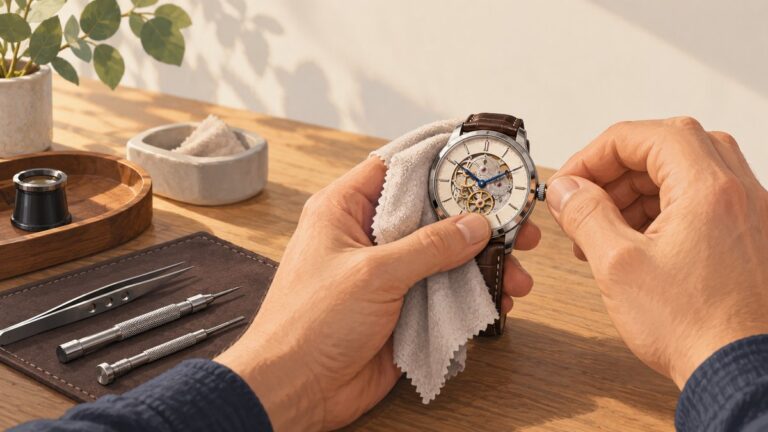
Buy the condition and documentation, not only the complication. Use a 10× watchmaker loupe, request clear movement and case photographs, and insist on a return period long enough for an independent watchmaker to examine the watch.
- Run the display through a complete transition. Confirm that every satellite or disc indexes cleanly, the current hour reaches the end of its sector and the next hour appears without hesitation or scraping.
- Inspect the display surfaces. Look for chipped or lifting numerals, damaged satellite edges, faded lume and worn or flaking anodized coatings.
- Examine case geometry under magnification. Over-polishing can soften sharp angles, alter brushing and reduce collector value. Compare photographs with an unpolished example where possible.
- Match identity marks. Check serial numbers, edition markings, movement references and case-back inscriptions against the papers and the brand’s records when those records are available.
- Demand service evidence. Request the last complete-service invoice, the workshop’s authorization, the status of any oil-change or running-time indicator and a written estimate for deferred work.
- Verify water-resistance information. Confirm the published rating for the exact reference and whether gaskets were replaced at the last service. Do not infer a swimming rating from a screw-down crown or a sealed-looking case.
- Arrange an independent examination. A loupe check and movement inspection can reveal magnetism, debris, worn pivots, loose bridges or incorrect parts that photographs miss. Make the return terms explicit before payment.
Provenance and archive paperwork are material evidence, especially for limited editions. Missing papers do not automatically make a watch counterfeit, but they increase the work required to verify identity, service history and future resaleability.
How should you compare real wandering-hours options?
Use the same six questions for every candidate so that an entry-level Swiss microbrand, a collector satellite watch and a high-ticket hydromechanical model are not treated as direct substitutes.
Quick wins for a faster PC:
Scan for outdated or missing drivers - takes under a minuteDriver Scan →Repair Windows errors before they cause bigger problemsFix Now →Fix the driver behind crashes, sound loss and screen glitchesFind Drivers →| Decision axis | Questions to ask | Why it matters |
|---|---|---|
| Display geometry and legibility | How many satellites or discs are used? What is the arc angle? Can you read the numerals in low light and at an angle? | More visual drama can mean more depth, reflections and learning time. |
| Movement architecture | Is it a module on a proven base calibre, a proprietary satellite carousel or a fluidic system? | Architecture affects winding, setting, parts access and specialist labor. |
| Wrist dimensions | What are diameter, lug-to-lug length, thickness, crown position and strap articulation? | Comfort depends on the complete profile, not diameter alone. |
| Water resistance and daily wear | What rating is published for the exact reference? Are gasket changes documented? | Unstated resistance should be treated as unknown, not as permission for water exposure. |
| Service support | Does the maker document an indicator, authorized workshops, parts access and expected turnaround? | A complicated display can dominate long-term ownership cost. |
| Price and provenance | Is the figure recurring or promotional? How many pieces were made? Are serials, papers and invoices present? | Edition size and documentation influence both risk and resale confidence. |
Which buyer profile fits each example?
- Choose the DWISS S1 profile if you want a 40 mm case, a 44 mm lug-to-lug span, a 68-hour automatic reserve and a comparatively accessible Swiss entry point, while accepting that the display module still needs specialist attention.
- Choose the Urwerk UR-101 profile if the satellite-carousel experience and collector-level engineering matter more than a public list price. Obtain a written quote and detailed service plan before purchase.
- Choose the HYT S1 profile if a large 45.30 × 46.30 × 17.20 mm case, manually wound fluidic display and 72-hour reserve fit your wrist and budget. Confirm the tax treatment and specialist support for the capillary system.
These are fit-and-priority matches, not a universal ranking. The best wandering-hours watch is the one whose reading method you can use comfortably, whose servicing you can fund and whose history you can verify.
Independent reader supportYour contribution helps us test, update, and keep practical guides available for everyone.What are the most important ownership habits?
- Learn the maker’s setting sequence before changing the time; satellite and retrograde systems can have restrictions that ordinary hands do not.
- Keep the service invoice, movement reference, serial photographs and any oil-change-indicator record with the watch.
- Do not expose the watch to water unless the exact rating is documented and current gasket condition is known.
- Have the display checked after a significant impact, even if the balance still appears to run.
- Store the watch so that the crown and crystal are protected from pressure and abrasion, and use the supplied case or a padded alternative during transport.
Wandering-hours watches reward buyers who treat the display as a precision mechanism rather than decoration. Verify how the hours travel, how the minutes are read, how the case fits and how the mechanism will be serviced before you compare finishes or negotiate price.
FAQ: Wandering-hours watches
Can I wear a wandering-hours watch while swimming?
Only when the exact reference has a published water-resistance rating, intact gaskets and a recent pressure test where appropriate. The comparison models do not establish a universal swimming rating, so ask the seller or brand for the specification instead of inferring it from case construction.
Is an oil-change indicator a guarantee that the watch is healthy?
No. It signals the maker’s intended lubrication or running-time service point, but it does not replace inspection for wear, impact damage, dried oils or display alignment. Treat the indicator as one maintenance input alongside service records and a complete functional check.
Also popular on Amazon

- 【User-Friendly Design】The 10X Jewelry Loop Magnifier is incredibly easy to use, designed to enhance efficiency during detailed tasks. Its intuitive functionality allows you to maintain your focus, whether for watch maintenance or other intricate operations.
- 【Exceptional Magnification】Featuring an impressive loupe watch, this tool brings fine details into focus. suitable for precise work, it meets all your needs in hobbies or professional projects that demand accuracy and clarity.
- 【Portable and Compact】ThisWatchmaker Loupe is designed for convenience. Small enough to fit in your or toolkit, it makes on-the-go tasks simple, whether you're repairing watches or checking intricate details during inspections.
- 【sleek Appearance】The adds a modern flair to toolkits. Combining functionality and aesthetics, this loupe not only performs well but also looks great, making your work experience unique and enjoyable.
- 【Versatile Applications】Ideal for various tasks, this is suitable for watch maintenance but also serves hobbyists and professionals alike. It’s a must-have tool for anyone requiring precision in their projects.
Can any general watchmaker service a wandering-hours watch?
A general workshop may be able to service the base calibre, but the satellite, planetary, retrograde or fluidic display can require brand-specific tools, parts and procedures. Ask whether the workshop has serviced that exact calibre and request a written scope covering the display mechanism.
What if the watch has no original papers?
Proceed only if the serial, edition marks and movement identity can be independently verified. Require a return period, budget for an authentication and service assessment, and price the additional provenance risk into the transaction rather than treating the watch as equivalent to a fully documented example.
Do all wandering-hours watches show seconds?
No. Sub-seconds are design-specific: the HYT S1 lists small seconds, while the cited specifications for the DWISS S1 and Urwerk UR-101 do not establish a seconds display. Check the exact reference if seconds are important to your daily use.
Frequently Asked Questions
Can I wear a wandering-hours watch while swimming?
Only when the exact reference has a published water-resistance rating, intact gaskets and a recent pressure test where appropriate. The comparison models do not establish a universal swimming rating, so ask the seller or brand for the specification instead of inferring it from case construction.
Is an oil-change indicator a guarantee that the watch is healthy?
No. It signals the maker’s intended lubrication or running-time service point, but it does not replace inspection for wear, impact damage, dried oils or display alignment. Treat the indicator as one maintenance input alongside service records and a complete functional check.
Can any general watchmaker service a wandering-hours watch?
A general workshop may be able to service the base calibre, but the satellite, planetary, retrograde or fluidic display can require brand-specific tools, parts and procedures. Ask whether the workshop has serviced that exact calibre and request a written scope covering the display mechanism.
What if the watch has no original papers?
Proceed only if the serial, edition marks and movement identity can be independently verified. Require a return period, budget for an authentication and service assessment, and price the additional provenance risk into the transaction rather than treating the watch as equivalent to a fully documented example.
Do all wandering-hours watches show seconds?
No. Sub-seconds are design-specific: the HYT S1 lists small seconds, while the cited specifications for the DWISS S1 and Urwerk UR-101 do not establish a seconds display. Check the exact reference if seconds are important to your daily use.
Do these 3 things before closing this tab:
1Scan for outdated or missing drivers - takes under a minute2Repair Windows errors before they cause bigger problems3Fix the driver behind crashes, sound loss and screen glitches