What’s actually slowing this PC down?
Pick the symptom - the matching free tool is one click away.
Some links on this page are affiliate links: if you buy through them we may earn a commission, at no extra cost to you.
A tachymeter bezel is a numbered scale used with a chronograph seconds hand to convert elapsed time into an approximate hourly rate. Time how long a moving object takes to cover a known distance—normally one kilometer or one mile—and the hand points to the speed in kilometers per hour or miles per hour. The same scale can work backward to estimate distance at a constant speed, or measure how many identical tasks can be completed in an hour.
The scale is normally calibrated for events lasting 60 seconds or less. It may be printed on a fixed outer bezel, an inner ring, or the edge of the dial; despite the name, it is not necessarily a rotating bezel. Correct distance markers, accurate start-and-stop timing, and a functioning chronograph determine how useful the result is.
As an Amazon Associate I earn from qualifying purchases.
The Tool Desk
Outbyte Driver Updater FREEScan for outdated or missing drivers - takes under a minuteDriver Scan →Outbyte PC Repair FREERepair Windows errors before they cause bigger problemsFix Now →What does a tachymeter bezel measure?
A tachymeter measures a rate, expressed as units per hour, by using the relationship between elapsed time and a known distance or repeated output. On a conventional watch, the scale is synchronized with the chronograph’s seconds hand. If one kilometer takes 30 seconds, the hand aligns with 120, meaning approximately 120 kilometers per hour. If one mile takes 30 seconds, the same reading means approximately 120 miles per hour.
The distance unit sets the output unit. Timex explains that a tachymeter can express miles per hour, knots, or kilometers per hour; the unit you use for the timed distance determines the corresponding hourly unit. A scale does not identify the unit by itself, so check the watch’s markings and use one consistent distance system.
Popular on Amazon
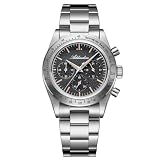
- Unique Design: Multi-functional tachymeter chronograph timepiece. Features 3 sub-dials: 24-hour, 60-minute chronograph, and a dedicated 60-second small seconds for continuous timekeeping
- Tachymeter Bezel: Use the tachymeter scale to measure speed and distance during track days, road trips, or workouts. A must-have for motorsports fans, driver, runners, and speed lovers
- Waterproof Watch: 100m (330ft) water resistance, built for daily commutes and desk life, yet tough enough for rain, handwashing, and accidental spills. No need to take it off—reliable protection through your entire day
- Luminous: Powered by premium C3 super luminescent coatings, emitting brigh glow for crystal-clear visibility in complete darkness
- Size: 37 mm case diameter, 46 mm lug-to-lug, 12.7 mm thickness, 20 mm lug width. The micro-adjustable fold-over clasp allows you to fine-tune the fit for all-day comfort
What the printed numbers mean
The numbers are not minutes or seconds. They are hourly-rate values calculated from the time needed to cover one distance unit. Higher numbers appear near the shorter-time end of the scale because a faster event covers the distance in fewer seconds. Lower numbers correspond to slower events and are reached later by the seconds hand.
How do you use a tachymeter to measure speed?
Use a measured course and the chronograph together. The ordinary scale is intended for a single event completed in 60 seconds or less.
- Choose two markers. Set the start and finish exactly one kilometer or one mile apart, depending on the unit you want to report. A surveyed road, track marker, or other known-distance course is preferable to an estimate.
- Reset the chronograph. Press the reset control so the chronograph seconds hand returns to zero. Identify which hand is the chronograph hand; a small running-seconds hand is often separate from it.
- Start at the first marker. Press the start/pusher as the moving object crosses the first marker. Begin timing as consistently as possible with the chosen reference point.
- Stop at the second marker. Press the stop control when the same reference point crosses the finish marker. Do not stop at a convenient visual point after the object has passed.
- Read the scale. Find the tachymeter number aligned with the chronograph seconds hand. That number is the approximate hourly speed for the distance unit you timed.
Casio describes this method as timing, within 60 seconds, the time needed to cover one kilometer and then using the result to determine approximate average hourly speed. For example, 30 seconds over one kilometer produces a reading of 120, or approximately 120 km/h. Citizen’s official example uses 45 seconds over one kilometer and gives approximately 80 kph (50 mph). TAG Heuer’s guide, published November 28, 2023, gives the equivalent one-mile example: 30 seconds for one mile produces approximately 120 mph.
What if the event takes less than 15 seconds?
Many tachymeter scales become crowded or difficult to read at very short intervals, even though the mathematical rate is higher. Read the closest graduation available and treat the result as approximate. For a very fast event, a longer measured distance can produce an easier-to-read time, then you can adjust the result for that distance.
How do you adjust a tachymeter reading for a different distance?
The printed scale assumes one distance unit. Multiply or divide the reading in proportion to the actual distance, provided the complete event still falls within the scale’s timing range.
Also popular on Amazon

- CHRONOGRAPH FUNCTION: Features a precise chronograph movement with three sub-dials for accurate timekeeping and elapsed time measurement.
- TACHYMETER BEZEL: The bold black tachymeter bezel allows you to calculate speed and distance, adding a sporty and professional look.
- WATER RESISTANT: Rated WR 3ATM, this watch can withstand splashes and brief water exposure, making it suitable for everyday wear.
- COMFORTABLE SILICONE STRAP: The durable black silicone strap provides a secure, comfortable fit for all-day wear in any setting.
- DATE DISPLAY & BOLD DESIGN: Includes a convenient date window and a striking black dial with luminous hands for easy readability day or night.
Use hourly rate = tachymeter reading × actual distance in scale units. Thus, a two-kilometer course doubles the one-kilometer reading, while 500 meters (half a kilometer) halves it. Timex gives a 1.2-mile example: a reading of 80 becomes 96 mph, calculated as 80 × 1.2, when the course is completed within the timing range.
Windows Errors? Fix Them Before They Spread
Repair common Windows errors and clear accumulated junk for a smoother, more stable PC - no reinstall needed.Free scan · no reinstallOutdated Drivers Are Slowing You Down
One free scan finds every outdated or missing driver and matches the right update for your exact hardware.Free scan · exact hardware match| Timed distance | Chronograph time | Scale reading | Adjusted result |
|---|---|---|---|
| 1 kilometer | 30 seconds | 120 | Approximately 120 km/h |
| 1 kilometer | 45 seconds | About 80 | Approximately 80 km/h (about 50 mph) |
| 1.2 miles | Time corresponding to 80 | 80 | 96 mph (80 × 1.2), Timex example |
| 2 kilometers | Any reading within range | For example, 60 | 120 km/h (60 × 2) |
| 500 meters | Any reading within range | For example, 120 | 60 km/h (120 × 0.5) |
Do not mix units during the adjustment. A reading taken over one kilometer cannot be relabeled as miles per hour without converting the distance and applying the conversion separately.
Can a tachymeter measure distance?
Yes, but only when the object’s speed is constant and known. This is the reverse-tachymeter method documented by Garmin and Timex. Instead of timing a known distance, you use the known speed to identify when one distance unit has passed.
- Establish a steady speed in the same unit system as the scale, such as 60 km/h on a kilometer-calibrated scale.
- Start the chronograph as the object reaches the reference point.
- Stop when the chronograph seconds hand reaches the number matching the speed—in this example, 60.
- The elapsed sweep represents one kilometer. At 60 km/h, the hand reaches 60 after one minute, so the distance is one kilometer.
The method is sensitive to speed changes. Acceleration, braking, hills, traffic, or an imprecise speed indication make the distance estimate less reliable. It is a practical approximation, not a substitute for surveying equipment or a calibrated distance meter.
How can a tachymeter measure production rate?
A tachymeter can time repeated, identical work rather than travel. Start when one unit begins, stop when it is complete, and read the scale as units per hour. Orient’s manual describes this use and limits the measurement to one minute or less.
Also popular on Amazon
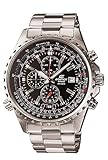
- Silver-tone watch featuring left-handed crown and black dial with 1/20-second chronograph function, slide-rotating inner bezel, and date window
- 45.5 mm stainless steel case with mineral dial window
- Quartz movement with analog display
- Stainless steel band featuring fold-over push-button clasp with safety
- Water resistant to 100 m (330 ft): In general, suitable for swimming and snorkeling, but not scuba diving
For example, if one item takes 30 seconds, the scale reads 120 units per hour. That result assumes every unit takes roughly the same time and that setup, pauses, rejects, and changeovers are not included in the timed cycle. If those factors matter, a longer observation and separate calculation will give a more realistic production rate than a single tachymeter reading.
Why is the tachymeter limited to 60 seconds?
The normal scale is mathematically tied to a one-hour rate and a one-unit distance. A one-unit event lasting more than 60 seconds would place the chronograph hand beyond the useful part of a standard scale. Orient’s manual states, “The measurement time of the tachymeter is 1 minute or less,” and notes that an average speed or hourly production rate cannot be read when the measurement exceeds one minute.
If your event is slower, measure a longer distance so the event finishes within 60 seconds, then multiply the reading by that longer distance in scale units. If no practical distance adjustment is possible, use the chronograph to record the full time and calculate the rate with a calculator instead of forcing a tachymeter reading.
Where is a tachymeter scale placed on a watch?
Manufacturers use several layouts:
- Fixed outer bezel: The numbers surround the crystal and are usually easiest to see while operating the pushers.
- Inner bezel or flange: The scale sits inside the crystal, protecting it from knocks but sometimes reducing contrast or usable space.
- Dial-edge scale: The markings are printed around the dial perimeter and may share space with minute or telemeter markings.
These layouts are fixed scales unless the manufacturer specifically provides a rotating bezel. A rotating dive bezel and a fixed tachymeter scale serve different purposes; turning a non-rotating scale will not change the chronograph calculation.
What should you compare when choosing a tachymeter chronograph?
The scale itself is only one part of a useful watch. Compare the following features rather than assuming every numbered bezel works identically.
Also popular on Amazon

- The Lacoste Boston chronograph blends sporty sophistication with timeless style. Featuring 3 subdials, tachymeter bezel, and a choice of punched leather strap or H-link bracelet, it’s a versatile, refined timepiece in multiple colorways.
- Men's Boston, black ion-plated case with a matching black dial and black ion-plated bracelet, combining sleek style with precise stopwatch functionality.
- Quartz Chronograph Movement: Battery-powered quartz movement with a chronograph function. Acts as a stopwatch with an independent sweep second hand that can be started, stopped, and reset by pressing the stem.
- Water Resistant: Up to 50m (165ft): Wearable for short periods of recreational swimming and showering, but not diving or snorkeling; 5 ATM.
- Caring for your timepiece: Your Lacoste watch has been developed with meticulous attention to quality, function and detail. A maintenance interval of 3 to 5 years is recommended, in addition to any required battery replacement. Never open the watch yourself.
| Comparison point | Why it matters | Questions to ask |
|---|---|---|
| Scale placement | Determines viewing angle, glare, and protection. | Is it on the outer bezel, inner ring, or dial edge? Can you read it while pressing the pushers? |
| Legibility | Closely spaced numbers can make short-time readings difficult. | Are the numerals high contrast? Are graduations visible between major numbers? |
| Chronograph layout | You must identify the timing hand and operate start, stop, and reset controls accurately. | Are the pushers distinct? Is the chronograph seconds hand clearly separated from running seconds? |
| Unit system | The distance unit determines whether the result is km/h, mph, knots, or another rate. | Does the printed scale or manual specify the intended unit? |
| Timing range | Standard tachymeters are useful for events up to 60 seconds. | Does the manual state a different range or provide a special scale? |
| Design purpose | Some watches include the scale mainly for motorsport styling. | Is the scale practical to read, or primarily a historical or racing-inspired design element? |
TAG Heuer describes the tachymeter’s historical association with aviation and racing. That heritage explains its frequent appearance on sport chronographs, but a racing-inspired design does not guarantee better measurement visibility or timing precision.
Independent reader supportYour contribution helps us test, update, and keep practical guides available for everyone.What can make a tachymeter result inaccurate?
Official guides describe the result as approximate and do not establish one universal accuracy tolerance. The main sources of error are procedural:
- Distance error: If the markers are not exactly one unit apart, the calculated rate is proportionally wrong.
- Reaction time: Delays when pressing start or stop add or remove seconds, especially over short events.
- Hand identification: Reading the small running-seconds hand instead of the chronograph hand produces a meaningless value.
- Scale resolution: The hand may fall between graduations, so interpolation is an estimate.
- Changing speed: The result is an average over the timed section, not the instantaneous speed at every point.
- Chronograph operation: A hand that does not reset to zero, a pusher that fails to start or stop, or a movement that is not running properly invalidates the reading.
For a repeatable result, mark the course carefully, use the same reference point on the moving object, and repeat the timing when conditions permit. Report the result as approximate and include the distance and unit used.
Recommended Free Tools
What does a tachymeter bezel not tell you?
It does not provide a direct digital speed display, store a route, compensate for acceleration, or establish a legally certified measurement. It also cannot produce a valid reading for an event longer than the scale’s stated range without changing the setup. The number is a rate derived from one timed interval, so it should not be treated as a precision instrument reading.
How do you troubleshoot a tachymeter reading?
The hand does not return to zero
Do not use the reading. Reset the chronograph according to the watch manual; if the hand remains offset, the movement may require adjustment by an authorized service professional.
Also popular on Amazon

- Men's luxury timepieces with technical advancements and a sporty style
- 1 Second Chronograph Measures up to 60 Minutes, 12/24 Hour Time, Date
- Silver-Tone Stainless Steel Case
- Mineral Crystal
- 100 Meters Water Resistant and 5 Year Limited Warranty
The event lasts more than one minute
Measure a longer known distance so the interval falls within 60 seconds, then multiply by the distance factor. Otherwise record the elapsed time and calculate the rate directly.
The scale number is hard to read
Improve the viewing angle and lighting, and identify the exact graduation before stopping the chronograph. If the scale is persistently obscured by glare or crowded printing, use the chronograph time with a calculator rather than implying greater precision than the dial supports.
What’s actually slowing this PC down?
Pick the symptom - the matching free tool is one click away.
The result seems implausible
Check the distance unit, confirm that you used the chronograph seconds hand, verify the start and stop markers, and recalculate with rate = reading × distance. A unit mismatch—kilometers timed but miles reported—is a common cause of an apparently wrong result.
Frequently Asked Questions
Can I use a tachymeter at walking or running speed?
Yes, if the course is long enough for the event to finish within the scale’s 60-second window. For a slow pace, measure a longer distance and multiply the reading by that distance in kilometers or miles.
Do all chronograph watches have a tachymeter bezel?
No. A chronograph measures elapsed time, while a tachymeter is an additional scale or function. Some chronographs use a telemeter, pulsometer, or no calculation scale at all.
Why does my tachymeter scale start at 60 or 100 instead of zero?
The scale displays hourly rates, not elapsed seconds, so zero is not needed. Values near the 60-second end represent slower rates, while values toward the short-time end represent faster rates.
Can I read a tachymeter at night?
Only if the scale and the chronograph hand remain visible in the available light. Luminous hands do not necessarily make printed bezel numerals luminous, so low-light legibility depends on the specific watch design.




