Free tools Windows power users keep installed
One-click scans. No signup required.
Some links on this page are affiliate links: if you buy through them we may earn a commission, at no extra cost to you.
Nazaré’s giant waves are dangerous because Atlantic storm swell is concentrated by an unusual underwater canyon, then amplified as it reaches shallow water beside Praia do Norte. The Nazaré Canyon runs about 200 kilometres offshore, plunges deeper than 5,000 metres and ends less than one kilometre from the beach. Its deep channel lets part of a swell keep moving quickly while adjacent energy crosses a shallow shelf and slows, bending the wave toward North Beach. A second wave train can meet it from the northwest, adding energy through constructive interference.
The result is a break where a wave measured at about 4 metres offshore can grow beyond 8 metres near shore, while exceptional faces can exceed 20 metres. This is not a recreational surf spot: Praia do Norte is unsupervised and officially described as dangerous for swimming. Professional surfers manage the risk with tow-in teams, rescue personal watercraft, flotation, communications, strict operating rules and extensive preparation.
As an Amazon Associate I earn from qualifying purchases.
Do these 3 things before closing this tab:
1Scan for outdated or missing drivers - takes under a minute2Repair Windows errors before they cause bigger problems3Fix the driver behind crashes, sound loss and screen glitchesWhy are Nazaré’s waves so big?
Nazaré’s size comes from bathymetry and storm swell working together, not from a single unusual weather event. The canyon acts like a deep-water corridor that focuses incoming energy close to shore.
The canyon keeps part of the swell moving fast
The Nazaré Canyon extends roughly 200 kilometres offshore, reaches more than 5,000 metres deep and points toward Praia do Norte, ending less than one kilometre from land. Long-period Atlantic swell can travel through that deep section with relatively little slowing. At the same time, neighboring parts of the same wave cross the shallower continental shelf and lose speed.
Popular on Amazon

- Main Function: The surfboard ropes is mainly used to connect the surfboard and the foot rope, and the connection is firm to prevent the oar from falling off during use
- Double Nylon Porcelain Braid: The nylon paddle board connection fixed rope is made of internal and external reinforced double nylon porcelain braid, which is strong and wear-resistant, good toughness
- Product Size: This paddleboard nylon rope is small in size, light in weight, and foldable, size: length: approx. 110mm/4.3in, diameter: approx. 4mm/0.16in
- Replacement Accessories: The 4 mm traction rope can replace your original worn or damaged traction rope, making the repair of the surfboard easier
- Wide Range Of Applications: This surfboard ropes is not only very suitable for short boards, long boards, pedal paddles and inflatable paddle boards, but also very suitable for canoes, boats and kayaks
Refraction turns energy toward North Beach
When one section of a wave moves faster than another, the crest bends. This refraction steers the canyon-traveling energy toward Praia do Norte instead of allowing it to spread evenly along the coast. The deep channel therefore concentrates energy at a particular stretch of shoreline.
Two wave trains can reinforce each other
Nazaré can receive another train of swell from the northwest. When the refracted canyon swell meets that second train in phase, constructive interference temporarily produces a much larger combined wave. The effect changes with swell direction, period and timing, which is why the biggest days require precise forecasting rather than a simple “large swell” prediction.
Outdated Drivers Are Slowing You Down
One free scan finds every outdated or missing driver and matches the right update for your exact hardware.Free scan · exact hardware matchWindows Errors? Fix Them Before They Spread
Repair common Windows errors and clear accumulated junk for a smoother, more stable PC - no reinstall needed.Free scan · no reinstallShallow water makes the final jump in height
As the focused energy reaches shallow water, the wave slows, steepens and rises through shoaling before it breaks. That is why an offshore forecast number cannot be read as the face height a surfer or spectator will see at the break.
How high do Nazaré waves get?
Measurements from different locations describe different stages of the wave. Offshore values are taken before the canyon focus, shoaling and breaking increase the visible face height.
| Measurement or description | Value and qualification | Source and date |
|---|---|---|
| Nazaré Canyon length | About 200 km | Nazaré Qualifica, 2026 |
| Maximum canyon depth | More than 5,000 m | Nazaré Qualifica, 2026 |
| Distance from canyon head to shore | Less than 1 km from Praia do Norte | Nazaré Qualifica, 2026 |
| Illustrative offshore-to-nearshore growth | About 4 m offshore can become more than 8 m near shore | Nazaré Qualifica, 2026 |
| Typical winter North Beach waves | About 15 m on average | NASA Earth Observatory, 2022 |
| Exceptional North Beach waves | About 24 m; exceptional faces can exceed 20 m | NASA Earth Observatory, 2022; Nazaré Qualifica, 2026 |
| 29 October 2020 offshore swell | More than 6 m at a 17-second period, before nearshore amplification | NASA Earth Observatory, 2022 |
The 2020 event was influenced by distant storm systems, including remnants of Hurricane Epsilon and a low-pressure system near Greenland. A 17-second period indicates widely spaced, powerful swell capable of carrying substantial energy even when the beach itself does not yet look dramatic.
Also popular on Amazon

- VERSATILE: This curled security cable allows you to safely tie down valuables such as surfboards, stand up paddle boards with loops
- Adjustable Length: The flexible, stretchable design extends from 24 inches up to 6 feet, providing customizable length and reach.
- EASY CONNECTION: Features a sturdy velcro strap on one end that wraps around a fixed object and a securing cord on the other end for quick connection.
- Durable Construction: Made from reinforced steel with a protective plastic coating, ensuring long-lasting strength and resistance to cuts or frays.
- Vibrant Color Options: Available in a range of 9 vivid colors including pink, yellow, red, orange, green, purple, black, gray, and white.
What makes Nazaré dangerous beyond the wave height?
The hazard is the amount of moving water and the environment around it, not just the number of metres in a photograph.
- Extreme impact: A focused, breaking wave releases enormous force. Falling near the lip can drive a surfer deep underwater and into turbulent foam.
- Long hold-downs: Large sets can keep a fallen surfer submerged through several cycles, leaving little time to orientate before the next wave.
- Currents and turbulence: Water moving around the canyon-influenced break can push a surfer away from the intended line or toward another breaking section.
- Powerful sets: Waves arrive in groups. Surviving one ride does not mean the channel is clear for a relaxed paddle back.
- Limited recreational safety cover: Praia do Norte is not a supervised swimming beach. Turismo de Portugal warns that its rough sea is dangerous for swimming, and the area has a history of fatal incidents involving fishermen.
These factors make an ordinary beach response—wading out, bodysurfing or trying to retrieve equipment—unacceptably risky on a giant-wave day.
Can beginners surf Nazaré?
No. Nazaré’s giant-wave zone is for highly experienced big-wave surfers operating in an organized, authorized system. A beginner or intermediate surfer should not attempt to paddle into the main break, follow a tow-in team, or treat a quieter-looking set as a training opportunity.
Professional big-wave ability includes reading complex swell, managing severe wipeouts, holding breath under pressure, using specialized boards and flotation, and communicating with a trained rescue crew. Even surfers who are advanced at ordinary beach breaks may lack the specific skills needed for Nazaré’s speed, impact and rapidly changing currents.
How does tow-in surfing reduce the risk?
A tow-in surfer is pulled into a moving wave by a personal watercraft (PWC), usually a jet ski, rather than paddling into the peak. The method gives the surfer enough speed to catch a steep, fast-moving face and keeps a PWC nearby for an immediate extraction. It does not make the wave safe; it creates a coordinated rescue system around an otherwise extreme ride.
Quick wins for a faster PC:
Scan for outdated or missing drivers - takes under a minuteDriver Scan →Repair Windows errors before they cause bigger problemsFix Now →Fix the driver behind crashes, sound loss and screen glitchesFind Drivers →Also popular on Amazon

- VERSATILE: This curled security cable allows you to safely tie down valuables such as surfboards, stand up paddle boards with loops
- Adjustable Length: The flexible, stretchable design extends from 24 inches up to 6 feet, providing customizable length and reach.
- EASY CONNECTION: Features a sturdy velcro strap on one end that wraps around a fixed object and a securing cord on the other end for quick connection.
- Durable Construction: Made from reinforced steel with a protective plastic coating, ensuring long-lasting strength and resistance to cuts or frays.
- Vibrant Color Options: Available in a range of 9 vivid colors including pink, yellow, red, orange, green, purple, black, gray, and white.
The required team
Nazaré’s local tow-in rules define a team consisting of the surfer, a spotter, a tow PWC and a separate rescue PWC. The spotter watches the set, line and hazards while maintaining contact with the PWC operator. The rescue craft remains available to reach a fallen surfer or assist another watercraft.
What happens during a run
- The team studies the swell direction, period, wind, currents and expected sets before entering.
- The tow operator accelerates the surfer onto a selected wave while the spotter tracks the approach and keeps the operating area clear.
- The surfer releases the line, rides and prepares for a controlled exit or a possible impact.
- If the surfer falls, the rescue PWC moves in, retrieves the surfer or deploys its rescue equipment, and returns the team to a safe position before the next set.
The second PWC matters because the tow craft may be out of position, damaged or occupied with the line. A dedicated rescue craft preserves a response option when seconds count.
What equipment and permissions are required at Nazaré?
The maritime authority’s 2025 notice sets a minimum operating framework for tow-in activity in the giant-wave area. Outside competitions, the operation requires authorization from the captain of the port.
| Requirement | What it means in practice |
|---|---|
| Flotation aids | Tow-in participants must use flotation equipment, such as an impact or flotation vest suited to big-wave conditions. |
| Two PWCs | One PWC tows the surfer and a separate PWC is assigned to rescue. |
| SLED on every PWC | Each personal watercraft must carry a SLED for recovering a person from the water. |
| Communications | The PWC operator and spotter must be able to communicate; certified communications equipment is required. |
| Line of sight | The operator and spotter must maintain visual contact during the activity. |
| Emergency towing cables | Each PWC must carry a cable capable of towing another PWC in an emergency. |
| Operating hours | Tow-in activity must finish 30 minutes before sunset. |
| Coordination and notification | The team coordinates with Nazaré’s permanent safety service and informs maritime police before and after the operation. |
| Protection of other users | The tow area must be clear of third parties; non-tow sliding sports have priority. |
Operating without the required authorization is an administrative offence. The rules are not a suggestion for casual visitors; they are the legal and operational baseline for organized activity in this specific area.
How do professional surfers prepare for a Nazaré swell?
Preparation starts before the team reaches the water. Sebastian Steudtner summarizes the approach as: “You have to do your homework.” In his explanation, that homework includes fuel, board hardware, travel logistics and having emergency doctors ready.
Also popular on Amazon
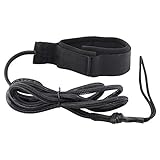
- 【Fits Any Ankle Size】: Comfortable ankle strap with magic sticker fits any ankle size, suitable for both men and women.
- 【Keep Surfer's Safety】: The surf leash plays an important role to keep surfer's safety.
- 【High Strength】: High strength, good elasticity, soft, smooth, safe and comfortable to use.
- 【Lightweight And Flexible】: Lightweight and flexible, suitable for surfboard, kayak and others.
- 【Durable And Wear-Resistant】: Made of PVC material, solid, durable and wear-resistant.
Equipment checks
- Inspect board construction, leash systems and tow equipment for the expected impact.
- Confirm that both PWCs are fueled, functioning and carrying the required SLEDs, communications equipment and emergency towing cables.
- Fit flotation equipment and verify that every team member knows how it is used during a hold-down or rescue.
People and emergency care
A Porsche profile describes a preparation group of about 17 people, including mechanics, several PWC drivers and an emergency doctor. The exact staffing varies by athlete and operation, but the principle is consistent: a giant-wave attempt is a team project rather than a solo session.
Forecast and logistics
Teams monitor storm tracks, swell period, direction, wind, tide and local restrictions, then arrange travel, launch access and medical support around the forecast window. A forecast can identify a promising swell, but the canyon’s interference pattern and nearshore conditions still have to be assessed on site.
Is Praia do Norte safe for swimming or close-up photography?
No. Official tourism guidance describes Praia do Norte’s rough sea as dangerous for swimming, and there is no lifeguarded recreational setup comparable to a managed bathing beach.
What’s actually slowing this PC down?
Pick the symptom - the matching free tool is one click away.
Visitors should watch from designated, elevated viewpoints and follow instructions from maritime authorities, event organizers and local safety personnel. Do not walk toward the waterline to photograph a set, retrieve an object or stand inside a tow-in operating area. The operating rules require the area to be clear of third parties, but they do not publish one universal spectator-distance number; the safe position can change with the event plan, swell and beach access controls.
Independent reader supportYour contribution helps us test, update, and keep practical guides available for everyone.When is Nazaré’s big-wave season?
The largest swells are most associated with autumn and winter Atlantic storms. Distant low-pressure systems can generate long-period energy that reaches Portugal later, and the canyon can transform that offshore swell into a much larger breaking wave.
Also popular on Amazon

- 4MM NYLON LEASH STRING: Made from 4 mm black nylon cord for surfboard leash attachment. Each string is approximately 33 cm long, with seared ends and a pre-tied loop for quick replacement.
- 550 LB CORD RATING: Heavy-duty nylon cord is rated to approximately 550 lb. Designed for use as the leash-string connection between your board’s leash plug and the rail saver.
- FOR SURFBOARDS, LONGBOARDS & SUPS: Works with common surfboard, longboard, stand-up paddleboard and inflatable SUP leash setups. Check your leash plug opening and preferred cord thickness before ordering.
- HELPS PROTECT YOUR BOARD: Proper leash-string placement lets the rail saver rest against the board instead of allowing the thicker leash cord or hardware to dig into the rail.
- 4 READY-TO-USE REPLACEMENT STRINGS: Includes four black leash strings, pre-cut, seared and tied so you can keep spares in your board bag, vehicle or surf repair kit.
Seasonality is not a guarantee of size. A calm-looking beach can change when a long-period set arrives, while a stormy forecast may fail to produce the right direction or interference pattern at Praia do Norte. Surfers therefore use current marine forecasts and local authority information rather than relying on a calendar date.
What should a visitor do on a giant-wave day?
- Check official local maritime, beach and event notices before traveling to Praia do Norte.
- Use a designated elevated viewing point and stay behind barriers or staff instructions.
- Keep clear of launch zones, tow lines, PWCs and marked operating areas.
- Never enter the water to swim, bodysurf, paddleboard or retrieve equipment when giant-wave conditions are present.
- If you witness an incident, alert the designated safety service or emergency authorities instead of entering the surf.
How should Nazaré be compared with another big-wave spot?
The most useful comparison is not a single record wave. Assess the underlying conditions that determine both size and survivability:
Recommended Free Tools
- Bathymetry: Does a canyon, reef or shelf focus energy, and how close is that feature to shore?
- Offshore versus breaking measurements: What are the swell height and period offshore, and how much do shoaling and refraction add at the break?
- Direction and interference: Can separate wave trains combine, or does the spot receive one dominant angle?
- Rescue infrastructure: Are tow and rescue PWCs, trained crews, communications and medical support available?
- Exposure and escape: What are the water temperature, likely hold-down time, currents and exit routes?
- Access rules: Is the break supervised, restricted or governed by an authorization system?
Nazaré is especially demanding because its canyon focuses energy very close to shore, while the giant-wave area lacks a simple recreational safety setup. Those characteristics matter as much as the headline height.
Frequently Asked Questions
Why can a relatively small offshore forecast produce a huge Nazaré face?
The offshore figure is measured before the swell is focused by the canyon and amplified by shoaling. Refraction, constructive interference and the steepening of the wave in shallow water can more than double the visible height in the nearshore zone.
What does a 17-second swell period tell a surfer?
A long period means more time between crests and usually indicates swell generated by a powerful, distant storm system. At Nazaré, that spacing allows substantial energy to travel through the canyon before the waves break, so the beach may look calm between very powerful sets.
Why are two personal watercraft used instead of one?
The tow PWC may be towing, repositioning or dealing with a line when a surfer falls. A separate rescue PWC stays available for an immediate pickup or for assisting another craft, preserving a response option during the most chaotic part of a set.
The Tool Desk
Outbyte Driver Updater FREEFix the driver behind crashes, sound loss and screen glitchesFind Drivers →Outbyte PC Repair FREEClear out junk files and repair common Windows errorsFree Scan →Can spectators stand anywhere on the cliffs above Praia do Norte?
No. Viewers should use designated elevated viewpoints and obey barriers, staff and maritime instructions. Access arrangements can change with swell size, events and operating zones, so a familiar viewpoint is not automatically safe on every day.




