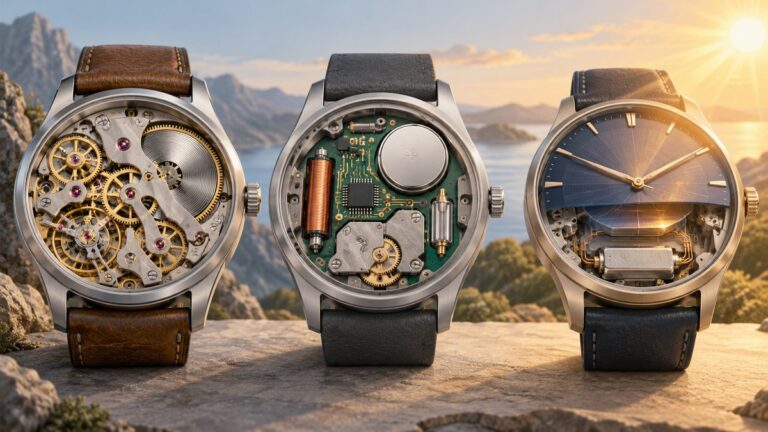
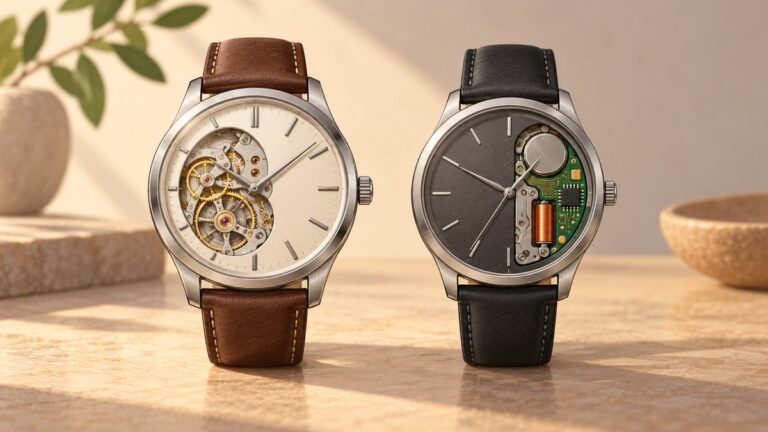
Most automatic watches will gain or lose a few seconds per day. The useful measurement is a multi-day average, taken while the watch is worn consistently and compared with the exact movement specification. A single day can be skewed by winding level, wrist motion, temperature, resting position, magnetism or shock. A steady rate within the maker’s stated range is generally normal; a sudden, large or erratic change deserves diagnosis.
What “accurate” means for an automatic watch
An automatic watch is a mechanical, self-winding watch. Its balance wheel oscillates thousands of times per hour, while a spring stores energy and a gear train turns the hands. Friction, gravity, temperature and the changing force of the mainspring mean that the rate is never perfectly constant. “Accuracy” is therefore expressed as seconds gained or lost per day, not as an expectation of zero deviation.
As an Amazon Associate I earn from qualifying purchases.
Manufacturers do not all publish the same kind of figure. A specification may be a static rate measured on a timing instrument, a mean daily rate averaged across positions, or a normal-wear target for a finished watch. Those figures cannot be compared as if they were identical tests. Always identify the caliber and the test method before deciding that one watch is more accurate than another.
Outdated Drivers Are Slowing You Down
One free scan finds every outdated or missing driver and matches the right update for your exact hardware.Free scan · exact hardware matchWindows Errors? Fix Them Before They Spread
Repair common Windows errors and clear accumulated junk for a smoother, more stable PC - no reinstall needed.Free scan · no reinstallHow to calculate your daily rate
Synchronize the watch with a trusted reference time, such as a radio-controlled clock or a reliable time server. After a known number of days, record the total difference and divide by the elapsed days:
#1 Best Overall

- Read Before You Buy — No Video Output: These adapters support charging and USB 2.0 data transfer, but cannot transmit video signals. Except for standard USB webcams (which use USB data only), they are not compatible with HDMI/DisplayPort cables, video-capable USB-C hubs, or docking stations with video output.
- Convert USB-A Ports to USB-C: Designed to connect USB-C earphones, cables, flash drives, card readers, and other USB-C accessories to standard USB-A ports. Plug-and-play with no drivers or software required.
- Aluminum Alloy Housing: Built with a sturdy aluminum alloy shell that aids in heat dissipation and protects against daily wear and scratches. Designed to maintain a stable and secure connection.
- Compact & Travel-Friendly: The ultra-compact design allows the adapter to stay plugged into your device without blocking adjacent ports or adding bulk, reducing wear and tear on your original USB ports.
- 12-Month Warranty: Backed by a 12-month manufacturer warranty for peace of mind. Designed to meet strict quality control standards for reliable everyday performance.
daily rate = total seconds gained or lost ÷ number of days
For example, a watch that is 42 seconds fast after seven days averages +6 seconds per day. Keep the plus sign for gaining time and the minus sign for losing time; do not average the absolute values of different days.
How much deviation is normal?
There is no universal tolerance for every automatic watch. Seiko advises judging mechanical-watch loss or gain as a mean daily rate averaged over one week or ten days of actual wear, because the rate changes with winding, movement, temperature and position. That approach is more representative than a single morning-to-evening reading.
The following published figures illustrate the range of modern specifications. They apply only to the named movement or brand standard, not to unrelated watches.
Rank #2

- 5-in-1 USB-C Hub: Experience comprehensive connectivity featuring a Power Delivery input, two USB-A 2.0 ports, a USB-A 3.0 port, and an HDMI port. (Note: The USB-C power delivery input port is only for connecting an external wall charger to power your laptop and cannot power peripheral devices.)
- 90W Pass-Through Charging: Achieve optimal charging with 90W pass-through power to your laptop, supported by a total input of 100W, with the hub reserving 10W for operational efficiency. (Note: Wall charger not included.)
- Quick Data Transfers: Accelerate your productivity with rapid data transfers using a high-speed 5Gbps USB 3.0 port and two 480Mbps USB 2.0 ports.
- 4K HDMI Display: Enhance your visual experience with a hub capable of delivering 4K resolution at 30Hz in both mirror and extend modes. Please note that this hub is compatible with MacBook (macOS 12 and newer), Windows 10 and 11, ChromeOS, and laptops equipped with DP Alt Mode and Power Delivery. Note: This device is not compatible with Linux.
- What You Get: Anker USB-C Hub (5-in-1, 4K HDMI), welcome guide, 18-month warranty, and our friendly customer service.
| Published figure | What it describes | Qualification |
|---|---|---|
| -1 to +10 seconds/day | Normal-usage target | Many Grand Seiko calibers; particular calibers can have different ranges. The instruction document was published in 2024. |
| -3.0 to +5.0 seconds/day | Average static accuracy | Citizen Caliber 0200 product specification; static testing is not the same as a week of wrist wear. |
| -2 to +2 seconds/day | Finished-watch tolerance | Rolex Superlative Chronometer standard, as stated in its current precision explainer. |
| -4 to +6 seconds/day | Movement-only chronometer test allowance | Rolex’s movement test, before the finished-watch tolerance is applied. |
These examples show why “Is +10 seconds a day normal?” has a conditional answer. +10 seconds/day is inside the cited normal-usage range for many Grand Seiko calibers, but outside the listed Citizen Caliber 0200 average-static range and the Rolex finished-watch tolerance. Your watch’s manual, warranty card or caliber documentation takes precedence.
When a small deviation is acceptable
A steady gain or loss that remains inside the manufacturer’s stated range is generally expected behavior. Even a watch with a tight specification may show different readings on the dial-up, dial-down, crown-up or crown-down positions. The balance also behaves differently when the mainspring is nearly full than when it is close to unwound.
When the number is a warning
Arrange a diagnosis when the multi-day average is persistently outside the published tolerance, when the rate changes abruptly, or when day-to-day results are erratic rather than gently varying. Accuracy concerns are more urgent if they accompany a shorter power reserve, difficult winding, a loose or gritty crown, visible damage, condensation under the crystal or a recent impact.
Free tools Windows power users keep installed
One-click scans. No signup required.
Why an automatic watch gains or loses time
Winding state and wearing pattern
The torque delivered by the mainspring changes as it unwinds. An automatic watch that is worn for only a few hours, left stationary overnight or hand-wound inconsistently can produce different rates on different days. Seiko specifically lists the amount of winding and arm movement as influences on accuracy. Follow the winding instructions for your caliber and use the same wearing pattern while testing.
Rank #3

- Sleek 7-in-1 USB-C Hub: Features an HDMI port, two USB-A 3.0 ports, and a USB-C data port, each providing 5Gbps transfer speeds. It also includes a USB-C PD input port for charging up to 100W and dual SD and TF card slots, all in a compact design.
- Flawless 4K@60Hz Video with HDMI: Delivers exceptional clarity and smoothness with its 4K@60Hz HDMI port, making it ideal for high-definition presentations and entertainment. (Note: Only the HDMI port supports video projection; the USB-C port is for data transfer only.)
- Double Up on Efficiency: The two USB-A 3.0 ports and a USB-C port support a fast 5Gbps data rate, significantly boosting your transfer speeds and improving productivity.
- Fast and Reliable 85W Charging: Offers high-capacity, speedy charging for laptops up to 85W, so you spend less time tethered to an outlet and more time being productive.
- What You Get: Anker USB-C Hub (7-in-1), welcome guide, 18-month warranty, and our friendly customer service.
Position and gravity
The balance assembly is affected by gravity. Resting the watch crown-up can produce a different rate from resting it dial-up or on its side. Longines notes that position and arm movement can change the daily rate. Recording the overnight position helps explain a repeatable overnight gain or loss; it does not by itself prove a fault.
Temperature and environment
Temperature changes alter the dimensions and elasticity of components, while the surrounding environment can affect lubricants and the balance. Longines identifies temperature and environment as day-to-day factors. Avoid using one unusually hot, cold or damp day as your only accuracy test.
Magnetism
Strong magnetic fields can affect steel components and cause turns of the balance spring to cling together. The common result is a sudden large gain, although an erratic rate is also possible. Potential sources include loudspeakers, magnetic clasps, some tablet or phone accessories, induction equipment and workshop magnets. A change immediately after such exposure is a reason to have the watch checked or demagnetized.
What’s actually slowing this PC down?
Pick the symptom - the matching free tool is one click away.
Shock
A hard knock can disturb the balance system or bend a delicate spring. Seiko lists shock as an accuracy influence, and Longines warns that impacts can affect the balance spring. Do not assume that a watch is unharmed because the crystal and case look intact.
Rank #4

- Dual Converters, Infinite Potential:Includes 2× USB C male to USB A female adapters and 2× USB A male to USB C female adapters. Perfect for a wide range of uses—tablets with Bluetooth keyboards, expand USB ports on macbook, and more. Two different converters for all your daily needs
- Next-Level 10Gbps & 3A Charging: No more slow 480Mbps, this usb to usb c adapter has a transfer speed of up to 10Gbps, allowing you to do more transferring in less time. This usb adapter fits both USB A and USB C charger, supporting up to 3A fast charging
- Upgraded Exquisite Craftsmanship: With an aluminum alloy housing and metal connector, the usbc to usb adapter is extremely durable and sturdy. Rigorously tested to withstand more than 10,000 times of plugging and unplugging, ensuring long-lasting performance
- Broad Compatible: The usb c to usb adapter widely supports all USB C/ USB A devices like laptops, tablets, cellphones, car chargers, and phone chargers. Such as compatible with MacBook Pro/Air 2023/2022, Thunderbolt 4/3 Devices,Apple MagSafe Watch 9/8/7/SE/Ultra, iPad Pro 2022/2021, Samsung Galaxy S23/S20/S10, and iPhone 17/16/15 Pro. Plug and play
- Please Note: To reach 10Gbps speed, keep the cable under 3.3 ft. For USB A Male to USB C adapters, try flipping the USB C connector. USB C Male to USB A adapters support bidirectional 10Gbps transfer within 3.3 ft
Aging oils and wear
Lubricants can deteriorate as a movement ages. Longines explains that degraded oils increase friction and inaccuracy. Wear in pivots, the escapement or the automatic winding system can also affect rate and power reserve. Regulation alone may hide the symptom temporarily if the underlying movement needs cleaning and lubrication.
A reliable seven-day accuracy check
Use a consistent method before requesting regulation or service. The aim is to separate normal variation from a persistent fault.
- Read the manual. Confirm the caliber, winding procedure, power-reserve estimate and any manufacturer accuracy range. Do not substitute a specification from a visually similar model.
- Start from a known winding state. Fully wind the watch as the manual permits. For a screw-down crown, unscrew it before winding and screw it down securely afterward. Never force a crown at the end of its travel.
- Synchronize to a trusted reference. Note the exact date, time and whether the watch is fully wound. A phone’s displayed time can be delayed by network or screen updates, so use a dependable reference when possible.
- Wear it consistently for at least seven days. Seiko’s guidance uses one week or ten days of actual wear. Keep the daily routine as similar as practical instead of alternating between a desk drawer and vigorous activity.
- Record readings at the same time each day. Write down the watch time, reference time, difference, winding event and overnight resting position. Also note unusual heat, cold, magnets or impacts.
- Calculate the average. Divide the final total gain or loss by the number of elapsed days. If you have daily readings, look for a stable pattern rather than reacting to the largest single value.
- Compare like with like. Match your result to the exact caliber’s published mean daily, normal-usage or static specification. A static timing-machine number is not a promise of identical wrist performance.
- Decide on the next action. A stable in-range result needs normal care. An out-of-range, sudden or erratic result calls for a qualified watchmaker’s diagnosis.
Magnetism and shock: practical troubleshooting
Signs that suggest magnetism
- A sudden, conspicuous gain that begins after contact with a strong magnet.
- Large swings between readings instead of a repeatable daily rate.
- A watch that was accurate before exposure and changed without a winding, temperature or impact explanation.
Demagnetizing can correct a magnetized movement, but it is not a complete diagnosis. If the rate remains abnormal, the watch may also have suffered a shock, contamination or mechanical wear. A valuable, water-resistant or visibly damaged watch should go to a qualified professional rather than being repeatedly treated at home.
What to do after an impact
Stop using the watch for strenuous activity, document when the impact occurred and repeat the multi-day check only if the case and crystal are sound. If the crown feels different, the hands stop, the power reserve drops or the rate changes sharply, request an inspection. A timing measurement can identify a rate problem, but it cannot replace examination for bent or displaced parts.
Best Value

- 5-in-1 Connectivity: Equipped with a 4K HDMI port, a 5 Gbps USB-C data port, two 5 Gbps USB-A ports, and a USB C 100W PD-IN port. Note: The USB C 100W PD-IN port supports only charging and does not support data transfer devices such as headphones or speakers.
- Powerful Pass-Through Charging: Supports up to 85W pass-through charging so you can power up your laptop while you use the hub. Note: Pass-through charging requires a charger (not included). Note: To achieve full power for iPad, we recommend using a 45W wall charger.
- Transfer Files in Seconds: Move files to and from your laptop at speeds of up to 5 Gbps via the USB-C and USB-A data ports. Note: The USB C 5Gbps Data port does not support video output.
- HD Display: Connect to the HDMI port to stream or mirror content to an external monitor in resolutions of up to 4K@30Hz. Note: The USB-C ports do not support video output.
- What You Get: Anker 332 USB-C Hub (5-in-1), welcome guide, our worry-free 18-month warranty, and friendly customer service.
When should an automatic watch be serviced?
Service intervals are brand recommendations, not a universal expiry date. Condition, climate, water exposure and use matter as much as the calendar. The following published guidance shows the spread:
| Brand guidance | Published interval or check | What to understand |
|---|---|---|
| Seiko | Service-center examination, cleaning and oiling once every three years | A recurring service recommendation from Seiko customer service. |
| Tissot | General check every three to four years | Shorter intervals may be appropriate depending on climate and use. |
| Omega | Complete service every five to eight years; yearly water-resistance check | The water-resistance check is separate from a complete overhaul. |
| Longines | Full service every six to eight years; another accuracy document says approximately every five years as oils age | Use the watch’s condition and current service policy to resolve the difference. |
Service sooner than the nominal interval if the average rate is outside tolerance, the watch suddenly changes rate, the power reserve falls, winding or setting feels abnormal, the watch has taken a significant shock, or water resistance is important and its test is overdue.
What a complete service involves
Longines describes a workflow that starts with diagnosis, followed by disassembly, cleaning, lubrication, adjustment and precision testing. The movement is tested on a measurement and calibration device before the watch is returned. Ask the service center which components are included, whether worn parts are replaced, what water-resistance test is performed and what warranty covers the work.
How to compare automatic watches on accuracy
Accuracy should be one decision factor, not the only one. Use a consistent comparison checklist:
- Published rate: record the seconds-per-day range and whether it is static, mean daily, normal-wear or a finished-watch tolerance.
- Testing or certification: identify whether the watch carries a chronometer or brand-specific standard. A certification describes a defined test, not every owner’s result in every environment.
- Magnetic resistance: check whether the movement is designed and tested for elevated magnetic fields. Omega’s Master Chronometer process, for example, tests temperature, extreme magnetism and six positions over four consecutive 24-hour periods.
- Shock and positional behavior: look for the manufacturer’s stated tests and the number of positions measured.
- Service support: consider authorized service availability, turnaround, parts access and water-pressure testing in your region.
- Total ownership cost: a tighter specification can be useful, but recurring service and local support may matter more than a few seconds per day.
Tools that help—and what they cannot do
Mechanical watch timegrapher
A timegrapher measures rate, amplitude and beat error in selected positions. It is the clearest diagnostic aid for checking whether regulation is plausible before paying for work. Longines describes precision testing with a measurement and calibration device, and watch-service workshop guidance includes timing equipment. A timegrapher reading is a snapshot under test conditions; it does not replace a complete overhaul, a multi-day wear test or water-pressure testing.
Watch demagnetizer
A demagnetizer can remove residual magnetism when magnetism is the cause of the rate change. It should be used alongside, not instead of, diagnosis. A sudden gain can also come from shock or a damaged balance spring. Valuable or damaged watches are safer with a professional who can verify the result afterward.
Authorized service center
Seiko, Tissot, Longines and Omega all publish recurring care guidance. When selecting a center, verify that it works on your caliber, can test water resistance when required, documents replaced parts and provides a post-service rate or warranty policy. No interval eliminates the need to respond to symptoms.
The Tool Desk
Outbyte PC Repair FREERepair Windows errors before they cause bigger problemsFix Now →Outbyte Driver Updater FREEScan for outdated or missing drivers - takes under a minuteDriver Scan →Quick Recap
Common mistakes that create false alarms
- Judging accuracy from one day instead of a seven- to ten-day average.
- Comparing a static laboratory figure with a normal-wear target as though they were the same test.
- Changing resting position every night while trying to identify a trend.
- Declaring a movement defective before checking magnetism, shock, winding state and temperature.
- Regulating a watch that actually needs cleaning, lubrication or worn-part replacement.
- Ignoring water resistance because the watch still keeps time; seals can fail without an immediate rate change.
Product prices and availability are accurate as of the date/time indicated and are subject to change. Any price and availability information displayed on Amazon at the time of purchase will apply.