Free tools Windows power users keep installed
One-click scans. No signup required.
Baidu previewed its first AI glasses in November 2024; the retail product, Xiaodu AI Glasses Pro, went on sale in China in November 2025 for a reported 2,299 yuan (about $322 at the time). It offers camera-based AI assistance and audio, not a lens display. That makes it a China-focused entrant in the smart-glasses race—not a direct match for every product in Meta’s portfolio or proof that Baidu has caught Meta in scale.
What Baidu actually launched
Baidu’s Xiaodu consumer-hardware business introduced its AI-glasses concept at Baidu World on November 12, 2024, with a planned first-half 2025 release. That announcement was a preview, not the retail launch. Yicai reported that the Xiaodu AI Glasses Pro went on sale in China in November 2025 for 2,299 yuan, approximately $322 at the exchange rate reported at the time. The product is therefore not a newly unveiled 2026 model.
The glasses are built around camera input, voice interaction and audio responses, with Baidu services and AI capabilities at the center. Baidu named Baidu Maps, Search and Baidu Baike, alongside ERNIE-based capabilities, as parts of its ecosystem integration. Yicai described the Pro as lacking a display; the available reporting does not establish an international retail launch.
Specifications and claims to put in context
| Item | What is reported | Qualification |
|---|---|---|
| Camera | 16-megapixel ultra-wide-angle camera; a later Baidu video listing describes 4K photography | 16MP is from Baidu’s 2024 announcement; 4K is a product-listing claim, not an independent test. Baidu announcement; Baidu video listing. |
| Weight | Approximately 45 grams | Baidu’s stated figure; comfort varies with fit and wearer. |
| Audio | Four-microphone array and open-ear speakers | Baidu says the design includes voice-source direction recognition and speaker separation. |
| Battery | 56 hours standby; more than five hours continuous listening; about 30 minutes for a full charge | Manufacturer figures from the 2024 announcement, under separate conditions—not a single everyday-use estimate. |
| Display | No integrated display identified | Yicai describes the glasses as not being AR glasses; no visual overlays are established. |
| China price and launch | 2,299 yuan; retail launch reported in November 2025 | Yicai reporting; the approximate $322 conversion was reported at the time and is not a current fixed exchange value. |
Sources: Baidu’s announcement and Yicai’s launch report.
#1 Best Overall

- 【Your Personal AI Assistant】Powered by ChatGPT and Gemini, smart glasses deliver intelligent voice assistance for conversations, information searches, writing help, brainstorming, and daily tasks.
- 【Voice, Video & Photo Translation】Automatically detects and translates over 164 languages in real-time, Supports over 98% of global languages, offering fast and accurate translations—ideal for international travel, business meetings, or cross-cultural communication.
- 【Open-Ear Audio & Hands-Free Calling】Dual noise-canceling microphones deliver clear calls, while open-ear speakers provide immersive music without headphones. Enjoy up to 6 hours of music playback and 4 hours of calls with dual 85mAh batteries.
- 【Smart Touch & Voice Assistant Control】With Voice Assistant. Simply triple-tap the temple of your smart glasses to activate your phone's voice assistant. Use touch controls to answer calls, activate voice assistant, and control music easily.
- 【Photochromic Lenses & IP67 Water Resistance】Automatically adjust from clear indoors to dark outdoors, keeping your vision sharp and protected in any environment. IP67 water resistance ensures durability for travel, sports, and outdoor activities.
What the glasses can do—and what the experience depends on
Baidu’s stated and listed functions include AI conversation, translation, object recognition, image analysis, text extraction, reminders, music and hands-free recording. In practical terms, a wearer might ask about a photographed landmark, listen to an answer, capture a point-of-view photo, or use the camera to help translate text. Baidu’s later listing specifically mentions translation and 4K photography; those are product claims rather than independent performance findings.
The camera-and-audio format can be useful when a phone is inconvenient, but it does not put answers in the wearer’s sight. Users must listen or consult a phone for visual confirmation. The sources reviewed do not establish the exact phone, Bluetooth, Wi-Fi, cellular or offline requirements for each function, so buyers should check the product documentation for connectivity, account and app requirements before relying on AI features away from a network.
- Translation results may vary with language pair, accent, background noise, lighting, text size and camera angle.
- Image analysis depends on what the camera can frame clearly; repeated capture or network retries can also affect battery life.
- Photographs may include people, confidential documents or sensitive locations. Check recording indicators, local rules and consent expectations, as well as how captured material is stored or processed.
AI glasses are not the same as augmented-reality glasses
“AI glasses” describes a broad category. Xiaodu AI Glasses Pro is primarily a camera-and-audio wearable: the evidence does not show an optical or lens-integrated display. It cannot visibly place navigation, translated text or AI responses over the scene. Calling it an AR headset would overstate what is documented.
This distinction matters when comparing prices and use cases. Display-equipped glasses are a different hardware proposition: they can present visual information in the wearer’s field of view, but a higher price for that capability is not an apples-to-apples comparison with display-free audio glasses.
The Tool Desk
Outbyte Driver Updater FREEFix the driver behind crashes, sound loss and screen glitchesFind Drivers →Outbyte PC Repair FREEClear out junk files and repair common Windows errorsFree Scan →How Baidu compares with Meta
| Category | Xiaodu AI Glasses Pro | Meta glasses |
|---|---|---|
| Company and ecosystem | Baidu/Xiaodu; Baidu Maps, Search, Baidu Baike and ERNIE-based features | Meta and eyewear partners; Meta AI and Meta’s consumer ecosystem |
| Interaction | Camera-based assistance, voice interaction and open-ear audio | Camera, microphones and speakers; features depend on model |
| Display | No display identified in the available reporting | The portfolio includes display-free glasses and a display-equipped model |
| Reported price signal | 2,299 yuan in China, reported around $322 in November 2025 | Reuters reported a new lower-cost range starting at $299 in the United States in June 2026; it also reported $800 for Ray-Ban Display glasses |
| Geographic position | China-first; international availability and support are not established here | Broader international presence, though availability and features vary by product and market |
| Scale | No comparable shipment figure established in the cited reporting | Meta accounted for an estimated 76.1% of global smart-glasses shipments in 2025, when shipments reached 9.6 million units, according to IDC data cited by Reuters |
The Meta price and shipment figures are from Reuters reporting republished by Sahm Capital. They do not make the products equivalent: the $299 starting price concerns a lower-cost range, while the $800 figure applies to display-equipped Ray-Ban Display glasses.
Rank #2
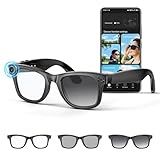
- 【4K HD Video Recording】A built-in 800W HD camera supports 2K HD image capture and 1080P video recording, with a built-in anti-shake algorithm for automatically optimized image quality. A single shot can capture 3 minutes of video, and can be used continuously for an hour.
- 【Automatic Sync to Phone】Equipped with a low-power BT5.3 chip and Wi-Fi dual transmission technology, captured images and videos are transferred to your phone in real time, eliminating manual export and eliminating storage worries.
- 【Object Recognition】Automatically recognizes objects, menus, landmarks, plants, and more, quickly analyzing the results and announcing them in real time. A built-in ChatGPT model ensures high-accuracy recognition. It instantly becomes your mobile encyclopedia on the go.
- 【Voice-Assisted Chat and Calling】ENC dual microphones offer noise reduction and interference resistance. Touch and click to adjust volume, and you can answer and end calls. The smart assistant can also be activated via voice commands, making it easy to have conversations, write text, and search for information.
- 【290mAh Ultra-Long Battery Life】Ultra-light at 42g, it's made of a durable, skin-friendly material, as light as a feather. Lenses are removable. Its simple, versatile design makes it a comfortable and comfortable wearer. 290mAh ultra-long battery life, 15 hours of music playback and 7 days of standby, making it a perfect travel companion.
Baidu has a plausible strategic challenge: it can bring Chinese-language search, maps and AI services to wearable hardware. But the available market evidence points to a substantial Meta lead in global shipments, while Baidu’s product is positioned first for China. The more accurate story is competition in a growing category, not a demonstrated two-company contest or a confirmed global displacement of Meta.
Independent reader supportYour contribution helps us test, update, and keep practical guides available for everyone.Why China is the more relevant battleground for Xiaodu
Baidu enters a crowded Chinese market that includes Alibaba, Xiaomi, Huawei and RayNeo. Local services, language support, retail channels and phone ecosystems can matter as much as the frame or camera. Yicai’s account places Xiaodu among these domestic competitors; Alibaba’s Qwen/Quark glasses are also part of the competitive landscape described by the South China Morning Post.
For Baidu, an advantage would depend on making its services useful and reliable on the glasses—not simply fitting an AI assistant into frames. Hardware adoption also depends on fit, style, prescription support, app quality, distribution and after-sales service. The cited coverage does not establish how Xiaodu performs on those measures outside China.
What buyers outside China should check
The reported yuan price is not a delivered international price. Before considering an import, verify all of the following with the seller and current product documentation:
- Whether the seller ships to your country and provides local warranty, returns and repair support.
- Whether the required app is available in your region, and whether setup requires a Chinese account, phone number or app-store region.
- Which languages and language pairs are supported, and whether the AI services can be reached from your location.
- Whether prescription lenses, replacement lenses, tint options and local fitting are supported for this specific model.
- Which functions need a connected phone or internet access, and what the product does offline.
- How recording is indicated and whether captured audio, photos or prompts are uploaded, retained or used by cloud services.
The 45-gram weight is a manufacturer claim, not a guarantee of comfort for every face or all-day wear. Likewise, the 56-hour standby figure should not be treated as normal mixed-use battery life: camera recording, continuous audio and connected AI use impose different demands.
Quick Recap
Who Xiaodu AI Glasses Pro may suit
- Potentially suitable: China-based users who want audio-led AI help, hands-free capture and integration with Baidu services.
- Less suitable: Anyone who needs visual overlays, confirmed international service and warranty, or an English-first experience without first verifying support.
- Not a direct substitute: Buyers seeking full AR features should compare display-equipped products, while checking that the specific model actually includes the display they need.
Product prices and availability are accurate as of the date/time indicated and are subject to change. Any price and availability information displayed on Amazon at the time of purchase will apply.