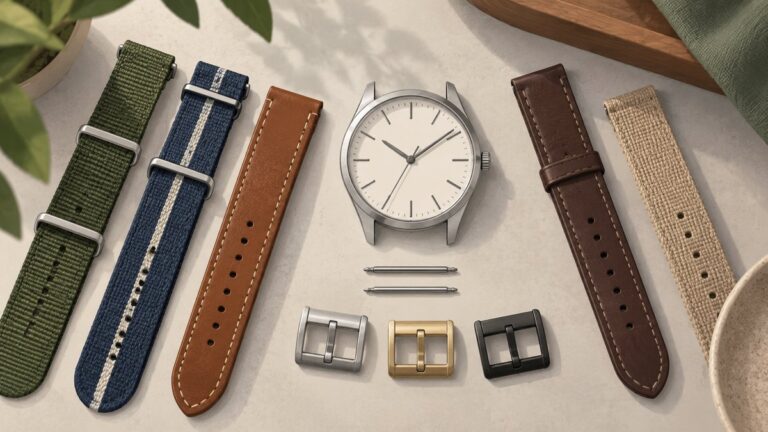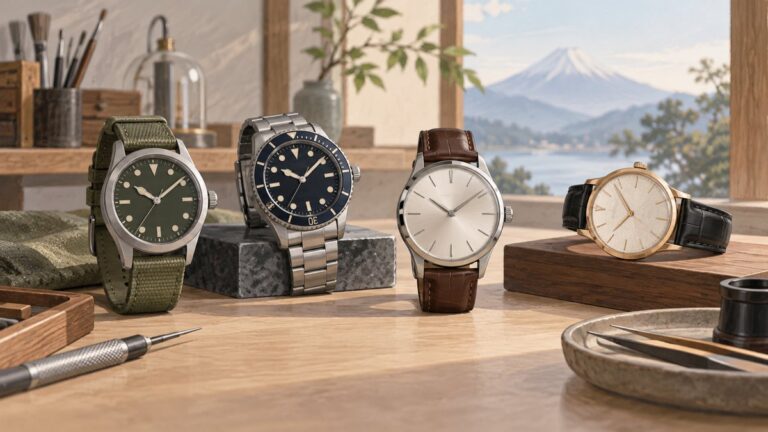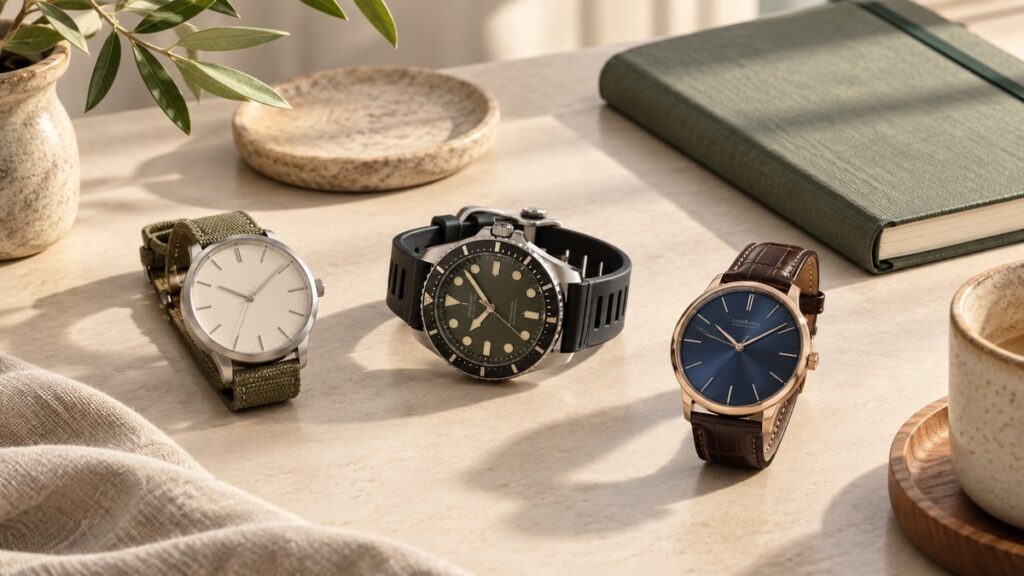
The perfect watch collection is the one that fits your life, your taste, your curiosity and your budget. No universal list of required watches exists, and no correct number of pieces does either. The more useful question is what you want your watches to do for you, and what you need to know to look after them well.
A collection is defined by purpose, not by a number
Phillips, the auction house, makes the point directly in its collector guide under the heading “A Collection Isn’t Defined By A Number.” In its account, a collection begins with the first watch rather than at a prescribed count. Its advice is to buy what you enjoy, study each prospective purchase closely, and put quality ahead of quantity. Because Phillips sells watches at auction, its guidance comes from the trade side of collecting, but the advice itself concerns personal taste rather than market timing.


Write a collecting purpose before you browse
Before you open a single listing, write down a few sentences that answer three questions:
- What do I value in a watch: design, engineering, history, legibility, or the routine of winding it?
- Where will I actually wear it: at the office, on weekends, while travelling, or at formal events?
- What do I want to learn or enjoy over the next few years?
The answers become your filter. A watch that matches the note gets a closer look. A watch that only fills a gap you imagined does not.
Roles can organise a collection, but they are not a formula
EveryWatch, a market-oriented guide publisher, offers one way to avoid redundancy: a daily watch, a formal watch and a statement watch. Treat this as a prompt for thinking about overlap, not as a three-watch rule. A collector who wears one watch every day may find that a second dressy piece rarely leaves its box, while a single well-chosen watch can serve as a complete collection for someone who is content with it.
The everyday wristwatch
This is the piece you wear most often, so comfort, strap fit, legibility and the water resistance specified for that model matter more than rarity. It is the watch that will show the most wear, which makes its practicality a sound test for any addition.
The dress watch
A dress watch is typically chosen for formal clothing and occasions. Its appeal is restraint: a slim profile and a clean dial. Worn daily, it is exposed to the same knocks as any other watch, so it suits a collector who keeps formal occasions in mind and is prepared to be careful with it.
The field watch
A field watch is built around readability and practicality, with a dial that is easy to read at a glance. It can serve as an everyday wristwatch for someone whose days are active or outdoors, and it is often a sensible starting point for a collector who wants a watch to be used rather than admired.
The Tool Desk
Outbyte Driver Updater FREEFix the driver behind crashes, sound loss and screen glitchesFind Drivers →Outbyte PC Repair FREERepair Windows errors before they cause bigger problemsFix Now →The statement watch
The statement piece is the one with personality, whether through colour, a distinctive design, a complication or a story. It is the most personal role, and the easiest to overbuy, so it is worth asking whether you would still choose it if nobody else ever commented on it.
Completeness versus attachment
This is the central tension in building a collection. Adding a watch broadens it. But a collection built around a handful of pieces you genuinely love can be more coherent than one that fills every slot. The common failure is buying a watch to complete a category list and then wearing it rarely.
Rank #3

- Book - a man and his watch: iconic watches and stories from the men who wore them
- Language: english
- Binding: hardcover
Phillips advises taking time, studying the watch and resisting hype, which is a practical way of guarding against that failure. Patek Philippe, speaking about its own development process in its philosophy material, says that “the development of a new watch, movement, or collection may take years, sometimes decades.” That is a statement about how a maker builds its products, not a buying rule, but it is a fair reminder that serious watchmaking rewards patience on the buyer’s side too.
How the movement changes ownership
The movement determines what routine a watch asks of you. Timex, a watchmaker, describes quartz movements as battery-powered and low-maintenance, and mechanical movements as gear-and-spring systems that may require more maintenance. Mechanical watches can be hand-wound or automatic.
| Ownership factor | Quartz | Mechanical |
|---|---|---|
| Power source | Battery, as Timex describes it | Gears and a mainspring, as Timex describes it |
| Routine | Battery replacement when the battery runs down | Hand-winding (hand-wound) or wearing the watch to keep it wound (automatic) |
| Maintenance described by Timex | Low-maintenance | May require more maintenance |
| Usual appeal described by Timex | Not stated in Timex’s guide | Often valued for craft |
Neither movement is the correct choice in the abstract. Choose the routine you are willing to keep. If you enjoy the ritual of winding, a mechanical watch will reward that. If you want a watch that asks little of you, quartz is the more straightforward option. Avoid claims that one movement is more accurate than the other, because the sources used here do not support a general precision comparison.
Set a comfortable budget before you shop
Timex says a collection can be personal at many different price points, and advises against feeling pressured by trends or by other collectors. Decide on a comfortable budget before you start, and include the cost of eventual servicing and storage, not only the purchase price. Any price examples in Timex’s guide reflect its own choices and should not be read as a market benchmark.
Compare watches on ownership factors
When two watches compete for the same place in your collection, compare them on the factors that affect daily life:
- Intended role and wearing occasions
- Comfort, case size and strap fit on your wrist
- Movement type and the winding or battery routine it requires
- Legibility and the practical value of any complications
- Water resistance as specified for that specific model
- Acquisition cost and the expected service burden
- Condition and originality, for pre-owned pieces
- Your own design or historical interest
Do not rank watches by brand prestige, rarity, resale potential or number of complications alone. EveryWatch discusses rarity, liquidity and market performance, but presents these as uncertain market considerations rather than promises of returns. If you consider resale at all, treat it as a background risk, not a reason to buy.
Quick wins for a faster PC:
Fix the driver behind crashes, sound loss and screen glitchesFind Drivers →Repair Windows errors before they cause bigger problemsFix Now →Scan for outdated or missing drivers - takes under a minuteDriver Scan →Best Value
Vintage and pre-owned: check condition and originality
Phillips recommends researching the specific reference before buying, examining the condition and originality of the piece, and asking a qualified specialist. The auction house notes that condition and original parts affect value. Its guidance is written from an auction perspective, and the sources used here do not set out a complete authentication procedure, so a specialist’s assessment should be treated as a required step rather than a substitute for your own checks.
Questions worth asking before you commit:
- Which components are original, and which have been replaced, including the dial, hands, crown and movement?
- Is there documentation for the reference, and does it match the piece in hand?
- Has the watch been serviced, and by whom?
- Does the asking price reflect the condition as it actually is?
A reputable pre-owned dealer or an auction house’s specialist department can answer these questions. Ask for the answers in writing wherever possible.
Care depends on the specific watch
Follow the user guide for your own model before you do anything else. Patek Philippe’s care guidance, which speaks about its own watches, is a useful example of what to protect against:
- Avoid shocks, prolonged vibration, extreme temperature changes and magnetic fields.
- Store the watch in a safe, dry place. Timex recommends safe, dry storage. A padded case or watch box that keeps pieces separated is one practical option.
- Arrange service through the right channel. Patek Philippe’s official care page states: “Quartz and mechanical watches with manually wound and self-winding movements should be serviced every eight to ten years through an official Service Center or Authorized Retailer.”
That interval is Patek Philippe’s guidance for the watch types it names. It is not a universal rule for other brands or other movements, so check the service recommendation in the manual or from the manufacturer for each watch you own.
Outdated Drivers Are Slowing You Down
One free scan finds every outdated or missing driver and matches the right update for your exact hardware.Free scan · exact hardware matchPC Slower Than It Used to Be?
A free scan shows the junk files, broken settings and background clutter dragging Windows down - then fixes them in one click.Free scan · Windows 10 & 11Quick Recap
Product prices and availability are accurate as of the date/time indicated and are subject to change. Any price and availability information displayed on Amazon at the time of purchase will apply.