Chrono24 transaction data for H1 2025 points to a more selective secondary watch market: Gen Z buyers leaned further toward dress watches and Cartier, Omega held second place among brands, and Rolex remained the leader as its declining share stabilized. These findings describe spending on Chrono24—not all worldwide pre-owned watch sales—and the report also detected a slight regional cooling in dress-watch demand that may or may not persist.
What changed in the secondary watch market in H1 2025?
The report, published jointly by Chrono24 and Fratello on October 22, 2025, compares H1 2025 with H2 2024 and with historical data dating to 2018. Its broad picture is a market that has cooled from the pandemic-era speculative peak but remains active and selective. Design-led dress watches attracted more attention, particularly among younger buyers, while demand in some previously hyped high-end segments normalized.


The figures are based on Chrono24 transactions. In the report’s example, Rolex’s 33.7% market share means that Rolex accounted for 33.7% of total watch spend on Chrono24 in H1 2025—not 33.7% of global watch sales, nor merely a share of spending on the ten largest brands. Changes are compared with the preceding period and are percentage changes in share, not percentage-point changes. Chrono24’s full H1 2025 report and Fratello’s co-author report provide the underlying context.
Are Gen Z buyers choosing dress watches?
Chrono24’s data shows a clear generational shift. From 2018 to 2025, dress-watch sales share among Gen Z rose 44%, compared with a 29% increase among other age groups. Dress watches made up 12% of Gen Z purchases, the highest share among the age groups reported.
#1 Best Overall
That growth does not mean all younger buyers prefer formal watches, or that dress watches now dominate their purchases. It does show that this category has gained ground faster among Gen Z than among older buyers in the Chrono24 data. The report describes demand as concentrated at both ends of the price spectrum—€500–€2,000 and above €20,000—with the middle less active. Those price bands describe the report’s observed pattern, not a separate estimate of the entire global market.
Why does Cartier stand out?
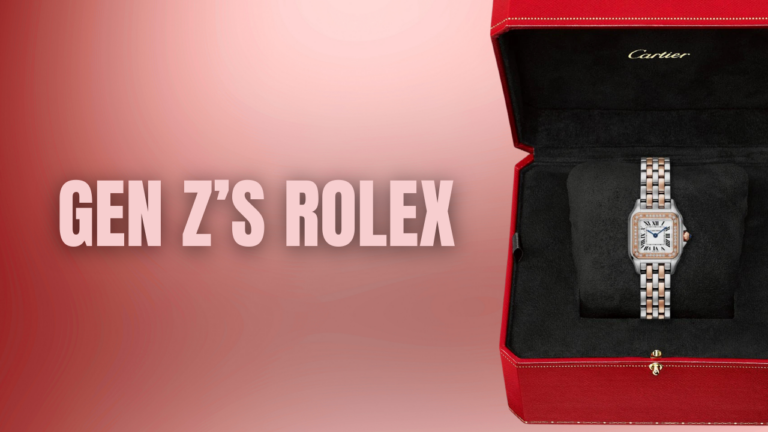
Cartier’s share of Chrono24 watch sales among Gen Z increased from 1.7% to 6.8% over seven years. Across all age groups, its share rose from 2.9% to 4.8% over the same span. The figures make Cartier one of the report’s clearest examples of the shift toward dressier, design-led watches.
Rank #2

- Used Book in Good Condition
The Tank and Santos are the collections highlighted for their distinctive, enduring designs. For someone considering a pre-owned Cartier Tank, the trend is context—not a reason to assume a particular watch is fairly priced or will hold its value. Compare the exact reference and dimensions, then inspect condition, provenance and service history. Vintage and pre-owned Must de Cartier models are identified in the report as potential lower-price entry points, but the report does not provide current prices or guarantee availability.
Which brands gained or lost share?
Chrono24’s H1 2025 results show different directions across the major brands. The changes below compare each brand’s reported share with H2 2024 unless the longer comparison is stated.
Rank #3

- Correlated to state standards for literature skills
- Features 20 reproducible book report forms
- Includes 18 individual book projects with step by step instructions
- Contains 96 pages
- Recommended for grade 1st and 2nd
| Brand | Chrono24 finding | Context |
|---|---|---|
| Rolex | 33.7% market share in H1 2025 | Still the largest brand by share. Its decline, which began in H1 2022, slowed in recent periods. |
| Omega | 11.3% share, up 4% | Second-highest brand share; the increase is a relative change versus H2 2024. |
| Tudor | Up 6.6% in the main report; up 6.8% in Chrono24’s announcement | The two Chrono24 pages report slightly different gains; the figures should not be combined or treated as a single precise value. |
| IWC | Up 4.9% | The report discusses the Ingenieur relaunch as possible context, not a proven cause of the change. |
| Patek Philippe | Down 8.2% | A relative share decline; H2 2024 had been unusually strong for Patek. |
| Audemars Piguet | Up 0.2% | A small relative share increase. |
These are relative changes in share, not percentage-point movements. For example, a share rising from 10% to 20% is a 100% increase in share under the report’s convention. The report links the cautious tone in high-end segments to normalization after pandemic-era speculation; it does not establish that each brand’s change was caused by one particular collection or event.
Did Rolex demand return to normal?
The report supports a narrower conclusion: Rolex remained the leading brand on Chrono24, and its falling share trend slowed. It does not say that demand or prices have returned to a defined pre-pandemic level. Market share is not the same as price, sales volume or waiting time, so the 33.7% figure cannot by itself answer whether Rolex watches became cheaper or easier to buy.
Rank #4

- Used Book in Good Condition
Within Rolex, the Datejust was the most popular collection in H1 2025, followed by the Daytona, which overtook the Submariner for second place. The report also identifies stainless-steel Daytona and GMT-Master II “Pepsi” models as difficult to obtain from authorized dealers. That availability observation is not a price forecast and does not apply to every Rolex reference.
Independent reader supportYour contribution helps us test, update, and keep practical guides available for everyone.Is the dress-watch trend slowing?
There is an early sign of a pause: after rising sharply from 2023, dress-watch demand showed a slight dip in Asia and North America during H1 2025. Cartier’s secondary-market sales also dipped slightly in that period. Chrono24 and Fratello do not establish whether these movements are temporary or mark a reversal, so it is too soon to call the broader shift over.
Recommended Free Tools
The report’s regional note matters because a rising multi-year trend and a short-term dip can coexist. The H1 signal should be read as a change in momentum within the observed period, not proof that demand has fallen everywhere or that the category’s long-term direction has changed.
What the report can—and cannot—tell watch buyers
The data is useful for understanding which brands and styles were gaining or losing relative share on one major marketplace. It is not a guide to future resale performance: a brand gaining share does not guarantee that any specific model will appreciate, sell quickly or retain value. Nor does a platform’s transaction mix represent every region, dealer channel or private sale.
For a purchase decision, use the report as a broad demand signal and assess the individual watch on its own merits. Reference, condition, originality, documentation and service history can matter more to the value and ownership experience of a particular pre-owned watch than a brand-level market-share movement. Chrono24’s announcement of the report includes the headline findings and quotations from the two organizations.
Quick Recap
Product prices and availability are accurate as of the date/time indicated and are subject to change. Any price and availability information displayed on Amazon at the time of purchase will apply.