A tachymeter scale converts the time it takes to cover a known distance into an average speed. A telemeter scale converts the delay between seeing an event and hearing its sound into an estimated distance. Both are read with a chronograph, but they answer different questions: how fast something travelled over a measured stretch, and how far away a sound-producing event was.
What each scale measures
The two scales share a chronograph hand and a printed scale, which is why they are often confused. The difference lies in the input. A tachymeter needs a distance you know in advance. A telemeter needs one event that produces both a visible cue and a sound. The table below sets out the contrast before the procedures are covered in detail.
| Comparison | Tachymeter | Telemeter |
|---|---|---|
| Quantity shown | Average speed (km/h or mph) | Estimated distance (km or miles) |
| Required input | Travel over a known distance | A visible event followed by its sound |
| Chronograph start | At the start of the measured distance | When the event is seen |
| Chronograph stop | At the end of the measured distance | When the sound is heard |
| Basis of the conversion | Elapsed time across a known distance, scaled to an hourly unit | Sound travel time, converted using an assumed speed of sound |
| Main limitation | Requires a known distance and a scale range suited to the elapsed time (Hamilton’s tachymeter procedure applies to timings of no more than 60 seconds) | An estimate; depends on the sound-speed assumption and on conditions in the air |
| Typical use | Timing a vehicle over one kilometre or one mile | Estimating how far away a storm is |
How the tachymeter works
TAG Heuer describes the tachymeter as a scale for determining speed from time: start the chronograph as an object passes a starting point, stop it when the object has covered a predetermined distance, and read the speed the hand indicates. The scale is calibrated for a fixed distance, most commonly one kilometre or one mile, and the reading is in the matching unit per hour.
Taking a tachymeter reading
- Choose a distance you can measure, such as a one-kilometre stretch of road or a marked track, and make sure the start and finish points are clearly visible.
- Press the chronograph start/stop pusher as the object passes the starting point.
- Press it again as the object passes the finishing point.
- Read the elapsed time against the tachymeter scale: the hand points to the average speed over the measured distance.
Casio’s worked example shows the arithmetic. If one kilometre takes 30 seconds, the hand points to 120, meaning an average of 120 km/h. Casio’s guidance on other distances is a simple scaling rule: for two kilometres, double the indicated value; for 500 metres, halve it. For a two-kilometre run timed at 30 seconds, the speed is therefore 240 km/h, and for a 500-metre run timed at 30 seconds, it is 60 km/h.
What’s actually slowing this PC down?
Pick the symptom - the matching free tool is one click away.
#1 Best Overall

- Chronograph Movement with Tachymeter: Features a tachymeter index along its outer minute track to measure speed
- Stainless Steel Adjustable Bracelet: Stainless steel bracelet fits comfortably on your wrist and can be adjusted for a custom fit
- Sturdy Stainless Steel Watch Case: Sleek and scratch-resistant stainless steel
- Iconic 60's Design: This timepiece retains the classic Marlin features with a domed acrylic crystal lens and retro-style square markers at 3, 9, and 12 o'clock
- Water Resistant to 50 Meters
What the reading does and does not tell you
A tachymeter reading is an average over the interval you timed. It is not a continuous speedometer and cannot show acceleration, braking or a peak speed inside that stretch. Hamilton’s instruction manual describes the scale as giving average speed in km/h or mph over one kilometre or one mile, and states that its described procedure applies only when the timing does not exceed 60 seconds. Check your own watch’s manual before applying the scale to longer or shorter intervals, because the printed range and instructions differ between models.
How the telemeter works
A telemeter scale uses the gap between a visible phenomenon and the sound it produces. Light travels so fast that the flash is effectively seen at once, whereas sound takes noticeably longer to reach the observer. The longer the gap, the farther away the event. Hamilton’s instruction manual defines the function this way:
Rank #2
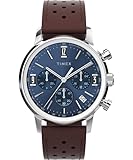
- Chronograph Movement with Tachymeter: Features a tachymeter index along its outer minute track to measure speed
- Natural Leather Strap: Adjustable leather strap fits comfortably on your wrist
- Sturdy Stainless Steel Watch Case: Sleek and scratch-resistant stainless steel
- Iconic 60's Design: This timepiece retains the classic Marlin features with a domed acrylic crystal lens and retro-style square markers at 3, 9, and 12 o'clock
- Quick-Release Spring Bars: Refresh your look in seconds with endless strap options - no tools required
“Chronograph provided with a scale allowing measurement of a distance, by measuring the interval of time between the observation of a phenomenon and the sound caused by it.”
That definition is from Hamilton’s instruction manual, whose publication date is not stated in the edition referenced here.
Quick wins for a faster PC:
Fix the driver behind crashes, sound loss and screen glitchesFind Drivers →Clear out junk files and repair common Windows errorsFree Scan →Rank #3

- Chronograph Watch: This men's chronograph features three sub-dials for a 24-hour indicator, a 60-minute chronograph, and small seconds. The large central second hand serves as the chronograph seconds for easy reading, offering precise stopwatch functionality. A practical date calendar and a quick-reset system add extra convenience.
- Multi-functional Slide Rule Bezel: This men's analog watch features a bi-directional rotating slide rule bezel — a practical tool that enables quick and accurate calculations. It simplifies complex mathematical tasks, combining style with functionality.
- Precision Japanese Movement & Super Luminous: Powered by the reliable Japanese quartz movement, this sophisticated quartz male wrist watch guarantees accurate timekeeping. Plus, it features luminous paint on both the hands and the markers, allowing you to easily read the time in low-light conditions.
- Durable Stainless Steel & Scratch-resistant Sapphire Glass: Both the case and the watch band are made from robust stainless steel, ensuring longevity. Meanwhile, the lens is made of high-quality sapphire glass, providing excellent clarity and resistance to scratches for everyday wear.
- 3ATM Water Resistant: This BERNY timepiece is equipped with 3ATM water resistance, suitable for everyday exposure such as handwashing or light rain. If you have any questions or doubts about our products, our timely and professional customer service team will provide you with satisfactory solutions.
Timing a thunderstorm
- Start the chronograph the moment you see the lightning flash.
- Stop it the moment you hear the thunder.
- Read the elapsed seconds against the telemeter scale; the hand points to the estimated distance to the strike.
Hamilton’s manual gives a worked example whose scale result is 13 kilometres. Citizen’s guide describes the same procedure and also suggests fireworks as an event, starting the timer when the light is seen. Any event with a clear flash and a sound that arrives later can be used, but the lightning-and-thunder case is the standard illustration.
Why a telemeter reading is an estimate
The scale assumes a speed of sound in air. The Fondation Haute Horlogerie’s glossary gives that speed as approximately 340 metres per second, with no publication date shown. Oris, in a support article updated on 3 May 2024, states its telemeter graduation is calculated at 343 metres per second in air at 20 °C. Both figures are reasonable approximations, but they are not identical, and the real speed of sound changes with air temperature.
Rank #4

- CLASSIC DESIGN: 45MM beautiful and exquisite big face with three functional subdials and date display, tachymeter numerals on the bezel, with a classic stainless steel bracelet, Quality quartz analog movement and long-life battery, provide precise time and perfectly match any of your outfits, Benyar analog wrist watch embodies the pursuit of fashion and quality that redefines time!
- QUALITY AND COMFORTABLE: High quality imported quartz movement to provide high stability and accurate timing. 304 steel case with mineral glass, which greatly improves the wear resistance and scratch resistance. Mens stainless steel watches not only looks elegant and luxurious, but is also comfortable and breathable to wear. BENYAR men's wrist watches will stand the test of style and last a lifetime if properly maintained.
- WATERPROOF CHRONOGRAPH WATCH: Multifunctional sub-dial can be used as timers (1/10 Second, Second and Minute Chronographs). BENYAR's waterproof chronograph watches for men is waterproof 30M/3ATM, can withstand sweat, accidental rain or water splash (Showering, swimming, immersion in water is not recommended). After absorbing enough light energy to have a certain glow-in-the-dark effect in dark environments. It is a multifunctional stainless steel watches for men.
- READY FOR GIFTS: Fashion and casual watches suitable for men and youth, perfect for everyday wear and any occasion, Providing accurate timekeeping and becomes a fashion statement for your versatile style. Packaged in a exquisite box, this luxurious stainless steel watch it is an ideal gift for yourself, friends, classmates, father, lovers, family for Graduations, Birthdays, Father's Day, Valentine's day, Thanksgiving ect.
- CUSTOMER SERVICE: BENYAR watch men provides a 2-year after sales service. BY BENYAR is committed to offering a range of classic high quality designer wrist watches for men and high standards of customer service. If you have any questions about our watch men, please contact us first via email and we will provide you with a satisfactory solution within 24 hours.
As a rough check you can do yourself, multiply the seconds you counted by about 340 metres: a three-second gap gives about 1,020 metres, or roughly one kilometre. Real conditions, the timing of your button presses and how sharply you see the flash all add error, so treat the result as an order-of-magnitude estimate rather than a measured distance.
Independent reader supportYour contribution helps us test, update, and keep practical guides available for everyone.Which scale answers your question
- Use the tachymeter when you know the distance and want the average speed over it, such as timing a car or cyclist over a measured kilometre.
- Use the telemeter when you have no known distance but can see an event and hear its sound, such as a storm, fireworks or a distant bang.
- Do not expect either scale to show instantaneous speed, a distance you have not timed, or an exact range without accounting for the sound-speed assumption.
Watches that carry both scales
Some chronographs print both scales on one watch. The CIMIER 711 Heritage Chronograph user manual describes a tachymeter and a telemeter, each with its own use instructions, which shows that the combination exists in at least one model. Confirm the scales, their ranges and the manual for any specific watch before relying on either function, because scale layout and instructions vary by model.
Quick Recap
Best Value

- Men's luxury timepieces with technical advancements and a sporty style
- 1 Second Chronograph Measures up to 60 Minutes, 12/24 Hour Time, Date
- Silver-Tone Stainless Steel Case
- Mineral Crystal
- 100 Meters Water Resistant and 5 Year Limited Warranty
Product prices and availability are accurate as of the date/time indicated and are subject to change. Any price and availability information displayed on Amazon at the time of purchase will apply.