High-end watch finishing is the shaping, smoothing, and decoration of a watch’s components. Anglage bevels and polishes an edge; Geneva stripes lay parallel bands across a movement part; perlage makes overlapping circles; mirror polish creates a highly reflective surface; and guilloché engraves a repeating pattern. These treatments can improve surface quality or control reflections, but a decorative pattern alone does not prove handwork, superior accuracy, or exceptional execution.
What watch finishing does
Finishing is the treatment of component surfaces during or after manufacture. It includes practical preparation—such as removing burrs and machining traces, smoothing edges that move against one another, and protecting surfaces against oxidation—as well as decoration. Patek Philippe describes these aims in its hand-finishing guide; Breguet also explains how anglage can remove burrs and marks that could affect movement operation and reliability, while creating contrast between satin faces and polished edges on its craftsmanship page.
Not every pattern should be assigned a mechanical benefit. Geneva stripes, perlage, snailing, and guilloché are described primarily as decorative treatments in the cited manufacturers’ explanations. A finish may contribute to the overall workmanship and visual character of a watch without making it more accurate or reliable.
Movement finishing styles
Anglage: beveled, polished edges
Anglage, also called beveling or chamfering, removes and shapes the sharp edge between a component’s top face and side. The resulting bevel is then polished. Patek Philippe describes a smooth, roughly 45-degree curve and notes that the artisan must control pressure carefully to avoid deforming the part. Breguet emphasizes the contrast between a satin-finished surface and its polished angle, as well as the removal of burrs and machining marks. A carefully executed bevel can make a component’s outline more distinct, but a visible bevel does not by itself establish that it was finished by hand.
The Tool Desk
Outbyte PC Repair FREERepair Windows errors before they cause bigger problemsFix Now →Outbyte Driver Updater FREEFix the driver behind crashes, sound loss and screen glitchesFind Drivers →#1 Best Overall

- WATCH HANDS INSTALLATION – This professional watch hand repair tool set includes 3 hand pressure tools, featuring 5 different precisely sized holes (0.2mm, 0.5mm, 0.8mm, 1.0mm, 1.5mm). Designed as a versatile watch hand setting tool, it fits most common wristwatches for safe and easy hand installation.
- WATCH NEEDLE REMOVER - Safe, scratch-free removal is guaranteed. This watch hand remover is crafted to protect your dial, enabling easy watch hand removal without risking damage to your watch parts. A must-have watch hand removal tool in any repair kit.
- SIMPLE TO OPERATE - Designed for quick and hassle-free removal of all watch hands (hour, minute, and second). This professional watch repair tool helps both watchmakers and hobbyists get the job done with greater ease and efficiency.
- QUALITY STEEL MATERIAL – Crafted from high-grade steel and alloy, these watch repair tools are built for durability and long-term use. Sturdy and reliable, they work with a wide variety of watches and sizes, making this multifunction hand remover and pusher a trusted choice for watch enthusiasts and professionals.
- TICFROG CUSTOMER SERVICE - All TICFROG products carry a full satisfaction guarantee within the 18 months of purchase. If for any reason you are unsatisfied , you can contact us directly, we'll respond within 24hrs. Customer satisfaction is our top priority and we aim to make every TICFROG customer a customer for life.
Breguet characterizes anglage as a complex skill passed down through generations. That describes the craft generally; whether a particular watch’s bevels were hand-finished depends on the maker’s model-specific disclosure.
Côtes de Genève: parallel stripes
Côtes de Genève, or Geneva stripes, are regular parallel bands applied to movement components, often bridges or rotor plates. The pattern structures the surface, softens reflections, and draws attention to bridge geometry, according to Breguet. Franck Muller describes small parallel waves on bridges and rotor plates in its craftsmanship overview. The stripes are often easy to see through a display back, but their presence alone does not identify the process or prove a particular level of hand finishing.
Rank #2

- PRECISION POLISHING PLATFORM: Designed specifically for watchmakers, this support platform holds watch cases at a fixed angle for consistent, accurate polishing results.
- FIXED-ANGLE DESIGN: The fixed-angle polishing platform ensures a stable, secure grip on watch cases, reducing slippage and improving polishing precision.
- VERSATILE WATCH ACCESSORY: Compatible with a wide range of watch case sizes and styles, making it a versatile addition to any watchmaker's toolkit.
- STURDY CONSTRUCTION: Built with durable materials to withstand repeated use, providing a reliable and long-lasting polishing support surface.
- PROFESSIONAL-GRADE TOOL: Ideal for both hobbyists and professional watchmakers seeking a dependable platform for achieving a high-quality case finish.
Perlage: overlapping circular graining
Perlage—also called circular graining or spotting—consists of small, often overlapping circles. Patek Philippe describes applying interlaced circles in rhythmic rows to mainplates and bridges with a round abrasive polisher. Franck Muller says spotting is especially found on bearing surfaces of movement plates. Because it can appear on surfaces partly hidden beneath bridges, perlage is a reminder that finishing is not limited to the most visible parts of a movement.
Mirror polish: a surface that shifts from bright to dark
Mirror polish, sometimes called poli noir or black polish, is produced by making a surface exceptionally smooth and reflective. Patek Philippe describes polishing steel with a diamond-paste-coated zinc plate. Franck Muller explains the visual effect: light reflects in one direction, so the part can look deep black from one angle and bright from another. It is an optical effect, not black paint or a dark coating.
Rank #3
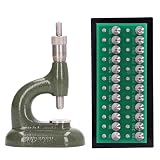
- 【ALUMINUM ALLOY】Watch Disassembly Repair Tool is Made of excellent aluminum alloy material, which is lightweight, and wear resistance, not easy to deform or .
- 【FOR WATCH REPAIR】Watch repair tool set, suitable for watch disassembly and case pressing, with multiple functions and a wide range of applications.
- 【WITH DIES】watch opener Comes with 48pcs jewelry hole dies, with different sizes, just choose the right dies, then screw them to the tool and press the handle.
- 【COMFORTABLE GRIP】Ergonomic non slip handle design, comfortable to hold, with exquisite workmanship, suitable for long term watch repairing .
- 【GLOSSY FINISH】This watch repair tool has glossy finish that will not leave scratches on the dial and case, and will not have to worry about pinching your hands.
Snailing and other circular or linear graining
Snailing creates circular or spiral motifs and may appear on parts such as rotors and barrels. Straight graining or satin finishing makes fine parallel lines, producing a matte or velvety appearance. Circular satin is another surface treatment. These finishes can create contrast with polished areas and influence how light plays across a component; the names and applications vary among makers.
Dial, case, and bracelet finishes
Guilloché: mechanically engraved patterns
Guilloché is patterned engraving made with an engine-turning machine or lathe, often on a dial. Breguet’s official history says Abraham-Louis Breguet introduced guilloché engraving on watch dials in 1786. The brand says the pattern helped reduce reflections, improve readability, and distinguish dial zones. This is Breguet’s historical account, rather than an independently adjudicated claim of priority. Its explanation appears on the history of guilloché page.
Rank #4

- High quality watch tool
- 7 different shape plastic tips for
- Professional tool for fixing different size of watch's hour, min and second hands
- Plastic tips will not scratch watch hands and dials, Easily hold watch dial to press watch hands
Brushing, satin, and sunburst
Brushed finishes use fine lines rather than a mirror-like surface. On a dial, sunburst brushing radiates from a central point. Patek Philippe describes using metal bristles and abrasive paste to create those rays. Brushing and satin finishes also appear on cases and bracelets, where they may be paired with polished surfaces to emphasize the shape of the metal.
Microblasting, frosting, and other textures
Microblasting projects fine beads onto metal to create an even matte texture, while Breguet describes a finely textured frosted effect. Audemars Piguet’s account of its frosted-gold treatment describes hammering gold with a diamond-tipped tool, leaving tiny indentations that sparkle. The Royal Oak Frosted Gold was unveiled in 2016 in collaboration with Carolina Bucci, according to the brand’s decoration overview. Case and bracelet surfaces may also combine satin brushing and polishing.
Free tools Windows power users keep installed
One-click scans. No signup required.
Best Value

- Material: Alloy Steel
- Package Includes: 1 X 9pcs Screwdriver Rotating Stand Extra Drivers
- 7 pcs Screwdrivers sizes:0.80mm,1.00mm,1.20mm,1.40mm,1.60mm,1.80mm,2.0mm. 2 pcs Slotted Screwdrivers sizes: 1.20mm,1.60mm.
- This economy 9-piece screwdriver set is great for watch repair, eye glass repair, hobbies, small electronics, and many other applications!
Other documented treatments include countersink preparation, polishing pinion ends, and sand-blasting, as well as engraving, shot-blasting, diamond polishing, drawing, and rhodium plating. These examples illustrate the breadth of watch finishing; makers do not necessarily use the same names or processes for comparable-looking results.
Independent reader supportYour contribution helps us test, update, and keep practical guides available for everyone.How to compare finishing on two watches
Look beyond a list of finish names. Compare where each treatment appears, how it interacts with light, what the maker says about the process, and how cleanly it is executed. Manufacturer documentation and clear, model-specific images are more useful evidence than generic claims about a brand or collection.
- Location: Identify whether the finish is on a bridge, mainplate, rotor, screw or countersink, dial, case, or bracelet. A movement photograph may show only some of the treated surfaces.
- Pattern and light: Distinguish parallel stripes, overlapping circles, radial rays, mirror reflections, matte textures, and engraved geometric patterns. Each creates a different visual effect.
- Process: Check whether the maker specifically discloses hand work, machine work, or a combination for that model. Appearance alone cannot establish the method.
- Execution: Look for consistent patterns, clean transitions between finishes, and edges that preserve the component’s geometry. The American Watchmakers-Clockmakers Institute’s 2015 high-end finishing course announcement warns that removing too much material can irreversibly change a part’s shape or size.
- Evidence: Prefer model-specific manufacturer descriptions and clear images over broad marketing language. For very small details, magnification can help; Patek Philippe notes that specialists sometimes use binocular microscopes for minute surfaces.
Does watch movement finishing matter?
It matters as workmanship, surface preparation, and design, but ornate decoration is not a shortcut to judging performance. Removing burrs and smoothing edges can serve practical purposes; the sources cited here do not provide comparative timekeeping tests showing that a more decorated movement keeps better time. Assess finishing alongside movement architecture, regulation, durability, serviceability, and verified performance.
For a valuable watch, treat close inspection as observation, not a reason to polish or refinish the movement yourself. Removing material can permanently alter a component, and the AWCI course document discusses that risk in a training context rather than as a do-it-yourself procedure.
Crashes, No Sound, or Screen Glitches?
Random freezes, missing sound and display glitches usually trace back to one bad driver. Find and replace yours safely.Free scan · under a minuteWindows Errors? Fix Them Before They Spread
Repair common Windows errors and clear accumulated junk for a smoother, more stable PC - no reinstall needed.Free scan · no reinstallQuick Recap
Product prices and availability are accurate as of the date/time indicated and are subject to change. Any price and availability information displayed on Amazon at the time of purchase will apply.