Windows Errors? Fix Them Before They Spread
Repair common Windows errors and clear accumulated junk for a smoother, more stable PC - no reinstall needed.Free scan · no reinstallOutdated Drivers Are Slowing You Down
One free scan finds every outdated or missing driver and matches the right update for your exact hardware.Free scan · exact hardware matchA marine chronometer kept the time of a known meridian aboard a ship. By comparing that reference with local time at sea, navigators could work out longitude. Today, “chronometer” usually describes a watch movement that has passed precision testing. The word connects two timekeeping traditions, but the shipboard instrument and the certified wristwatch serve different purposes.
What was a marine chronometer for?
A marine chronometer was a portable time standard, not simply a clock for keeping the crew on schedule. Before a voyage, sailors set it to the time at a place whose longitude was known, such as Greenwich. At sea, they compared its reading with local time determined through astronomical observation.
The time difference revealed how far east or west the ship had travelled. The Smithsonian Institution’s National Museum of American History explains the conversion as 15 degrees of longitude for every hour of difference. The comparison supplied longitude; it did not, by itself, determine the ship’s full position.
How did the longitude problem lead to Harrison’s timekeepers?
Finding longitude at sea was difficult enough that governments offered major rewards for a workable solution. Seiko Museum Ginza says the British Longitude Act of 1714 offered a prize of £20,000. John Harrison spent decades developing a succession of timekeepers, from H-1 through H-4.
#1 Best Overall

- Used Book in Good Condition
Harrison completed H-4 in 1761. Seiko Museum’s history says it performed better than the demanding target in a sea trial, but its technical complexity made it unsuitable for mass production. Its achievement showed what a sea timekeeper could do; it did not yet make that level of precision easy to reproduce widely.
Harrison was central, but he was not the whole story. Historian Jonathan Betts’s catalogue-based history of marine chronometers considers contributors before and after Harrison as well as the international context in which the instruments developed.
Rank #2
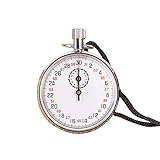
- The watch machine adopts stainless steel spring, single metal light balance wheel, nickel base alloy hairspring and kelleg vertical mechanism.
- One button function, starts, stops and returns to zero by consecutive crown depressions.Durable, dust, water, shock and corrosion resistant.
- Useful for rest in exercise; Metronome funcion, Grasp all the rhythms in the sports, useful for Fitness gymnastics.
- The movement is equipped with 13 gems ,The watch machine can be used at -10°C~+40°C
- Durable, dust, water, shock. Resolution ratio(1/10s), Size about 50 x 68 x 16mm.
How did marine chronometers become practical shipboard tools?
Wider use depended on making precision instruments more reproducible and less costly, not just on achieving an impressive result once. Later makers modified and simplified designs. Seiko Museum credits John Arnold and Thomas Earnshaw with adapting the detent escapement and helping disseminate less expensive marine chronometers in larger quantities.
The Smithsonian’s record for John Roger Arnold describes improvements including a detached escapement, a helical balance spring and a temperature-compensated balance. It also connects simplification with batch production. Together, these developments helped turn a demanding precision mechanism into a more practical maritime instrument.
What’s actually slowing this PC down?
Pick the symptom - the matching free tool is one click away.
Rank #3

- Start/ stop trigger with winding button
- Manual winding
- Measuring range up to 30 minutes
A 1942 instrument shows the specialized mechanism
Marine chronometers remained mechanism-rich shipboard instruments well into the twentieth century. Seiko Museum Ginza dates a Japanese naval chronometer in its collection to 1942 and says it was made at the Imperial Japanese Navy’s request. The record describes a bimetallic balance, a special hairspring, a detent escapement and a fusee.
For this specific instrument, the museum records a maximum daily error of 0.1 seconds. That is a measurement attached to the museum’s 1942 instrument entry, not a general accuracy figure for marine chronometers.
Rank #4

- Date Feature at 3 O'Clock with Even Numbered Days Displayed in Red and Odd Numbered Days in Black
- Tudor Caliber MT5612-LHD (COSC), Self-winding Automatic Chronometer Movement
- Titanium Screw Down Crown, Helium Escape Valve at 3 O'Clock and 70 Hour Power Reserve
- Titanium Bracelet with Steel Folding Clasp and Safety Catch and Bracelet Extension System
- Titanium Unidirectional Rotatable Bezel with Ceramic Matte Black Disc and 60 Minute Scale with Beige Luminescent Coating
What does “chronometer” mean on a wristwatch?
In modern watch terminology, “chronometer” is a precision designation associated with official testing of a watch movement. It does not mean the wristwatch is a marine navigation instrument, or that its movement is being used to calculate longitude.
Rolex’s 2021 corporate brochure says a Rolex wristwatch received a certificate from the Official Watch Rating Centre in Bienne in 1910, and that a Rolex model received a Kew Observatory Class A certificate in 1914. Rolex says this distinction had previously been reserved for marine chronometers. These dates and the account of the distinction are Rolex’s historical claims.
Best Value

- Pause & Reset Function: Equipped with a pause mechanism, this stopwatch allows you to temporarily halt timing without losing track, and easily reset for the next session. Measuring range extends up to 30 minutes, accommodating a variety of events.
- Large Dial Display: The clear, easy-to-read dial allows users to track time quickly and accurately. The bold markings and smooth sweep hand make it simple to measure each lap and overall duration.
- Stable Stainless Steel Construction: Crafted with sturdy stainless steel, the stopwatch is resistant to wear and corrosion, making it suitable for frequent use in sports fields, laboratories, or training environments.
- Precision Timing: This stainless steel mechanical stopwatch is highly accurate analog measurement, perfect for timing activities down to 0.2 seconds per lap. Ideal for sports, training, and experiments.
- Versatile Use: Perfect for runners, athletes, coaches, educators, and experimenters. Whether timing laps, experiments, or workout sessions, this handheld timer provides reliable performance for professional and personal applications.
How are ship and wrist chronometers alike—and different?
| Aspect | Marine chronometer | Wristwatch chronometer |
|---|---|---|
| Purpose | Preserves reference time for navigation and longitude calculation. | Signals that a watch movement has passed a precision-testing regime. |
| Reference or test | Set to the time at a known meridian and compared with local time at sea. | Movement precision is evaluated under a specified testing regime; Rolex’s account describes this certification history. |
| Form and setting | A specialized timekeeper carried aboard a ship. | A watch worn on the wrist. |
| What the term does not establish | It does not mean every marine chronometer had the same recorded accuracy; the Seiko Museum figure applies to its 1942 instrument. | It does not make the watch a shipboard longitude instrument. |
The connection is a shared demand for dependable timekeeping. The difference is what that timekeeping is for: a marine chronometer supplied a navigational reference, while a wristwatch chronometer designation describes the precision testing of a watch movement.
Quick Recap
Product prices and availability are accurate as of the date/time indicated and are subject to change. Any price and availability information displayed on Amazon at the time of purchase will apply.