Seiko’s general recommendation is to have a watch serviced at an Authorized Seiko Service Center about every three years. That figure is one of three intervals the company publishes, and they cover different work. A periodic check of the case and seal is recommended every two to three years, and a full mechanical overhaul is described as roughly every three to four years. Which schedule matters for your watch depends on what kind of work you mean and on its caliber, so check the caliber’s instruction before booking.
The three intervals Seiko publishes
Seiko’s guidance uses different wording depending on the document, so the intervals are not interchangeable. The table below lists each one with the scope Seiko gives for it.
| Type of maintenance | Interval Seiko states | Where the figure appears | What it covers |
|---|---|---|---|
| General service | About every three years | Seiko Watch Corporation US customer-service FAQ (undated) | Inspection for worn parts, disassembly and cleaning, renewed lubrication, and attention to water resistance. The FAQ says frequency depends on climate and the owner’s care. |
| Full overhaul | Approximately every 3 to 4 years | Seiko Watch Corporation H851 caliber instruction | Periodic inspection and adjustment by disassembly and cleaning, described as maintaining optimal performance over a long period. |
| Periodic check | Every 2 to 3 years | Seiko general analogue quartz and mechanical instruction | A check that the case, crown, gasket, and crystal seal remain intact. It is not a full overhaul and not a battery interval. |
These are manufacturer recommendations. No independent study of failure rates or service intervals across a population of watches was identified, so the figures describe what Seiko advises rather than what most owners experience.
What each interval means in practice
Periodic check: every two to three years
This is the lightest of the three. Its purpose is to confirm that the parts protecting the movement from moisture and dust are still doing their job: the case, the crown, the gasket, and the crystal seal. Seiko’s wording focuses on keeping these intact rather than on opening the movement. If your watch is worn daily, is exposed to water, or has a gasket that has been replaced before, this check is the one most relevant to you.
Free tools Windows power users keep installed
One-click scans. No signup required.
#1 Best Overall
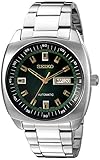
- Case diameter: 43.5mm
- Gold tone second hand
- Water Resistant To 165 Feet
- Power reserve: approximately 41 hours
- 21,600 vibrations per hour
Full overhaul: approximately every three to four years
An overhaul is the step that goes inside the movement. Seiko describes it as inspection and adjustment by disassembly and cleaning. The H851 instruction adds that a movement may be replaced during an overhaul and that original parts may not always be available. That statement belongs to that caliber’s guidance; it should not be read as a promise about how every Seiko service is carried out.
General service: about every three years
The three-year figure in Seiko’s US customer-service FAQ is the most widely quoted. The FAQ asks readers to have the watch serviced at an Authorized Seiko Service Center “about every three years” and states that the frequency “depends on the climate and the owner’s individual care of the watch.” In other words, a watch worn in humid or dusty conditions, or one that sees heavy use, may need attention sooner than a watch kept in a drawer and worn occasionally.
What a service actually involves
Seiko says periodic service is more than a battery change. According to its FAQ, the work includes inspecting parts for wear, disassembling and cleaning them, applying renewed lubrication, and checking water resistance. The exact work and any replacement parts depend on the condition of the watch when it arrives, so two watches of the same model can receive different treatment.
Ask the service center to tell you, in writing, which of these tasks it has performed. If it recommends replacing the movement or other parts, ask whether original parts are available for your caliber before you approve the work.
When not to wait for the calendar
Seiko identifies four causes of time loss or a stopped watch: degraded lubricant, wear, contamination, and moisture. It also notes that aging gaskets and shock-related deformation can compromise water resistance. Any of the following is a reason to contact Seiko or an authorized service center rather than waiting for the next interval:
- The watch has stopped.
- It is losing or gaining time more than usual.
- It has taken a significant knock or impact.
- It may have been exposed to water or moisture, including condensation inside the crystal.
Seiko’s published guidance supports these failure mechanisms but does not set an emergency timetable. Do not assume a watch will tolerate a delay of months because it still runs.
Rank #2

- STUNNING BLUE DIAL: this automatic men's watch features a deep blue, pressed pattern and gloss finish surrounded by a stainless steel watch case
- AUTOMATIC: these self-winding, automatic men's watches are powered by your movement, with a power reserve of 41 hours
- STAINLESS STEEL: features a durable stainless steel watch case and bracelet with see through caseback
- WATER-RESISTANT: these men's wrist watches are water-resistant down to 50 meters
- 4R35 CALIBER: equipped with the reliable caliber 4R35 automatic movement, this accurate men's watch keeps precise time
Water resistance is not permanent
A water-resistance rating describes the watch when it was new and sealed. Seiko recommends regular checks because gasket condition changes over time, and shock can alter the seal. Do not treat a rating printed on the dial or caseback as proof that the watch is safe for swimming or diving today. Have the seal checked when the periodic check falls due, after a significant impact, or after the crown or crystal has been opened, and follow the instructions in your model’s manual for any water-related use.
How to find your caliber’s instruction
Seiko says the caliber code is engraved on the case back, and the same code may appear on the certificate of guarantee. Use it to find the matching instruction. The steps are:
Crashes, No Sound, or Screen Glitches?
Random freezes, missing sound and display glitches usually trace back to one bad driver. Find and replace yours safely.Free scan · under a minutePC Slower Than It Used to Be?
A free scan shows the junk files, broken settings and background clutter dragging Windows down - then fixes them in one click.Free scan · Windows 10 & 11- Turn the watch over and read the caliber code engraved on the case back. Note the code exactly, including any letters.
- Check the certificate of guarantee for the same code if the caseback is hard to read.
- Find the Seiko instruction for that caliber among its after-sales instructions. If you cannot locate it, contact the retailer or Seiko customer service and quote the code.
- Read the interval and scope stated in that instruction, then book with an Authorized Seiko Service Center for the work it describes.
If your watch has no caliber code you can read, or the code does not match any instruction you can find, ask Seiko customer service before assuming an interval.
Cost and turnaround
Service prices and turnaround times are not established in the sources behind this guide. Both depend on the region, the watch model, and the condition of the watch. Ask your local Authorized Seiko Service Center for a written quote before authorizing work, and ask for an estimated completion date at the same time.
An Authorized Seiko Service Center is the route Seiko recommends for overhaul and water-resistance work, so it is the appropriate place to start for either.
Quick Recap
“
Product prices and availability are accurate as of the date/time indicated and are subject to change. Any price and availability information displayed on Amazon at the time of purchase will apply.