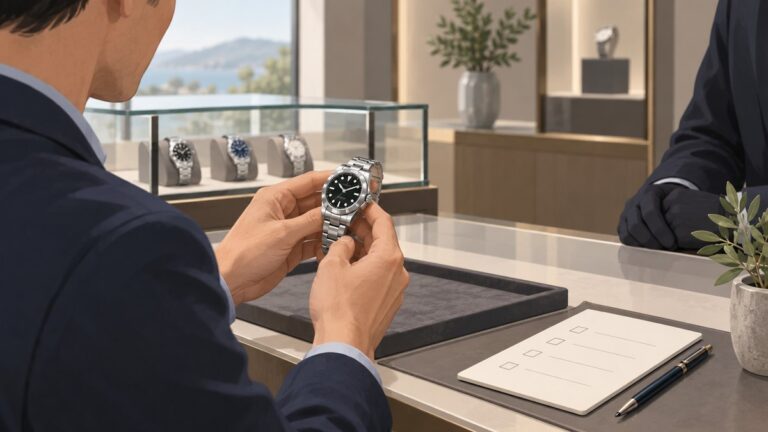
A chronograph fits your wrist when its case diameter, lug-to-lug length, and thickness all suit your wrist and the look you want, judged together. Case diameter alone is not a fit test. Seiko’s published specifications for its chronographs show that two watches with close diameters can differ by several millimetres in length and in thickness, and those differences change how a watch sits on the wrist.
Why diameter alone can mislead
Diameter is the number most listings headline, and it describes the dial’s footprint. It does not describe how far the case reaches across the top of your wrist or how much height it adds. Seiko publishes diameter, lug-to-lug length, and thickness for its chronograph models, so you can compare all three. The table below uses those official figures for four models.
| Model | Chronograph type | Case diameter | Lug-to-lug | Thickness |
|---|---|---|---|---|
| Seiko SSB479 | Quartz, 60-minute counter in 1/5-second increments | 38.7 mm | 45.1 mm | 12.6 mm |
| Seiko SSB453 | Quartz, 60-minute counter in 1/5-second increments | 40.0 mm | 45.8 mm | 11.5 mm |
| Seiko SSB429 | Quartz, 60-minute counter in 1/5-second increments | 41.5 mm | 46.5 mm | 12.1 mm |
| Seiko HBD001 | Mechanical, 30-minute and 12-hour counters | 42.0 mm | 49.5 mm | 14.6 mm |
The HBD001 and SSB429 have nearly the same diameter, 42.0 mm against 41.5 mm. The HBD001’s lug-to-lug is 3.0 mm longer and its thickness is 2.5 mm greater. On paper, the diameter comparison says these watches are similar; the other two measurements say they are not. The SSB453 shows the opposite pattern: it is the thinnest model in the group, yet its lug-to-lug is longer than the SSB479’s, despite a smaller diameter than the SSB429. These are manufacturer figures for four models, not a scale that labels any watch as suited to a particular wrist.
The three dimensions and what each one tells you
Lug-to-lug length
Lug-to-lug is the distance from the tip of the top lug to the tip of the bottom lug. It is the dimension most likely to decide whether a case looks balanced on your wrist, because it determines how far the case runs across the back of the wrist. If the lugs reach past the edges of your wrist, the watch will look and feel larger than its diameter suggests. Compare the published lug-to-lug with the width of your wrist and with the size you usually wear. This is the figure to check first when you narrow a shortlist.
What’s actually slowing this PC down?
Pick the symptom - the matching free tool is one click away.
#1 Best Overall

- Men's luxury timepieces with technical advancements and a sporty style
- 1/5 Second Chronograph Measures up to 60 Minutes, 12/24 Hour Time, Date
- Silver-Tone Stainless Steel
- Spherical Mineral Crystal
- 100 Meters Water Resistant and 5 Year Limited Warranty
Case diameter
Diameter sets the dial’s apparent size and the overall round footprint. It matters for visual presence, but it cannot tell you how the case ends at the lugs. Use it to judge the dial, then confirm the fit with lug-to-lug.
Thickness
Thickness governs the side profile. A thicker case sits higher off the wrist, which can be an issue under a shirt cuff or jacket sleeve, and it changes how the watch feels when you move your arm. The published thicknesses in the table range from 11.5 mm to 14.6 mm. Whether a given height is comfortable depends on your clothing and preference, and no universal comfort threshold is established by the manufacturer figures.
Rank #2

- Stainless Steel case with Black Resin Band
- Black Dial with date window at 3 O'clock
- Luminous markers and hour hands; sweep second hand
- Anti-reverse bezel
- Water-resistant to 200 M (660 feet)
Check the dial, not just the case size
A chronograph’s subdials, hour markers, and hands can make two cases of similar dimensions look very different. A larger, sparser dial may read more easily than a smaller one packed with scales and counters. Seiko describes the distinct sub-dial finishes on its HBD001 listing as improving chronograph legibility. That is the manufacturer’s own claim about its design. Check whether you can read the time and the counters at a glance, in the light you usually wear the watch, before deciding that a smaller case is the simpler choice.
Set the band, then judge the fit
Band adjustment is separate from case size, and a poorly adjusted strap can make a well-proportioned case feel wrong. Seiko’s mechanical chronograph instruction manual gives this direction: “When wearing the watch, leave enough room to insert a finger between the band and your wrist.” That clearance guidance applies to how snugly the band is set. It does not tell you which case dimensions to choose.
Quick wins for a faster PC:
Repair Windows errors before they cause bigger problemsFix Now →Scan for outdated or missing drivers - takes under a minuteDriver Scan →Rank #3

- Men's luxury timepieces with technical advancements and a sporty style
- 1 Second Chronograph Measures up to 60 Minutes, 12/24 Hour Time, Date
- Silver-Tone Stainless Steel Case
- Mineral Crystal
- 100 Meters Water Resistant and 5 Year Limited Warranty
A step-by-step way to compare candidates
- Write down the published diameter, lug-to-lug, and thickness for each candidate from the maker’s specification page.
- Rank the candidates by lug-to-lug first, then use diameter to judge dial presence and thickness to judge height.
- Measure the width of your wrist where the watch will sit. A flexible paper strip wrapped around the wrist and marked works for this.
- Compare the lug-to-lug figure against your wrist width, and note whether the lugs would extend beyond the wrist’s edges.
- Check the dial: confirm that you can read the time and counters in your usual lighting.
- Fit the strap or bracelet so a finger slides between band and wrist, then wear the watch for a day under your normal sleeve or cuff.
- If you already own a watch that feels right, compare its published dimensions with the candidate. This is often the most reliable reference you have.
What the published figures cannot establish
- Seiko’s specifications are product measurements. They do not include a wrist-circumference chart, a maximum overhang, or a guaranteed diameter range for any wrist size.
- The four models above illustrate how dimensions vary. They are not a universal fit boundary, and they should not be read as small-wrist or large-wrist watches.
- Weight and case material are sometimes published and are secondary to dimensional fit. Compare them only where the maker or retailer provides the figures.
- Prices and availability change. Confirm the dimensions on the current product page before you buy, because specifications can differ between versions of the same model.
Within these limits, the most dependable approach is to compare lug-to-lug length first, then diameter and thickness, and to test the result on your own wrist.
Quick Recap
Product prices and availability are accurate as of the date/time indicated and are subject to change. Any price and availability information displayed on Amazon at the time of purchase will apply.